really cool, abstracting away or compressing reasoning token outputs is one difficult challenge, but this is a really nice use case of the same technique in a place which is basically guaranteed to work and have immediate returns instead of praying that quality stays the same
Gisting is the most underappreciated LLM technique right now. It is basically "zipping" your prompt before running in production - it stops being human-readable, but is much smaller, runs much faster: ~40% lower E2E latency, ~15% higher throughput and the results are BETTER!
at some point you look back and realize its been so obvious, ofc chinese labs dont have access to mercor or micro1 so theyd fall behind when it came to data, but that is a vaultable moat
meanwhile they never stopped working on architecture and efficiency improvements, at deepseeks training and inference efficiency levels (all of which theyve opensourced), any frontier lab would be just horrified at the fact that theyre only a few dozen trillions tokens in quality training data away from surpassing them
Anyone who actually knows tech realizes this DeepSeek release is a way bigger shock than the last one.
Matching Opus at 1/10th the size means beating Opus with Haiku-level size and efficiency.
Not even Sonnet-level size.
That is just completely insane.
@natolambert Low hanging fruit would imply there was an innovation. This was basically a context blind spot everyone seemed to have missed and is making big deal out of it.
@yacineMTB i think even before AI slop, people really just wanted to sound smarter than they actually were. After AI, they finally had this tool that let them do that reliably. Which is funny because the data only shows that the brain gets gradually dumber the more it relies on these tools
perhaps, but then this could extend the argument to say training on any and all environments is a) cheating and b) will not generalize, so this isn't a valid argument i feel. coming up with newer envs is a massive part of the bridge to AGI
People don't realize that Anthropic literally trained Opus 5 on RL environments that resemble ARC-AGI puzzles
Anthropic pays human contractors to write down their chain of thought when solving these, and/or updates the weights based on rewards. The thing is, you don't know since it's closed-source
Sadly, this doesn't show generalization
@Zergylord for sure, in my experience even flash lite models outperform the other flagships (even gpt5.5) on tedious vision tasks, but thats about where it stops being superior or competitive, love that theyre prioritizing speed though
We solved Continual Learning (CL)
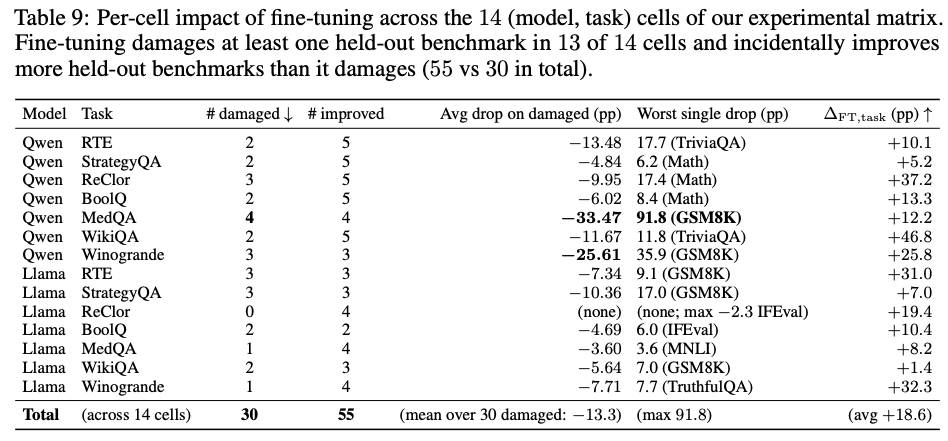
One of the biggest problems with CL is that of catastrophic forgetting. When models are trained on further tasks or datasets, they gain and generalize to these new tasks, but tend to forget and lose capabilities in other unrelated tasks. This meant that a finetuned model will almost never be good at both its specific task as well as the capabilities of the base model. Our test showed in 93% of cases, fine tuning caused damage in at least one unrelated benchmark on both Qwen3.5 4B (reasoning) and Llama3.2 3B (non-reasoning).
The biggest drop happened when we trained on medical QA, the model's performance on math (GSM8K) dropped by almost 92%!!!
Interestingly, this closely resembles model merging approaches, since it is a post-hoc checkpoint modification. WiSE-FT, developed by OpenAI and Google Brain researchers comes close, but still lags behind our DG-Hard approach.
We suspected last week's cyberattack might have come from a frontier lab, given the sophistication of the agent. Turns out it did!
We've spent the past 24 hours working closely with the @OpenAI team (thanks!), and we strongly believe there was no malicious intent on their part. It's quite mind-blowing that all of this happened autonomously!
The investigation is ongoing, and we'll share more learnings from what might be the first incident of its kind!