"Loop the Loopies!"
This paper Loopie shows recurrent Transformers can be compute efficient, not just parameter efficient.
Contrast to how we love stacking more layers, they have each MoE layer loops twice before moving on. This actually saves activation memory, improves throughput, and reinvests the gain into capacity.
Their Loopie-20B-A2B using this approach beats a compute-matched vanilla 30B-A3B MoE baseline, with only 2B active params, and reaches gold-level IMO/IPhO performance without tools.
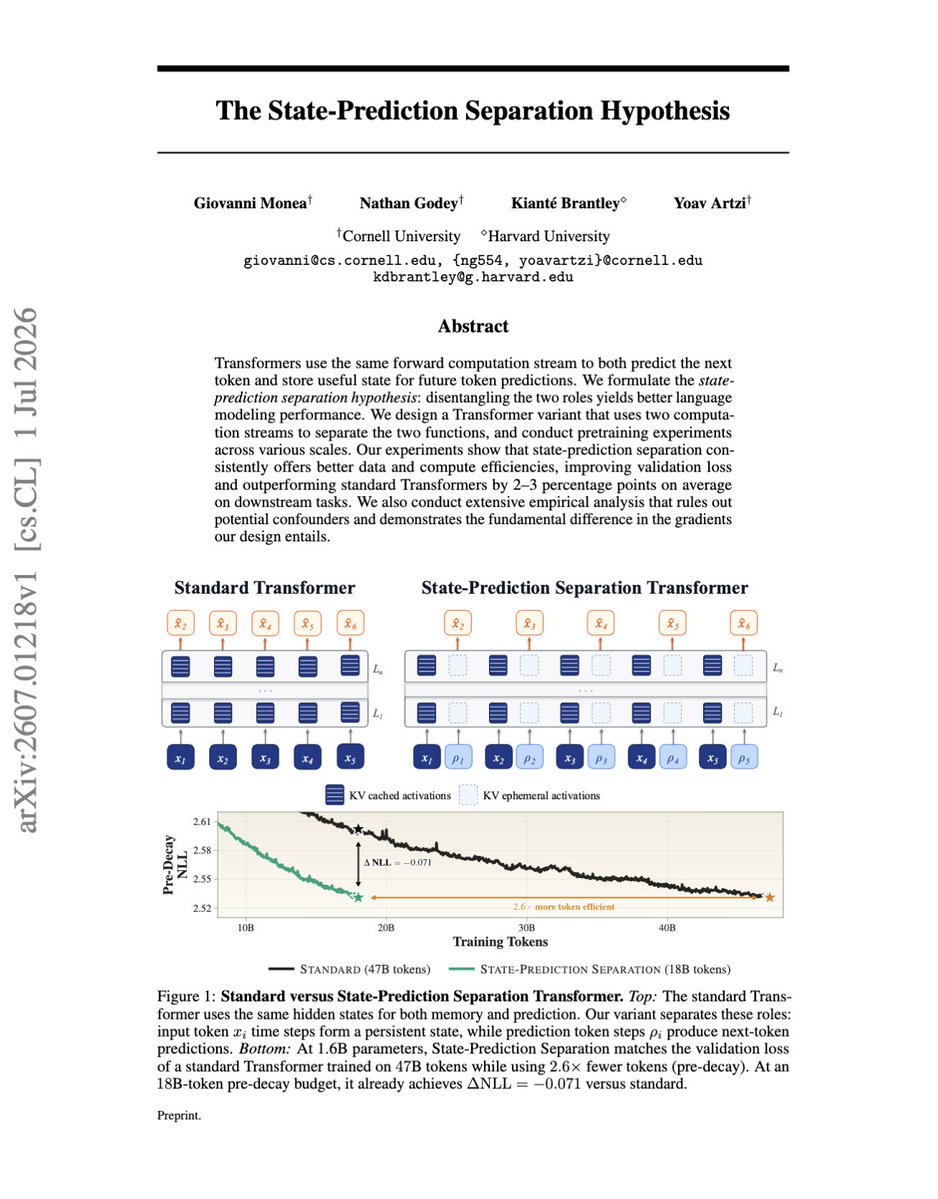
"The State-Prediction Separation Hypothesis"
Transformers use the same hidden state to both predict the next token and store memory for future tokens, which may force two competing jobs into one representation, and may be wasting data by mixing memory and prediction in the same computation.
This paper splits them into two streams, input tokens for persistent state and predict tokens for next-token prediction.
Across 53M to 1.7B params, this approach achieves lower loss, 2 to 3 point downstream gains, and at 1.6B matches a standard Transformer trained on 47B tokens with only 18B tokens.