Sleipnir is now live on Verathos mainnet.
Multiple machines pool their GPUs to serve larger models. Anyone can join, anyone can serve, because every response is cryptographically verified via Gleipnir. No whitelist, no enterprise-grade requirements.
Sleipnir + Gleipnir together: verified SOTA serving through a permissionless network of miners on consumer hardware. Built the way we think Bittensor was supposed to work.
Live now: GLM-5.2, DeepSeek-V4-Flash, Ornith-1.5-35B, Qwen3.8-27B + uncensored, Qwen3.6-27B, Qwen3.5-9B. Expanding fast to any SOTA open model, fine-tuned models feeding our model router (more on that soon), and Bittensor-trained models.
The full loop: run your own actual local AI compute, use your pool for yourself, serve excess to the network and earn on the side. Verified end-to-end.
https://t.co/qGOBrGvJ2v
A lot has changed on Verathos and the easiest way to see it is through the models we’re serving today.
We currently have nine models live, ranging from lightweight models built for speed to larger models for heavier workloads.
Kvasir 1.0 is our network MoE, routing requests across three miners with up to 512k context. GLM-5.2 goes up to 1024k context, while DeepSeek-V4-Flash, Qwen3.6, Qwen3.8, and Ornith-1.5 sit across different performance and cost tradeoffs but these aren’t just model endpoints.
Every response comes with a cryptographic proof, so inference can be verified instead of simply trusted.
We will also be bringing more models from across Bittensor onto the network, while making verified inference accessible through a simple API.
Verathos has been building Sleipnir because we believe AI inference shouldn't be limited to massive data centers. GPUs are already distributed everywhere, so why not connect them and make them work together?
Last week, Mesh LLM demonstrated a similar idea by pooling Nvidia GPUs across ordinary machines to run LLMs without relying on a central data center.
It validates something we've believed for a long time, but distributing compute is only half the problem. Once AI requests are being processed by GPUs operated by different people, how do you know the work was actually done?
A node could use a smaller model, skip computation, manipulate the output, or claim it completed work it never performed. Connecting thousands of machines solves where the compute comes from, but not whether you can trust it.
That's why we're building both sides of the stack:
• Sleipnir coordinates GPUs across machines, allowing operators to pool different types of hardware, serve larger models as a single endpoint, and earn from the compute they contribute.
• Gleipnir provides cryptographic proofs that make inference independently verifiable, so you don't have to trust the GPU operator or simply take the API's word for it.
Privacy can help keep your data away from centralized servers, but it doesn't prove what happened to your request once it reached the machine processing it.
We've already built the distributed compute layer with Sleipnir. Now we're bringing Verathos' verification layer into the mesh, making distributed inference not just possible, but provable.
One of the things we’ve wanted from the beginning was for Verathos to become bigger than the models we build ourselves.
There is a lot of excellent work happening across Bittensor, with different teams training different models, experimenting with new approaches, and pushing open AI forward in ways that we believe deserve to be accessible beyond their own subnets.
When you use a model today, you’re generally taking someone’s word for what happened behind the API. You don’t necessarily know which model actually ran, what hardware served your request, or whether the output came from the system you were promised. So, we’re opening the platform to models built by other teams across the ecosystem.
Coming to Verathos are:
• Albedo (SN97)
• Affine (SN120)
• Teutonic (SN3)
• IOTA (SN9)
None of these are serving live traffic yet, but they’re part of what we’re working towards, and we’ll announce them as they become ready.
The important part isn’t simply adding more models. It’s that when these models come to Verathos, they will come with the same verification layer we’ve built for our own inference. You won’t have to blindly trust that the model you requested is the model that ran, or assume that the infrastructure is doing what it claims. You’ll get cryptographic receipts that let you verify the inference for yourself.
We’re building a verification layer that can sit across the ecosystem, regardless of who trained the model or where it came from. More models, more compute, more choice, but most importantly, the same standard of proof.
One of the hardest problems in an open inference network is also one of the simplest questions to ask.
"How do you know a miner is actually running the hardware it claims to have?"
At Verathos, anyone can connect a GPU and start serving inference, but permissionless access only works if hardware claims can be verified. So instead of asking miners to report what they're running, we check them at random.
With no warning, a miner receives a challenge asking it to prove its GPU can do the work it claims it can.
Audit windows come from block hashes, which don't exist until the block is produced. Nobody can calculate a window ahead of time. Once the block lands, miners and validators independently arrive at the same answer from the same public data, so there's no argument about when an audit was due and nobody gets to pick a convenient moment to inspect an operator. By then the challenge is already on its way.
We calibrate challenges to specific GPU classes, from consumer cards to high end data center hardware, and measure responses against what that hardware should be capable of. Claiming a powerful GPU while running something weaker shows up in the numbers, and simulating the hardware in software is slower still.
The precomputation loophole closes the same way. Each challenge is tied to a blockchain event that doesn't exist when the miner commits to its result, so there's nothing to prepare in advance.
Then there's the operator who runs a cluster of machines and presents them as many independent contributors. We watch for patterns across endpoints that give that away.
Interesting read from @BitFanNetwork.
They’ve launched the BitFan Platform together with @PrometheonSN (SN108). A few details that stood out:
• The stated goal is to build a social and service discovery layer focused on the Bittensor ecosystem
• They’re using the subnet’s incentive mechanism to bring users in, while saying the priority is genuine daily engagement rather than pure incentive driven accounts
• Prediction markets for Bittensor related events are being activated this week
• New users currently receive 10,000 free credits on the Market page
• A trial period runs this week, with official weekly rewards for the top 3 traders, sharing 5% of owner emission, planned to start next week
• Subnet owners are invited to register accounts, manage their pages, post updates, and, if requested, have a free interactive demo of their product integrated into the platform
Their longer term framing is to create a place where both current participants and people still outside the ecosystem can follow events, explore subnets, and interact.
Early stage, with a clear focus on markets, social features, and optional product demos. This week’s trial will give a better sense of how users engage with the platform.
Last week, we flipped the switch on Sleipnir testnet (netuid 405), and it’s already serving.
For the first time on Verathos, you can pool multiple machines together to run large AI models as a single verified inference endpoint. Instead of needing one powerful, expensive machine, Sleipnir lets several computers split the workload and operate as one coordinated service.
Sleipnir distributes a model across your machines, coordinates the inference and serves the result through a single endpoint. Every response is backed by a Gleipnir proof, allowing validators to mathematically verify that the computation was performed correctly. Receipts are also signed, giving each inference a verifiable record.
In simple terms, we’re turning a collection of ordinary machines into one larger AI system without giving up verification.
Contributing your hardware is designed to be straightforward. A single command handles the setup, configures your environment, checks that everything is working and confirms your machines are serving correctly before they’re included in the network.
If you’d rather have an AI agent handle the process, point it to https://t.co/l3eEs8FGbi and it can walk through the setup end-to-end.
Several models are already live on testnet, including GLM-5.2, DeepSeek-V4-Flash, Ornith-1.5, and Qwen3.8-27B.
You can try them yourself at https://t.co/ltNBErUaA0 by switching to the “Testnet” option.
🎙️Subnet Summer AMA X @heydittoai, SN118
This Wednesday, 26th August at 5pm BST, @peytonspencer from Ditto will be showcasing what's coming in Ditto V2 and its goal of becoming Bittensor's agentic operating system.
Ditto (SN118) is the open-source agentic operating system on Bittensor: a persistent memory layer that gives AI agents shared context, collaborative workspaces, and long-running memory across every tool and session.
We'll cover:
- Live demo: what's new in Ditto V2
- The vision: Ditto as Bittensor's agentic operating system
- How the memory network and collaborative workspaces work in practice
- What's next on the roadmap
If you care about agent memory, persistent context, or where Bittensor fits into the agentic AI stack, this one's for you.
📅 Wednesday 26th August, 5pm BST 📍 https://t.co/tuwblNLhy8
Verathos v0.1.26 has now been live on the network for a week and it introduced Gleipnir v3 as the network’s new proof protocol.
Gleipnir v3 strengthens Verathos’ verification layer by making inference execution independently auditable. Instead of requiring users to simply trust the infrastructure serving an inference request, the network can now verify that the computation was actually performed as expected.
• Lightweight inference proofs that bind execution to the request, model context, output and authenticated commitments.
• Unpredictable hard inference audits that allow the network to challenge execution relationships against registered model weights and runtime state.
• Lightweight verification that does not require validators to load or reproduce an entire model. Hence, proof artifacts are signed and content addressed, making verification substantially cheaper than running the underlying inference.
• Direct integration with network operations, allowing proof results to influence capacity auditing, miner scoring, probation and recovery mechanisms.
The team has also completed a full 360 block mainnet epoch using Gleipnir v3, covering light proofs, hard proof verification, capacity verification, scoring and weight submission.
However, the goal is bigger than simply making inference faster or cheaper. We are building an inference network where computation can be independently verified and the verification result directly shapes how the network operates.
When people evaluate a subnet, the first question is usually whether anyone is actually using it. For NIOME, the answer has been building quietly for months.
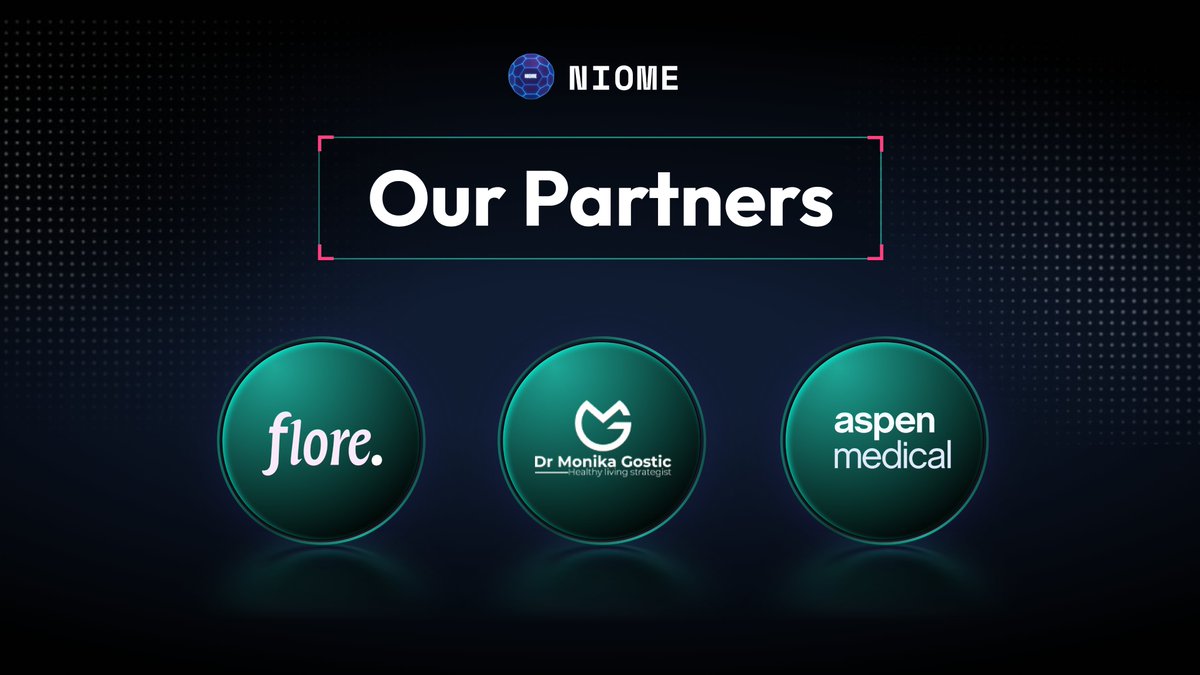
In under four months, NIOME has taken on three commercial partners, each in a different corner of healthcare, and each bringing a real research problem to the subnet.
The first was 𝗙𝗹𝗼𝗿é, a personalised microbiome company and NIOME's first official subnet partner. The work centers on how probiotic supplementation reshapes the gut virome, using years of anonymized microbiome data to build models that predict why the same probiotic helps one person and does nothing for another.
Next came 𝗗𝗿. 𝗠𝗼𝗻𝗶𝗸𝗮 𝗚𝗼𝘀𝘁𝗶𝗰 𝗡𝘂𝘁𝗿𝗶𝘁𝗶𝗼𝗻, based in Aberdeen. This engagement moved into an area most healthcare avoids entirely: how natural supplements interact with prescription drugs. Modeling those interactions as a function of genetics, starting with why some patients respond to certain treatments only when a specific supplement is introduced.
Most recently, 𝗔𝘀𝗽𝗲𝗻 𝗠𝗲𝗱 brought NIOME into the clinic. Their integrated service combines whole genome sequencing, secure storage, genetic counselling, and clinical interpretation, with NIOME's AI-powered insights supporting more personalised treatment decisions. Not a research dataset this time, but genomic intelligence reaching an actual patient pathway.
Three partners, three distinct categories of healthcare, one subnet.
Microbiome science, pharmacogenomics, and clinical care are very different problems, and each one now runs on synthetic genomic data generated through NIOME.
Stay tuned for more partnership announcements.
Precision medicine is a $44 billion market, but it still has a data problem.
Niome is building a different way to serve that market, with synthetic genomic data generated on Bittensor without relying on identifiable patient genomes.
https://t.co/OtRtc7DitQ has operated in genomics since 2018, and Niome brings that experience into a new model powered by distributed miner intelligence.
That means synthetic data for drug response variation, rare disease cohorts, and complex polygenic conditions like heart disease, Alzheimer’s, cancer, and schizophrenia.
This is AI applied to something that matters directly to human life.
Better disease research, safer data access, and stronger models for how people respond to treatment.
Niome is not just a subnet narrative, we are backed by a healthy operating company with real revenue, real clients, and a clear path toward product adoption.
As revenue grows, we will consider returning value to the subnet through token buybacks, provided clients continue to buy into Niome as a product first.
The strongest tokenomics come from the strongest business fundamentals, not the other way around.
The work continues.
Pewbeam MUST become the #1 product of the MONTH on Product Hunt. Nothing Less! I reckon we’ll need 700+ votes to make this happen. Link below.
Thank you for your attention to this matter! And please RT!
This is the doing of the Lord! Thank you Nigeria! Highest grossing film the weekend overall, whether Nollywood or Hollywood. Thank you all for showing up! This is just the beginning. Many more milestones to reach and records to break! Onobiren is showing in all cinemas nationwide
When you see this, please retweet and say ONOBIREN! See cinematography nau! We need 2k retweets on this please!
First official trailer for sweet film, out in cinemas on March 6th!
Thank you!
Don’t look and pass. This Onobiren poster deserves a retweet abeg!!!! See you in cinemas from March 6th. Tickets available now at https://t.co/4wSDNnyEES