@GSpier is an amazing human being. His conversation with Becky Quick is filled with grace, wisdom and humor in the face of a tough diagnosis. I am inspired by his example and by his courage speaking so openly here
https://t.co/gXMSdGw3dj
The New York state legislators who negotiate with the state's public sector unions are selected in primary elections in which ~10% of eligible voters turn out and ~30% of those eligible voters belong to a public sector union.
Our Founders anticipated the problem of faction - see Madison's Federalist 10. They would be surprised by how big government has gotten, but not surprised by the problem of unions electing their own bosses.
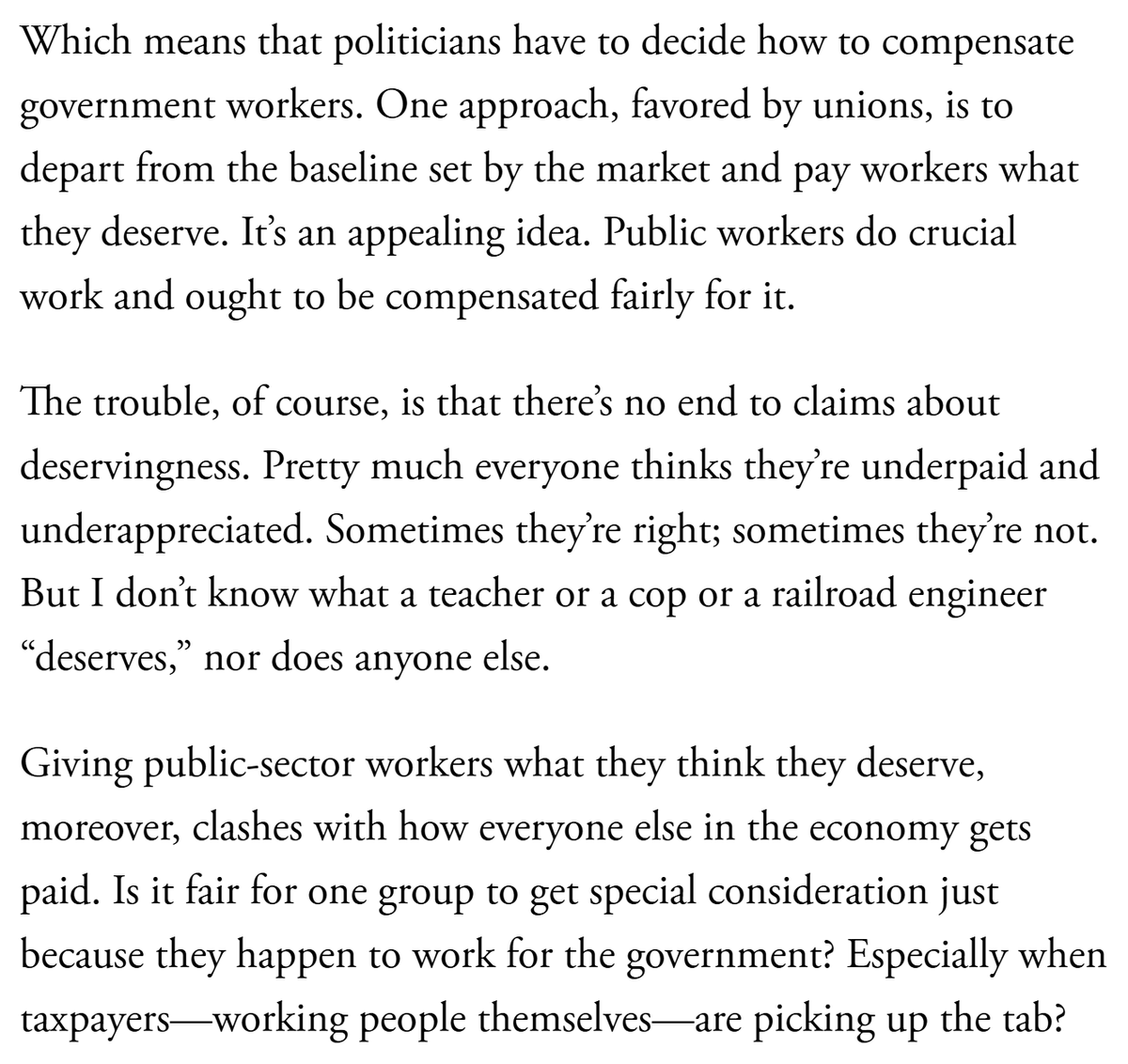
A fundamental tension in public-sector comp is whether pay should be determined by the labor market, as it largely is in the private sector, or by a broader and more subjective notion of what public employees "deserve."
Great article throughout by @nicholas_bagley
America's cultural ideal has been the self-made entrepreneur while Europe's was rooted in aristocracy, with status inherited rather than earned. Europe's inheritance laws show this divide.
Many European countries have "forced heirship" laws that require people to leave 50-75% of their estates to their children. Want to leave the majority of your wealth to charity? not allowed. Your kids are estranged from you, struggling with addiction, or irresponsible? still required to give them the money. Want your kids to avoid a life of entitlement? tough.
Incredibly, these laws look back at transfers made during your lifetime. If you have 3 children in France, you're required to bequeath them a minimum of 75% of your estate. Because French law calculates this based on your assets at death plus all lifetime gifts, giving away more than 25% of your wealth while alive means your heirs can legally sue to force charities or foundations to return the funds. This has limited the development of the nonprofit sector on the continent.
The cultural gap between an entrepreneurial society and one shaped by dynastic wealth is enormous. If you make it yourself, you tend to want your kids to do the same. If you inherit it, the primary goal is protecting the estate for the next gen.
Countries like Spain, France, and Italy legally entrench family dynasties, while America has historically sought to limit them through estate taxes. The result is not only a weaker culture of philanthropy and civil society in Europe, but also less economic dynamism.
This article argues that the U.S. Navy will never be able to open the Strait of Hormuz, and that the reason "isn’t a lack of missiles; it’s arrogance and hubris."
Hubris is not new for the U.S. military. Early battles have tended to be disasters - think Little Bull Run, Pearl Harbor and Kasserine Pass. Disasters led to learning which led to victory. The US military now needs to learn how to fight drones.
Good news: the Ukrainians already know how. Bad news: it will take time for the U.S. Navy to implement.
https://t.co/eRf8cngvJQ
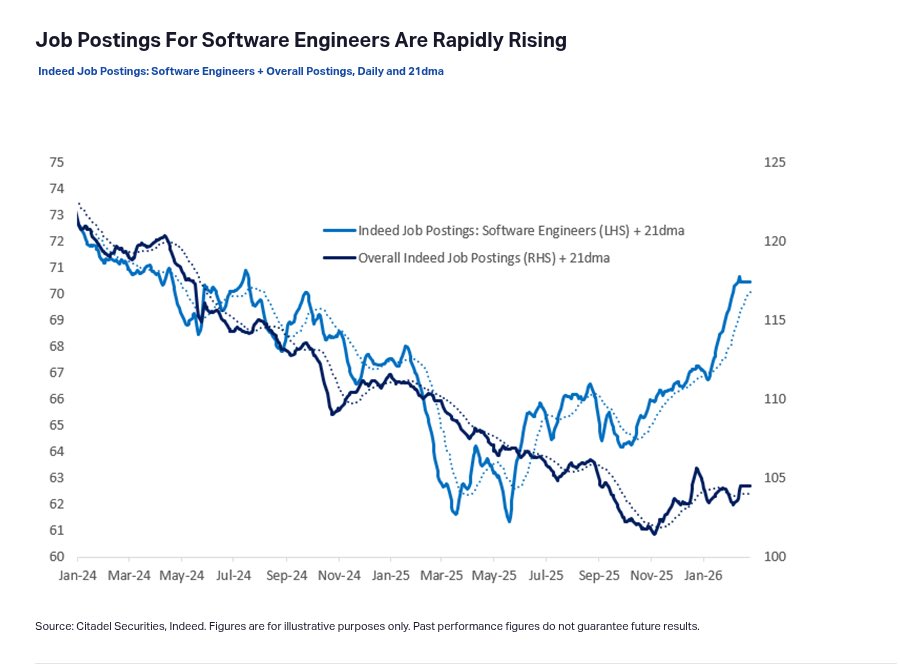
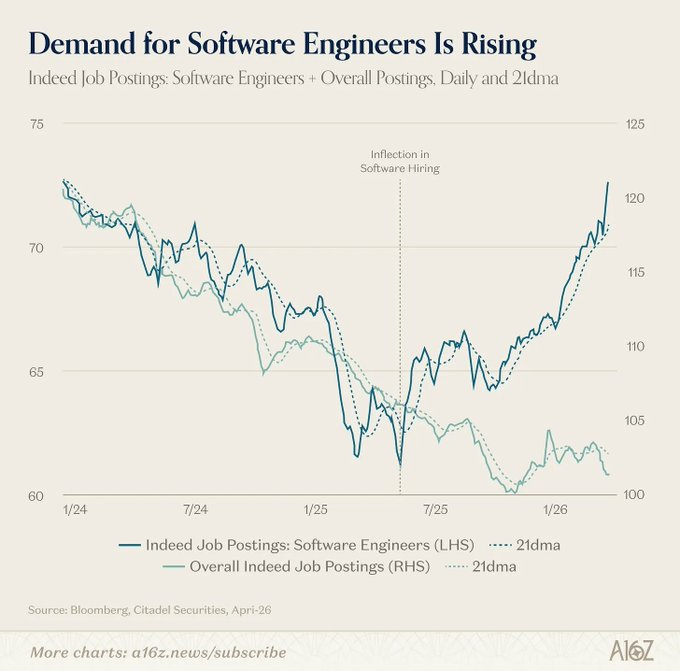
Q: How are job postings for software engineers rising rapidly despite AI agents automating coding?
A: Because there’s far more code to manage than ever before. We’re already seeing a 14x YoY increase in GitHub commits, and it’s accelerating.
AI has dramatically lowered the cost of writing code, so it’s now being used across far more businesses, applications, and use cases.
We’re at the beginning of a massive productivity boom driven by the proliferation of bespoke software throughout the entire economy.
Coding has been AI’s breakout use case this year. The fact that it’s increased demand for software engineers — rather than decreased it — should call into question the entire “AI will cause mass job loss” narrative.
“So the nation’s top law-enforcement official is asking for a slush fund to pay people who assault cops? Utterly stupid, morally wrong—take your pick” - Mitch McConnell, (R, Ky)
Jeff Bezos on NYC spending:
"If we ran Amazon the way New York City runs their school system, packages would take 6 weeks to arrive, we would charge you a $100 delivery fee and when the package did finally arrive, it would have the wrong item in it."
Interesting argument from @DavidGeorge83. If AI is going to decimate white collar employment, why is the number of job postings for software engineers increasing?
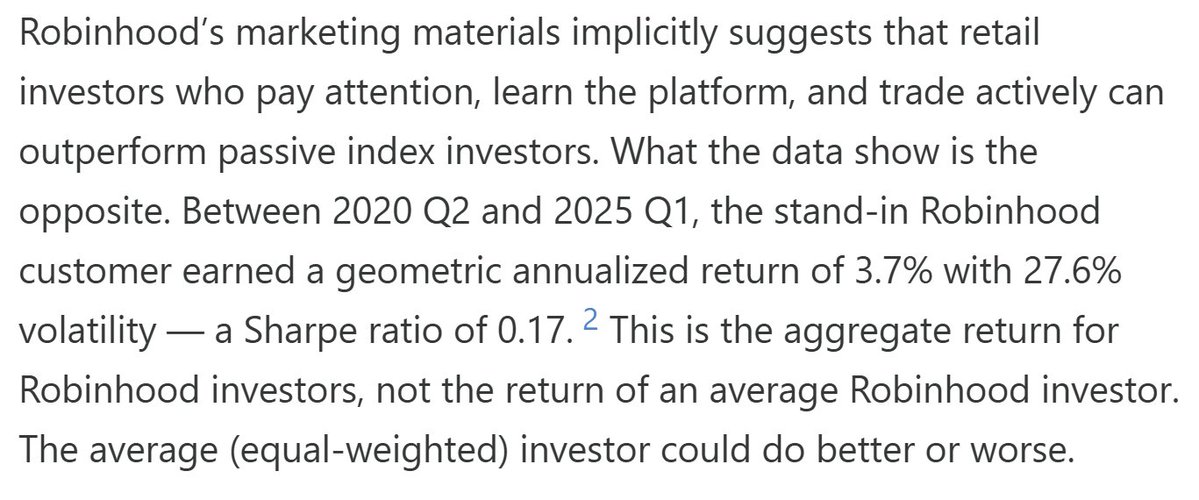
There’s a reasonable argument that small investors were better off before finance was democratized, when a stock trade cost $20 and research wasn't easy. Those frictions discouraged active trading in favor of 'buy and hold' investing, a far better strategy for the average person.
Imagine, if you will, the Middle East as a neighborhood.
On one side of the street, you’ve got the United Arab Emirates. The UAE is that guy who used to live in a tent but won the literal geological lottery and decided, instead of buying a fleet of gold-plated jet skis and retiring, he was going to build a cyberpunk forest in the middle of a literal furnace.
The UAE is what happens when a country looks at a desolate, 120-degree sand dune and says, “You know what this needs? A climate-controlled indoor ski resort and a branch of the Louvre.”
They’ve basically speed-run three hundred years of Western development in about forty. They’ve got high-speed rail, Mars probes, and a vibe that says, "We’ve decided that having a functioning economy is more fun than shouting at clouds."
Then, you’ve got Iran.
Iran is the neighbor who lives in a house where the plumbing hasn’t worked since 1979, but they refuse to call a plumber because they’re convinced the plumber is a CIA plant sent to steal their spiritual purity.
Iran is governed by a group of guys whose primary policy platform is "Being Extremely Grumpy About Everything." They’ve spent forty years trying to convince the world that the pinnacle of human achievement is a very specific type of frown and a centrifuge that occasionally makes scary noises.
Iran isn't hitting the UAE because they’re neighbors. They’re hitting them because the UAE is a walking, talking existential crisis for the Ayatollah.
See, the Islamic Republic’s entire brand is built on a single, desperate lie: “You can either be a good Muslim, or you can have nice things. You can’t have both because the nice things are poisoned by the Great Satan.”
Then the UAE shows up, sipping an iced latte, signing the Abraham Accords with Israel, and partnering with Washington. They’re proof that you can keep the faith, keep the culture, and still participate in the "Western Civilizational Package" without the universe exploding.
To Tehran, the UAE is a giant, neon-lit middle finger. Every time a new tech startup opens in Dubai, an Angel gets its wings and a Mullah loses his mind.
Iran looks at the UAE and sees a glitch in the Matrix. It’s an extension of the Western order, that place where "openness" isn't a dirty word, and "integration" isn't a conspiracy.
Because if an Arab Muslim state can be successful, modern, and friendly with the West, then the last forty years of Iranian "revolutionary" suffering have been a pointless, self-inflicted wound.
And nothing stings more than watching your neighbor throw a block party with the people you’ve spent your whole life telling everyone are "monsters."
Iran isn't just fighting a war over borders or oil. They’re fighting a war against the terrifying possibility that people actually like air conditioning and international trade more than they like miserable, state-mandated martyrdom.
The UAE is the living, breathing proof that Iran’s founding ideology is just a very expensive, very depressing hobby.
So yeah, Tehran strikes. Because when you’ve built your entire identity on being the "Alternative to the West," nothing is more dangerous than the guy next door who just figured out how to be the best version of it.
How did a 25-year-old podcast host make the CEO of the world's most valuable company so defensive?
Dwarkesh Patel asked Jensen Huang a simple question: what happens when your largest customers build their own chips?
How did Jensen answer?
He reframed Nvidia as "the operating system for intelligence." He defended CUDA's 20-year ecosystem. He dismissed Anthropic's pivot to Google's TPUs as a "unique instance." He admitted he was late to realize frontier labs needed the $5-10 billion checks only hyperscalers could write.
But he gave no clear answer on GPU vs TPU cost per token.
Here's why that matters:
The two most capable AI models in the world — Claude and Gemini — were trained largely on TPUs and Amazon's Trainium chips. The era of "you can't train frontier AI without CUDA" is over.
Google, Amazon, Meta, and Microsoft — Nvidia's four largest customers — are all building custom chips to avoid paying Nvidia’s 75% gross margins.
Anthropic, whose Claude Code and Cowork products are winning enterprise AI, has agreed to buy multiple gigawatts of TPU capacity from Google.
CUDA remains essential for the thousands of enterprises and startups that depend on Nvidia's ecosystem. But what happens when your fastest-growing customer is becoming profitable on models trained on a competitor's silicon?
Nvidia’s backlog of GPU orders is huge. But low cost eventually wins. And the low-cost producers are Chinese (if you are willing to trust them) and Google — with a full stack of chips, models and distribution.
https://t.co/P79F7Eo3fs
Rahm Emanuel throws Democrats under the bus for three minutes straight—then casually walks off with a sip of coffee.
Watch this guy closely. He clearly wants to be president.
“The Democratic Party… invited a bunch of culture wars into our kids’ schools, and we lost that war.”
“Up in San Francisco, [Democrats] were arguing and voted to take Abraham Lincoln’s name off of a high school. Not whether they were worried about whether the kids knew why Abraham Lincoln was such an icon, and the school was named after him. They lost the plot.”
“The American people… want us to show up and help them. Not argue about Latinx as a term. Not argue about defunding the police… or letting the border get out of control.”
“We actually have to show respect for the American people, their primary concerns, and help them.”
“Went down to Mississippi. They went from 49th to 9th in reading. A lot of interest groups don’t want to talk about it. We messed this up in our party.”
“We used to be really great about education. We’ve lost it… We’re worried about names of schools, bathrooms, locker room access. Get back to what matters.”
“Why do parents move to a neighborhood? Because that’s a good school for their kid. If you focus on that, guess what? People are going to support you. If you don’t focus on it, they’re going to walk away from you.”
[Sips coffee while the audience applauds]
Because we get asked a lot.
The Technological Republic, in brief.
1. Silicon Valley owes a moral debt to the country that made its rise possible. The engineering elite of Silicon Valley has an affirmative obligation to participate in the defense of the nation.
2. We must rebel against the tyranny of the apps. Is the iPhone our greatest creative if not crowning achievement as a civilization? The object has changed our lives, but it may also now be limiting and constraining our sense of the possible.
3. Free email is not enough. The decadence of a culture or civilization, and indeed its ruling class, will be forgiven only if that culture is capable of delivering economic growth and security for the public.
4. The limits of soft power, of soaring rhetoric alone, have been exposed. The ability of free and democratic societies to prevail requires something more than moral appeal. It requires hard power, and hard power in this century will be built on software.
5. The question is not whether A.I. weapons will be built; it is who will build them and for what purpose. Our adversaries will not pause to indulge in theatrical debates about the merits of developing technologies with critical military and national security applications. They will proceed.
6. National service should be a universal duty. We should, as a society, seriously consider moving away from an all-volunteer force and only fight the next war if everyone shares in the risk and the cost.
7. If a U.S. Marine asks for a better rifle, we should build it; and the same goes for software. We should as a country be capable of continuing a debate about the appropriateness of military action abroad while remaining unflinching in our commitment to those we have asked to step into harm’s way.
8. Public servants need not be our priests. Any business that compensated its employees in the way that the federal government compensates public servants would struggle to survive.
9. We should show far more grace towards those who have subjected themselves to public life. The eradication of any space for forgiveness—a jettisoning of any tolerance for the complexities and contradictions of the human psyche—may leave us with a cast of characters at the helm we will grow to regret.
10. The psychologization of modern politics is leading us astray. Those who look to the political arena to nourish their soul and sense of self, who rely too heavily on their internal life finding expression in people they may never meet, will be left disappointed.
11. Our society has grown too eager to hasten, and is often gleeful at, the demise of its enemies. The vanquishing of an opponent is a moment to pause, not rejoice.
12. The atomic age is ending. One age of deterrence, the atomic age, is ending, and a new era of deterrence built on A.I. is set to begin.
13. No other country in the history of the world has advanced progressive values more than this one. The United States is far from perfect. But it is easy to forget how much more opportunity exists in this country for those who are not hereditary elites than in any other nation on the planet.
14. American power has made possible an extraordinarily long peace. Too many have forgotten or perhaps take for granted that nearly a century of some version of peace has prevailed in the world without a great power military conflict. At least three generations — billions of people and their children and now grandchildren — have never known a world war.
15. The postwar neutering of Germany and Japan must be undone. The defanging of Germany was an overcorrection for which Europe is now paying a heavy price. A similar and highly theatrical commitment to Japanese pacifism will, if maintained, also threaten to shift the balance of power in Asia.
16. We should applaud those who attempt to build where the market has failed to act. The culture almost snickers at Musk’s interest in grand narrative, as if billionaires ought to simply stay in their lane of enriching themselves . . . . Any curiosity or genuine interest in the value of what he has created is essentially dismissed, or perhaps lurks from beneath a thinly veiled scorn.
17. Silicon Valley must play a role in addressing violent crime. Many politicians across the United States have essentially shrugged when it comes to violent crime, abandoning any serious efforts to address the problem or take on any risk with their constituencies or donors in coming up with solutions and experiments in what should be a desperate bid to save lives.
18. The ruthless exposure of the private lives of public figures drives far too much talent away from government service. The public arena—and the shallow and petty assaults against those who dare to do something other than enrich themselves—has become so unforgiving that the republic is left with a significant roster of ineffectual, empty vessels whose ambition one would forgive if there were any genuine belief structure lurking within.
19. The caution in public life that we unwittingly encourage is corrosive. Those who say nothing wrong often say nothing much at all.
20. The pervasive intolerance of religious belief in certain circles must be resisted. The elite’s intolerance of religious belief is perhaps one of the most telling signs that its political project constitutes a less open intellectual movement than many within it would claim.
21. Some cultures have produced vital advances; others remain dysfunctional and regressive. All cultures are now equal. Criticism and value judgments are forbidden. Yet this new dogma glosses over the fact that certain cultures and indeed subcultures . . . have produced wonders. Others have proven middling, and worse, regressive and harmful.
22. We must resist the shallow temptation of a vacant and hollow pluralism. We, in America and more broadly the West, have for the past half century resisted defining national cultures in the name of inclusivity. But inclusion into what?
Excerpts from the #1 New York Times Bestseller The Technological Republic: Hard Power, Soft Belief, and the Future of the West, by Alexander C. Karp & Nicholas W. Zamiska
https://t.co/8igjazz1On