🚨#BREAKING: A man in North Carolina has been arrested after he showed up to a small-town church full of worshippers with TWO FLAMETHROWERS, crossbows, 500 rounds of ammo...
...and a notebook listing the addresses of churches and schools
A church member saw him, sitting in his truck in FULL BODY ARMOR and camouflage and called 911.
An OFF-DUTY police officer, working security at that church, walked straight up to that truck and confronted him.
He told officers he was "law enforcement" there to enforce a smoking violation... but he was NOT law enforcement.
Police say what he actually had in that truck was an arsenal: two flamethrowers, two crossbows, a launcher made to look like a handgun, over 500 rounds of ammunition, knives, duct tape, and police scanners.
They disarmed him without a shot fired.
Every single church needs to have SERIOUS SECURITY, this could have been a complete massacre.
I haven't seen this story reported in any mainstream media, but it looks like this man was about to massacre hundreds of Christians in a church in North Carolina.
🚨𝐌𝐲 𝐍𝐄𝐖 𝐀𝐈 𝐏𝐢𝐜𝐤𝐬!🚨
Stock Talk Live is LIVE! https://t.co/lnjDQ817e9
We picked $AEHR @ $3 and today it got its own ETF $AEHG.😳There will ALWAYS be undiscovered AI plays to be found... and we keep finding more. The 30-year Wall Street Tech/AI vet who 𝐂𝐑𝐀𝐌𝐄𝐑 𝐏𝐀𝐈𝐃 𝐅𝐎𝐑 𝐏𝐈𝐂𝐊𝐒 is LIVE... NOW!
https://t.co/gKI6RpTIfx
We highlighted $AEHR @ 3, $NVDA @ 40, $MU @ 100, $ARM @ 100, $MRVL @ 70, $KRKNF @ $0.60, $OPTX @ 4.50 (and over 50 other triples) 🚀
Get his latest A.I. update and ask YOUR QUESTIONS with our global audience of 1O,OOO investors... NOW on Stock Talk Live!
🔥𝟏𝟓 𝐲𝐞𝐚𝐫𝐬 𝐨𝐟 𝟒𝟎% 𝐚𝐧𝐧𝐮𝐚𝐥 𝐫𝐞𝐭𝐮𝐫𝐧𝐬!!🔥
NO picks closed at a loss since MAY... of 2024 !
What do you expect from the guy who literally...
* Sold picks to Wall St in the '99 bubble
* Was paid by JIM CRAMER'S funds!
* Called the rise/fall of MoviePass (& was in the movie!)
* Lived one town from Roaring Kitty 😹
$AEHR, $AVEX, $CLFD, $CRM, $CURI, $CXDO, $DELL, $DRSHF, $EVLV, $GEODF, $GKPRF, $IDN, $INFU, $IREN, $ITMSF, $IWM, $IZEA, $KRKNF, $KRMD, $MU, $NOW, $NVDA, $OKTA, $OPTX, $RDCM, $SMCI, $SPCX, $TPCS, $TRAK, $TSSI, $TWLO, $VTSI, $WATT
𝐓𝐡𝐞 𝐀𝐫𝐭 𝐨𝐟 𝐎𝐟𝐟𝐢𝐜𝐢𝐚𝐥 𝐈𝐧𝐭𝐞𝐥𝐥𝐢𝐠𝐞𝐧𝐜𝐞 (𝐀𝐈)... 𝐋𝐈𝐕𝐄!
Are there ANY undiscovered AI stocks left ? The 30-year Wall Street Technology & A.I. veteran who 𝐂𝐑𝐀𝐌𝐄𝐑 𝐏𝐀𝐈𝐃 𝐅𝐎𝐑 𝐏𝐈𝐂𝐊𝐒 is LIVE... NOW !!!
https://t.co/lnjDQ817e9
He highlighted $AEHR @ 3, $NVDA @ 40, $MU @ 100, $ARM @ 100, $MRVL @ 70, $KRKNF @ $0.60, $OPTX @ 4.50 (and over 50 other triples) 🚀
🚨 𝐓𝐡𝐢𝐬 𝐖𝐞𝐞𝐤... 🚨
SPACE X to the moon?
Are mobile phones & telecom infrastructure the next AI frontier?
Are there ANY undiscovered AI stocks left ?
Chart-O-Rama !
Get his latest A.I. update and ask YOUR QUESTIONS with our global audience of 1O,OOO investors... NOW on Stock Talk Live!
https://t.co/gKI6RpTIfx
🔥𝟏𝟓 𝐲𝐞𝐚𝐫𝐬 𝐨𝐟 𝟒𝟎% 𝐚𝐧𝐧𝐮𝐚𝐥 𝐫𝐞𝐭𝐮𝐫𝐧𝐬!!🔥
NO picks closed at a loss since MAY... of 2024 !
What do you expect from the guy who literally...
* Sold picks to Wall St in the '99 bubble
* Was paid by JIM CRAMER'S funds!
* Called the rise/fall of MoviePass (& was in the movie!)
* Nailed $DWAC before it was $DJT
* Lived one town from Roaring Kitty 😹
$AEHR, $AVEX, $CLFD, $CRM, $CURI, $CXDO, $DELL, $DRSHF, $EVLV, $GEODF, $GKPRF, $IDN, $INFU, $IREN, $ITMSF, $IWM, $IZEA, $KRKNF, $KRMD, $MU, $NOW, $NVDA, $OKTA, $OPTX, $RDCM, $SMCI, $SPCX, $TPCS, $TRAK, $TSSI, $TWLO, $VTSI, $WATT
We don’t have 60 votes for the House-passed SAVE America Act
But we do have a simple majority
Given the bill’s widespread bipartisan popularity, we could pass it with a simple majority—by debating it until it passes
I explain how in this clip
Share if you want this to happen
Japan proves it: Whether cheering at a FIFA match or immigrating to a new country, Japanese visitors and newcomers show respect for the host nation. They express gratitude and leave every place better than they found it.
That’s how it’s done. Assimilate. Honor. Improve.
source: @FIFAcom
𝐌𝐚𝐤𝐞 𝐒𝐩𝐚𝐜𝐞 𝐟𝐨𝐫 𝐒𝐩𝐚𝐜𝐞 𝐗 ?
🚨𝐒𝐭𝐨𝐜𝐤 𝐓𝐚𝐥𝐤 𝐋𝐢𝐯𝐞 𝐢𝐬 𝐋𝐈𝐕𝐄!!!🚨
The 30-year Wall Street Technology & A.I. veteran who 𝐂𝐑𝐀𝐌𝐄𝐑 𝐏𝐀𝐈𝐃 𝐅𝐎𝐑 𝐏𝐈𝐂𝐊𝐒 is LIVE... NOW !!!
https://t.co/lnjDQ81F3H
He highlighted $AEHR @ 3, $NVDA @ 40, $MU @ 100, $ARM @ 100, $MRVL @ 70, $KRKNF @ $0.60, $OPTX @ 4.50 (and over 50 other triples) 🚀 What's next?
𝐓𝐡𝐢𝐬 𝐖𝐞𝐞𝐤:
SPACE X !!! (DUH)
Is the AI correction over ?
Are there ANY undiscovered AI stocks left ?
Chart-O-Rama !
Get his latest A.I. update and ask YOUR QUESTIONS with our global audience of 1O,OOO investors... NOW on Stock Talk Live!
https://t.co/gKI6RpUg55
🔥𝟏𝟓 𝐲𝐞𝐚𝐫𝐬 𝐨𝐟 𝟒𝟎% 𝐚𝐧𝐧𝐮𝐚𝐥 𝐫𝐞𝐭𝐮𝐫𝐧𝐬!!🔥
NO picks closed at a loss since MAY... of 2024 !
What do you expect from the guy who literally...
* Sold picks to Wall St in the '99 bubble
* Was paid by JIM CRAMER'S funds!
* Called the rise/fall of MoviePass (& was in the movie!)
* Lived one town from Roaring Kitty 😹
$AEHR, $AVEX, $CLFD, $CRM, $CURI, $CXDO, $DELL, $DRSHF, $EVLV, $GEODF, $GKPRF, $IDN, $INFU, $IREN, $ITMSF, $IWM, $IZEA, $KRKNF, $KRMD, $MU, $NOW, $NVDA, $OKTA, $OPTX, $RDCM, $SMCI, $SPCX, $TPCS, $TRAK, $TSSI, $TWLO, $VTSI, $WATT
Lots of people have been contacting me about yesterday's stock market action.
After 3 years of confidently chanting "AI is not a bubble!!", I recently stated my belief that certain segments of the stock market have entered bubble territory... but I do NOT believe "the bubble" is about to pop.
First of all, capex spending forecasts continue to INCREASE. Industry giants which were hoarding cash and doing buybacks are now pouring trillions into the economy (and raising money to pour even more). This is a big tailwind for economic growth (and corporate earnings, if you didn't notice this past quarter).
Individuals have not yet tapped a meaningful percentage of what AI can do for their lives. Meanwhile, with the emergence of agentic AI, corporations are scrambling to see what it means for them (positively or negatively). So, they're spending on capex too. That's not a 3 month process. It's a massive investment wave, which is economically bullish.
Of course, many valuations have become stretched, but TBH I'm not God to know with surety which ones! It really depends on how much more AI has to offer... and its new capabilities have surprised me each step of the way (and I've been a bull the whole way).
It's true that a growing number of people are pontificating about "the end of the AI bubble" this week, but I've been hearing that for 3 years. Everyone's an expert.
Meanwhile, bigger/smarter entities (like GOOGLE) are putting their money on AI. If they didn't believe in AI, they'd stop spending and watch OpenAI, Anthropic, etc. blow themselves up.
I DO believe this will end in a bear market, but so what? It always does! Until then, you can count on Wall St to bang the drum until it breaks. They're all about the money, so they'll sell the story until the book bursts into flames... and then they'll sell THAT to the public.
Personally, I think the story remains very much intact. There WILL be bumps in the road (check out the crazy corrections that occurred in 1998/1999!), but as long as the big guys keep raising capex forecasts, I don't know how anyone can say this is over.
The money is flowing, just like in 1998 and 1999. The difference is that there's a lot more immediate ROI this time around. In 1999, I was the head of Investment Research at AMR Research (one of the world's top Software/Internet consulting firms on the planet) and personally saw RFIs and RFPs fall off a cliff in November of 1999. That foretold the end. QQQ was at $67. Four months later QQQ topped out...
...at $120.
Here in June 2026, we don't yet see signs of slowing spending. There ARE many people and corporations adjusting their spending, but there are also many ramping it up (mine keeps going higher and is more likely to double than get cut). This is why capex forecasts keep going up. That's the statistic that tells you what you need to know.
I'm not saying to let things blindly ride. Being cognizant of the potential for a bursting bubble is healthy. Just understand that bull markets take two steps forward followed by a scary step back.
Accordingly, IDK if this "correction" is over, but I doubt the bull market is.
_________________________
🔥𝟏𝟓+ 𝐲𝐫𝐬 𝐨𝐟 𝟒𝟎% 𝐚𝐧𝐧𝐮𝐚𝐥 𝐫𝐞𝐭𝐮𝐫𝐧𝐬!!🔥
NO priority ideas closed at a loss since MAY... of 2024 !
Highlighted $AEHR @ 3, $NVDA @ 40, $MU @ 100, $ARM @ 100, $MRVL @ 70, $KRKNF at $0.60 (and dozens of other documented multi-baggers). 🚀
https://t.co/DSgv7C1UfM
No subscriptions, sponsorships, advertisements, or gimmicks. Every Friday on Stock Talk Live 💪🏽
https://t.co/lnjDQ817e9
All from the guy who literally...
* Sold picks to Wall St in the '99 bubble
* Was paid by JIM CRAMER'S funds!
* Called the rise/fall of MoviePass (& was in the movie!)
* Lived one town from Roaring Kitty 😹
$AEHR, $AVEX, $CLFD, $CRM, $CURI, $CXDO, $DELL, $DRSHF, $GEODF, $GKPRF, $IDN, $INFU, $IREN, $ITMSF, $IWM, $IZEA, $KRKNF, $KRMD, $MU, $NVDA, $OKTA, $OPTX, $SMCI, $TPCS, $TRAK, $TSSI, $TWLO, $VTSI, $WATT
A.I. (aye, I told you so) !
🚨𝐒𝐭𝐨𝐜𝐤 𝐓𝐚𝐥𝐤 𝐋𝐢𝐯𝐞 𝐢𝐬 𝐋𝐈𝐕𝐄!!!🚨
The 30-year Wall Street Technology & A.I. veteran who CRAMER PAID FOR PICKS is LIVE... NOW !!!
https://t.co/lnjDQ817e9
On last Friday's show, Money Mark identified $DELL and $TSSI as winners in the Anthropic / xAI data center deal... and how the market made the wrong move on $EVLV and $AVEX ... and BOOM! 🔥🚀
We've also highlighted $AEHR @ 3, $WATT @ 12, $NVDA @ 40, $MU @ 100, $ARM @ 100, $MRVL @ 70 (and numerous small cap A.I. multi-baggers)🚀
Get today's A.I. update / picks + YOUR Q&A with our 1O,OOO global followers... NOW on Stock Talk Live! https://t.co/gKI6RpTIfx
𝐓𝐡𝐢𝐬 𝐖𝐞𝐞𝐤:
Could Chinese DRAM impact $MU and $DRAM?
Lessons from 1999... how to ride a bubble!
$WATT CEO buys MORE stock!
AI earnings roundup $MBD $DELL $OKTA $SNOW etc.
🔥𝟏𝟓 𝐲𝐞𝐚𝐫𝐬 𝐨𝐟 𝟒𝟎% 𝐚𝐧𝐧𝐮𝐚𝐥 𝐫𝐞𝐭𝐮𝐫𝐧𝐬!!🔥
NO picks closed at a loss since MAY... of 2024 !
What do you expect from the guy who literally...
* Sold picks to Wall St in the '99 bubble
* Was paid by JIM CRAMER'S funds!
* Called the rise/fall of MoviePass (& was in the movie!)
* Nailed $DWAC before it was $DJT
* Lived one town from Roaring Kitty 😹
$AEHR, $CTLP, $CURI, $CXDO, $DELL, $DRSHF, $GEODF, $GKPRF, $GLD, $IDN, $INFU, $ITMSF, $IWM, $IZEA, $KRKNF, $MOB, $MU, $NVDA, $OPTX, $SMCI, $TPCS, $TRAK, $TSSI, $TWLO, $VTSI, $WATT
Gave you $AVEX on the day it IPO'd (40 PT -- achieved!) and again on my weekly show Friday after traders wrongly sold it off after earnings🔥🚀
30 years of Wall Street experience at work. Direct link to my assessment
https://t.co/5infy1DL64
He also picked $AEHR @ 3, $WATT @ 12, $NVDA @ 40, $MU @ 100, $ARM @ 100, $MRVL @ 70 etc 🚀
🔥𝟏𝟓 𝐲𝐞𝐚𝐫𝐬 𝐨𝐟 𝟒𝟎% 𝐚𝐧𝐧𝐮𝐚𝐥 𝐫𝐞𝐭𝐮𝐫𝐧𝐬!!🔥
1O,OOO global followers
NO picks closed at a loss since MAY... of 2024! What do you expect from the guy who literally...
* Sold picks to Wall St in the '99 bubble
* Was paid by JIM CRAMER'S funds!
* Called the rise/fall of MoviePass (& was in the movie!)
* Lived one town from Roaring Kitty 😹
$AEHR, $CTLP, $CURI, $CXDO, $DELL, $DRSHF, $GEODF, $GKPRF, $GLD, $IDN, $INFU, $ITMSF, $IWM, $IZEA, $KRKNF, $MOB, $MU, $NVDA, $OPTX, $SMCI, $TPCS, $TRAK, $TSSI, $TWLO, $VTSI, $WATT
There's a federal tax law that lets you rent your own house to your own business for $5,000 a day
The business deducts the rent as an expense
You receive the rent personally as tax-free income
This is fully legal under IRC Section 280A(g) and every smart business owner in america uses it
It's called the Augusta Rule and 90% of business owners have never heard of it
Internal Revenue Code Section 280A(g), commonly called the "Augusta Rule," allows a homeowner to rent their personal residence for up to 14 days per year and receive the rental income completely tax-free. The rental income does not need to be reported as income on your personal tax return
The provision was originally written to protect homeowners in Augusta, Georgia who rent their homes to spectators during the annual Masters Tournament. The IRS recognized that 14 days a year of rental income shouldn't trigger reporting requirements for an otherwise personal residence. The rule applies nationwide to anyone who rents their residence under 14 days
Critical mechanic for business owners:
If you own a business (LLC, S-Corp, C-Corp), the business can rent your personal residence for meetings, events, retreats, or any legitimate business purpose. The business pays you market-rate rent. The business deducts the rent as a business expense (reducing the business's taxable income). You receive the rent personally tax-free under Section 280A(g)
Result:
Business's taxable income: reduced by the amount of rent paid
Your personal taxable income: not increased (rent under Section 280A(g))
Net effect: cash moves from business to your personal account, fully tax-deductible on one side and fully tax-free on the other
This is a tax-arbitrage between the business entity and the individual that the tax code explicitly permits
The math:
Suppose your business is an S-Corp with $300,000 in annual taxable income. Your business is taxed at the corporate level (or flows through to you at personal rates depending on structure)
Without the Augusta Rule: business pays roughly $90,000-$120,000 in combined taxes on the $300K (depending on state and structure)
With the Augusta Rule: business rents your home for 14 days at $2,500/day = $35,000 in rent
Business taxable income reduces from $300,000 to $265,000
Tax savings on the $35,000 expense: roughly $10,500-$14,000 (at 30-40% effective business tax rate)
Personal income from $35,000 rent received: $0 (tax-free under 280A(g))
Net effect: $10,500-$14,000 in actual cash savings per year, just for renting your own house to your own business for 14 days
What is "market rate" rent:
The IRS requires the rental to be at a "fair market rate" for similar properties in your area. You can't rent your $400K home for $50,000/day. You also don't need to charge $200/day for a $2M property
Realistic market rates for short-term residential business rentals:
Modest home (under $400K): $400-$800/day
Mid-range home ($400K-$1M): $1,000-$2,500/day
Luxury home ($1M-$3M): $2,500-$5,000/day
High-end estate ($3M+): $5,000-$15,000+/day
You're typically renting your home for "executive retreats," "client meetings," "strategic planning sessions," "board meetings," etc. Market rate is what similar properties would charge as event venues or short-term executive rentals
How to support the market rate:
Get 3-5 comparable rental quotes from event venues, AirBnB executive rentals, or boutique meeting spaces in your area
Document the comparable rates in your business records
Use the median or 75th percentile rate, not the highest
If you can document that comparable executive retreat venues in your area rent for $3,000-$5,000/day, charging $3,500/day to your business is defensible
The execution:
Step 1: write a rental agreement between your business and you personally
The agreement should specify:
Dates of the rental (14 specific days per year max)
Rental rate per day
Purpose of the rental (business meeting, retreat, client event, strategic planning, etc.)
Standard rental terms (similar to commercial rental agreements)
Step 2: have a legitimate business purpose for each day of rental
Quarterly executive retreats (4 days/yr)
Annual strategic planning summit (3 days/yr)
Client appreciation event (2 days/yr)
Board meetings (3 days/yr)
Investor presentations (2 days/yr)
= 14 days/yr at $3,000/day = $42,000 in tax-free transfer
Step 3: document the business purpose with meeting minutes, agendas, attendee lists, and photos
Step 4: the business issues a 1099-MISC to you for the rental at year-end
Step 5: you report the rental on Schedule E of your personal tax return, then claim the Section 280A(g) exclusion (under 14 days = $0 reportable income)
Step 6: the business deducts the rent as an expense on the business tax return
Documentation requirements:
The IRS occasionally audits Augusta Rule claims because some taxpayers abuse the provision (renting at inflated rates, claiming days without legitimate business purpose, etc.). To survive audit:
Maintain calendar evidence of the 14 days
Maintain meeting agendas and minutes
Maintain attendee lists (employees, contractors, clients)
Maintain photos of the events
Have a written rental agreement
Have documentation of market rates
If you can produce all of this, the IRS audit defense is straightforward
The tax savings at scale:
Small business with $200K profit, rents at $1,500/day for 14 days:
Annual rent: $21,000
Tax savings at 35% effective rate: $7,350
Tax-free personal income: $21,000
Mid-size business with $500K profit, rents at $3,000/day for 14 days:
Annual rent: $42,000
Tax savings at 40% effective rate: $16,800
Tax-free personal income: $42,000
Large business with $2M profit, rents at $5,000/day for 14 days:
Annual rent: $70,000
Tax savings at 45% effective rate: $31,500
Tax-free personal income: $70,000
The savings scale linearly with the business size up to the 14-day limit. At the $5,000/day rate for 14 days ($70K), most business owners hit the practical ceiling
Compounding effect over time:
Using the Augusta Rule every year for 20 years on a mid-size business:
Annual tax savings: $16,800
Total over 20 years: $336,000
The Augusta Rule alone produces a third of a million dollars in extra wealth over a 20-year career for a single business owner
Other tax provisions stack with this:
Section 179: immediate expensing of equipment and vehicles purchased (up to $1.16M in 2024)
Bonus depreciation: 60-100% accelerated depreciation on assets
QBI deduction (Section 199A): 20% deduction on qualified business income
Section 121 home sale exclusion: $250K-$500K of profit on personal residence sale, tax-free
Health Savings Account: $4,150-$8,300 in pre-tax contributions, grows tax-free, withdrawn tax-free for medical
A business owner stacking all these provisions properly pays an effective tax rate of 12-18%. The same business owner without sophistication pays 28-35%
The difference is roughly $40K-$80K per year in saved tax. Over a 30-year career: $1.2M-$2.4M in extra net worth
The Augusta Rule is just one of about a dozen highly-leveraged tax provisions that ordinary tax filers never hear about because they're operating in W-2 reality. Every business owner with sophistication uses these provisions. Their accountants know about them. Their tax attorneys know about them. The IRS published them in the tax code
The middle-class American working a W-2 job has access to ZERO of these provisions. The W-2 employee can deduct standard items (mortgage interest, charitable giving, state and local taxes) but cannot:
Deduct vehicle expenses (no Section 179)
Deduct rental income from personal residence to employer (no 280A(g))
Get QBI deduction (W-2 income doesn't qualify)
Deduct home office (since 2017 W-2 employees lost this)
Strategic planning of capital gains (income is fixed by employer)
Almost everything that lets the wealthy reduce taxes requires you to be a business owner (or capital owner). The W-2 path categorically excludes you from the entire tax optimization layer
This is by design. The tax code rewards capital, business ownership, and asset accumulation. It punishes labor. The reward is approximately 20-30% lower effective tax rates for business owners using sophisticated strategies vs W-2 earners
The Augusta Rule is one of the simplest, lowest-effort tax savings available. Cost to implement: zero (if you already own a home and run a business). Time: maybe 4 hours per year for documentation. Annual savings: $7,000-$31,500
Most American business owners don't use the Augusta Rule. They don't know it exists. Their accountants might mention it once but never set up the structure. The provision sits in the tax code from 1976 waiting for someone to invoke it
You can be that someone. You need a home, a business, and 4 hours of paperwork per year
(if you want to fix your credit and qualify for the 0% APR business credit that helps you build the business that uses the Augusta Rule. link in bio)
There’s a generation a lot of people forget exists. We were born at the tail end of the Boomers, but we are not culturally the same as people born in the 40s and early 50s. We are Generation Jones.
And honestly, it explains a lot.
We grew up in a world that still felt fundamentally analog, but we were young enough to be dragged headfirst into the digital revolution. We are the bridge generation between rotary phones and smartphones, between slide rules and AI, between Walter Cronkite and algorithm driven media.
We remember when there were only a few television channels and the entire country watched the same thing at the same time. We also adapted to the internet, email, forums, social media, streaming and now artificial intelligence. We lived before and after the technological singularity hit everyday life.
That is not a small thing.
People born in the 40s came of age in a post World War II America that was still industrial, deeply hierarchical and institutionally stable. Their formative years were shaped by the Cold War, Vietnam, the civil rights era and a society where information moved slowly.
Generation Jones came later. We inherited the aftermath of all of that.
We were the kids who watched Watergate destroy blind trust in government. We watched manufacturing begin to collapse. We saw divorce rates explode. We were the first truly latchkey generation in massive numbers. We learned independence early because many of us had to.
We grew up with one foot in old America and one foot in whatever this new thing was becoming.
We played outside until the streetlights came on but we also learned DOS commands. We learned cursive and keyboarding. We had card catalogs and Google searches. We went from vinyl records to cassette tapes to CDs to MP3s to streaming in one lifetime.
We remember maps. We remember memorizing phone numbers. We remember life before GPS and before every human interaction became filtered through a screen.
And because of that, I think Generation Jones developed a very unique perspective. We are adaptable because we had no choice but to adapt. We learned technology as adults instead of being born into it. We remember a slower world but were forced to survive in a rapidly accelerating one.
That creates a very different mindset than either older Boomers or younger Gen X and Millennials.
A lot of us also reject the caricature people now associate with “Boomers.” We were not buying houses for the cost of a sandwich in 1965. The interest rate on my first house was over 14% and that was after buying down a point. Many of us got hit by recessions, outsourcing, pension collapses and economic instability just like younger generations did. We watched promises evaporate in real time.
We understand older generations because we were raised by them. We understand younger generations because we had to evolve alongside them.
That’s why the Jones generation often feels culturally homeless. We are rarely discussed, rarely defined and usually lumped into categories that don’t actually fit us.
But we exist.
We are the human transition point between the industrial age and the digital age.
And frankly, there will probably never be another generation quite like us again.
Farmers have figured out that the cheapest pesticide is a strip of flowers.
When you plant wildflowers through a crop field, not just around the edge but in strips running through the middle, you get ladybugs, lacewings, hoverflies, and parasitic wasps living in the field instead of visiting it.
They eat the aphids, the caterpillars, and the mites for free, all summer long.
In controlled trials, fields with tailored flower strips had leaf-beetle numbers 40 to 50% lower and crop damage cut by around 60%, enough to drop below the threshold where spraying was even considered worth it.
The flowers attract a standing army to our fields.
We spent decades engineering chemicals to kill the insects eating the crop, when the insects that eat those insects would have worked for the price of seed.
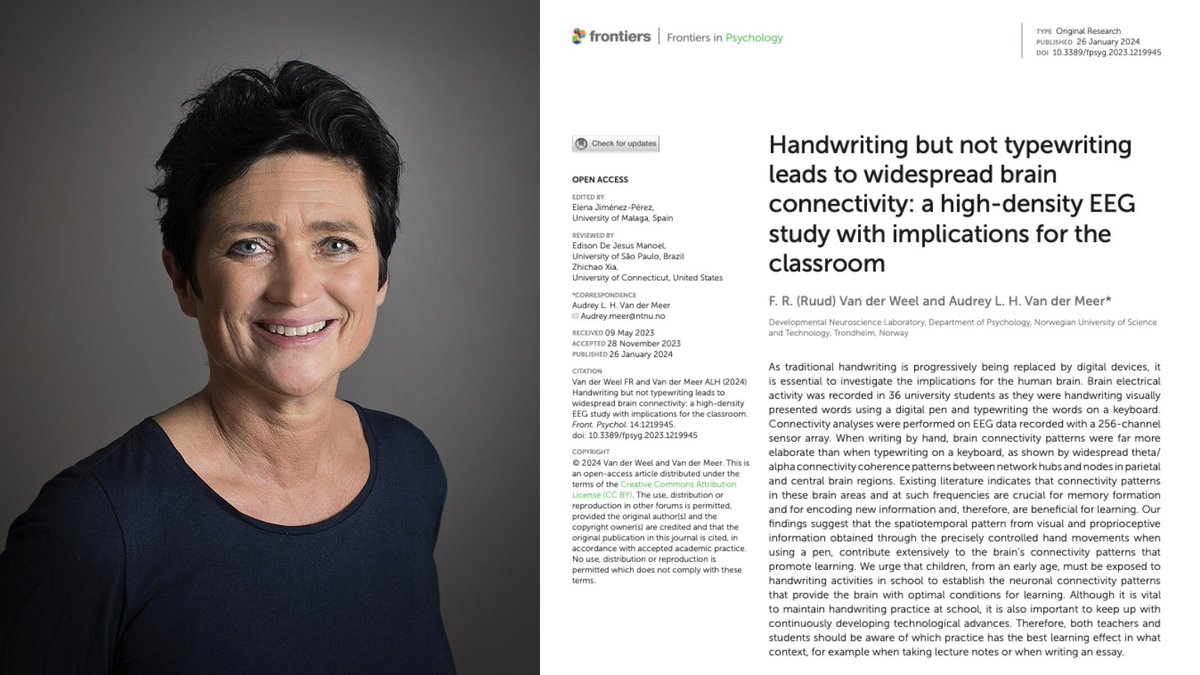
A Norwegian neuroscientist spent 20 years proving that the act of writing by hand changes the human brain in ways typing physically cannot, and almost nobody outside her field has read the paper.
Her name is Audrey van der Meer.
She runs a brain research lab in Trondheim, and the paper that closed the argument was published in 2024 in a journal called Frontiers in Psychology. The finding is brutal enough that it should have changed every classroom on Earth.
The experiment was simple. She recruited 36 university students and put each one in a cap with 256 sensors pressed against their scalp to record brain activity. Words flashed on a screen one at a time.
Sometimes the students wrote the word by hand on a touchscreen using a digital pen, and sometimes they typed the same word on a keyboard. Every neural response was recorded for the full five seconds the word stayed on screen.
Then her team looked at the part of the data most researchers had ignored for years, which is how different parts of the brain were communicating with each other during the task.
When the students wrote by hand, the brain lit up everywhere at once.
The regions responsible for memory, sensory integration, and the encoding of new information were all firing together in a coordinated pattern that spread across the entire cortex. The whole network was awake and connected.
When the same students typed the same word, that pattern collapsed almost completely.
Most of the brain went quiet, and the connections between regions that had been alive seconds earlier were nowhere to be found on the EEG.
Same word, same brain, same person, and two completely different neurological events.
The reason turned out to be something nobody had really paid attention to before her work. Writing by hand is not one motion but a sequence of thousands of tiny micro-movements coordinated with your eyes in real time, where each letter is a different shape that requires the brain to solve a slightly different spatial problem.
Your fingers, wrist, vision, and the parts of your brain that track position in space are all working together to produce one letter, then the next, then the next.
Typing throws all of that away. Every key on a keyboard requires the exact same finger motion regardless of which letter you are pressing, which means the brain has almost nothing to integrate and almost no problem to solve.
Van der Meer said it plainly in her interviews.
Pressing the same key with the same finger over and over does not stimulate the brain in any meaningful way, and she pointed out something that should scare every parent who handed their kid an iPad.
Children who learn to read and write on tablets often cannot tell letters like b and d apart, because they have never physically felt with their bodies what it takes to actually produce those letters on a page.
A decade before her, two researchers at Princeton ran the same fight using a completely different method and ended up at the same answer. Pam Mueller and Daniel Oppenheimer tested 327 students across three experiments, where half took notes on laptops with the internet disabled and half took notes by hand, before testing everyone on what they actually understood from the lectures they had watched.
The handwriting group won by a wide margin on every question that required real understanding rather than surface recall.
The reason was hiding in the transcripts of what the two groups had actually written down.
The laptop students typed almost word for word, capturing more total content but processing almost none of it as they went, while the handwriting students physically could not write fast enough to transcribe a lecture in real time, which forced them to listen carefully, decide what actually mattered, and put it in their own words on the page.
That single act of choosing what to keep was the learning itself, and the keyboard had quietly skipped the choosing and skipped the learning along with it.
Two studies. Two countries. Same answer.
Handwriting makes the brain work. Typing lets it coast.
Every note you have ever typed instead of written went into your brain through a thinner pipe. Every meeting, every book highlight, every idea you captured on your phone instead of on paper was processed at half depth.
You did not forget those things because your memory is bad. You forgot them because typing never woke the part of the brain that would have made them stick.
The fix is the thing your grandmother already knew.
Pick up a pen. Write the thing down. The slower road is the faster one.
Many more NGOs operate with taxpayer funding, and you can find them using the advanced financial tool on my website.
Additionally, there is a distinct category of NGOs where former politicians serve. These organizations rarely rely on small-dollar donations but instead receive large grants from Donor-Advised Funds.
While these "retirement" NGOs do not receive direct taxpayer funding, they often function as platforms for paid speaking engagements or conferences with little to no real attendance. They are typically identifiable by their association with high-profile figures, vague missions, and names featuring words like "Democracy" or "Freedom." Examples include the American Security Project (EIN 204079553) and States United Democracy (EIN 861704152), both of which have many high-profile retired federal officials.
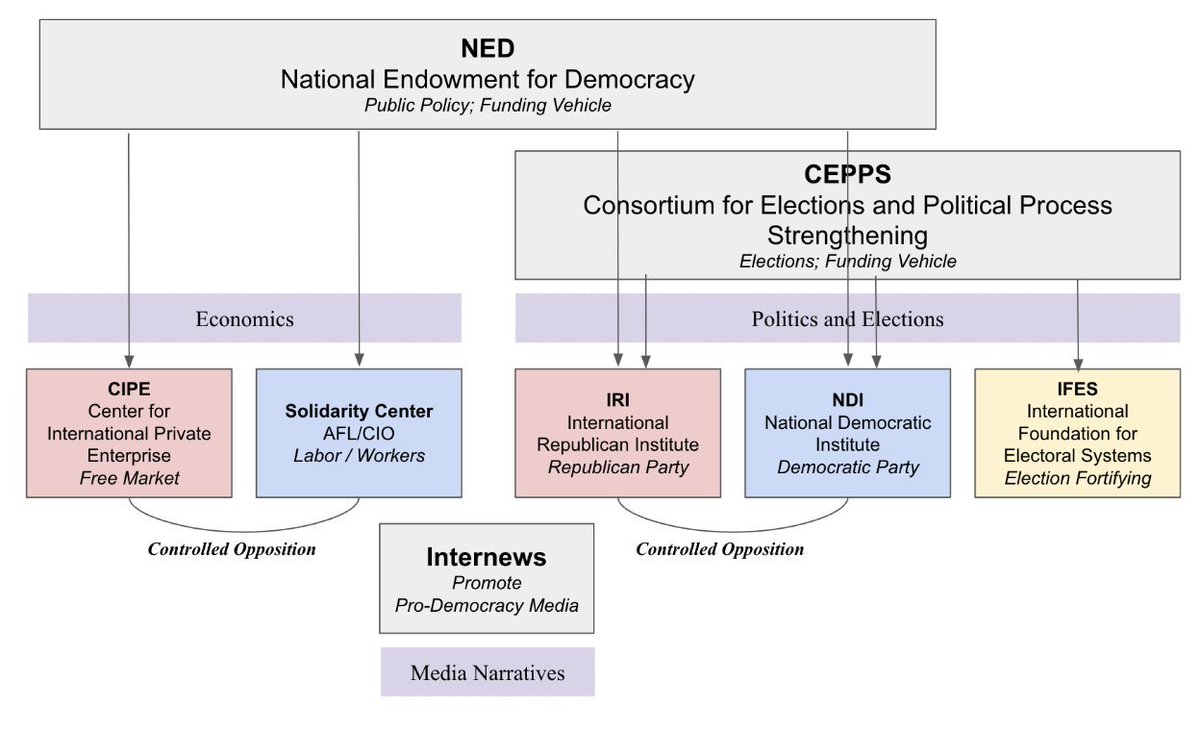
For new followers, here is a diagram illustrating how core NGOs collaborate to create a global soft power structure that shapes elections, public policy, economic policy, and media influence.
Again, many **current** members of Congress hold positions within these taxpayer-funded NGOs. Please read the whole thread.
After thinking it over last night, here’s how I would summarize it: These seven NGOs (eight if you count the off-the-chart Solidarity Center) together function as an "off-the-books" shadow U.S. government.
The National Endowment for Democracy (NED) was created to unify the U.S. against communism. Its four core organizations reflect a neat ideological symmetry of America’s two-party system:
➜CIPE pushes free-market policies, Solidarity Center represents labor and unions.
➜IRI serves Republican interests, and NDI aligns with the Democrats.
CEPPS is another umbrella group that includes IRI and NDI but also brings in IFES under the guise of fortifying election integrity.
And to make sure the narrative sticks, Internews Network spreads these viewpoints through global media.
Most of these NGOs were born during the Reagan years. While not all USAID and State Department funding flows through them, they control the purse strings for much of America’s global financial influence.
DEI initiatives created a system of unaccountability and dependency, which ended up injecting more money into them and further entrenches their power.
They see any challenge to their authority as a threat to democracy itself. But their greatest enemy is still the same one they've had since the Cold War—Russia. They've never lost the "Cold War" boomer mindset.
In their minds, they’re the superheroes keeping America from crumbling. And that entitles them to their travel perks, cushy post-election gigs, and all the other benefits that come with running an unacknowledged empire.
🧵THE UNIPARTY UNMASKED – They Believe They Are “Democracy”
The seven NGOs in the chart below, in my view, represent the Uniparty. Each of these organizations receives substantial financial support from USAID or the Department of State.
Around 2019, the phrase “democracy in danger” began to dominate public discourse, amplified by the media. This was odd—after all, the U.S. is a democracy (or more precisely, a constitutional republic). But as I traced the influence of these NGOs, a pattern emerged: they are controlled by establishment politicians, they play a major role in shaping political narratives worldwide, and their core mission is always framed as “protecting democracy.”
Originally, these NGOs were created to support U.S. democratic efforts abroad—many of them emerging during the Cold War to combat the spread of communism. But with the fall of the Soviet Union, their original purpose faded. Instead of dissolving, they redefined their mission. Now, they have positioned themselves as the guardians of democracy itself.
This shift explains why Trump’s re-election was framed as a "threat to democracy." To these NGOs, “democracy” means themselves. Their survival depends on maintaining that role, and any challenge to their authority is perceived as a direct attack on democracy itself.