Bron mobile app is now live.
Probably our most requested release so far.
The wallet built for serious self-custody finally fits in the palm of your hand.
Hidden accounts, policies, inheritance features and cross chain swaps are now much easier to access when you actually need them.
Download now. Available on iOS and Android.
REMINDER
Bron wallet is now available on the device where most crypto decisions are made badly and then justified as “high conviction”.
Use Bron. Stay safe.
@tokarev_d and Tyler Kenyon will be at @proofoftalk in Paris this week.
If you are there, come find him and talk about how Bron is building self-custody for people who need more than another app to view balances.
See you in Paris.
Bron mobile app is now live.
Probably our most requested release so far.
The wallet built for serious self-custody finally fits in the palm of your hand.
Hidden accounts, policies, inheritance features and cross chain swaps are now much easier to access when you actually need them.
Download now. Available on iOS and Android.
Exchange risk isn’t just operational. Our CCO Mike Milner breaks down what the UK’s OFSI sanctions on HTX mean for crypto holders, why “pick a better exchange” isn’t a real strategy, and why self-custody with a genuine usability layer is the only durable answer.
Your exchange doesn’t have to fail to take your money with it.
This week, OFSI designated HTX (formerly Huobi) under Section 17A—the first time the UK has applied banking-style sanctions to a crypto exchange.
That changes more than most people realize.
Bron founder Dmitry Tokarev once found a tech investor’s leaked email and password in public breach databases. Behind that login was $1.2M in Bitcoin and no 2FA.
People think crypto losses always come from elite hackers. Sometimes the whole setup fails at the first step.
A company CFO should be able to run crypto payroll.
That does not mean they should have full treasury access.
With Bron, a company can give operational access without giving away total control. A CFO can prepare payments, while larger transfers or sensitive actions require approval from the right person.
Rules can depend on amount, destination, account, or approval structure. Smaller payments can move faster. Larger ones can require another signer.
There is another problem most teams ignore: public payroll trails.
If salaries, contractors, or operating expenses move onchain, anyone can track them. Bron’s confidential transfers feature helps keep sensitive activity private, so a company can manage payments without exposing every internal expense pattern to the market.
Operational access should not mean unlimited access.
And payroll should not become public intelligence.
This is why the old self-custody model is breaking.
A seed phrase in a safe does not protect you if attackers know where you live.
A hardware device does not protect you if someone can pressure you in person.
Modern self-custody needs more layers: hidden accounts, spending limits, approvals, delays, and recovery that does not expose balances to anyone helping you.
That is how Bron helps reduce real-world risk.
If someone forces you to unlock the wallet, hidden accounts can stay out of sight.
If they try to move serious funds, policy rules can require another approver.
If they rush you into signing, transaction delays can create time to cancel before funds leave.
Crypto security is not just about keeping keys safe.
It is about keeping people safe.
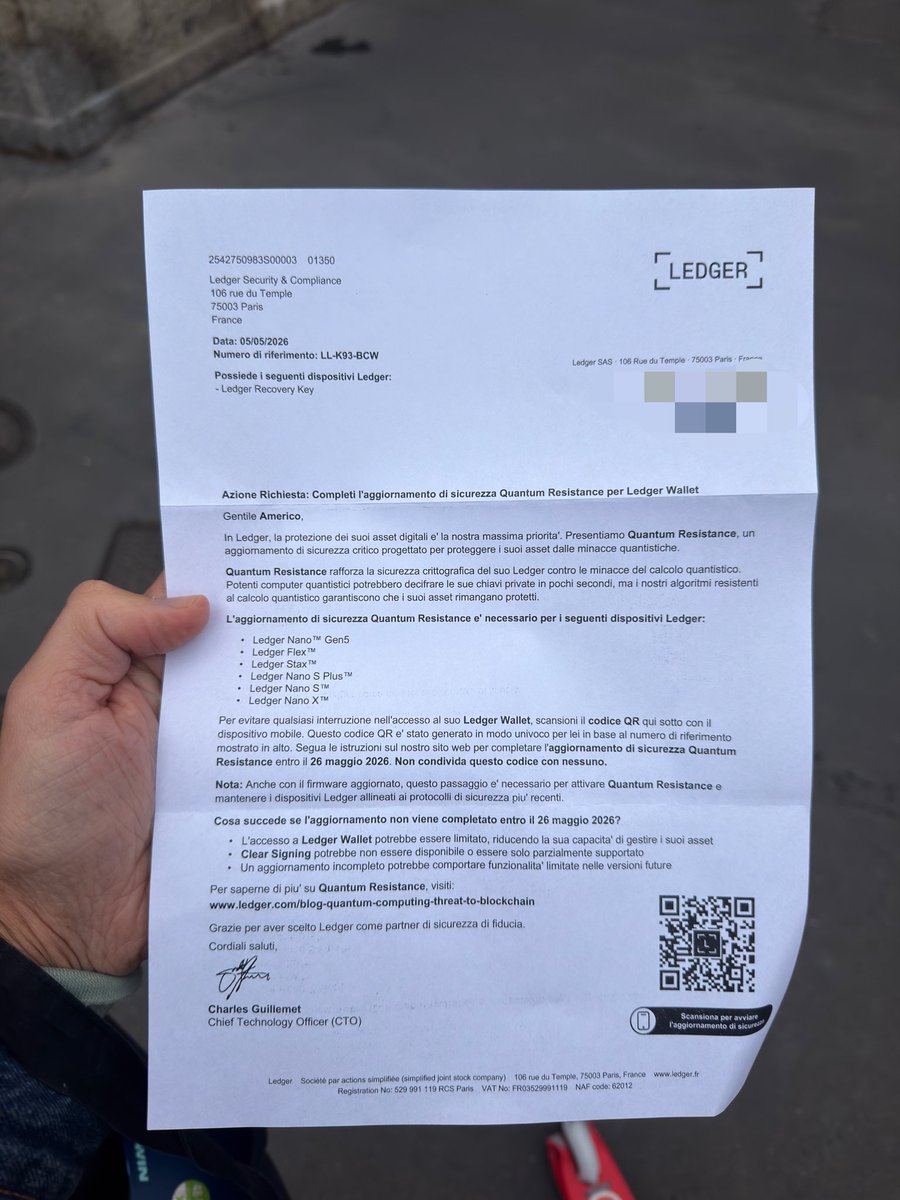
This is terrifying @Ledger.
I just received a physical scam letter at my home address in Italy 🇮🇹
How the hell do scammers have access to the addresses of Ledger users? This goes way beyond phishing emails now.
People’s safety is literally at risk.
Only 60 million people on earth (1.6% of adults) have a net worth over $1 million.
Those 60M people hold 48% of all global wealth.
The bottom 1.55 billion hold 0.6%.
Source: UBS Global Wealth Report 2025
$6B+ in fresh crypto VC funding is closing right now.
The obvious theses are stablecoins, RWAs and AI agents.
But if more value moves onchain, more responsibility moves onchain too.
Stablecoin payments need secure treasury workflows. RWAs need clean permissioning and reporting. AI agents need strict spending limits.
Everyone wants more assets, more users, and more agents onchain.
That only works if the custody layer becomes much better than seed phrases and hot wallets.
That is where Bron fits.
We provide teams a treasury workflow around self-custody: roles, limits, approvals, recovery, and MPC-based signing in one place.
A finance manager can prepare payroll, vendor payments, or treasury transfers without having full control over company funds.
Founders or senior approvers stay involved only when a transaction crosses a defined threshold.
Tax advisors can review activity without touching funds.
No shared seed phrase. No founder approving every small transfer. No “who has the wallet?” routine every time money needs to move.
As more company money moves onchain, teams need wallets that work like real operating systems, not personal accounts stretched past their limit.
April was already ugly for crypto security.
May is not getting better.
In four days, we saw another wave of major incidents. THORChain was reportedly exploited for more than $10M. Verus-Ethereum bridge was drained for about $11.5M. Echo Protocol saw an attacker mint roughly 1,000 unauthorized eBTC, with reports placing the fake mint around $76M.
If a bridge holds a large pool of liquidity, it becomes a target. Hackers do not need to attack every user. They need to find the one place where everyone’s funds pass through.
Bron takes a different route.
There is no giant bridge pool sitting inside Bron waiting to be drained. Swaps are accessed from the wallet through independent solvers and on-chain execution. Users get quoted terms before signing, and funds move through the protocol between counterparties.
Bron does not operate the swap infrastructure or act as a counterparty. There is no need to connect your wallet across random external apps just to move assets between chains.
For users moving meaningful size between chains, the goal is simple: fewer exposed steps, clearer terms, and less operational risk.
@brian_armstrong security for self-custody users. current setups with seed phrases possess so many internal and external risks. mpc is the way to go. institutions have been on it for years
Most wallets were built for one person securing one seed phrase.
That works until real life gets involved.
A company needs a CFO to send payroll without giving them full access to the treasury. A family needs shared control without everyone seeing everything. A trader needs delays and limits for large moves. A founder needs recovery without handing over control to a custodian.
Bron was built around those use cases.
You can create shared workspaces, assign roles, add approval rules, set transaction limits, use hidden accounts, export transaction history, and recover access without relying on one seed phrase forever.
Self-custody should not stop at “protect the words.”
It should let you actually run your financial life.
8 things to do if you hold $100K+ in crypto
1. Use metal backups, not paper
2. Store them in at least 3 separate locations
3. Make sure those locations do not share the same disaster risk
4. Use safes built for real fire and water exposure, not normal home storage
5. Have inheritance instructions that someone can actually follow
6. Keep a decoy wallet for worst-case situationsasswords are even better
7. Keep a decoy wallet for worst-case situations
8. Test recovery regularly, because a backup that was never tested is just a theory
Or install Bron and skip the operational headache.