We should stop calling them China Hawks as the name gives them legitimacy as an argument- they're really just racists, bigots, imperialists or a combination of the 3
There is only ONE country most Chinese hate for its criminal past > JAPAN.
Japan never apologised, Japan is still used as a US proxy in the South China Sea.
And yet…. Most Chinese are pragmatic and will never want to go to war against Japan, unless Japan meddles with the Taiwan issue & Chinese sovereignty.
If conflict happens…Then China would be merciless.
In the meantime > China gains leverage through trade and engagement with its neighbour/competitor > the moto is > “look for what unites & set aside differences”.
Most westerners will never understand the power of “engagement” with competitors/enemies…. Just because they will never try to understand Chinese culture/history/mentality/values.
China and most Chinese do not forget about history and yet…they will always seek peace and prosperity.
Why am I defending Jensen? I've never met him & don't do business in chips. I'm defending him because he's being crucified for having an affair
There's no proof he's done anything illegal. None
And now they are going after his daughter too. What the fuck did she do wrong? It's a 2026 lynching
Now, there's a concerted effort to take Jensen down by media outlets like NYT & WSJ that have done more than Raytheon to turn America into a warmongering, racist nation.
We have wonder why
Is it because he pushed for pragmatic and sane relations with China?
Because he pushed for open source?
And now we hear Nvidia introduced Alibaba to Alice Huang. If she's a spy for China, why did she need to be introduced to Alibaba
They've destroyed her life too
Whatever the underlying reasons, we can see who benefits from Jensen's downfall:
1) Marco Rubio and China Racists
2) Anthropic and alleged eunuch Darius Amodei
3) US weapon manufacturers
Now, if Jensen did break any laws, then he needs to be held accountable.
But there needs to be evidence and proof of actually breaking laws
That's why I'm angry. They can come after anyone with allegations if you go against the system and want pragmatic relations with China.
I've suffered for taking this line and for my skin color. Jensen has too now. Who else will they go after?
This is worse than fascism or anything China doles out.
Kishore Mahbubani tells a story you won't read in Western papers.
Former US ambassador to China Stapleton Roy, fluent in Mandarin, told him that at a meeting with Obama, "maybe 2014", Xi Jinping offered to demilitarize the South China Sea.
"The United States, instead of accepting the offer, rejected the offer. And that's why the militarization began."
What is on record : September 2015, White House Rose Garden, Xi says China "does not intend to pursue militarization" in the Spratlys.
Washington's answer was more patrols, then years of "China lied" headlines.
Mahbubani's other point >
> China is "the world's number one trading power"
> so it has "a greater vested interest in freedom of navigation than the United States"
I have heard the "China will block the sea lanes" line for years. Block its own trade ?
So was there an offer on the table ? And if there was, who walked away ?
Extremely wise words by Shivshankar Menon, India's former Foreign Secretary and National Security Advisor.
Asked by the host what worries him about India - what is a burden of history for India - he replied that "there is such a thing as excessive pride in your past."
He explains that talking of "your glorious golden ages in the past" to "feel good about yourself" is ok - a normal aspect of building an identity for yourself - but "when you then carry it on into victimhood and into revenge for history" and when that becomes a driving force for today's actions, then it becomes "dangerous."
He takes the example of people in India speaking about "a thousand years of slavery" (meaning Muslim and then British rule) or of Chiang Kai-shek writing every night in the top right of his diary "never forget national humiliation" (I checked and he actually wrote 雪耻 - xuě chǐ - which means "avenge the humiliation": https://t.co/6y1P9HUMfC, he did it from 1928 until his last diary entry in July 1972).
It's a wise point in general: when you think about it, nationalism isn't necessarily destructive in and of itself. But it becomes so when you convince yourself as a nation or people that you are a victim and that there is a guilty party. Because, as Menon puts it, it makes you "stop dealing with reality as it is" and leads to "counterproductive policy and ideas."
All the more dangerous because it’s so easy: nothing easier as a people, or as the ruler of a nation, than to blame others for what’s wrong. It spares you the much harder work of looking at your own failings, and absolves the rulers of responsibility.
And the inverse is really hard: nothing harder when you have indeed been a victim than to resist turning that grievance into a political program, and to instead focus on what you can actually build today - which often involves working hand in hand with the guilty party.
Which is, incidentally, why what China did was so impressive. It could have turned national humiliation into policies of revenge and hatred but instead chose to define it largely as China's own mistake for having been weak enough that foreigners could take advantage of that (Xi Jinping himself defines it that way in his book: https://t.co/kmmdYdWSjm). Which is constructive, because then the objective isn't revenge but building yourself, and China did that working hand in hand with the West.
We’re seeing some version of victimhood drive policies in too many countries around the world. Europe is, sadly, a case in point: Russia and China have become the all-purpose explanation for almost every problem on the continent, from energy prices to deindustrialization. Very practical for EU leaders who never have to answer for their own choices...
It's a good rule of thumb to have: if any politician builds his message around blame, take it as a red flag. That's what you reach for when you won't build.
This is the source video, by the way: https://t.co/qUCnMB8Qed On the WorldView Postcast of my friend @Hansong_Li
Seven years ago the ban was meant to end Huawei.
Last month it shipped a chip the sanctions were designed to make impossible, then today Qualcomm licensed the patents behind it.
In May 2019 Washington put Huawei on the Entity List and Google pulled Android within days, then by September 2020 TSMC had stopped making Kirin altogether. Richard Yu told a conference in China that year might be the last generation of Huawei’s high-end chips, while allies were also being leaned on to rip the gear out of their networks.
The charge was spying, a backdoor and a listening post disguised as a router.
The evidence never appeared. An 18-month review ordered by the White House and reported by Reuters in October 2012 questioned nearly 1,000 telecom equipment buyers and found no clear evidence of spying. One individual expressed it clearly, stating they would have found it if it existed. The congressional chairman who claimed customers had watched routers send valuable data to China was quietly corrected, because the company was Leap Wireless and its own investigation found infected computers and no stolen data.
Nothing since then has changed that. The trial that opened in Brooklyn on the 9th September runs on Iran sanctions, bank fraud, racketeering and trade secrets covering Cisco source code, a T-Mobile testing robot and an old Motorola file, with no espionage count anywhere on it. After seven years of bans the original accusation is still not on the charge sheet.
Huawei was already the world’s largest maker of telecoms equipment and, in the second quarter of 2020, briefly the largest phone maker on earth, the first company outside Samsung and Apple to top the table in nine years. The cut-off was meant to stop it there, but it did the exact opposite.
Without Android it built HarmonyOS and without TSMC it turned to SMIC and DUV multi-patterning. When the Mate 60 Pro appeared during a visit by the US commerce secretary in 2023, teardowns found a SMIC 7nm Kirin 9000s built without EUV, so Washington opened a probe. The Commerce Department’s own statement revealed the honest truth: the restrictions in place since 2019 “have knocked Huawei down and forced it to reinvent itself”.
The machines came next. Chinese immersion DUV scanners are in production-line validation at domestic fabs, where Huawei’s own investment arm has put money into the domestic light source and the projection optics. When that story arrived in July, ASML lost about 44 billion dollars of market value in a single day.
The architecture changed after that. On the 7th of September 2026, in Guangzhou, the Mate XT 2 shipped on the Kirin 9050 Pro, the first mass-produced phone chip built on Huawei’s Tau scaling law and LogicFolding. Instead of waiting for a smaller transistor (following Moore’s Law) it stacks logic and shortens the wire. Density goes from about 155 million to 238 million transistors per square millimetre, which is a step the older geometric treadmill needed three years to make. Multi-core performance is up 52% with the whole device 42% ahead of the previous Mate XT.
The honest part is that this is still a 7nm-class chip printed on DUV with Bernstein putting it roughly 30% behind Apple’s newest, so the gap has gone from four years to three rather than to nothing.
Four weeks after Guangzhou the Mate 90 series shipped.
Then Monday happened. Huawei and Qualcomm announced a multi-year cross-licence covering 5G, computing, AI and networking, with Qualcomm also buying a set of Huawei’s US patents in computing, AI and networking. Bloomberg reported that the agreement reaches near- and co-packaged optics as well as the patents underpinning LogicFolding, which means the American company that used to sell Huawei its phone chips is now licensing the architecture Huawei built to navigate around the ban.
Huawei first paid Qualcomm for patents in 2001 and the money ran one way for a quarter of a century. In 2020 Huawei handed Qualcomm 1.8 billion dollars in back royalties. Nikkei reported that once this agreement takes effect, Qualcomm becomes a net payer to Huawei for the first time ever. Huawei expects the total value of its patent licensing agreements to pass 6.9 billion dollars when the deal closes.
It needs US regulatory approval before that happens, so Washington still holds a vote on whether the company it blacklisted can collect royalties from San Diego.
Moore’s law was a manufacturing treadmill owned by whoever held the next ASML machine, while Tau is the workaround, performance by design rather than by permission. Washington spent seven years trying to keep China one node behind. Huawei answered by changing the ruler.
Living here in China, the shift seems usual nowadays. HarmonyOS is on 85 million devices, tri-folds sit on restaurant tables and the chip roadmap no longer asks Cupertino or Eindhoven for the next step.
A ban with no public proof of spying built a rival that no longer needs your operating system, your foundry or your scaling law, one that now licenses the patents behind its own chip architecture to San Diego.
Who exactly got contained?
@RnaudBertrand We also won’t forget Washington’s kidnap of Huawei founder’s daughter in 2018 based on lies. Recall that even the Washington Post counted over 21,000 lies committed by Trump from 2017-2020
THE UN FOUND NO HUMAN RIGHTS ABUSES OF THE UYGHURS IN CHINA!!
Allegations of abuse were promulgated by Uyghur separatists who were funded by the CIA!
Statement by UN High Commissioner for Human Rights Michelle Bachelet after official visit to China https://t.co/Iqeg0toe5A
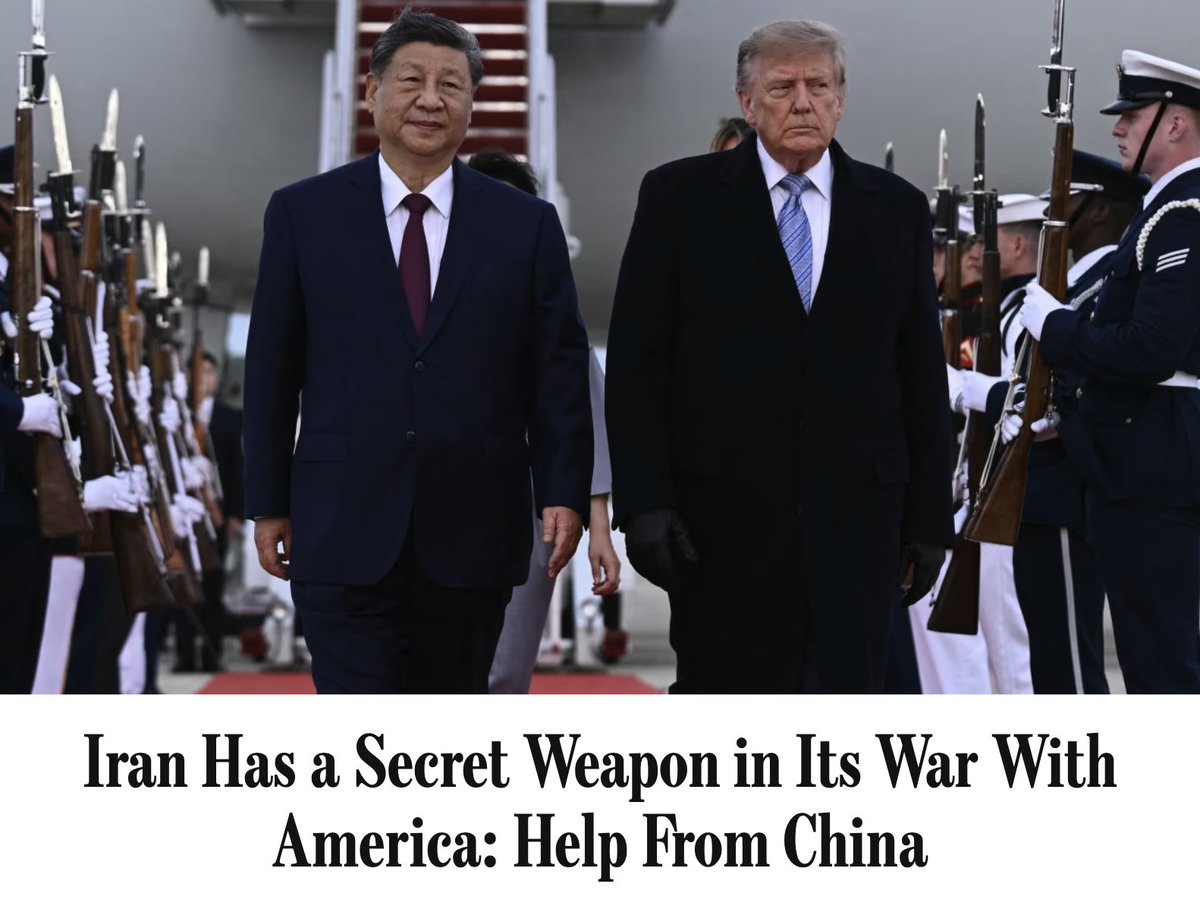
Another major scoop from the Wall Street Journal: China is selling electronics to Iran.
Specifically, around 1,300 shipments of “dual-use” components to Iran’s defence ministry in the first half of this year: GPS tracking devices, electric motors, aircraft engine parts, electronics components, chemical compounds.
All of these could apparently be used in drones and missiles. Although to be fair, they could also be used in tractors, washing machines and hospital equipment. That’s rather the point of “dual use”. All phones have GPS chips. You might as well say that anything made of atoms is “infinite use”, and therefore Washington must sanction trade in all physical matter 🤷🏽♂️
It turns out “dual use” is just a mechanism for the US to apply sanctions whenever the buyer is on its enemies list.
Besides, China has every right to trade with Iran. Iran is a sovereign state defending itself against an illegal war of aggression. China observes UN-approved sanctions and rejects unilateral measures as illegal. Meanwhile the actual bombs that the US supplies to Israel to carry out its genocide in Gaza are very much not “dual use”.
Interesting to note also that it’s the Dems really pushing this line. Trump has learned the hard way not to make too much noise on this sort of thing, because China can fight back. So Elissa Slotkin and Elizabeth Warren are running to Trump’s right on China, demanding tighter chip controls, more arms for Taiwan, pressure over Ukraine, and a showdown over Iran.
Strange world.
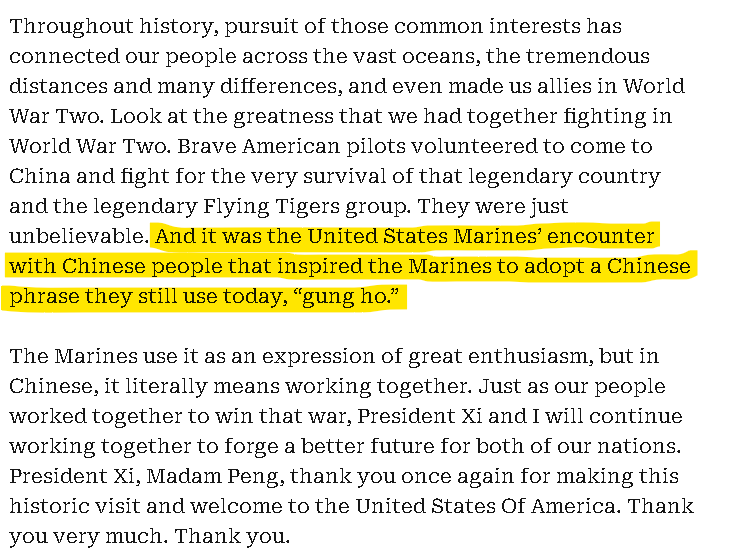
Really interesting that Trump mentioned the Chinese origin of the term "gung ho" during his remarks at Xi's arrival ceremony 👇 (https://t.co/NB5ydHmC2T)
What he didn't mention, however, is the most fascinating fact: it directly comes from an organizational concept that the US Marines borrowed from the Communist Army during WW2.
See, during WW2, the Communists were at a big disadvantage versus both the Japanese and Chiang Kai-shek's Nationalists: fewer weapons, less money, no foreign backing to speak of.
Yet they kept proving extraordinarily capable, scoring many victories, and an American Marine officer named Evans Carlson (https://t.co/MTNtQZDskj) decided to embed himself with the Eighth Route Army (the Communist forces under Zhu De) in order to understand why.
What he found - which deeply impressed him - was a completely different organizational culture to traditional armed forces: almost no hierarchy, officers sharing the same food and hardships as the men, open discussion of objectives, and discipline based on conviction rather than rank.
In short, the Communists' secret weapon was cohesion - the way they worked together - and Carlson came away convinced it was the model for how fighting units should be run.
He didn't quite know how to call this organizational concept so he borrowed a term from a Chinese cooperative movement he'd come across during his travels (the Chinese Industrial Cooperatives: https://t.co/abEo7GCetn), known by the abbreviation 工合 (gōnghé) which literally means "work together". It captured exactly what he'd seen in the Eighth Route Army.
Back in the Marines he took command of the 2nd Marine Raider Battalion ("Carlson's Raiders") in 1942, and he adopted "Gung Ho" as the unit's motto and applied the Eighth Route Army model.
He held "Gung Ho meetings" where rank was set aside and men could speak freely and criticise, officers had no special privileges, and everyone was expected to understand why they were fighting. The Raiders became famous for the Makin Island raid (August 1942) and the "Long Patrol" on Guadalcanal (late 1942).
Carlson's Marine unit became so legendary that Hollywood made the 1943 film Gung Ho! about them (https://t.co/GeSCG9Sk3I!), which is largely how the phrase spread into general American English.
So there you have it, many ironies here, first among which is the fact that the US Marines learned to let their men speak freely and criticize their leaders by... watching the Chinese Communists 😊
Live and Let Live: Only Their People Get to Judge Them
Do you like Putin? Xi? Macron? Trump?
The honest answer is not a fan club membership. It is this: my opinion is not the verdict that matters. Russians judge Russia. Chinese judge China. The French judge France. Americans judge America.
Outsiders arrive with different lenses, strong bias, and a great deal of ignorance. Treating another country’s politics as a moral occupancy is not virtue. It is an imperial habit.
A real choice still needs civic consciousness and an information space that is not permanently manipulated. Without that, “public opinion” can be manufactured.
With or without it, the alternative to domestic judgment is foreign tutelage — and that is worse.
Read the full article:
https://t.co/NIuEyN53Bm
Fair trial? After they already tried to kill the company.
They spent years cutting Huawei off chips, software, 5G, phones, even grabbing Meng Wanzhou. Now they sit in Brooklyn talking about a “carefully selected, impartial jury.”
No one who watched the last decade believes that.
This is not a normal commercial case. It is the US trying to turn its court into a global regulator for every tech company that does not fly the American flag. Win and they expand dollar-clearing jurisdiction. Lose and the precedent cracks.
Huawei did not collapse. It built its own stack and pushed Nvidia out of parts of the China market. That is why this trial exists.
Watch what the jury is actually being asked to rubber-stamp. Not the press conference.
Xiong'an is a new city being built just south of Beijing.
It is already beginning to attract valuable talents and is growing FAST.
No above ground powerlines, and the most modern infrastructure.
Worth visiting to see the city of the future.
👇
BRIDGE BETWEEN CHINA AND THE WEST
I first arrived in China in 1995. Learned the language. Walked Yunnan. Watched the country rise with my own eyes — not through headlines.
After years speaking to the West, I am now speaking directly to Chinese audiences.
This video is the start of that conversation: honest talk on politics, media, culture, and real life. No filters.
The more we talk, the more we see we are the same.
Watch here: https://t.co/o2zlPq8tDs
Angelo Giuliano
🇨🇭🇮🇹 Living in China since 1995
You ask what China’s development cost.
Fair question.
But it becomes a much less comfortable question when you apply it consistently.
What did Western development cost?
Coal smoke.
Child labour.
Plantation slavery.
Indigenous dispossession.
Colonial extraction.
Policy-made famines.
Cleared forests.
Poisoned rivers.
Crushed strikes.
Suppressed unions.
Markets opened by gunboats.
Generations of workers whose suffering disappeared into the word "industrialisation."
You present China’s development as evidence against its system.
Western development, meanwhile, is granted the luxury of becoming "history," severed from the system that produced it.
That is not serious comparison.
It is moral accounting that begins only after one side has already accumulated the capital, infrastructure and power, then turns around and lectures those still climbing.
If the costs of development are going to be counted, then count them consistently.
Count all of them.
If you want the full text of the BRICS joint declaration that was just signed in New Delhi, it's available here: https://t.co/9O0tpxtXbA
It's huge: 140 paragraphs, and almost 18,000 words - on an incredible array of subjects from the wars in the Middle-East, to AI, to agriculture.
I won't go into the details of it, if only because there is just an overwhelming amount of it, but the overall impression it gives is that this is what serious multilateral governance looks like - especially if you compare it to recent G7 summits, which only produce a handful of short reactive statements rather than anything resembling this kind of comprehensive institutional blueprint.
Here - from building alternative financial infrastructure to food security - you really get the feeling that, as difficult as it is with such a diverse group of countries, they're actually trying to build things and to answer the governance challenges of our age, many of which are ironically created by the G7 😅
That's the new era: half the world, quietly building the institutions the West is busy destroying.