the world is undergoing a fundamental transition where apps are becoming agents & it’s well underway.
this matters cuz the unit of distribution is changing. i.e. apps were how capabilities reached users.. neatly bundled with ui, brand, billing, & a discovery surface. if agents become the new distribution layer, everything downstream has to be rewired from discovery, trust, monetization, brand, to even what it means to “ship” a product.
shifts to the atomic unit of distribution are rare in modern history which is exactly why this opens opportunity scopes at every layer of the stack, from silicon up through the interface.
agency is a muscle。
很喜欢notion 创始人 evan zhao 的这个比喻。干净利落,抓住了 agency 的本质。
过去几十年,衡量工具好坏的标准几乎只有一个:效率。更快、更准、更省力。ai 更是把这条逻辑推到了极致——一切皆可自动化,一切皆可外包。但这里藏着一个危险的盲区:当工具接管的不是洗碗这样的纯机械劳动,而是需要判断力、创造力和好奇心参与的认知过程时,效率的提升可能正在悄悄侵蚀一种比效率更稀缺的东西:agency。
“agency is a muscle. tools can strengthen it — or let it atrophy.” 肌肉遵循一条铁律:用进废退。它需要阻力才能增长,需要持续锻炼才能维持。agency 也是如此——它不是天赋,不是人格特质,而是一种需要不断施加认知阻力才能保持的能力。
ai 对人类 agency 的影响,要么是加强(strength),要么是弱化萎缩(atrophy)。 strengthen 的路径是让人在使用过程中做更多决策、承担更多判断;atrophy 的路径是让人外包判断、放弃思考。医生使用 ai 辅助检测息肉三个月后,独立检测能力下降;年轻人越依赖 ai 做决策,批判性思维得分越低。这就是 the age of de-skilling 正在发生的事。
karpathy 发过一条推:agency is significantly more powerful and significantly more scarce. 如果 agency 比 intelligence 更稀缺、更强大,那么任何让 agency 萎缩的工具,都在摧毁人类最稀缺的资源。ai 的 agency 是工具理性,人的 agency 是目的理性。前者是手段,后者才是目的。
使用 ai,最重要的一条原则:它对使用者 agency 的净效应。每一个产品、每一个 ai agent、每一个工作流,都值得用这把标尺重新丈量一遍。
Unexpected forms of generosity:
-Being early can be a form of generosity. You wait, so they don't have to.
-Leaving something unsaid can be a form of generosity. You don't always need the last word.
-Delivering your work on time can be a form of generosity. You make life easier for everyone downstream.
-Not taking things personally can be a form of generosity. You give people the space to say things imperfectly.
Why OpenClaw will create jobs:
" I can't see these as doing anything other than creating a lot more jobs. Like there's just so much more stuff that needs to get built and needs to get managed."
"The same thing happened with cloud, right? When cloud came around, I remember sitting in my big corporate job thinking 'half of these people will be gone in five years.'"
"And then, lo and behold, 10 years later, 20 years later, the IT organizations are bigger than they were then, and they're spending even more money."
" Trying to ignore this new technology and waiting for it to go away usually doesn't work."
@stuffyokodraws@appenz on the AI + a16z Podcast
Introducing the Readwise CLI.
Anything you've saved in Readwise (highlights, articles, PDFs, books, youtube, newsletters) is now instantly accessible from the terminal.
For you, and your AI agents.
npm install -g @readwise/cli
Obsidian just got agent-ready.
obsidian-skills teaches AI how to actually work with your vault:
• write valid Obsidian Markdown
• generate Bases databases
• create JSON Canvas diagrams
• manage notes via CLI
Turn your AI into a real second brain.
My biggest takeaways from @qasar:
1. The real AI revolution over the next 5 to 10 years will happen in the physical world, not in software. While everyone obsesses over ChatGPT, Claude and coding agents, the real impact will come from autonomous vehicles, mining robots, and farming equipment. They’ll save lives (over 30,000 die annually in U.S. car accidents), enable mobility for disabled people, solve labor shortages in dangerous industries where nobody wants to work, and much more.
2. AI isn’t replacing jobs in industries like trucking and farming—it’s arriving just in time to fill a labor gap that already exists. The average age of a farmer in the U.S. is in the late 50s. Long-haul trucking jobs go unfilled not because people can’t do them but because the tradeoff isn’t worth it anymore; a family can choose DoorDash or Uber so the parent can pick up their kid. Qasar’s view is that physical AI will fill gaps created by demographic shifts and changing preferences, not displace workers who want those roles. He’s careful to say this doesn’t mean there are no downsides, but that the framing of “AI is coming for your job” misses the more immediate reality.
3. Comparing Chinese AI companies to American AI companies is a category error. Qasar uses Huawei as his example: the company’s name means “China’s ambition,” roughly a quarter of its employees are Communist Party members, and its goal is not to grow profits but to extend the state. So when people say Chinese EVs are outcompeting Detroit, they’re comparing a government-backed entity with no profit constraint to companies like Rivian that get hammered by public investors for losing money. Qasar says that if American companies were freed from profit expectations the same way, they’d field comparable products. The point isn’t that China is incompetent or not a serious competitor; it’s that the comparison framework most people use is wrong.
4. The Industrial Revolution is the best mental model for AI. Just like the late 1800s brought child labor and monopolies but also unprecedented access to healthcare, heating, cooling, and material goods, AI will have downsides we must address while delivering massive benefits. The key: don’t pump the brakes on technology to protect jobs—that hurts the people you’re trying to help most. Find solutions that account for workers while enabling progress.
5. Building under the radar can be your competitive advantage. Qasar built Applied Intuition for nearly a decade without a social media presence. One of the company’s early core values was “Our best work is done alone and quietly.” His reasoning: every minute spent on a podcast, a post, or content for public consumption is a minute not spent on customers and the product. Qasar adds an important caveat—he could afford to stay quiet because he was already known in the ecosystem. Founders without an existing network may need the visibility that public presence creates.
6. Qasar thinks most Silicon Valley CEOs lack taste—both in the artistic sense and in the sense of making good operational decisions—because their life experience is too narrow. A founder who grew up in Cupertino, went to Berkeley, and immediately started a company has never experienced what it’s like to be at the bottom of a 100,000-person organization. Qasar spent over a decade at GM and Bosch and says that experience—the bureaucracy, the bad tools, the disconnected leadership—directly informs how he leads Applied Intuition today. His broader point is that taste comes from exposure to a wide range of human experience: backpacking, reading old books, working in different cultures and industries.
7. Successful companies almost always show traction early. If you’re two years in and the market isn’t giving you increasingly specific signals about what to build, consider resetting. The foundation might be wrong—co-founders, market, or life phase. Your first startup is practice; treat it as building the muscle of being a founder, not as your magnum opus.
8. Emotions are a filter that distorts decision-making, and the goal should be to remove that filter so the “raw image” of the decision comes through. Qasar doesn’t mean leaders shouldn’t have empathy; he means that attachment to your own idea, the desire to be right, and the tribal instinct to follow the loudest voice are all emotional distortions. His practical heuristic: the same decision, presented to multiple people independently in the company, should produce the same result. If it doesn’t, some emotional filter is warping the signal. This connects to his broader philosophy of creating a culture where the best idea wins regardless of who proposed it or how senior they are.
9. Qasar’s advice on company values: don’t invent them philosophically. Instead, write down the 5 to 10 things that explain why your company is already successful, and those become your values. Applied Intuition’s values include “Move fast, move safe,” “Never disappoint the customer,” “Technical mastery,” “High output matters,” “Laugh a lot,” and “Half of the work is follow-up.”
10. Treat your first startup as a zero—a practice round, not destiny. Qasar tells founders leaving Applied Intuition to start companies that their first three years will likely produce nothing, and that’s fine. Founding is a craft, like woodworking. If your first table is wobbly, you don’t quit—you build another one. He thinks a lot of founders, especially first-timers, put so much pressure on themselves to succeed immediately that they miss the real value of the experience: learning and building the muscle. His own third company is the most successful by far, and he sees this pattern repeatedly. There are entire funds focused exclusively on multi-time founders for exactly this reason.
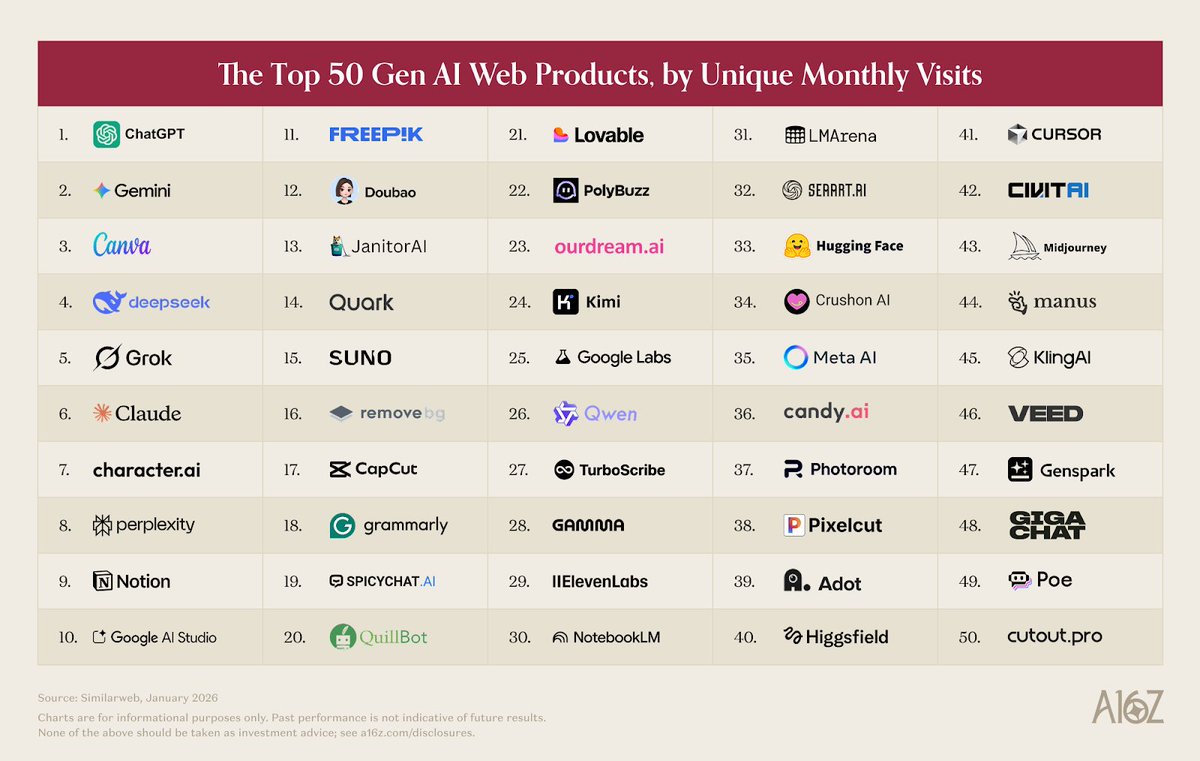
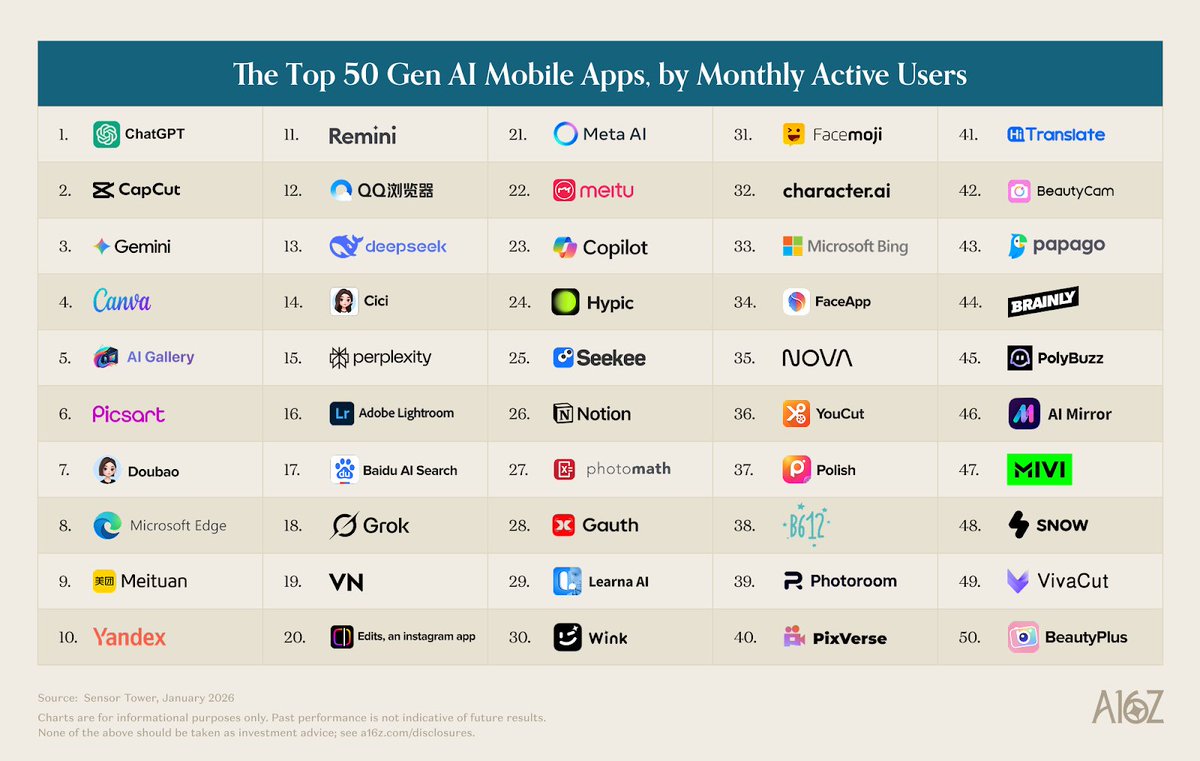
🚨 The @a16z consumer AI Top 100 is back!
For the sixth time, we ranked consumer AI websites and mobile apps by usage (monthly unique visits and MAUs).
This edition, we changed the rules. Here's why - and what the new list says about where consumer AI is heading 👇