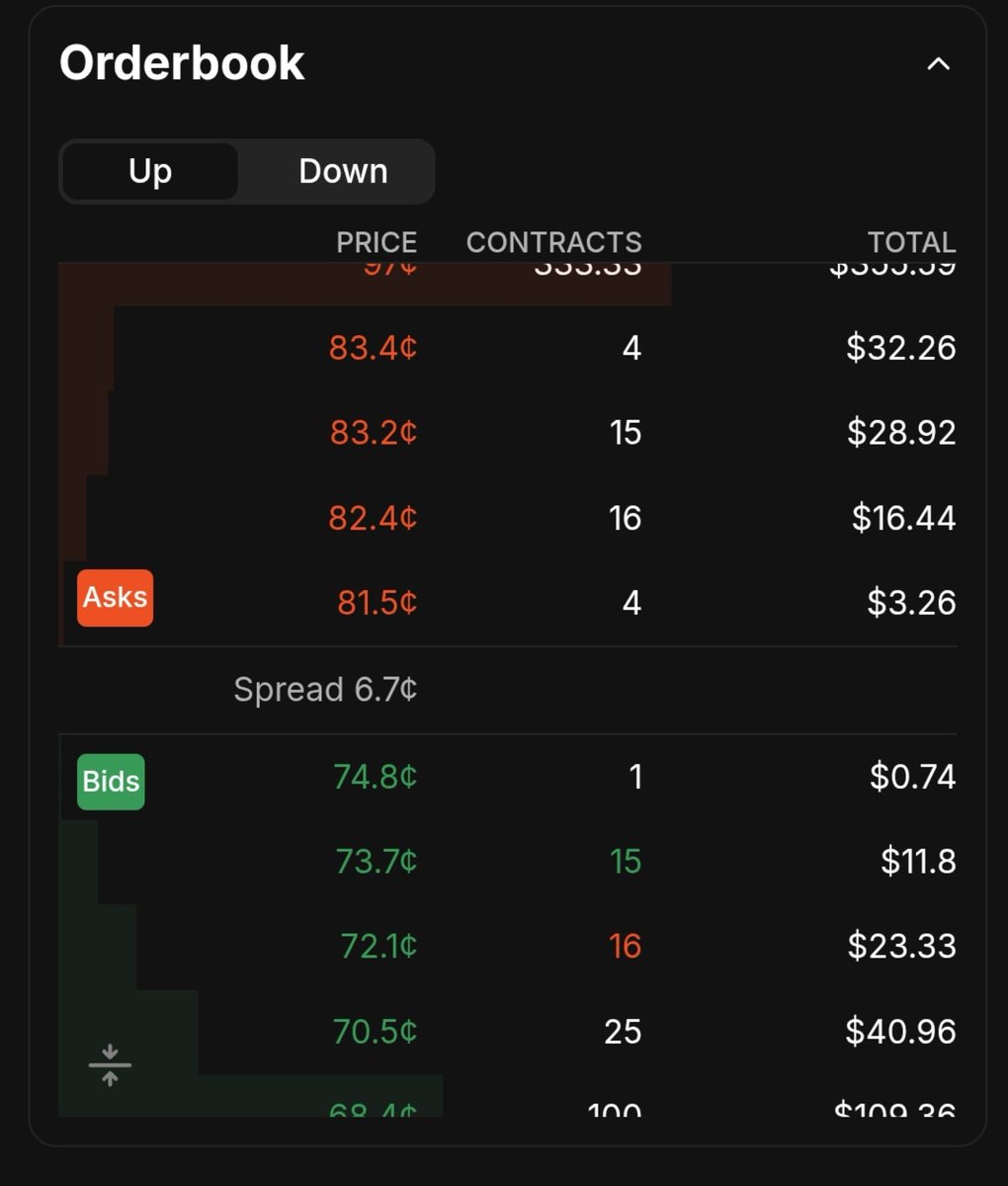
pretty sure at least one time you tried to trade on a prediction market, you entered at 50c but it moved you to 60c
the mechanics behind that is simple and you will learn something from this :)
we have two systems that run the buy and sell of a prediction market
⤷ Orderbooks
⤷ AMMs ( automated market makers )
now, what's the difference and which one is better? let's go through each starting with order books
in order books, buyers post the price they'll pay (bids), sellers post the price they'll accept (asks)
a trade happens only when the two meet example, the cheapest seller wants 53c and the best buyer offers 52c
someone has to cross the gap, because those two don't meet and that what costs you :)
that 1 cent gap is the spread, that spread is the hidden cost of trading
now for the part most people miss, the size of your trade also matters
say 800 shares are for sale at 53c, then 500 at 54c, then 300 at 55c
buy 1,000 shares with a market order and 800 fill at 53 cents ($424), then 200 at 54 cents ($108).
what you paid $532, an average of 53.2 cents, not the 53 you saw.
that gap between the price you saw and what it gave you is slippage, and a thin order book makes it worse.
imagine moving from 53 to 63c because of a market order, that's what happens on a very thin order book
the fix? a limit order. you name your price and wait.
the bad part? your trade might partly fill or never fill :) and this order book is bad for start up prediction markets
now for automated market makers (AMMs)
this system is good for startup prediction markets and markets with thin or low liquidity
now how does an amm work?
you have to pay very very close attention to this particular line below
there's a pool of YES and NO shares plus a formula sets the price, so you can always trade, whether there's another human or not
the bigger the pool, the less price impact
let's start with 1,000 YES and 1,000 NO in the pool
each yes costs 50 cents, now someone spends $100 on YES.
the formula is simple, YES times NO has to be constant, so the price has to climb.
(this formula is common but some other companies use the LMSR, a different version)
the price of YES = NO in pool ÷ (YES + NO) = 1,000 ÷ 2,000 = 50c.
since you spent $100 on YES:
your $100 creates 100 YES and 100 NO.
the pool keeps the new NO, so it now has 1,100 NO
The rule is that YES × NO stays at 1,000,000 because 1000 x 1000 is 1million
because of this the pool's YES drops to 1,000,000 ÷ 1,100 = 909.09
you then receive your 100 YES plus the 90.91 the pool gave up equalling 190.91 shares
your average price is now (remember that formula above) 100 ÷ 190.91 = 52.4c.
The new price: 1,100 ÷ (909.09 + 1,100) = 54.75c.
So your own trade moved the price from 50c to 54.75c, and you entered at 52.4c
now you might be thinking, let me spend 500 instead:
now NO becomes 1,500, YES becomes 666.67, and you get 833.33 shares at an average of 60c
the price jumps to about 69.2c, a very huge slippage from the beginning.
Now let's use a bigger pool, 10,000 each, and you spend $100
now you get about 199.01 shares at an average of 50.25c.
the same trade barely moves the price, because the higher the pool, the less price impact it will have :)
finally caved and tried Kalshi and man what a drive by on retail - double digit wide spreads, 25% spreads on exiting positions, no orderbooks, all market orders, gross fees. This thing will destroy retail capital
also congrats polymarket on 2b at 9b very cool