Ph.D. in Psychology
Post-Doctoral Associate @nyuabudhabi
Social Psychology - Conspiracy Beliefs/Economic inequality
RT not endorsement, just worth mentioning.
🚀 New paper out!
From curiosity to conspiracy 🧠🔍
Proud to share our new paper in the British Journal of Social Psychology:
“From curiosity to conspiracy: How epistemic motivation shapes competing ways of knowing”
(with Caterina Suitner & Anne Maass)
https://t.co/PiAfyLQl6p
Los filósofos de consumo popular, como Zizek y Byung-Chul Han, no son de consumo disciplinar. Los profesionales que se dedican a investigar y publicar artículos no los toman en serio.
Y sospecho que lo mismo sucede en todas las disciplinas.
💡 Science and conspiracy theories respond to fundamentally different epistemic needs.
Understanding these mechanisms is crucial to:
✔️ counter misinformation
✔️ strengthen public trust in science
🚀 New paper out!
From curiosity to conspiracy 🧠🔍
Proud to share our new paper in the British Journal of Social Psychology:
“From curiosity to conspiracy: How epistemic motivation shapes competing ways of knowing”
(with Caterina Suitner & Anne Maass)
https://t.co/PiAfyLQl6p
These profiles also show up in behavior 👇
📉 Insecure epistemic needs + sensation seeking
→ more interest in conspiratorial online content
📈 Secure curiosity + cognitive reflection
→ stronger preference for scientific content
A lot of people are pointing out that copyright rules are breaking under the weight of generative AI, which exploits creative labour at scale. The solution is not to erect digital walls, but to treat collective knowledge as a public good and fund it collectively.
Read piece for @ProSyn by Fausto Gernone and me ➡️ https://t.co/raH5ee8LP3
Are you a student or professor in psychology -- or any of the social sciences?
If so, you've definitely seen this mistake before.
It's all over the textbooks and journal articles.
You might have seen it formulated in any of these ways:
- Is that behavior evolved or learned?
- Innate or acquired?
- Biological or environmental?
- Evolutionary or sociocultural?
This is 100% the wrong way to think about it.
My newest publication (out now in American Psychologist, @APA_Journals) shows exactly why this is wrong and suggests a better, more accurate alternative:
https://t.co/YvMtkrv2YS
Pls consider RTing for greater spread. Thanks! 🙏
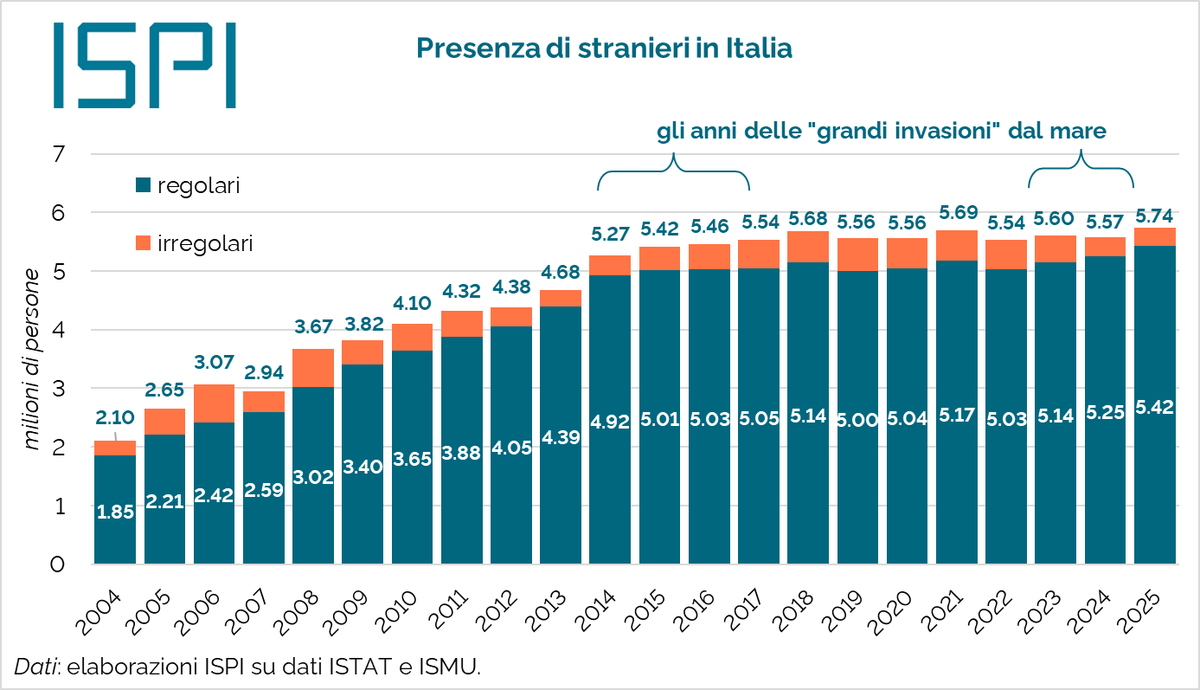
⛔️🇮🇹 Malgrado due periodi di "grandi invasioni" dal mare (almeno così ce le hanno raccontate), sono ormai più di dieci anni che il numero di stranieri presenti in Italia non aumenta.
E anche quest'anno, saremo invasi l'anno prossimo. ❤️
Conservatives are celebrating Trump's Executive Order to erase gender identity as the basis for any law or policy and replace it exclusively with biological sex.
This comes in response to years of liberals trying to erase sex as the basis for any law or policy and replace it exclusively with gender identity.
Both approaches are wrong. While the "sex only" approach will solve some of the problems created by the "gender only" approach, it will create a different set of problems.
Why? Because while biological sex and gender identity are related (and sex greatly informs gender identity), they are not the same. They are distinct concepts, they both exist, and they both matter (albeit in somewhat different ways and for somewhat different purposes).
The optimal solution to maximize happiness for everyone in society is to decide certain societal policies based on sex, others based on gender identity, and others still on a combination of both.
We're not ready to get to this more nuanced position just yet. After existing for some time in one extreme, society often over-corrects by swinging the pendulum too far in the other extreme. We experienced the problems caused by the "gender only matters" extreme, now it's time to experience the problems caused by the "sex only matters" extreme.
It will take some time for all of this to play out, and some people will suffer in the process. But eventually we'll collectively figure out that the truth lies somewhere in between. My hope is that it will happen during our lifetimes.
🚨Our meta-analysis of the motives associated with conspiracy beliefs has been accepted at Psychological Bulletin!🚨“Reasons to believe: A systematic review and meta-analytic synthesis of the motives associated with conspiracy beliefs” https://t.co/vjjZhdLW83🧵👇1/16
Stereotype threat: a once-dominant idea in social psychology that shaped how we think about identity and performance. But what happens when the evidence crumbles? A deep dive into the failed replications, the myths, and what it all means. Read my latest post.
The cumulative incidence of autism diagnosis by vaccination status over fourteen years in over 650,000 children.
The (nonsignificant) association was negative, meaning that vaccination was related to lower rates of autism.
Across five pre-registered studies, Koetke et al. find that perceptions of scientists’ intellectual humility positively affect how trustworthy scientists and their research are perceived.
https://t.co/XhjcFjuYvb
📖A big pay gap between top managers and employees detrimental for well-being at work - Our new study finds that as employees perceive a larger pay gap, they feel less valued, less satisfied, and more disconnected from their organizations.
@BrunoGab92
https://t.co/9V7hgKHhHU
Simple yet effective strategy to deploy survey data toward partisan ends:
1) Take a mainstream right-wing attitude
2) Take an extreme right-wing attitude
3) Show they are correlated (obviously, because they are both right-wing)
4) Claim that 1 is "really" a wrapper for 2
1/
📢📢📢 I’ll be recruiting a PhD student to join my lab at @NYUAbuDhabi starting in Fall 2025! Looking for applicants w/interests in gender, stereotyping and prejudice, & workplace culture. More info below. Please share!
https://t.co/uUs7JMJ1xM
…while less polluted nations tweet more about sustainability and mitigation 🌱. The power of social media in bridging online activism with real-world change is clear. Want to learn more? Check out the full study here: [https://t.co/LTaTIXNMFZ] #ClimateAction#SocialMedia
🌍 How do countries talk about #ClimateChange on social media? In our new study, we analyzed over 19,000 tweets from the height of #FridaysForFuture to uncover global trends. Countries with high pollution often focus on adaptation strategies (or denial 😶)…