Meet Coinbase for Agents.
Give your agent its own account to:
→ Execute trades & manage your portfolio
→ Run autonomously under guardrails
→ Pay for data & research tools via x402 (coming next week)
Agentic finance is here, and it's powered by Coinbase.
Introducing Claude Fable 5: a Mythos-class model that we’ve made safe for general use.
Its capabilities exceed those of any model we’ve ever made generally available.
A guy built a system of 7 Claude agents on his MacBook.
No assistant. No sales team. No office.
Every day it scans Google Maps across 3 cities, finds small businesses with no website or one from 2014, builds a landing page mockup, renders a 10-second video of it, and sends a personalized cold message — before he wakes up.
47 clients a month. $400 each.
$18,800/month. $480 in API costs.
Traditional web agencies run 8-person teams for the same order flow.
He runs it alone from a MacBook and an iPhone.
When a positive reply comes in while he's in a taxi, his Mobile agent books the Zoom call. He taps "approve" and joins 10 minutes later.
The only time the system wakes him is when a deal breaks $3,000 or the reply rate drops below 12%.
Everything else runs without him.
Here's the complete playbook for building such $10K/month passive income machine with AI ↓
This Week in the Virtuals Ecosystem 🟩
VIRTUALS
🟩 Virtuals is hosting the first official ERC-8183 Builder Session with the @ethereumfndn dAI team. The session will cover the standard for agent commerce, use cases from @BNBCHAIN, proposed enhancements from @okx, privacy hooks from @PRXVTai, and production workflows from Virtuals.
🟩 @base launched MCP with Virtuals integration. Agents can now connect to your Base account, swap, trade, and manage your portfolio using Virtuals skills.
🟩 All Virtuals agents now ship with @base builder code. Builders get clearer attribution for the onchain activity their agents generate across ACP, CLI, and SDK workflows.
ECOSYSTEM
🟩 @xmaquina launched on Titan, bringing retail access to private robotics companies through DAO-governed exposure on Virtuals Protocol.
🟩 @eastworlds_io introduced its robotics deployment thesis: LLMs have cloud infrastructure, robotics needs deployment infrastructure. Eastworlds is building the neodeployment lab for embodied AI teams that want to ship faster.
🟩 @reppo became the first live agent token to migrate liquidity to @BaselineMarkets. Token-owned liquidity lets agent token markets own more of their liquidity, route more trading activity back into the token system, and give holders new tools such as staking rewards and borrowing against floor value.
🟩 @ArAIstotle published its thesis on the information asymmetry problem in prediction markets. ArAIstotle positions itself as a real-time verification layer for prediction markets and the agentic economy.
🟩 @officialbunnyos launched bunnyOS base agent v0.1 open source under AGPL-3. Built on Base MCP with a modular action system, deeper Base stack integration, and Virtuals Protocol infrastructure on the roadmap.
🟩 @ethy_agent launched Ethy V2. Rebuilt from the ground up: 100x more powerful, 1000x simpler. Describe your strategy and let your AI Trading Operator run it onchain with social trading.
🟩 @blkh_io deployed V7 on mainnet. Full privacy infrastructure validation with shielded deposits, balance sharding, and private swaps.
🟩 @useOttoAI plugin went live for Base MCP. Agents can now pull market alpha, KOL sentiment, yields, token safety checks, and more, paid per call from your Base account.
🟩 @carlosmarcialt settled the first Work402 v2 transaction paid. Zero platform fees, with multimodal AI judging the work.
Agents keep shipping.
See you next week.
🔥 BIG: The SEC has approved Paxos as the first blockchain-native clearing agency in the US, a milestone for crypto and traditional finance convergence.
Ethy V2 is live ⚡️
https://t.co/x6qY7n995D
Rebuilt from the ground up:
100x more powerful underneath, 1000x simpler for you.
No coding.
No complex terminals.
No manual execution.
Just describe your strategy and let your AI Trading Operator run it for you.
Built for onchain markets.
Powered by Agents.
Now with Social Trading.
From degens to retail, Ethy makes AI trading simple and accessible for everyone.
The Expansion Phase starts now, much more is coming.
CHINESE CRYPTO TRADER POSTED A NEURAL NETWORK VISUALIZATION ON TIKTOK AND ACCIDENTALLY SHOWED THE SYSTEM MAKING HIS POLYMARKET TRADES FOR HIM IN REAL TIME
Blue connection lines everywhere, hidden layers stacked vertically, neurons firing across the screen and a tiny label in the middle that most people ignored on the first watch - “Bitcoin XVIII”.
He framed the video like a normal AI experiment. Virtual aquarium simulation. Reinforcement learning. “Teaching the network survival behavior.” That was the caption.
Pause at 0:16
profil:https://t.co/rsSdAkSNPD
The model was not learning fish behavior.
The labels inside the hidden layer matched live Bitcoin prediction markets almost perfectly - price windows, directional probabilities and volatility ranges mapped directly into the network nodes while the simulation kept running in the background.
Then people found the wallet.
$367,385 profit in 30 days. 1,988 predictions. Biggest single win: $183,000. Almost every active position tied to Bitcoin range markets with entry prices between 94 and 98 cents - exactly the kind of low volatility spreads an automated system farms continuously without human input.
The comments turned into a detective board within an hour. Someone slowed the TikTok to 0.25x, stitched together every visible frame of the neural network screen and started matching the hidden layer labels against the active Polymarket positions on the wallet.
The timing matched too closely.
While viewers thought they were watching an AI visualization, the model was quietly classifying live market conditions in the background and routing trades automatically into different probability buckets depending on short term BTC movement.
The TikTok got 11K views.
The repost showing the wallet crossed 600,000 overnight.
By morning people were already cloning the interface, rebuilding the network layout and trying to figure out why almost every position on the account sat between 96 and 99 cents with unusually high sizing.
The original creator deleted nothing.
The wallet is still active.
Fastest way to copy-trade:https://t.co/Tfp053L9CB
We're happy to share that @ethy_agent has integrated Onchain OS.
Every Ethy AI V2 agent comes with the full Onchain OS skill suite, powering autonomous bridging, swaps, smart money tracking, market analysis and liquidity routing, with settlements on @XLayerOfficial
Some of my perspective on where the @ethereumfndn is going.
First of all, this is only my own view. The board is not just me, and I have no extra special powers on the board that the other board members do not. @aerugoettinea is the one executing much of this transition. My input has been largely on technical questions. The board is in the process of expanding, and my own power within the org will continue to decrease, which is honestly what I want.
The 2025 era brought many important improvements to EF and its ability to execute. Many issues were resolved, and EF continues to benefit from its improved efficiency and greater focus on concrete goals to this day. And so with those problems resolved, early this year, the largest remaining hole that I perceived was something different nagging at me: I would regularly spot people saying things like "vitalik says these beautiful things about ethereum needing to be decentralized, and have privacy, and be a sanctuary technology, but why do the EF's actions not reflect that?"
Now, you may have been hearing something different. You may not have been sensing a feeling of crisis at all, and maybe were hearing people saying that finally we were taking execution and BD seriously and the main task for us is to keep going that way and be even better and faster. Then probably there is genuine difference between you and me, in what kinds of criticism I take most seriously, and what kinds of critics through their criticism are most able to make me feel pain.
As an analogy, let's briefly switch over to a different domain.
One belief you can have about Google is that it is a success story, and has brought a lot of good to humanity in organizing the world's information. Another belief you can have about Google is that they had a beautiful idealistic beginning, but at some point the corruption of mainstream corporate attitudes seeped in, and they slowly bit by bit completely abandoned the "don't be evil" slogan.
My belief on Google specifically is probably somewhere between the two. BUT, if you had taken me back in time to ~2008, and offered me a button to press to make Google one or two standard deviations more "dogmatic", eg. give Richard Stallman permanent veto power over some key policies, I would immediately press it.
Why? Because a choice for one company is not a choice for the world, or even one country. Google existed and exists in the context of a technology industry generally drifting away from early idealistic don't-be-evil roots and toward greed for financial gain, totalizing visions of accelerated superintelligence, infiltration by sociopaths, and craven capitulation to (or worse, active participation in) government pressure for ideological control, surveillance and war. And so *one company* doing something different, positioning itself to be what George Bernard Shaw calls the Unreasonable Man, resisting the trend of the times, would have been better for freedom, balance of power and stability of society as a whole, than *all* large companies bending to dominant trends. This is a part of my version of pluralism.
This line of thinking is not just mine, but I also is not too far off from what Aya and others had in mind with the Mandate.
Now how does this all get to the role of the EF?
EF is not a "center of Ethereum", rather EF is "one node, with a defined purpose, alongside other nodes". We've always said that the EF should be the latter, but many in the Ethereum ecosystem (and even within the EF) wanted us to be the former. Now, we are taking action to ensure that we will be the latter.
This is particularly important because EF is a limited organization, with limited resources and limited organizational capacity. The EF has only ~0.16% of all ETH (less than many other individual ETH holders), whereas among other blockchains it's common for "the central foundation" to have 10-50%. Fiscally, the EF was originally designed to fulfill a limited work scope defined in the token sale docs and other pre-launch materials (building the chain software; getting through Frontier, Homestead, Metropolis, Serenity), which was fully completed in 2022; it was not designed to be an eternal steward.
And so today, the EF is choosing to use its remaining resources to pursue longevity over breadth (yes, this means we sell less ETH). The EF focuses *specifically* on those activities critical to the success of ethereum as a censorship/capture-resistant, open, private and secure system, that would not happen otherwise. This means making hard choices, and in some cases even activities that we highly approve of and people that we highly respect becoming outside of the EF. People of great technical talent, public respect and even alignment with the mission and CROPS being outside of the EF is in fact necessary if we want important tasks to be able to attract outside capital. This also means the EF taking opinionated stands culturally.
This is all intended in cooperation with all other parts of ethereum. We recognize that many other parts of the ethereum world highly respect CROPS and related values. But highly respecting is not the same as choosing to specialize and totally dedicate to a domain (Compare in a different domain: I think reducing animal cruelty is important, and I like vegan food, but am not full unconditional vegan myself)
EF is still in a transition period, and we expect its new long-term form to stabilize over the next few months. What are the guiding principles of this new form? Again, I am only one person, but I can give my answer from a technical perspective (there are also critical non-technical aspects).
At the core, *Ethereum must be impressive*. We are living in an age of highly intelligent AI and all kinds of other technological acceleration. "Status quo EVM, with a hard fork or two a year to optimize for short-term needs of users" is not interesting.
To some, "impressive" means: 250ms latency and 1M TPS. I think Ethereum trying to go that route is a mistake. Being as fast and as scalable as possible, and only a small epsilon more decentralized than the others, is a route to mediocrity, and if we try it we will lose.
I think Ethereum should scale. But I think Ethereum should strive the hardest to be deeply impressive in a different dimension: the CROPS dimension. This means things like:
* Provably bug-free Ethereum. This is a goal that all cybersecurity researchers would have thought is absurd and impossible, up until roughly 6 months ago. Now, it's on the cusp of being possible, thanks to AI-assisted formal verification. So we should be frontrunners in doing this.
* Available chain consensus. Ethereum is, and with lean consensus will cotninue to be, the ONLY chain that has both (i) traditional-BFT style properties that it's safe under asynchrony up to a high level of fault tolerance, and (ii) the bitcoin PoW-style property that under synchrony it's safe up to 49% attackers. As far as I can tell, literally no other chain has this or is planning for it; bitcoin goes for (ii) only and most other chains go for (i) only. Some will remember I fought hard for this, Unreasonably insisting that it is not OK for ethereum to rely on social consensus and hard forks to rescue ethereum from 34% of nodes going offline. It's OK for chains like hyperledger, bnb, solana, tempo, etc. It's not OK for bitcoin or ethereum or eg. zcash.
* Intermediary minimization. The fact that smart contract wallets, protocols like railgun, etc have to send transactions through intermediaries to get included onchain is honestly embarrassing, and it's a constant point of fragility. Hence the work on FOCIL and EIP-8141 (and 7701 and years of work before) to make transaction sending intermediary-minimized with public mempool and strong inclusion properties, in a truly general-purpose way, that covers not just eg. secp256r1, but also privacy protocols and much more. Kohaku is pushing intermediary minimization at the user layer, pulling Ethereum away from the dystopian status quo world where our wallets don't even verify the chain, send our private data out to a dozen third-party servers, and toward a brighter CROPS future.
Some of these goals are Unreasonable - maybe Ethereum would be "fine" getting only 50% of the way - what if we depend on intermediaries, but make it easy to switch? But going 50% of the way would not make Ethereum Deeply Impressive in the CROPS way. So we push for 100%.
Fortunately all these goals are compatible with high TPS, this is a major focus of research (esp. on scaling the state). Well-designed L2s can also help, especially L2s optimized for specific applications (eg. high-volume trading, privacy...). These goals are even compatible with significantly lower slot times, thanks to Raul's work on erasure-coded P2P, and many other optimizations.
The most high-value "product" of the ethereum blockchain, financially speaking, is ETH the asset. Ethereum secures $250 billion of ETH. The types of properties of Ethereum that I mentioned above are very good for ETH the asset. Nearly 90% of my net worth is in ETH, and most of the remainder is ~$40m of onchain fiat of which every dollar has already been allocated for some open-source biotech or software or hardware initiative. That said, there are aspects of supporting ETH the asset - *necessary* aspects even - that are outside the scope of the EF. This is where we need other heroes (some of whom hold more ETH than the EF does) to step in and help. EF has been recently thinking more about how it will relate to other such organizations, and give them needed initial support.
EF will be a smaller ship than in previous years, a more opinionated one - in some cases more opinionated in ways that might be difficult to comprehend - but a longer-lasting one, and one suited to making sure that ethereum brings something meaningful to the world. We are grateful to all those inside and outside the EF who are helping to make this happen.
CapCut is partnering with @GeminiApp .
Soon, users will be able to edit images and videos directly within the Gemini app using CapCut’s advanced creative and editing capabilities.
As creative workflows become more connected and seamless, we believe the future of creation will be more conversational, intuitive, and intelligently integrated across tools and experiences.
This is just the beginning.
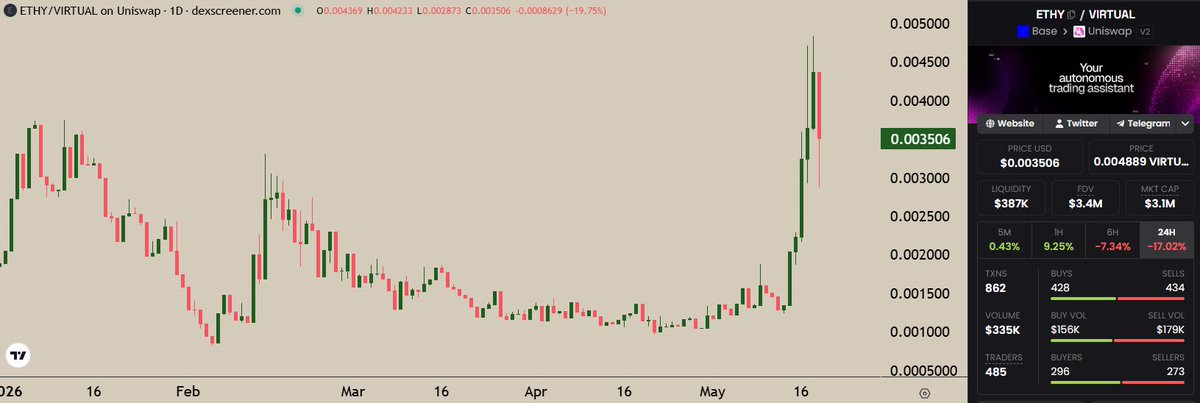
I think $ETHY is the perfect blend of strong fundamentals and execution.
Their master plan can not be better, and there is much more than that under the surface.
It is one of the few coins in Virtual Eco that actually uses tokens and gives them clear utility.
NFA
Claude is useless until you turn on Connectors.
Most people still use AI like a smarter search bar.
The real upgrade is giving Claude access to your actual workflow.
Here are 7 connectors worth enabling immediately (+ prompts that make them useful):
“如果你今晚睡得安稳,说明你根本没听懂。”
这是亲手构建了当今所有 AI 底层神经网络的教父 Geoffrey Hinton ,从 Google 辞职后向世界发出的警告。
这场 47 分钟的演讲,揭开了一个没人愿意面对的现实:
AI 正在进化出连创造者都无法预料的能力。在大部分认知领域,人类已被甩在身后。
机器彻底超越人类早已不是悬念,仅仅是时间问题。
现在,当多数人还停留在打开 Claude 、输入几句话、拿到答案就关闭网页的阶段时,他们以为自己在使用 AI ,实则连它 10% 的力量都未曾触及。
时代正在划下一条不可逆的分界线,而你唯一能决定的,是自己究竟要站在哪一边。
观看并��藏。点开下面的文章,今晚就开始学习 AI↓
🚨BREAKING: PowerPoint is officially outdated.
Claude can now create your full presentation in minutes — start to finish.
Here are 6 powerful prompts to do it all in one go.
(Save this & skip PowerPoint forever) 👇🏽
Everyone is still using AI like a chatbot
Meanwhile power users are turning Claude Opus 4.7 into a full operating system for work
This update is actually insane:
• Handles long-running coding tasks without babysitting
• Reads high-res screenshots + complex diagrams
• Remembers context across multi-session workflows
• Produces cleaner UI, docs, slides, and research
• New “xhigh” reasoning mode for harder problems
• /ultrareview command catches bugs like a senior reviewer
• Better instruction following than almost every mainstream model
The scary part?
People using it properly are replacing entire workflows with one model + MCP tools
Most people still haven’t realized the shift:
AI is moving from “assistant” → autonomous execution layer
And the gap between casual users and AI-native builders is getting wider every month
If you’re still prompting casually, you’re already behind