Google is raising $80 billion of equity a week before SpaceX is trying to raise $75 billion a few months before Anthropic and OpenAI are trying to raise $100 billion from investors and you’re laughing???
This is a cataclysmic exit liquidity avalanche
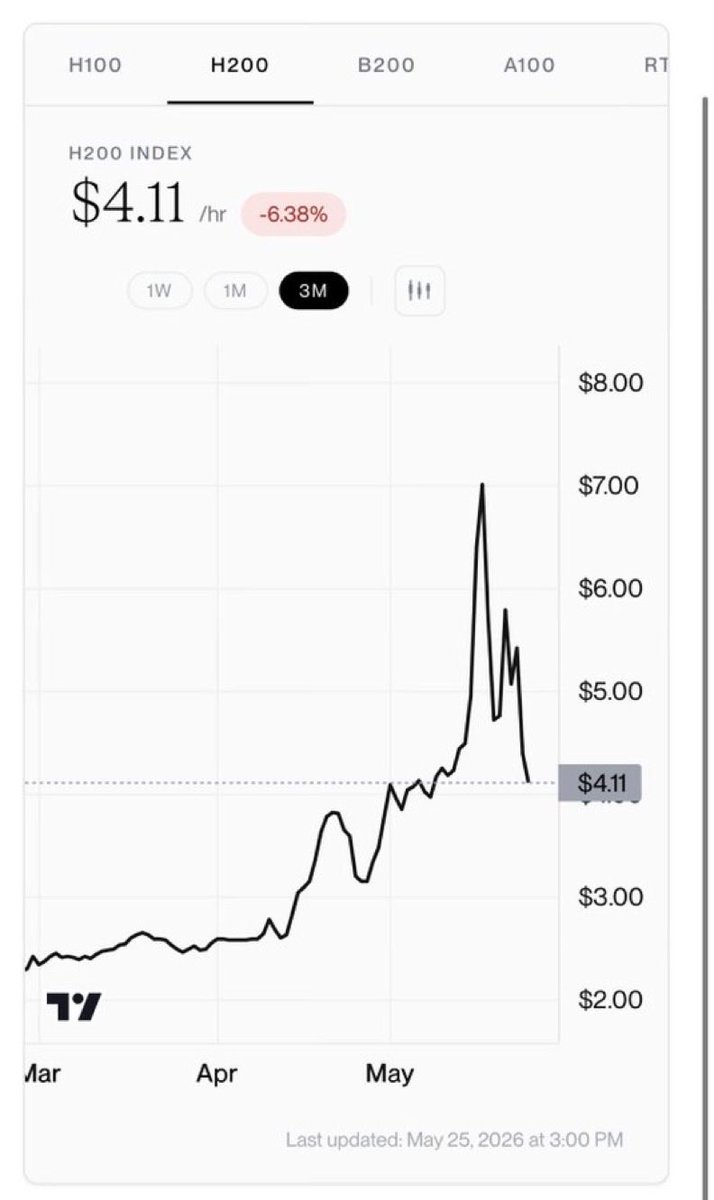
The price to rent an Nvidia H200 just collapsed from $7/hr to $4/hr in three weeks.
A -40% drop in the cost of the single most strategic asset in tech.
When the underlying commodity that powers your entire thesis loses 40% of its value in a month, that usually means one of two things: supply finally caught up, or demand was never as deep as the headlines said.
Either way, somebody is selling.
So why is the AI trade still pricing in scarcity?
We welcome today’s CFTC actions: approval of the first U.S.-listed perpetual derivatives contract, an accompanying Commission policy statement on the listing of perpetual derivatives, related interpretive guidance and no-action relief from the Market Participants Division, and a Staff Advisory on 24/7 Trading, Clearing, and Settlement, as a long-overdue acknowledgment that perpetual derivatives are a legitimate and essential tool for price discovery and risk management.
For too long, regulatory ambiguity drove these markets offshore, depriving American traders and institutions of access to regulated venues and undermining U.S. competitiveness in the global derivatives markets.
Today’s actions chart a new path forward. We look forward to engaging closely with the Commission to ensure that the framework it develops is workable not only for centralized intermediaries, but for the onchain protocols where the most significant perpetuals activity actually occurs.
will keep saying this over and over and over
There are 4 outcomes
Big win
Small Win
Small Loss
Big Loss
Your job is just to eliminate #4. You will have good trades, and bad trades. but as long as you eliminate the big losses, the other 3 outcomes will lead to consistent growth over time. Our decisions compound with time.
We will have both ups and downs. That's unavoidable bc we all make mistakes. But the goal is just to have higher lows and higher highs consistently. You might have a 20% win here, and a 5% loss there. Then you move onto the next one. It always comes down to probabilities and just putting ourselves in a position to win.
We just wrapped what began as an 8-hour challenge - and it ran for 200 hours without a failure
Shoutout to the team for the hardcore engineering behind F.03 and the robust Helix models powering it
Great news, retail investors will officially be offered @SpaceX IPO shares!
SpaceX shares will be offered to retail investors through the brokerages of Charles Schwab, Fidelity, Robinhood, SoFi and E*Trade.
"Any purchase of our Class A common stock in this offering through these platforms will be at the same IPO price, and at the same time, as any other purchases in this offering, including purchases by institutions and other large investors." - SpaceX
Yesterday, I was impressed with the ETF inflows doing 4x the daily AF buybacks, but today is on another level!
The two HYPE ETF inflows exceeded $25M today. That is almost as much as the total cumulative amount of inflows prior to today since they launched.
The last time HYPE was $50:
- BTC was $125K
- ETH was $4600
- SOL was $235
- HIP-3 didn’t exist
- HIP-4 didn’t exist
- PURR wasn’t bidding HYPE
- HYPE ETFs didn’t exist
- Circle wasn’t giving HL 90% of their USDC yield
- People assumed team unlocks was 10M HYPE tokens monthly
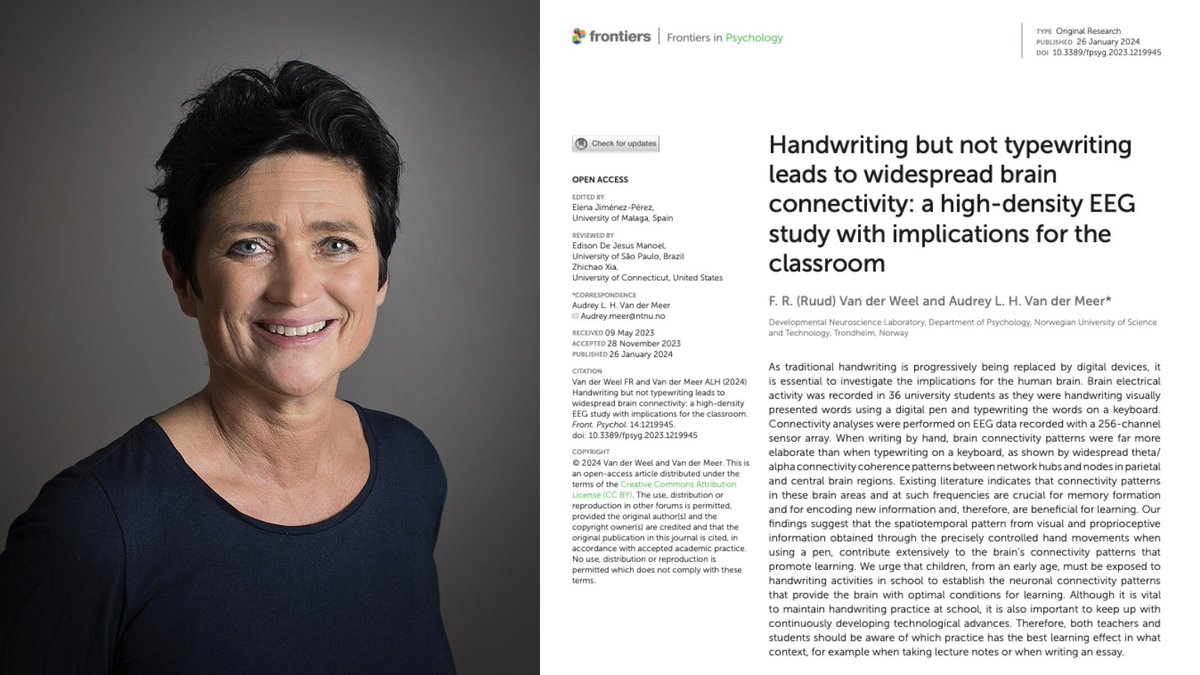
A Norwegian neuroscientist spent 20 years proving that the act of writing by hand changes the human brain in ways typing physically cannot, and almost nobody outside her field has read the paper.
Her name is Audrey van der Meer.
She runs a brain research lab in Trondheim, and the paper that closed the argument was published in 2024 in a journal called Frontiers in Psychology. The finding is brutal enough that it should have changed every classroom on Earth.
The experiment was simple. She recruited 36 university students and put each one in a cap with 256 sensors pressed against their scalp to record brain activity. Words flashed on a screen one at a time.
Sometimes the students wrote the word by hand on a touchscreen using a digital pen, and sometimes they typed the same word on a keyboard. Every neural response was recorded for the full five seconds the word stayed on screen.
Then her team looked at the part of the data most researchers had ignored for years, which is how different parts of the brain were communicating with each other during the task.
When the students wrote by hand, the brain lit up everywhere at once.
The regions responsible for memory, sensory integration, and the encoding of new information were all firing together in a coordinated pattern that spread across the entire cortex. The whole network was awake and connected.
When the same students typed the same word, that pattern collapsed almost completely.
Most of the brain went quiet, and the connections between regions that had been alive seconds earlier were nowhere to be found on the EEG.
Same word, same brain, same person, and two completely different neurological events.
The reason turned out to be something nobody had really paid attention to before her work. Writing by hand is not one motion but a sequence of thousands of tiny micro-movements coordinated with your eyes in real time, where each letter is a different shape that requires the brain to solve a slightly different spatial problem.
Your fingers, wrist, vision, and the parts of your brain that track position in space are all working together to produce one letter, then the next, then the next.
Typing throws all of that away. Every key on a keyboard requires the exact same finger motion regardless of which letter you are pressing, which means the brain has almost nothing to integrate and almost no problem to solve.
Van der Meer said it plainly in her interviews.
Pressing the same key with the same finger over and over does not stimulate the brain in any meaningful way, and she pointed out something that should scare every parent who handed their kid an iPad.
Children who learn to read and write on tablets often cannot tell letters like b and d apart, because they have never physically felt with their bodies what it takes to actually produce those letters on a page.
A decade before her, two researchers at Princeton ran the same fight using a completely different method and ended up at the same answer. Pam Mueller and Daniel Oppenheimer tested 327 students across three experiments, where half took notes on laptops with the internet disabled and half took notes by hand, before testing everyone on what they actually understood from the lectures they had watched.
The handwriting group won by a wide margin on every question that required real understanding rather than surface recall.
The reason was hiding in the transcripts of what the two groups had actually written down.
The laptop students typed almost word for word, capturing more total content but processing almost none of it as they went, while the handwriting students physically could not write fast enough to transcribe a lecture in real time, which forced them to listen carefully, decide what actually mattered, and put it in their own words on the page.
That single act of choosing what to keep was the learning itself, and the keyboard had quietly skipped the choosing and skipped the learning along with it.
Two studies. Two countries. Same answer.
Handwriting makes the brain work. Typing lets it coast.
Every note you have ever typed instead of written went into your brain through a thinner pipe. Every meeting, every book highlight, every idea you captured on your phone instead of on paper was processed at half depth.
You did not forget those things because your memory is bad. You forgot them because typing never woke the part of the brain that would have made them stick.
The fix is the thing your grandmother already knew.
Pick up a pen. Write the thing down. The slower road is the faster one.
Every economy in the world has a very clear choice right now:
1) hike and push their economy into a recession, in which case China hollows out more of that country's industrial base
OR
2) Blow up this bubble even further
Every country will choose #2. You would do the same if you were in their shoes
Biggest IPO in modern finance about to get 24/7 price discovery before the S-1 even goes public.
SpaceX targeting $1.75t, $75b raise. that's 2.5x saudi aramco's book, the current record holder.
$cbrs was just the test. Tradexyz's pre-ipo perp predicted $270-$350. cerebras ipo'd at $185, opened at $350 day one, peaked at $386. the top of the perp's range was literally the open tick. $280m in 24h volume, 9th most traded asset on the venue. that was a chip company. Now apply the same mechanism to the most followed private company on earth.
Every starship launch, every starlink milestone, every elon tweet now has a tradable instrument with deep liquidity that doesn't gate on accredited status. funding rate becomes the default sentiment indicator for a $1.75t asset that public markets can't trade yet. Everyone is going to discover hyperliquid by accident.
Ventuals trades on valuation in billions. tradexyz trades on share price with auto-conversion to a standard perp at listing and twap settlement if the listing slips. structurally cleaner for the ipo arc, which is exactly the arc spacex is on.
This is the listing that turns hyperliquid into the default pre-ipo price discovery venue.
Hyperliquid
Welcome to the most asymmetric trade in modern financial history.
The thread below lays out why. The opportunity exists because capital has chased the AI trade while ignoring the physical assets AI requires to run — assets that have quietly become the best-performing asset class of the decade. Since October 2020 when we first called for the commodity super cycle: QCI Total Return +217%, GSCI Total Return +205%, Gold +140%. NASDAQ trails at +130%. S&P 500 at +85%. The top three are all commodities. Yet oil cannot get out of its own way while copper and the broader atom complex prints fresh highs . That is the dislocation. That is the trade.
Get long. Buckle in. Hang on for the ride.
Forgive the longer posts in this thread — attempting to mimic my old 10-bullet commodity takes. On to it.
Elon completely stole the banquet 😂
He was already posing for someone else when Xiaomi CEO Lei Jun walked up to his idol asking for a selfie
Elon instantly poses with the funniest face
does the same funny expression with Apple CEO Tim Cook too
Now Elon became the MAIN attraction across Chinese media and the entire world 🤣
The more I think about this Coinbase partnership, the more I believe it is Hyperliquid’s biggest announcement all year.
Stablecoin yield is the largest revenue source in the industry next to trading fees and Hyperliquid is now the first blockchain to internalize both.
This is a fundamental transformation of Hyperliquid as a business.
Yield sharing enables Hyperliquid’s revenue to scale more directly with deposits, rather than just trading volume. And because deposits tend to be stickier than volumes in downturns, this could make Hyperliquid’s buybacks more resilient across cycles.
For example Hyperliquid stablecoin deposits are currently only down 15% from ATHs compared to monthly volumes down 55%.
Zooming out, there’s currently ~$80B in stablecoins deposits on Binance, Okx, and Bybit compared to ~$5B on Hyperliquid.
It doesn’t take crazy share gains or sector wide growth for the revenue numbers from yield sharing to get crazy for $HYPE.
Think $300M - $500M in incremental run-rate revenue from yield sharing is achievable within next 12 months, and billions in the years beyond as the cryptoeconomy reaccelerates.
Hyperliquid.
Der 100-Jahre-Plan für den Aktienmarkt
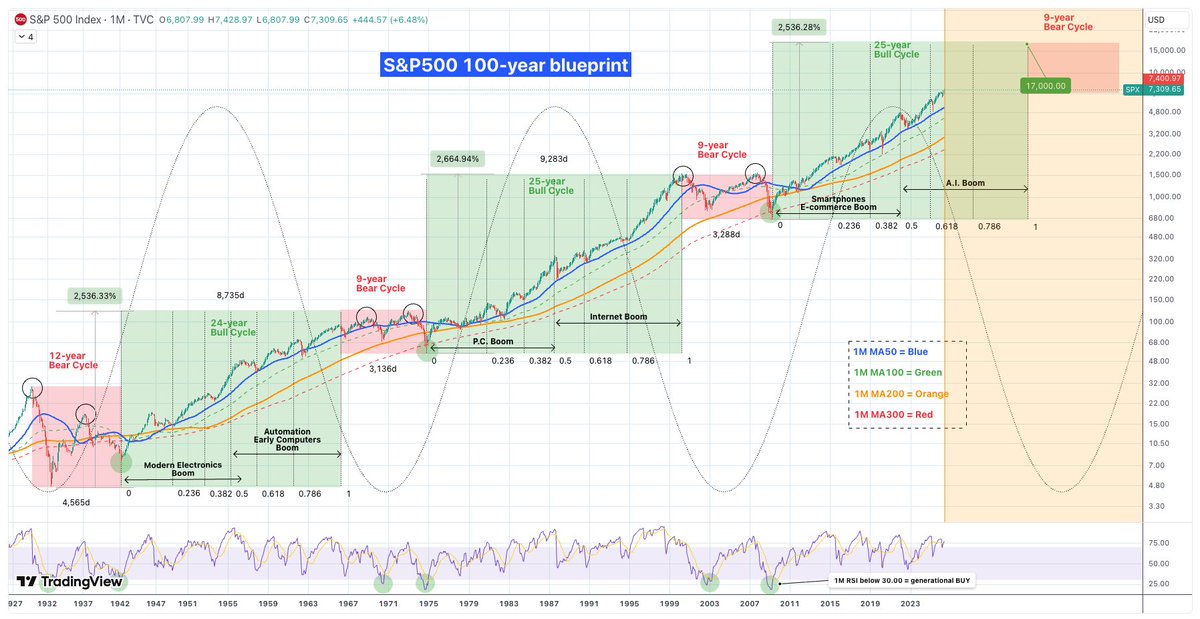
Wenn du dir die letzten 100 Jahre anschaust, siehst du ein klares Muster: Der Markt wiederholt immer wieder die gleichen Zyklen. Seit der Großen Depression 1930 gab es drei große Abwärtsphasen und drei Aufwärtsphasen .
Wir stecken gerade mitten im dritten großen Bullenmarkt.
Die schlechten Zeiten (Bärenmärkte)
Diese Phasen dauerten meistens etwa 9 Jahre (die Weltwirtschaftskrise von 1930 war mit 12 Jahren eine Ausnahme). Ein typisches Zeichen war, dass der Markt zweimal oben und zweimal unten „anklopfte“, bevor es wieder aufwärts ging. Oft krachte der Kurs bis zu einer bestimmten langfristigen Linie (dem 300er-Schnitt im Monatschart) und startete von dort aus neu durch.
Die guten Zeiten (Bullenmärkte)
Die ersten beiden großen Aufwärtsphasen dauerten jeweils 24 und 25 Jahre. Das Spannende: Sobald der Markt einmal Fahrt aufgenommen hatte, fiel er fast nie unter eine bestimmte grüne Linie (den 100er-Schnitt). Die blaue Linie (50er-Schnitt) war dabei immer die beste Chance, um günstig nachzukaufen, wenn es mal zwischendurch ruckelte.
Warum steigt der Markt so extrem?
Hinter jedem Bullenmarkt steckt eine neue Technologie:
Früher waren es industrielle Durchbrüche.
Dann kam der Internet-Boom.
Heute erleben wir den E-Commerce- und Social-Media-Boom.
Klar, irgendwann platzen diese Blasen immer, weil die Leute übertreiben. Aber die Technik bleibt! Das Internet ist nicht verschwunden, nur weil die Kurse im Jahr 2000 abgestürzt sind – es wurde zum Fundament für alles, was wir heute nutzen.
Der KI-Boom
Wir sind jetzt im zweiten Teil des aktuellen Aufschwungs, und der wird von der Künstlichen Intelligenz getrieben. Wahrscheinlich wird diese Blase um das Jahr 2034 platzen. Das wird wehtun, aber danach wird KI das feste Rückgrat unserer gesamten Wirtschaft sein.
Im Grunde sind die letzten 100 Jahre eine Kette von Erfindungen, die die Kurse immer höher treiben. Die Abstürze zwischendurch sind nur dazu da, die heiße Luft rauszulassen und Platz für neues Geld und die nächste Technologie zu machen.
Was bedeutet das für dich heute?
Wenn dieser Zyklus so läuft wie die letzten beiden, könnte der S&P 500 bis auf 17.000 Punkte steigen.
Es wird zwischendurch immer wieder Korrekturen geben. Der Zoll-Crash Anfang 2025 war so ein Moment, hat aber die wichtige blaue Linie nicht ganz berührt.
Schau auf den RSI-Anzeiger. Wenn der unter 30 fällt, ist das eine Chance des Jahrzehnts. Das ist in 100 Jahren erst sechsmal passiert – und jedes Mal war es der perfekte Zeitpunkt zum Kaufen.
Liken, Folgen, Speichern, Kommentieren, Teilen.
Danke für den Support 🫶😊🫶
Everyone is arguing about $USDH dying. They're missing the point entirely. What happened today is the single most important business move in Hyperliquid's history.
Let me explain. Revenue, liquidity, politics, lobby, and what it means for the USDH vote debate.
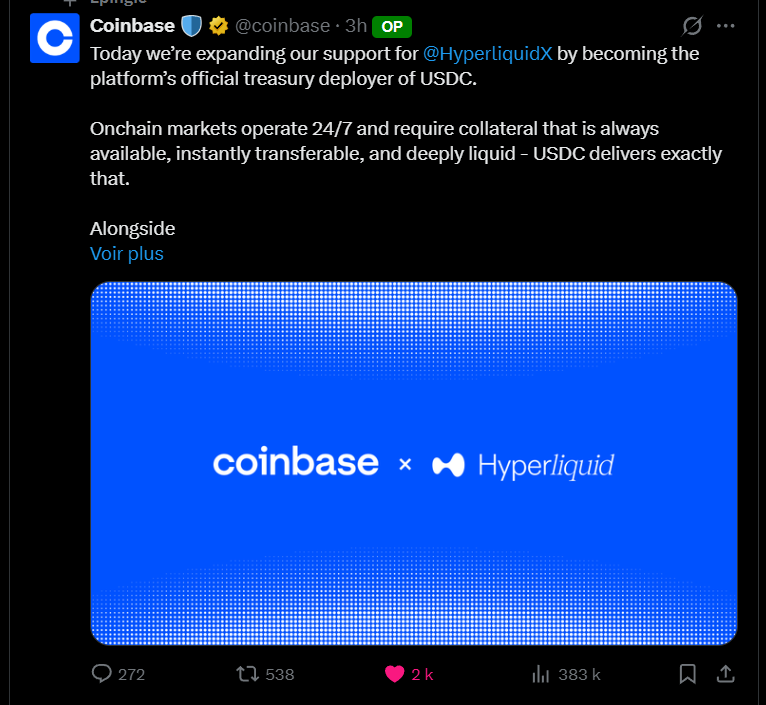
Coinbase is now the official treasury deployer of $USDC on Hyperliquid under AQAv2. Circle handles the technical side (CCTP, cross-chain infra). Both are staking hyperliquid:native. Native Markets agreed to sell the USDH brand assets to Coinbase.
$USDH is sunsetting. But the mechanics it pioneered are not. They just got applied to a $4.7B asset instead of a $100M one.
Let's break down why this is a win on every single front.
LIQUIDITY
The biggest complaint from traders and builders for months: fragmentation. $USDH had the alignment but not the liquidity. $USDC had the liquidity but not the alignment. You had to choose.
That choice is gone. One stablecoin. One orderbook per pair. No split liquidity. No confusion for HIP-3 deployers picking a quote asset. No friction for new users bridging in.
$4.7B in USDC on Hyperliquid, 2x year over year. That is the base generating yield now, not $100M.
REVENUE
Under AQAv2, the treasury deployer shares 90% of the reserve yield revenue with the protocol. Run the numbers on the current $USDC supply:
$4.7B at 3.8% interest rate, 90% shared with the Assistance Fund = $160M+ per year flowing directly into HYPE buybacks. That is $440K per day. Every day.
For context, USDH at peak supply was generating a fraction of this on $100M. The AQA model worked. It just needed to be applied at the right scale.
POLITICS AND LOBBYING
This is the angle most people are sleeping on. Coinbase is the largest publicly traded crypto company in the US. They spent over $100M on crypto lobbying and political action in the last cycle. They are the single most powerful voice for crypto regulation in Washington.
The CLARITY Act markup is happening today. Coinbase has been one of its strongest advocates. Having them financially aligned with Hyperliquid, staking HYPE, operating as treasury deployer, is not just a liquidity play. It is a regulatory shield.
Every conversation about "is Hyperliquid a US regulatory risk" just got a lot harder to make when Coinbase is literally staked into the network.
Circle staking 500K HYPE and moving toward becoming a validator. Jeremy Allaire posting "Hyperliquid." That is institutional endorsement at the highest level.
THE USDH QUESTION
"Was USDH a failure?" "Was the vote theater?" "Did Native Markets just flip an asset?"
No. USDH was a weapon. It was a credible threat that proved a protocol can demand yield sharing from stablecoin issuers. Before USDH, Hyperliquid had $5B+ in USDC generating $150-200M/year for Circle and Coinbase. The protocol saw none of it.
USDH launched. The AQA model proved that yield can be redirected onchain, transparently, back to the protocol. It only reached $100M in supply but that was never the point. The point was forcing incumbents to the table.
Basit said it best: the entire lifecycle of USDH from launch to sunset should be studied. Coinbase didn't come to Hyperliquid out of goodwill. They came because USDH proved they would lose the venue if they didn't align.
"But Paxos offered better economics during the vote." Maybe on paper. But 95-100% of a stablecoin that might have also struggled to reach $100M in supply is still less revenue than 90% of $4.7B. The vote was never about picking the best yield split on a small asset. It was about creating the leverage to capture yield on the dominant one.
WHAT THIS MEANS FOR BUILDERS
USDC becomes the canonical quote asset for HIP-4 outcome markets. No more guessing which stablecoin to build around. Hyper Foundation is issuing grants to HIP-3 and HIP-1 deployers who integrated USDH to cover migration costs. Feeless conversions from USDH to USDC during the transition.
For HIP-3 deployers running equity perps, commodity perps, outcome markets: one liquidity pool, one collateral asset, deeper books.
SECOND ORDER EFFECTS
Coinbase operating perps through Hyperliquid via builder codes? Not confirmed, but now structurally possible. Their existing perp product is weak. Hyperliquid's infrastructure is the best in crypto. The incentive alignment is there.
Tether now has a clear path to compete. AQAv2 is an open spec. Any stablecoin issuer can stake 500K HYPE and share yield to become an aligned quote asset. Competition is good.
AQAv2 becomes a blueprint for every other chain. Hyperliquid just proved that a protocol can force the largest stablecoin issuers in crypto to share revenue at the protocol level. No one has done this before.
Hyperliquid.