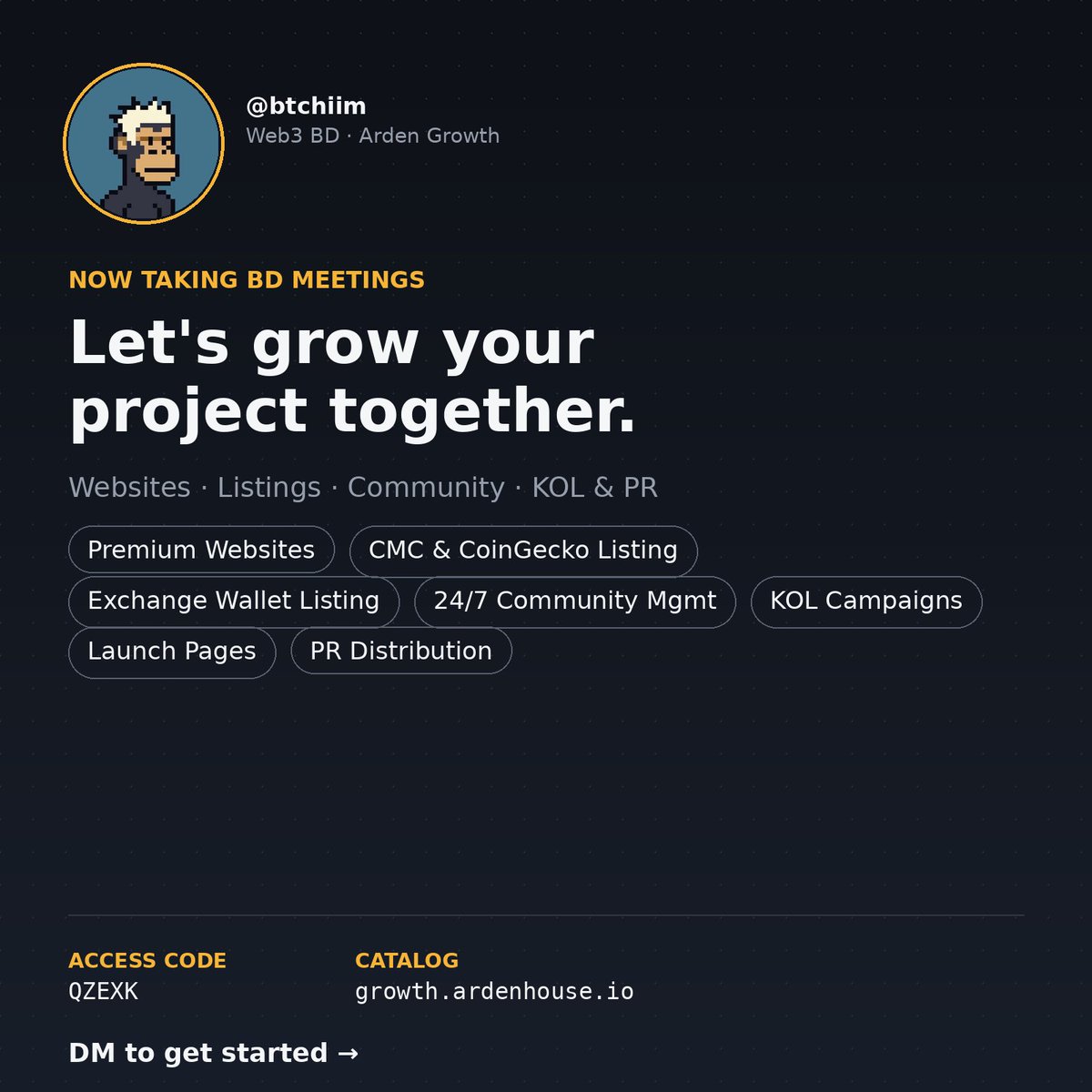
Been quiet on here but time to put you guys on 👀
I’ve moved into BD for @ArdenHouse_ basically the bridge between projects that need real growth infra and the people who build it.
what that means in practice: I work with teams on the stuff that actually moves the needle once the product is live:
→ premium websites that don’t look like every other template
→ CMC & CoinGecko listing (supply verification, corrections, the whole tedious process handled)
→ exchange wallet listings (Coinbase, OKX, Bitget, Binance, Gate)
→ community management that doesn’t sleep
→ KOL campaigns + X Spaces
→ launch pages for TGEs/presales
→ PR distribution
if you’re building something real and any of the above is a gap for you or you know a team that needs it this is your sign to reach out.
Catalog: https://t.co/MPG4C4253B
Access code: QZEXK
let’s build 🫡
Web3 growth teams should pay closer attention to what happens after a campaign brings people in.
Impressions tell you who saw the message. Clicks tell you who showed interest. But activation tells you who actually took the next step.
For example, if a campaign drives traffic to a trading platform, look beyond the number of visitors:
• How many connected their wallets?
• How many explored the actual product?
• How many completed a meaningful first action?
• Where did interested users drop off?
These answers help a team understand whether its marketing is attracting the right audience or simply generating attention.
Growth reporting should connect marketing activity to product behaviour.
Q4 in a nutshell:
- Binance hacked
- Railway hacked
- OpenCode hacked
- European Commission breached
- CNN compromised
- BBC compromised
- CIA system hacked
- PHP exploited
- Apple went down
- Charles Schwab went down
- Microsoft exploited
- AWS went down
- Chrome exploited
- Google Cloud went down
- GitHub compromised
- Cursor hacked
- Coinbase vendor hacked
- Fireworks AI hacked
- SoftBank subsidiary hacked
- Optimizely hacked
- Ledger compromised
- Mercado Bitcoin hacked
- Chainflip hacked
- Keplr compromised
- NEAR Intents exploited
- Kava Lend exploited
- JPMorgan vendors hacked
- Visa vendor hacked
- Mastercard vendor hacked
- TSMC vendor hacked
- Japan Airlines vendor hacked
- FAA grounded flights nationwide
- United Airlines went down
Happy cybersecurity quarter.
And December hasn't even started.
A Web3 launch is not the finish line. It’s the beginning of a much harder phase: maintaining attention.
Before launch, there’s usually a lot happening:
🔥 Teasers and announcements.
🔥 Community building.
🔥 KOL campaigns.
🔥 Partnerships and collaborations.
But what happens after the launch?
Who keeps communicating with users? Who follows up on partnerships?
Who turns early interest into continued product usage?
This is where execution matters.
A strong launch can create attention, but a capable team needs a post-launch growth plan to build on it.
I believe Web3 projects should think about distribution beyond launch day, not just how to make a big entrance.
One thing I pay attention to in Web3 content strategy is the difference between posting consistently and communicating strategically.
A project can post every day and still struggle to build recognition.
Why?
Because content needs direction.
A good content strategy should help people understand:
⚪️ What the project stands for.
⚪️ What problem it is solving.
⚪️ Why its product deserves attention.
⚪️ What makes it different from competing projects.
Not every post needs to promote a feature or announce an update.
Some posts should educate. Others should build trust, explain the vision or create conversations around the product.
The goal isn’t just to keep the timeline active. It’s to make every piece of content contribute to how the market understands the project.