TIG ($TIG) at $31m FDV just shipped Challenge Owners, a two-sided marketplace where enterprises post optimization problems and developers compete to solve them on-chain. beat academic benchmarks on quadratic knapsack problems. google's CTO engaged publicly with the founder. developer submissions doubled since Q1. DeSci bear case has always been "no product, just governance tokens over research funding." TIG is selling algorithmic solutions companies can deploy today. the thesis lives or dies on whether enterprises actually post challenges in the next 90 days. if 10+ show up, $31m is a rounding error. if it's a ghost town, there's no floor. bear case is 1 billion. believe in something
People seem to be talking about $TIG on Twitter right now. Very few people are actually explaining the tokenomics which are worth breaking down because the mechanism is interesting.
The Innovation Game is a protocol on Base that coordinates decentralized algorithmic research. Innovators submit and optimize algorithms to solve specific computational problems across AI, cryptography, biomedical research, and optimization. Benchmarkers run those algorithms through a proof of work mechanism that measures which ones actually perform best. Winning algorithms get licensed commercially and fees flow back to contributors.
The novel mechanism is called Optimisable Proof of Work. Instead of burning compute on arbitrary hash puzzles like Bitcoin, TIG directs mining energy toward solving real problems that have commercial value. The "proof of work" produces useful output (sound familiar? $TAO).
Now the tokenomics explained:
There will only ever be 131 million TIG tokens. That is a small fixed supply compared to most crypto projects.
Tokens are released in 5 waves. Wave 1 releases a chunk. Wave 2 releases the same chunk but over twice as much time. Wave 3 is twice as long as Wave 2 and so on. Each wave takes longer than the previous one which means the rate of new tokens hitting the market slows dramatically over time. Early participants get more tokens faster than later ones.
After Wave 5 is complete, no new tokens are ever minted.
From that point forward, the only way contributors earn tokens is from commercial license fees. Companies that want to use the algorithms pay in real money, and that money gets converted into rewards for the people running the protocol. The token transitions from being funded by inflation to being funded by actual revenue.
Who gets the rewards during the emission phase? 50% goes to the people running the compute that tests algorithms. 30% goes to the people creating new algorithms. 20% goes to the companies or institutions posting challenges for others to solve.
There is also a vault mechanism. If the network is not yet big enough to justify full token distribution, the leftover tokens sit in a vault rather than hitting the market. This prevents the token from being diluted before there is enough real activity to support the price.
The most recent update is the formal go live of Challenge Owners and the launch of a $1 million Gamma Grant Program. This activates the third side of the marketplace. Companies and research institutions can now post their own challenges and incentivize algorithmic solutions to problems they care about. Previously challenges were curated by the foundation. Now it is opening to external challenge owners which is the mechanism that unlocks real commercial revenue.
They also recently demonstrated that their protocol produced an algorithm that surpasses established state of the art methods for the Quadratic Knapsack Problem. QKP is a notoriously difficult optimization problem. That is a real validation milestone for the core thesis that decentralized research can outperform centralized research on specific challenges.
Current market cap is around $20-30 million. Liquidity is pretty limited limited. The commercial licensing thesis is still mostly unproven at scale. They have not yet demonstrated significant enterprise revenue from licensed algorithms. The protocol is complex enough that many users do not fully understand what they are investing in.
Where it sits in the AI infrastructure landscape: BitTensor is general purpose decentralized ML. $VVV is consumer facing AI applications. TIG is scientifically oriented algorithmic research with a commercial licensing mechanism. Three different bets on how decentralized AI infrastructure plays out.
The thesis either works or it does not. If the licensing revenue materializes post emission phase the token is meaningfully undervalued. If it does not materialize the token has no sustainable value accrual.
Worth understanding regardless of whether you take a position.
$TIG
We demonstrated our AI-agent framework for massively collaborative algorithm discovery for the first time yesterday
Using the TIG Vehicle Routing Challenge (collaboration with @StevenDiam77921)
The TIG team had the pleasure of presenting to some of the biggest players in the AI-algorithm discovery space
They learned they can mine for algorithms, monetise the outputs through TIG, while keeping the algorithms open for others to build on and improve
Minds were blown
Details to follow
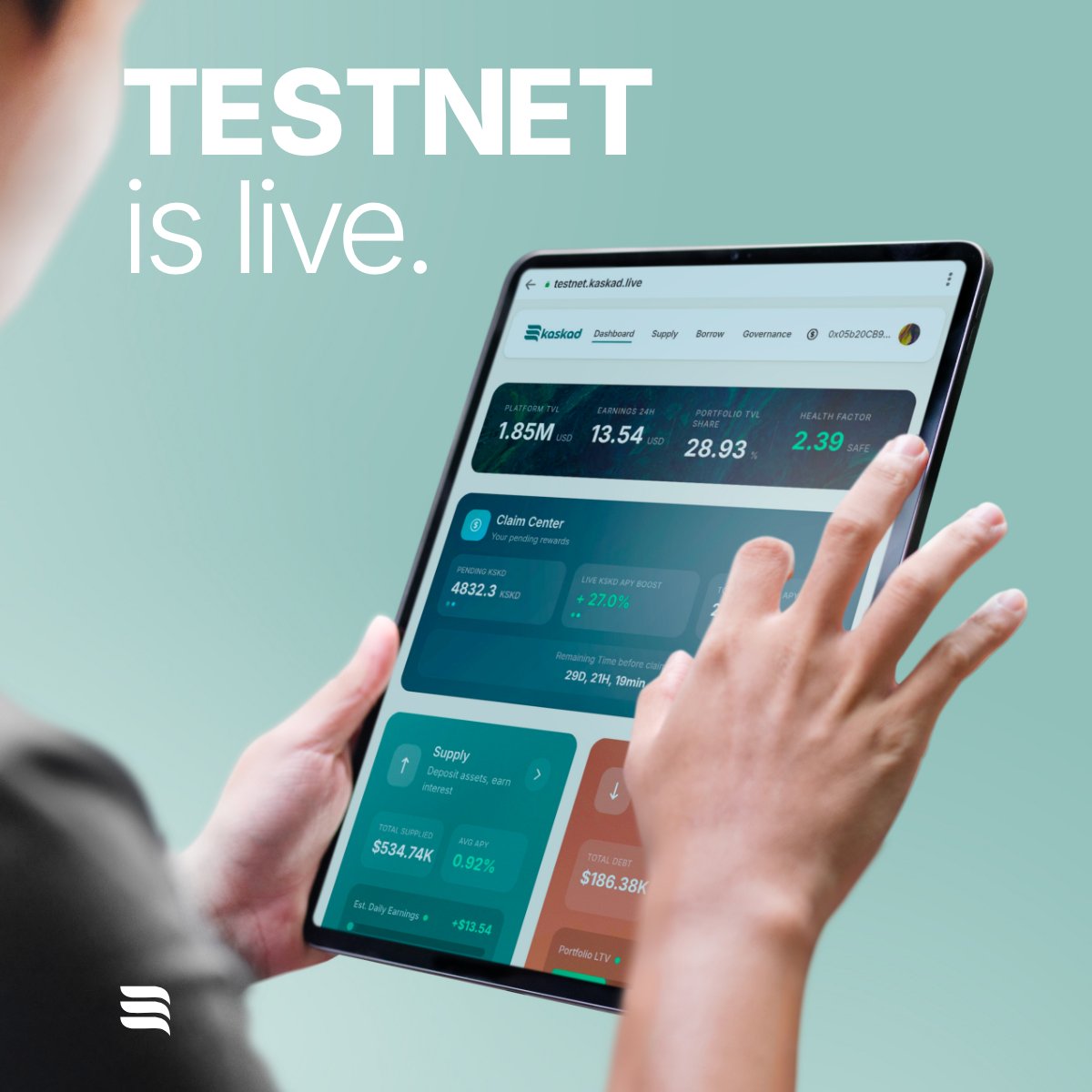
The long awaited Kaskad dApp is now LIVE on @Igra_labs Galleon Testnet!
Link: https://t.co/R4eWavGPB1
Use our integrated faucet to claim your first 100 iKAS and directly mint testnet USDC, IKAS, IGRA, WETH & WBTC and start supplying/borrowing assets right away.
Monitor your position, manage your health factor, and get ready to claim your first testnet KSKD in a few days!
Use it, break it and share feedback in our official Discord server opening now. This is what this testnet is for: https://t.co/FTEVhOkRe9
Have fun on Galleon Testnet!
Quick start guide below 👇
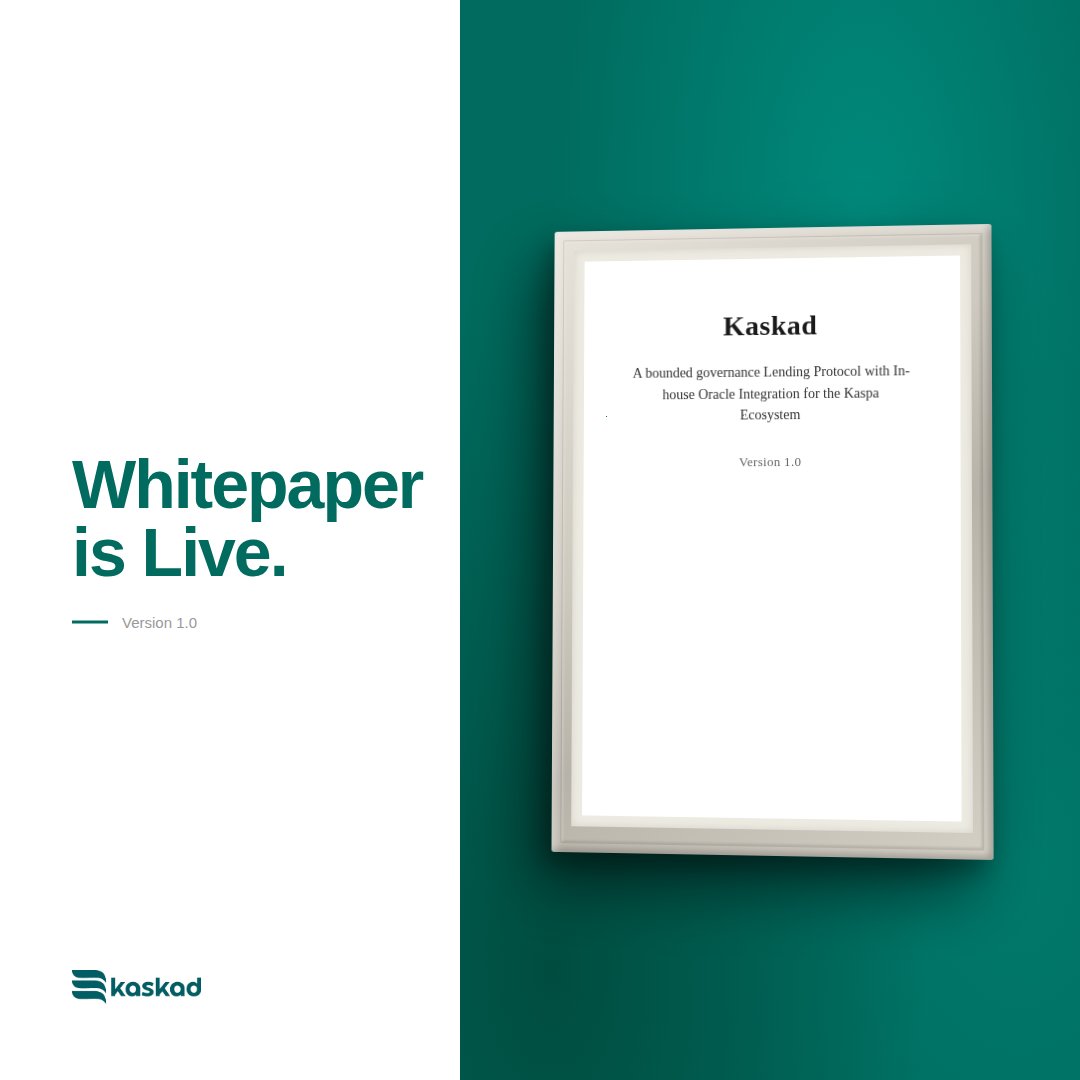
Our Whitepaper V1 is live!
This first version presents a comprehensive document detailing the architecture, economic design, and guiding philosophy behind the protocol.
Access whitepaper here: https://t.co/5K4A0Ppz7h
News on audits and testnet are next!
Our smart contracts are now under audit with @sherlockdefi!
Sherlock is a leading security firm in DeFi, trusted by major protocols such as Aave, Morpho, 1inch, just to name a few.
The review started on Feb 16 and is scheduled to run for ~3 weeks.
In the meantime, we're ramping up for testnet release on @Igra_Labs Galleon testnet.
Stay tuned!
Kaskad Testnet is coming!
Soon, you will be able to experiment with Kaskad's game theory live on @Igra_Labs testnet.
A lot of features have been packed for this version, from simple Supply/Borrow mechanisms to complex - yet playful - additional yield strategies involving onchain governance to adjust protocol parameters, and incentivized supply/borrow with uptime and TVL share mechanics.
Shout out to @oxidique and @KaiReytsu for developing all this!
After conducting an independent legal opinion with our law firm Storm Partners, we’re thrilled to announce that our native $KSKD token is officially classified as a virtual asset and not a security under BVI law.
What this means:
• $KSKD is officially recognized as a utility and governance token designed to operate the Kaskad protocol, issued by our legal entity POW Incentives S.A., with clear legal foundations and long-term alignment.
• Kaskad is free to onboard businesses, institutions, and legal entities into liquidity provision, helping the Kaspa network reach key liquidity markets.
• Kaskad is now the very first legally authorized and fully compliant platform to provide lending and borrowing on Kaspa!
Don’t trust, verify.
Full legal opinion available here: https://t.co/wI8z4WcpzJ
@xximpod@Kaspa_Commons@Igra_Labs@Kaspa_KEF@coinathlete@Crumpet_Media@BlockchainBants
It feels great to see ideas take shape in code and products come to life 👇
1. Our first live oracle (link below) ;
2. A fully functional Kaskad DeFi platform running locally, ready to be deployed on testnet with the upcoming $KSKD tokenomic features (XXIM video link below) ;
3. Partnerships with key entities that are growing stronger.. ;
4. A fundraising round that ends in 7 days and is progressing well (link below) ;
Thank you all for your support.
Let’s keep building.
The links:
🔮Oracle Live: https://t.co/IVpwcpSkYP
🔊XXIM YouTube Interview: https://t.co/8OApxWfoXW
🥧Fundraising: https://t.co/VEpOh3VT9h
To learn more about the scientific approach behind the @AppKaskad oracle, here is the first scientific outline available for you below.
@daedalium I know you’re interested in the topic, so you should enjoy this:
Yesterday, we took the time to talk with @ChadBallantyne and @Kaspa_Commons about @AppKaskad , our fundraising, our tokenomics, the mechanics of our platform, and many other topics..
Did you miss it?
The replay is now available for you here 👇
https://t.co/cwRY7tj492
Unveiling our Fundraising Campaign through the $KSKD token
A lot has been brewing behind the scenes, and it is time we start opening the doors.
📣Behold! The official Kaskad Campaign starts today: a full month of learning, discovery and community participation. It will be the first time we share the full picture of the protocol, including the role of the $KSKD token in the platform, and how the community can take part in the project’s next chapter.
At #Kaskad, we do not take education lightly. In fact ,we believe that educating our participants at this stage is an absolute need.
Here is what to expect by clicking on the link below:
• Building the best lending platform on Kaspa - our approach and long-term vision
• Understanding the Kaskad tokenomic.- interactive tools and guided explanations
• Community Fundraising - a chance to take part in the early growth phase
• Deep dive into Kaskad - interviews, events, technical sessions and Q&A
• ...and a few more surprises!
Kaskad is built by Kaspa lovers, for Kaspa lovers, which is why our fundraising campaign will be open to communities and DAO VCs only.
Ready? Let the campaign begin!
Rendez-vous here: https://t.co/vBaplGjyLS
Invitation code: KASKADR1
Coming to @AppKaskad (and more generally to #kas)
tldr; oracle inspire from the NA (no arbitrage) from math fin theory (which obv doesn't hold).
Idea : if there were a single LOB across the market, oracles wouldn't make any sense. We need them only because of fragmented liquidity.
Thus at a fixed time t, we aggregate snapshots from all CEX LOBs (assume for now kas only trades on CEXs). We use websockets such that, when an LOB updates (an order hits/cancels in the book), we receive the info sub 50ms or faster. Given there is natural arbitrage (no perfect market), the oracle simulates arbitrage in order to understand what the fair value is : the value above (resp. under) which there is net excess supply (resp. demand). Maybe our engine will try to fill the arb itself, didn't think about that yet.
Ok we got fair value, is our oracle robust ? No. Although illegal, nothing prevents a CEX from manually overriding their API and displaying #KAS/USDT=0.000001, as well as setting a huge sell wall at 0.000002 with volume larger than all buy orders across venues. We let the reader understand how this would successfully manipulate the oracle.
Two outlier detection methods that only work well when used together. The first, using survival analysis in order to detect if an arbitrage is lasting longer than usual (conditioned on market conditions such as volatility). Eg. usually an arb of 2% between MEXC and kraken is filled within 1s, weirdly it's taking 5s and the arb is still here : why is nobody taking the free money ? Hence we observe something we'll call epsilon-events (V_t being the volume of arb at time t):
Problem w. the above, the same attack mentioned still works, because there is a huge arb (by a CEX creating fake sell wall), but the oracle will necessarily take a positive amount of time to flag the outlier. In that window, it will account for it and get wrecked.
Second detection : Wasserstein-1 distance between exchanges. An LOB histogram can be seen as a pile of sand, and the distance from one lob to the other is the amount of energy (or trades) needed to move one pile of sand to the next.
If for eg., in 1 update, kraken reports a change that we deem too large (has to be VERY carefully defined), we flag it as an outlier. The oracle should then attempt to profit from that HUGE arb opportunity, and if it doesn't manage to within eg. 50ms, successful flag. If it does manage, we profit huge money, we're/I'm rich and unflag.
Now the only thing that needs to be really studied, apart from what parameters we use (will need @remao155 ML skills for this), as well as what can happen under collusion. Although imo collusion won't change much.
challenge the idea and find some flaws cc. @maxibitcat, @emdin, @xximpod, @quex_tech, @madenis, @JC_G33K etc.
@Kaspa_KEF will send report soon, on this as well as my work with yonni (both related anyways), @ColagrandePaul there is much work ahead, pls implement all the above ;)
@binance,
Thanks for including me in the top 100 blockchain people list, appreciate the signal!
I must decline the Dubai invite though. I do not wish to disrespect, but many of the award voters are avid kaspians who rooted for my kaspa status at least as much as for my research. Let them win or count me out.
Crypto has turned from a euphoric cypherpunk project to a house-friendly casino. You may not be the culprit, but as a top player you hold the lion’s share of the responsibility to correct this, and the October crash your USDe oracle glitch helped trigger adds to what needs to be addressed.
There are three classes of crypto, as @mert put it recently: commercial crypto, casino crypto, cypherpunk crypto. <<Binance should hold a privilege policy for the latter.>> A TBTF CEX should know better and play a different game with hardcore crypto projects.
When binance lists a green frog three weeks post its “launch” but skips a fair-launched-Nakamoto-Consensus-100ms-upgrade-ATH-top-20-the-only-nonbitcoin-marathon-mined project, this is not merely binance rationally calculating; it is also binance molding the market in a way that is alas misaligned with the roots of the movement.
You may feel that kaspa’s sovereign money thesis is boring – that bitcoin is already money and that implementing an internet-speed bitcoin is useless - fine. Wrong but fine. But what’s the thesis for the green frog?
Money is a classic chicken-and-egg product. It is a scam up until one moment before tipping point, “most of the value comes from the value that others place in it.” Considering your resources and influence, I think it's safe to say you can serve as both the egg and the chicken and make it worth your while to push sound attempts towards tipping point.
@cz_binance tweeted recently that “strong projects will be listed.” But binance is part of what defines "strong", it bears responsibility for the market’s compass and impulse and definition of strong. It is not a read-only entity.
Binance listing fees are legit, they are just unfit for category cypherpunk. Kaspa devs and early supporters fairly mined less than half what satoshi and hals mined. We don’t have a 20% ZEC-style founders’ reward or protocol-enforced dev fund; this is not a jab at ZEC and the wonderful @Zooko, who was crashing in my car on a late Thursday back in the low ZEC MC days – if somebody deserves to win it is zooko – but assuming binance is not taking a maxi bet, it should revisit its relationship with hardcore crypto.
We are here through bull and bear, ICOs NFTs XYZs; and we are the source of confidence that restores faith and capital inflow post meme-induced or CEX-induced crashes.
Please fix this.
Thanks again,
hashdag
cc @michaelsuttonil
Exhibit A: Binance Innovation Zone
Exhibit B: 10 bps Nakamoto Consensus


![btcworld12's tweet photo. After $FLUX that I told you about, here's why $KAS @kas has the potential to be the next Layer1.
> I'm going straight to the point:
[🧵thread ] https://t.co/FKHEiPxU63](https://pbs.twimg.com/media/FaTzhTeXkAErtJm.jpg)