@Eric_Erins Supposedly a young Frank Lloyd Wright designed many of the trims in there (including the column capitals) when he was an apprentice in Sullivan’s firm
Scaling finally works for Time Series Foundation Models.
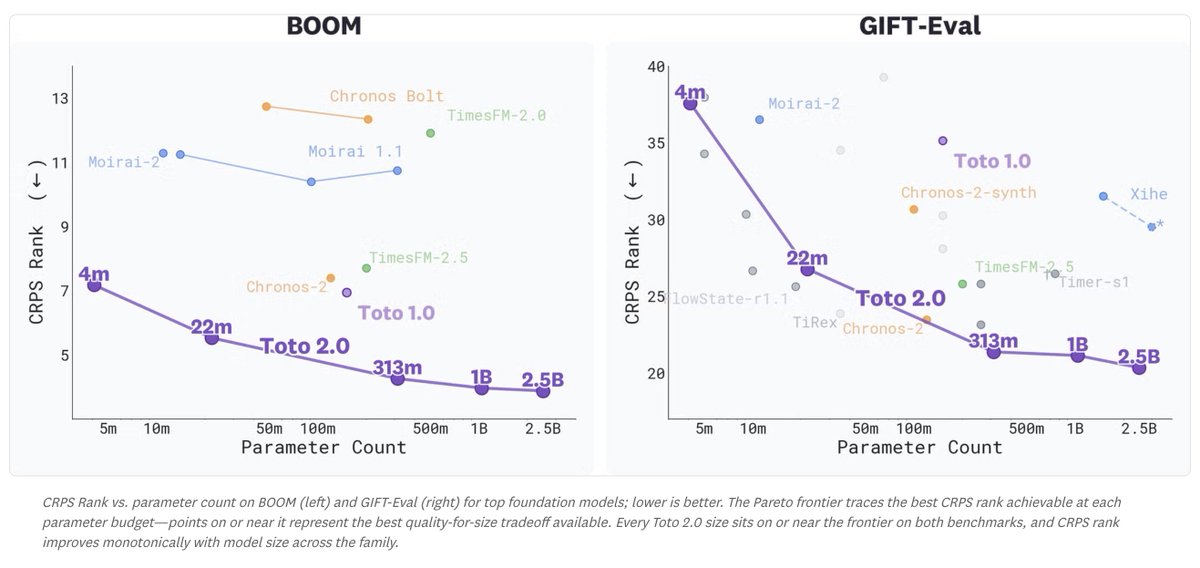
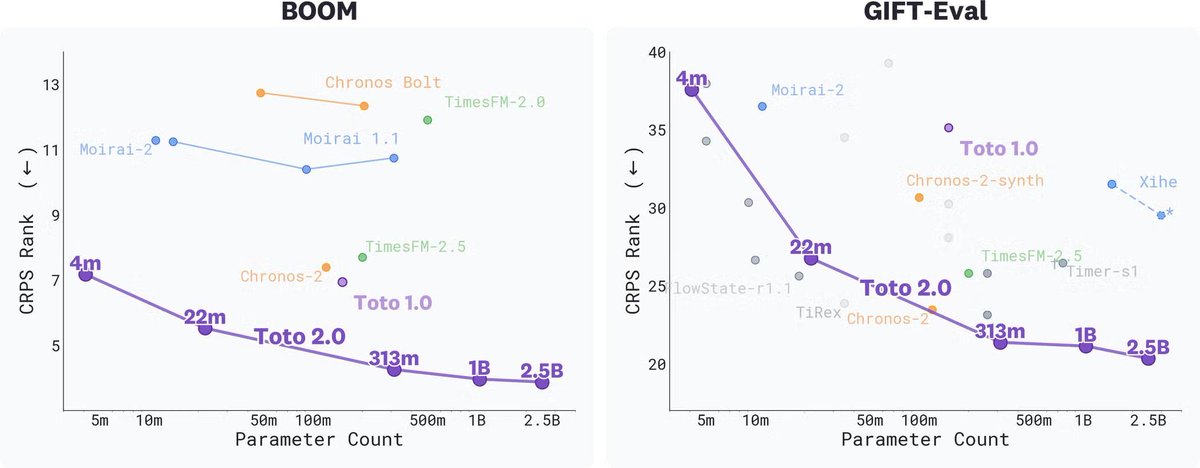
Introducing Toto 2.0: open-weights TSFMs from 4M to 2.5B params, where every size beats the last from a single hyperparameter config. #1 on leading benchmarks: BOOM, GIFT-Eval, and TIME.
Most TSFM families ship multiple sizes that all perform roughly the same. This one doesn't.
Toto 2.0 is here: Datadog AI's 5 open-weights forecasting models (4m-2.5B params) finally make scaling work for time series forecasting! #1 on BOOM, GIFT-Eval, and TIME. Weights/code Apache 2.0.
🔗 Read the blog post for more details: https://t.co/CEQSfUhvOA
Are scaling laws finally working for time series foundation models?
Today, @datadoghq is releasing Toto 2.0 weights in Apache 2.0 on @huggingface. It's a family of open-weights TSFMs from 4M to 2.5B parameters, where every size beats the last from a single hyperparameter config. First across the leading benchmarks: BOOM, GIFT-Eval, and TIME.
Most TSFM families ship multiple sizes that all perform roughly the same. This one doesn't.
Why it matters: scaling laws gave language and vision a predictable relationship between compute, data, parameters, and downstream performance. Time series hasn't had that curve until now. Once you have it, you can scale data and compute with confidence, and start asking which new capabilities emerge at the next order of magnitude.
2.5B open-source weights: https://t.co/prpcGoCw0U
4M open-source weights: https://t.co/5d6rw5NYL2
Blogpost: https://t.co/xKazgTMh1I
So excited for my colleagues’ work (Emaad Khwaja, @woo_gerald@BitsOfChris)! A year ago we launched Toto, a novel TSFM architecture that was SOTA on both observability and general-purpose forecasting tasks. There’s been so much excitement and innovation around foundation models for time series lately. The biggest open question has been: will they scale? Will the bitter lesson apply? With the release of Toto 2.0, we can now emphatically say yes! 🚀
Toto 2.0 is here: Datadog AI's 5 open-weights forecasting models (4m-2.5B params) finally make scaling work for time series forecasting! #1 on BOOM, GIFT-Eval, and TIME. Weights/code Apache 2.0.
🔗 Read the blog post for more details: https://t.co/CEQSfUhvOA
Congrats to @tyler_griggs_ and the whole SkyRL team on an impressive release! They are doing important work to democratize RL post-training infrastructure, and moving us closer to a world where agentic RL is as accessible to large and small organizations as SFT and context engineering are today.
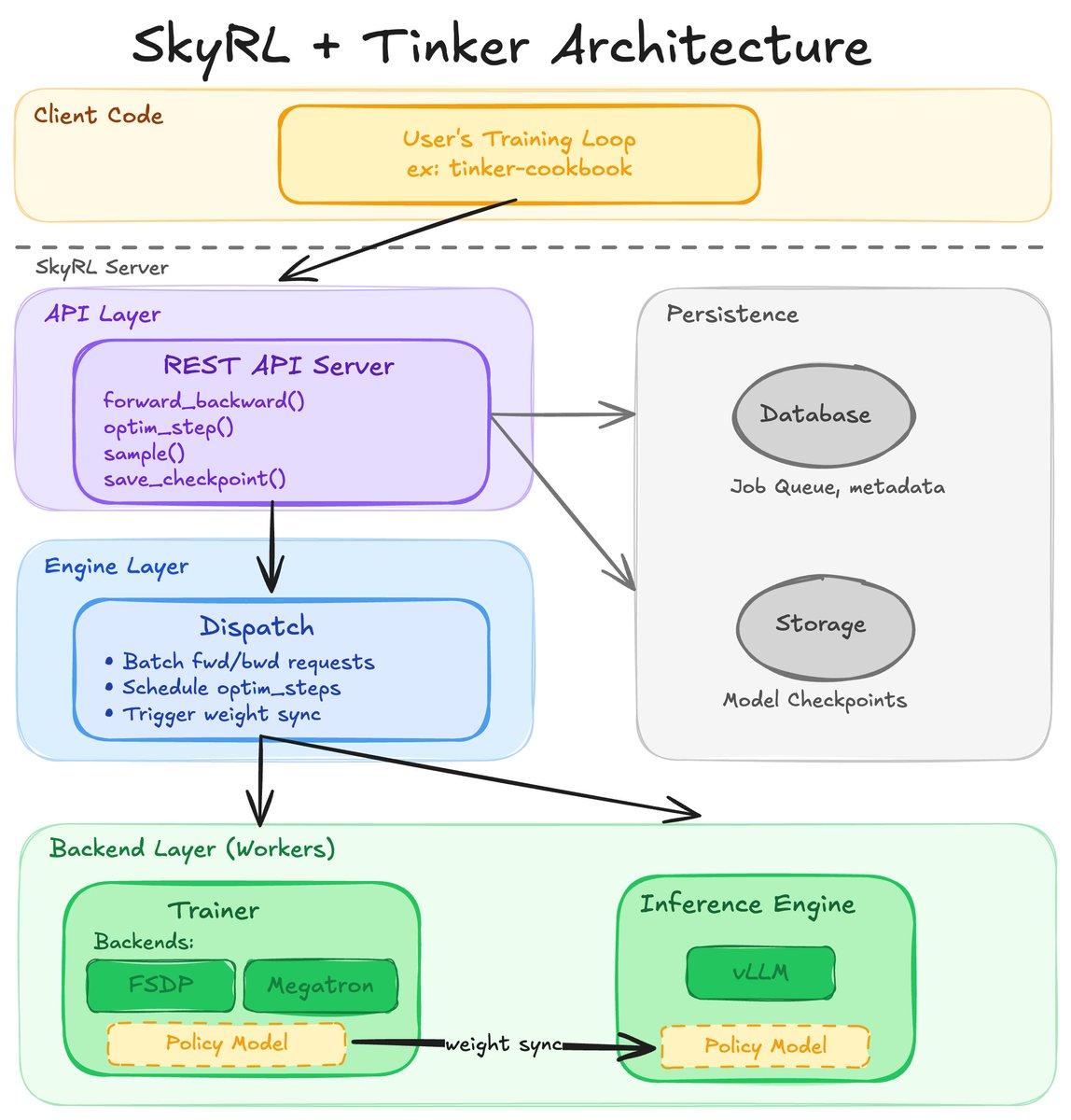
SkyRL now implements the Tinker API.
Now, training scripts written for Tinker can run on your own GPUs with zero code changes using SkyRL's FSDP2, Megatron, and vLLM backends.
Blog: https://t.co/GAtW81jM38
🧵
Datadog AI Research is excited to be a Gold Sponsor at NeurIPS 2025 San Diego. Stop by booth 631 to talk with our scientists and engineers about time series foundation models, agentic RL, agents for autonomous incident response, and the future of AI Observability.
Read our blog to learn more: https://t.co/b4GSPqnU8Z
#NeurIPS
I will be at @NeurIPSConf in San Diego this week with colleagues from @datadoghq presenting our work on Time Series Foundation Models for observability! If you want to chat about AI/FMs for o11y, agentic RL, or scaling RL environments and RL infra, DM me! We’re hiring for RS/RE.
@karanjagtiani04@NeurIPSConf@datadoghq For more discussion, you can check out some of our blog posts: https://t.co/IQ8eTZehtN, https://t.co/B1u5sFWwti, and our NeurIPS paper: https://t.co/BYveYf6rZ6
@karanjagtiani04@NeurIPSConf@datadoghq Lots! Time series analysis is a core competency for SRE - capacity estimation, anomaly detection, root cause analysis...if we want strong agents for debugging production issues, they need to be able to understand metrics at an expert level.
I'll be at @NeurIPSConf with several of my Datadog colleagues. We're actively hiring Research Scientists & Research Engineers, and would love to chat at our booth in the expo hall, during the poster session where we're presenting Toto, or at my talk at the TSFM workshop!
@jon_barron This is super interesting! Is f differentiable with respect to lambda? In time series modeling it's common to apply a learned Box-Cox transform to the data, but this is typically treated as a hyperparameter. Could we learn an optmal transform based on the inputs?