@BullTheoryio Other than adding another layer of unnecessary paperwork for tax purposes, there's no reason really for anyone to have uninvested cash in the ISA. The UK should enact policies and laws that actually matter instead of wasting time and money on something that has little benefit
$NUAI officially included in the Russell Index 3000 & Microcap index means two distinct categories of passive institutional funds are legally forced to buy the stock to replicate their respective benchmarks.
Are we going to trend upwards to new price floors?
👀s on 29th June
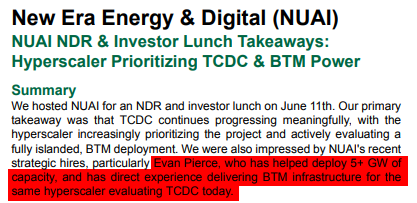
Does the update from Northland on $NUAI mean the hyperscaler is actually $AMZN and not $MSFT ?
This is going to be explosive eitherway once confirmed - very exciting for $NUAI holders and bulls
The re-rate of $NUAI is happening right in front of our eyes.
Dropping a new Chief Accounting Officer (ex-HF Sinclair director) into an 8-K this week, and the team is currently in Cannes pitching global hyperscalers at the Datacloud Global Congress.
Check out the 3-month catalyst roadmap below. With passive index funds forced to start buying by June 29th, what do you think is the biggest catalyst here—the Russell addition or the looming hyperscaler lease conversions? 👇
Are we still early? 🙃
$NUAI #AI #ENERGY #TECH
$NUAI - Another heavy hitting hire for the exec team
https://t.co/70XyP0ydFG
1. Fact-Checking the Financials & Benefits
The cash and equity metrics laid out in the 8-K are highly standardized but lucrative for a micro-cap company, designed to secure top-tier corporate talent:
*Base Salary: Exactly $350,000 annually.
*Annual Performance Bonus: A target of up to 40% of his base salary ($140,000 max target per year).
*Signing Bonus: $30,000. This includes a 12-month clawback provision, meaning if he voluntarily leaves or is fired for cause within his first year, he has to pay it back.
* The Equity (The Real Payday): He is receiving 325,000 Restricted Stock Units (RSUs). Instead of the standard annual cliff vesting, these vest monthly over a 4-year period.
2. Decoding His "Motivations" (The Golden Parachute & M&A Smoke)
Looking strictly at the legal protections written into his employment agreement, Rovell’s core motivations are heavily tied to long-term stock performance and protection against a corporate buyout or merger:
*The Equity Upside: Because his 325,000 RSUs vest monthly, his personal net worth is tied directly to the live ticker. He is fundamentally incentivized to keep the financial reporting flawless to help the stock trend higher.
*The "Change in Control" Trigger: The most telling part of the filing is how aggressively he is protected if NUAI gets acquired or merges:
**Standard Termination: If he’s let go without cause normally, he gets 100% of his base salary ($350k) as severance and 12 months of health benefits.
**M&A Termination: If the company undergoes a Change in Control and he is terminated within 12 months after that event, his severance packages violently spike to 150% of his base salary ($525k cash) and 18 months of benefits.
**Immediate Vesting Acceleration: Under a Change in Control termination, all unvested portions of his 325,000 RSUs instantly accelerate and fully vest.
The Structural Read:
Highly skilled corporate accountants do not demand heavy, accelerated change-in-control clauses unless there is an internal corporate expectation that the company could be an acquisition target or undergo a major joint-venture consolidation in the near-to-medium future or it could mean standard protection for said employee.
I remain bullish as ever 🚀🚀🚀 for $NUAI
$Nuai another hire Michael Johnson from Coreweave
Before CoreWeave, he spent two and a half years as Associate General Counsel at Switch, where he directly represented the company across seven massive data center campuses in the US.
Switch is legendary in the industry for building some of the highest-density, most energy-efficient data center ecosystems on earth.
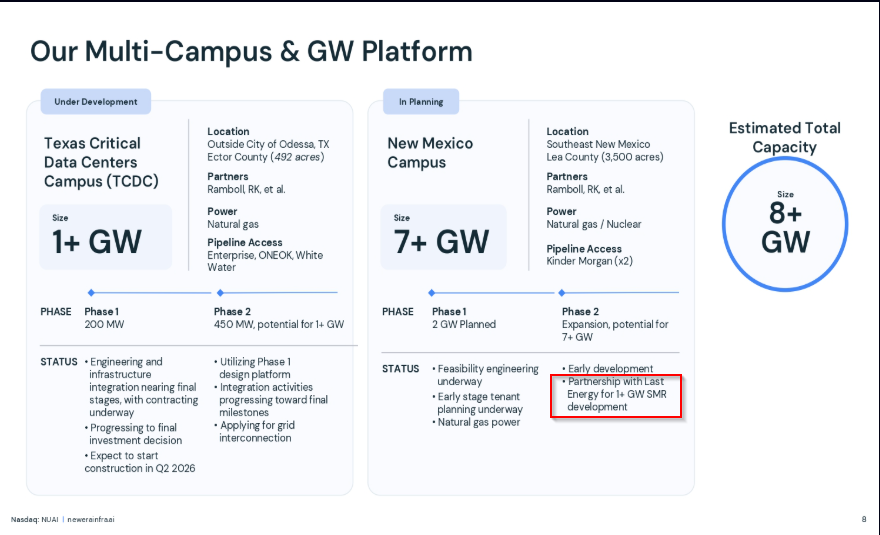
His experience there explicitly covers campus subdivision, commercial construction contracts, and real estate acquisitions. This is a 100% direct translation to what NUAI is trying to execute right now with the 1.4 GW Texas Critical Data Center (TCDC) and the newly cleared New Mexico site.
https://t.co/piQrEsOoqD
@Dragobbbb whilst we're looking for $NUAI's first hyperscaler tenant, I feel like they're already planning for their second and third with the connections this exec team has 🤞
$NUAI - Double re-rating on the cards?
1. Hyperscaler for TCDC
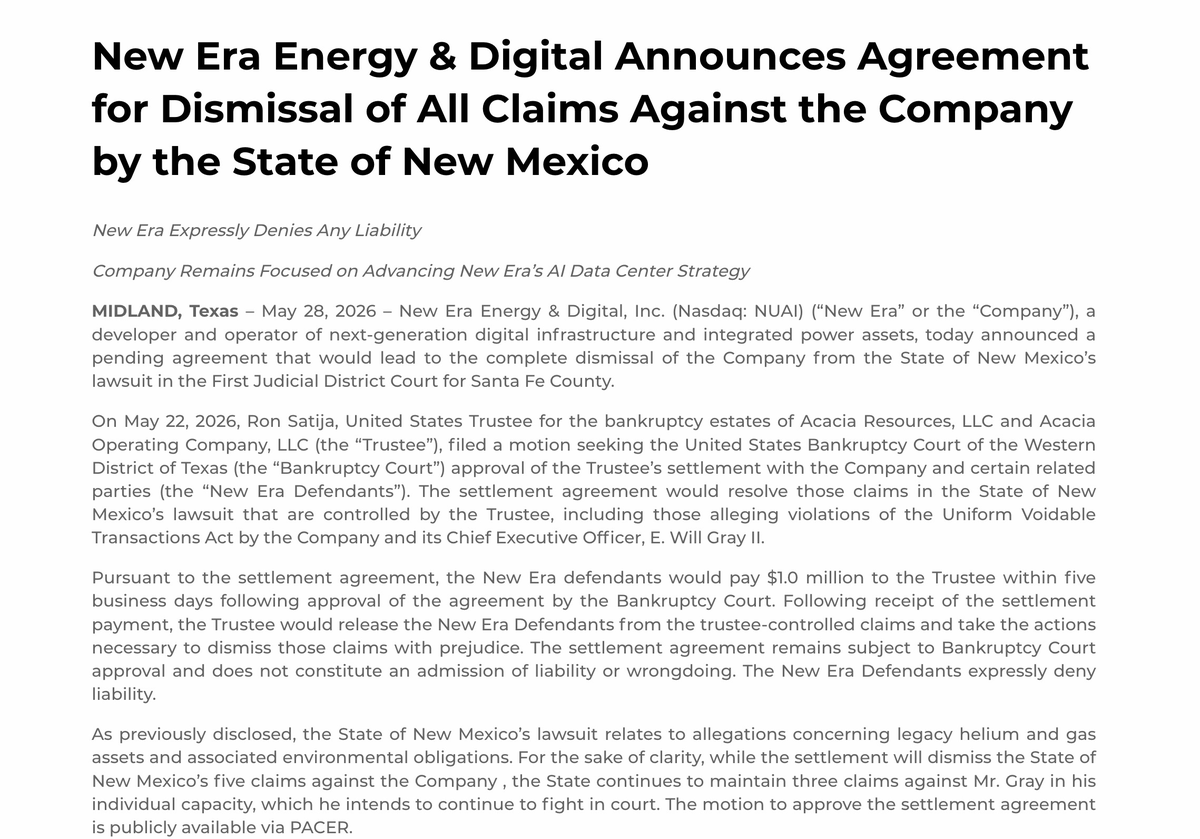
2. With the NM lawsuit cleared it paves the way for potential partnerships for the nuclear SMR development thats specifically mentioned in the 8-K
Excited for $NUAI
$ONDS - Summit could have attendees that include defense ministers, NATO reps, and military decision-makers. If Ondas can secure a pilot program, a testing agreement at the NATO Innovation Range, or a procurement contract with an allied nation, it could be the catalyst before year end to $15+🚀
I don't know why I asked AI for this.
$ONDS x $NVDA
NVIDIA’s newly launched Vera Rubin architecture features NVLink 6, which delivers a massive 3.6 TB/s of bandwidth, allowing multiple GPUs to act as one single, giant, unified super-brain.
If we take NVLink, apply it to drones, and hook it up to a VR tactical command center, the resulting scenario represents the ultimate high-tech setup.
🎬 The Setup: The "Ghost Pilot" VR Network
The Problem: Standard military drones stream a single, compressed 2D video feed back to a pilot sitting in a container in Nevada. It’s laggy, has blind spots, and offers zero depth perception. If a pilot is trying to steer a drone through a blown-out window in an urban warzone, they are flying blind.
To fix this, you need a hyper-realistic, zero-latency 3D VR environment streamed straight to a commander's headset. But a 4K, 360-degree VR stream requires massive computational power—way too much for a single drone to carry without falling out of the sky from the weight of the hardware.
⚡ The Solution: The NVLink Air-Grid
Ondas mounts a lightweight NVIDIA Jetson Thor chip onto three different Airobotics Optimus Drones flying in a tight, V-shaped formation above a city.
Instead of running independently, the three drones connect using a secure, ultra-low-latency directional RF data link (provided by Ondas Networks' FullMAX technology).
This wireless connection functions as an "Airborne NVLink".The three separate chips on the three separate drones fuse their processing power together over the air. They are now operating as a single, distributed supercomputer floating in the sky.
The VR Tactical Deployment:Back at the command center, a NATO general puts on a next-generation VR headset.
The Fused Feed: Drone 1 captures the front view, Drone 2 captures the left flank, and Drone 3 captures the right flank.
The Real-Time Render: Thanks to the Airborne NVLink combining their processing power, the drones don't just record video—they use NVIDIA Cosmos world-vision AI to instantly render a 3D, photorealistic holographic model of the entire city in real time.
The "Ghost" Command: The general isn't flying a drone with a joystick. They are standing inside a live, holographic digital twin of the battlefield.
When they point their finger at a rooftop sniper in the VR world, the Omnisys BRO software instantly calculates the trajectory and commands an Ondas Iron Drone to intercept the target autonomously.
💥 The "Retail Hype" Translation
If the market caught wind of an "Airborne NVLink" architecture, the narrative shift would likely bypass standard financial metrics:
The Catchphrase: Traders on Wall Street stop calling Ondas a drone company. The new tagline becomes: "Ondas is building the physical sky-tracks for NVIDIA’s Omniverse."
The Valuation Leap: The market stops valuing $ONDS based on physical hardware sales and starts valuing it as a infrastructure-as-a-service play.
While a multi-drone wireless NVLink array remains a conceptual design, the foundational components—Ondas' high-bandwidth secure radios, Omnisys' simulation software, and NVIDIA's edge AI chips—are real-world technologies that are actively scaling.