🚨 BREAKING: FSD can come to Austria 🇦🇹, and the Austrian government just confirmed it in writing.
@Tesla@teslaeurope@elonmusk, the green light is here. Ship FSD to Austria ASAP 🇦🇹
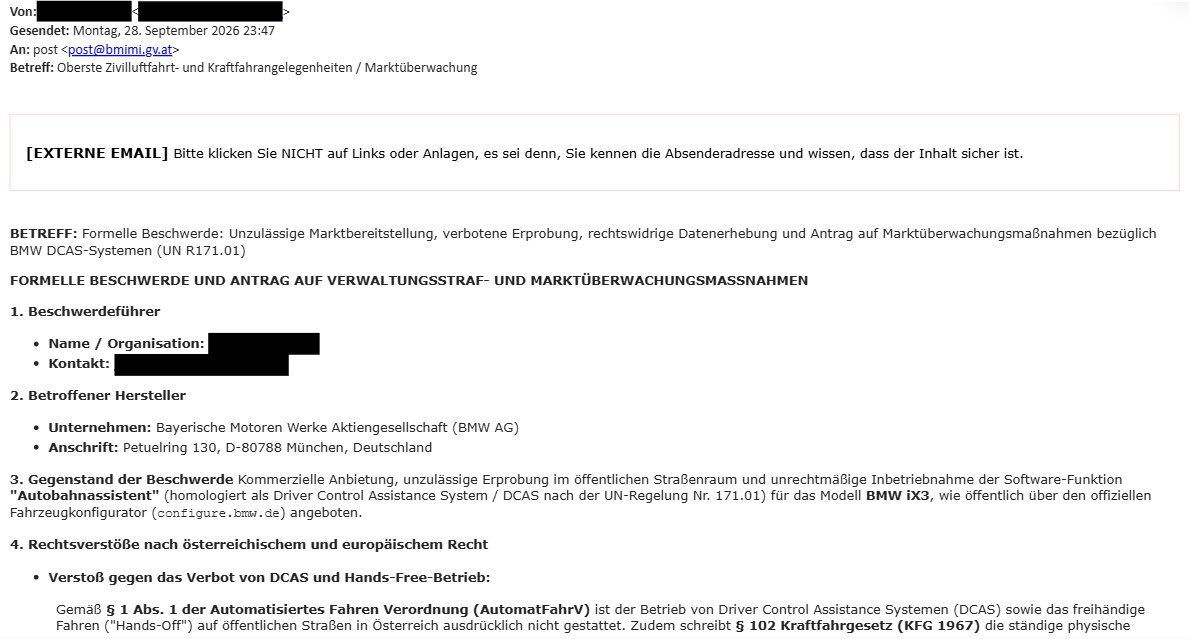
BMW is already selling its hands-free Highway Assistant in Austria. So why not Tesla?
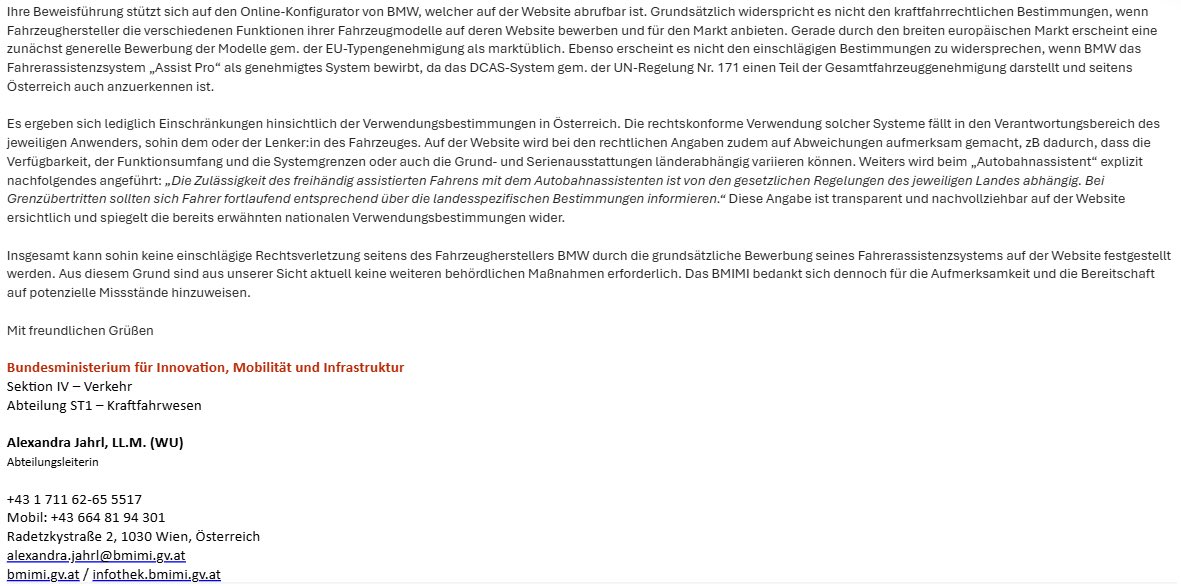
The Austrian transport ministry (BMIMI) has now answered:
✅ Selling it is fine. The manufacturer may advertise and sell the system, and Austria has to recognise the EU approval.
✅ The driver is responsible. Using the system legally is up to the driver, not the manufacturer.
Why does this matter? Because the ministry separates two things: approving and selling a car, and how it's used on the road.
Approval is EU law. Once a system is approved, every EU country has to accept it, including Austria. How it's used is national law, and that part is on the driver, not the company.
FSD Supervised falls under the same EU rule (UN R171) as BMW's system. Same rule, same approval, same market.
So Tesla can legally roll FSD out to Austrian cars RIGHT NOW. An Austrian owner can drive to Italy 🇮🇹, where it's approved, and use it fully legally there. If they choose to use it at home in Austria, that's their own personal responsibility, not Tesla's.
There's no legal reason for Austrian Tesla owners to be left out from a life saving technology. Use it if you want to. Or don’t. It’s up to you. But since there is no regulatory barrier, why not let them chose themselves?
Full ministry reply attached.
FSD take rate will see a steep increase thanks to v15 and Reality View.
I sense FSD Annualized Run Rate (ARR) to reach $3B by the end of Q1, 2027, and $5B by the end of 2027.
This is a good demonstration of what the camera sees in low visibility situations. Clearly the camera isn’t as nerfed as our eyes. LiDAR believers are in shambles
v15 is 25x safer than v14 across the fleet.
That’s hard to notice on any individual drive because most drives are already very safe. The difference only becomes clear when you aggregate millions of miles.
All credit goes to the incredibly talented and dedicated @TeslaSI engineers who made this possible. It’s an honor to work alongside them.
Cybercab shuttles to and from Dallas, Austin, San Antonio and Houston are going to be SO lit.
Fraction of the price of a plane ticket, completely private, super comfortable, with door to door pick up and drop off.
THE FUTURE.
Tesla Semi-Truck charging hubs are amazing! With up to 1.2 MW of power, Megacharger can add up to 60% of range in 30 minutes.
The hubs are spacious, clean and FAST!
This particular location in Bloomington, CA has an office space available, driver lounge with couches, vending machines, water and clean restrooms.
@Tesla knows what they are doing and all charging hubs should be identical.
@tesla_semi@elonmusk #EVSemi #TeslaSemi #EV #mcs #eVSemiFleet
Truck & Content owned by: EV Semi-Fleet Corp.
When Tesla Robotaxi first launched in Dallas with the Model Y, I started a little experiment.
I’d casually ask bartenders, cashiers, or strangers sitting next to me: “Have you heard of Tesla Robotaxi?”
90% of the people I asked had no idea what I was talking about.
These weren’t Tesla fans. They weren't following FSD or autonomous driving. Some knew about Waymo but had no interest in trying it.
Yesterday the Cybercab arrived.
I’m seeing them everywhere around Uptown and Downtown Dallas. And unlike the Model Y, which blends into traffic, the Cybercab is impossible to ignore.
That got me thinking.
Could the Cybercab’s design be its own best advertising campaign?
In a week or two, I’m going to repeat my little experiment. Same questions, same kind of people outside the Tesla bubble.
I'm curious whether simply seeing these futuristic vehicles on the streets will make people download the app and try their first ride.
Because if Cybercab starts converting people who never cared about Tesla into paying Robotaxi customers, the implications for Tesla’s business could be enormous.
Full release notes below
– – –
v15 upgrades every part of the end-to-end driving network. Includes:
Upgraded vision encoder shared between FSD, Robotaxi, and Optimus, which is trained on millions of internet videos for improved generalization and data efficiency, improving the critical intervention rate by 25x.
Introduced Tesla Reality View, replacing all of the explicit model signals into a single end-to-end visualization using less total compute.
Improved navigation by using an end-to-end learned model based on route preference data from the fleet.
Improved parking location selection by using personalized parking history, and the map will now display multiple parking options at your destination.
Improved driver monitoring by increasing vision-based attention monitoring availability with hats and sunglasses and decreasing strictness in higher speed driver profiles.
Improved detection of road signs, small animals, road debris, and chains.
Improved detection of potholes, road details, and avoidance of deep standing water.
Improved speed handling for each driver profile, school zones and speed limits, and inclement weather.
Improved Autoshift functionality by unifying with FSD-based gear predictions.
FSD v15 now starting to roll out – upgrading every part of the end-to-end driving network
Safety
25x better handling of safety critical cases
Tesla Reality View
Adds a live visualization of the drive that lets you see & control what FSD is planning to do
Navigation for start & end of the trip now learns end-to-end from fleet route preferences. Later v15 releases will expand this to the entire route.
You also should notice better detection of signs, animals, debris, potholes and standing water, plus more natural speed handling in school zones and inclement weather.
Lastly, FSD can now slow for speed cameras & Bike Rack Mode lets you enable FSD w/ bike racks or similar hitch accessories