Maka hiduplah dg penuh cinta & kasih dlm hatimu,
Sehingga apapun yg terjadi denganmu sampai sekalipun malaikat melakukan kesalahan & mengirimmu ke neraka
Sang iblis sendiri yg akan mengantarmu kembali ke surga
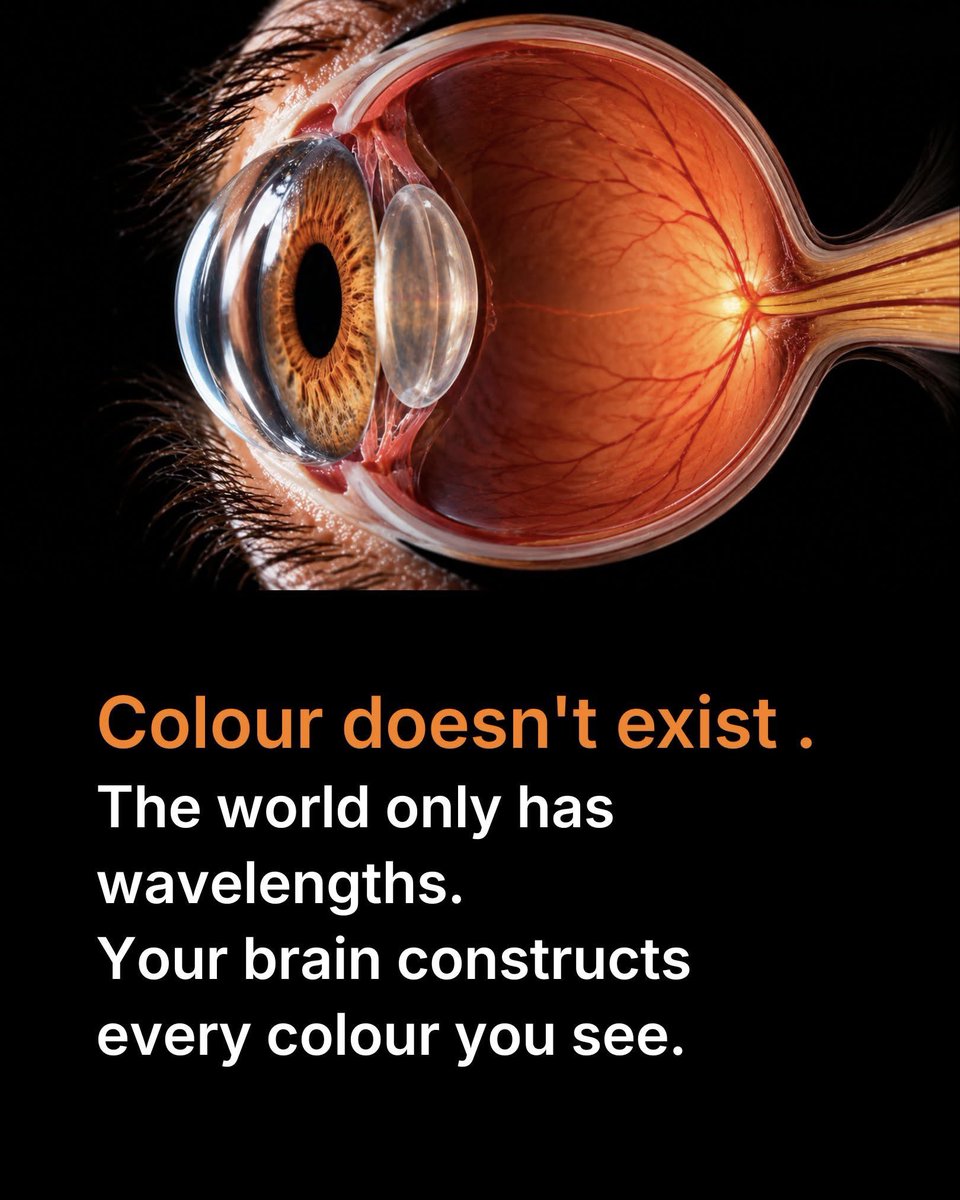
🧠 Your Brain Creates the Colours You See Every Day
The colours around you are real—but the experience of colour happens inside your brain.
When light enters your eyes, tiny cells in your retina called cone photoreceptors detect different wavelengths of light. Humans have three main types of cones, each sensitive to a different range of wavelengths.
Your brain compares the signals from these cones and turns them into the colourful world you experience every day.
Here's the fascinating part: light has wavelengths, but colour is a perception created by your nervous system. The sky's blue, a flower's red, and a rainbow's colours are experiences your brain builds from information received by your eyes.
You don't simply see the world as it is. Your brain interprets the light reaching your eyes and creates the colours you experience.
Source: OpenStax. (2025). Introduction to behavioral neuroscience: The retina.
🧠 Your Thoughts May Appear in Your Mind Before You Know Where They Came From
You didn’t consciously choose your last thought. It simply appeared in your mind.
Try something strange: sit quietly and attempt to predict your exact next thought before it arrives. You may find that it appears spontaneously, without a conscious decision to create it.
So, where do your thoughts come from?
Neuroscience suggests that many mental processes happen outside conscious awareness. Your brain constantly processes information, forms associations, and generates ideas before you become aware of them.
By the time a thought enters your consciousness, some of the work that produced it may already be complete.
But here's the mystery: does this mean you aren't truly creating your thoughts, or does conscious thinking work differently from what we imagine?
Scientists have not established that thoughts are literally received from an external source. The deeper question is how unconscious brain activity becomes the experience of having a thought.
And perhaps the strangest part is this: you can observe your thoughts appearing, but you cannot always observe the hidden processes that create them.
Source:
Libet, B. Unconscious cerebral initiative and the role of conscious will in voluntary action. Behavioral and Brain Sciences, 8(4), 529–539.
@GuntherEagleman There is no afterlife, no cosmic justice, and no inherent purpose. Consciousness ends at death in an indifferent universe that will outlast every human concern.
𝗣𝗮𝗻𝘁𝗲𝘀𝗮𝗻 𝘆𝗮 𝘀𝗲𝗿𝗶𝗻𝗴 𝗮𝗱𝗮 𝗻𝗮𝘀𝗶𝗵𝗮𝘁 𝗸𝗮𝗹𝗼 𝗽𝗮𝘁𝗮𝗵 𝗵𝗮𝘁𝗶 𝗶𝘁𝘂 𝗸𝗲 𝗴𝘆𝗺 𝗮𝘁𝗮𝘂 𝗱𝗶𝗸𝗮𝘀𝗶𝗵 𝗷𝗮𝗱𝘄𝗮𝗹 𝗹𝗮𝗿𝗶.
Ada penelitian baru banget yang nunjukin kalo tikus yang dibuat depresi dan kemudian dibuat lari selama 4 minggu berturut-turut. Hasilnya ternyata menunjukkan 𝘁𝗶𝗸𝘂𝘀 𝘆𝗮𝗻𝗴 𝗱𝗶𝗯𝘂𝗮𝘁 𝗹𝗮𝗿𝗶 𝗿𝘂𝘁𝗶𝗻 𝘁𝗲���𝗻𝘆𝗮𝘁𝗮 𝗺𝗲𝗻𝘂𝗻𝗷𝘂𝗸𝗸𝗮𝗻 𝗽𝗲𝗿𝗯𝗮𝗶𝗸𝗮𝗻 𝗸𝗼𝗻𝗱𝗶𝘀𝗶 𝗱𝗲𝗽𝗿𝗲𝘀𝗶𝗻𝘆𝗮.
Mekanismenya ada pada 𝗽𝗿𝗼𝘁𝗲𝗶𝗻 𝗮𝗽𝗲𝗹𝗶𝗻 yang bisa pindah dari otot ke otak untuk berikatan dengan sel saraf dan berujung pada perubahan persinyalan di otak yang mengarah pada perbaikan kondisi depresi.
Semoga bermanfaat!
Sumber Ilmiah:
How muscle talks to brain: apelin protein mediates exercise-induced antidepressant effects. Molecular Psychiatry.
Bertrand Russell’s Ten Commandments of Critical Thinking and Democratic Decency
1. Do not feel absolutely certain of anything.
2. Do not think it worth while to proceed by concealing evidence, for the evidence is sure to come to light.
3. Never try to discourage thinking for you are sure to succeed.
4. When you meet with opposition, even if it should be from your husband or your children, endeavor to overcome it by argument and not by authority, for a victory dependent upon authority is unreal and illusory.
5. Have no respect for the authority of others, for there are always contrary authorities to be found.
6. Do not use power to suppress opinions you think pernicious, for if you do the opinions will suppress you.
7. Do not fear to be eccentric in opinion, for every opinion now accepted was once eccentric.
8. Find more pleasure in intelligent dissent than in passive agreement, for, if you value intelligence as you should, the former implies a deeper agreement than the latter.
9. Be scrupulously truthful, even if the truth is inconvenient, for it is more inconvenient when you try to conceal it.
10. Do not feel envious of the happiness of those who live in a fool’s paradise, for only a fool will think that it is happiness.
Ternyata ini ada penelitiannya!
Strategi adulting dengan "never asking why" ini namanya adalah radical acceptance. Penelitian menunjukkan bahwa strategi ini bisa membantu kita untuk regulasi emosi dengan lebih baik, sekaligus mengurangi mood negatif.
Penerimaan terhadap kondisi yang kita alami dapat melindung kesehatan mental dan meningkatkan ketenangan hidup.
Semoga bermanfaat!
Sumber Ilmiah:
The benefits of radical acceptance of reality as a standalone strategy for emotion regulation.
Ceritakan tentang masakan ibumu yg tak pernah bisa kau lupakan.
10 pencerita terpilih di Instagram & 10 di X/Twitter akan mendapatkan paket buku saya + Kopi Komeng dari saya & @JNE_ID yg always "Connecting Happiness".
Always GiveAway
GiveAway always
#JNEConnectingHappiness
A woman decided to celebrate her 70th birthday by treating herself to one night in a very nice hotel. The next morning, when she went to check out, the desk clerk gave her a bill for $250. She was shocked and asked why it was so expensive. “I agree it’s a nice hotel, but the room isn’t worth $250 for just one night — I didn’t even have breakfast,” she said. The clerk explained that $250 was the standard rate, and breakfast was included if she had chosen to have it.
She asked to speak with the manager. The manager came out, already informed about the complaint, and said, “Our hotel has an Olympic-sized swimming pool and a large conference center that guests can use.”
“But I didn’t use them,” she replied.
“Well, they are available, and you could have used them,” he answered.
He continued, saying the hotel also offered famous in-house shows with top entertainers from around the world.
“But I didn’t attend any of those shows,” she said.
“They are available, and you could have gone,” the manager repeated.
Every time the manager mentioned another facility, she answered, “But I didn’t use it,” and he kept giving the same reply.
After several minutes of going back and forth, and seeing that the manager would not change his mind, she agreed to pay. She wrote a check and handed it to him.
The manager looked at it and said, “Madam, this check is for only $50.”
“That’s right,” she said. “I charged you $200 for sleeping with me.”
“But I didn’t do that!” the manager replied.
“Well,” she answered calmly, “I was here, and you could have.”
Mengapa filosofi pendidikan “sesuai industri” itu problematis?
Saya agak gelisah baca wacana menutup prodi yang dianggap “tidak relevan dengan industri”, yang disampaikan Sekjen Kemendikti, Prof Bakri Munir Sukoco.
Bukan karena saya anti industri.
Tapi… industri yang mana?
Yang hari ini?
Atau yang bahkan belum ada 10 tahun lagi?
Masalahnya sederhana: industri sendiri sering belum tahu arah masa depannya.
Laporan World Economic Forum dan McKinsey & Company berulang kali bilang hal yang sama: banyak pekerjaan masa depan belum eksis hari ini.
Jadi kalau kampus sibuk “menyesuaikan diri” dengan kebutuhan sekarang, kita mungkin sedang menyiapkan lulusan… untuk dunia yang sudah lewat.
Dan biasanya, yang pertama dikorbankan itu selalu sama:
Filsafat.
Sejarah.
Sastra.
Yang dianggap tidak praktis.
Padahal banyak pemimpin, pembuat kebijakan, bahkan inovator yang lahir dari sana.
Sekarang bahkan keguruan dan kedokteran ikut disorot oleh Sekjen Kemendikti. Keduanya dibutuhkan masyarakat tapi katanya terlalu “market-driven”, harus jadi “market-driving”.
Tapi jujur saja kedua istilah ini masih dalam logika yang sama: pasar sebagai penentu. Bedanya hanya soal siapa yang lebih pandai meramal pasar.
Padahal masalah utamanya bukan di situ.
Masalah pendidikan di Indonesia itu ada di tata kelola.
Prodi dibuka karena tren. Karena peminat. Karena pemasukan. Bukan karena visi pendidikan.
Kalau akarnya di situ, menutup prodi dari atas itu cuma seperti memotong daun, tanpa menyentuh akar.
Yang kita butuhkan bukan sekadar menutup prodi, tapi membenahi cara kita menilai dan membiayai pendidikan. Quality control dan akreditasi tetap penting, tapi ukurannya harus nyata: kualitas belajar, daya pikir lulusan, dan dampaknya bagi masyarakat, bukan sekadar dokumentasi.
Yang dibutuhkan adalah pendanaan berbasis kualitas, kurikulum yang lentur, dan keberanian menjaga ilmu yang tidak selalu “laku”.
Karena saat industri jadi satu-satunya ukuran, dunia kampus menjelma hanya melatih tenaga kerja bukan melahirkan manusia yang mampu berpikir, menilai, dan membentuk zamannya sendiri.
Tabik,
Nadirsyah Hosen
Bakteri yang ada di mulut, ternyata bisa ditemukan di otak orang dengan Alzheimer!
Untuk yang belum tahu, Alzheimer adalah penyakit otak degeneratif progresif yang menjadi penyebab utama demensia (60-80% kasus), ditandai dengan penurunan daya ingat, kemampuan berpikir, bahasa, dan perubahan perilaku.
Nah di penelitian ini, para peneliti memeriksa otak pasien Alzheimer yang sudah meninggal dan menemukan bakteri Porphyromonas gingivalis yang biasa ditemukan di mulut dan menyebabkan radang gusi pada 90% (9 dari 10) pasien.
Diperkirakan bakteri ini dapat merusak protein yang terkait dengan memori, membentuk plak amiloid, dan menyebabkan kematian sel saraf, yang berkontribusi pada penurunan kognitif dan demensia.
𝗬𝗔𝗡𝗚 𝗣𝗘𝗥𝗟𝗨 𝗗𝗜𝗣𝗘𝗥𝗛𝗔𝗧𝗜𝗞𝗔𝗡!
Masih perlu penelitian lebih lanjut apakah bakteri ini benar-benar penyebab utama Alzheimer atau hanya faktor pendukung semata.
Setelah baca penelitian ini gue semakin yakin bahwa menjaga kesehatan gigi dan mulut itu sangat krusial. Udah berhubungan dengan sakit jantung, sekarang berhubungan juga dengan alzheimer.
Semoga bermanfaat!
Sumber:
Dominy (2019). Porphyromonas gingivalis in Alzheimer’s disease brains: Evidence for disease causation and treatment with small-molecule inhibitors.