As someone who has personally spent $500k / mo+ on Google Ads for years, I can tell you with certainty:
This revenue growth in Search is artificial & extremely unhealthy for Google’s business long term
Search volumes are declining as legacy search is being increasingly cannibalized by non-monetized LLM queries
Google’s response?
Manufacture revenue growth via short-sighted, highly extractive, customer-hostile tactics. I.e. charge advertisers more for lower quality clicks, including clicks they do not want and explicitly did not approve Google to charge them for
A few examples to illustrate:
For all of its history until recently, Google operated on a 2nd price auction model
I.e. if you bid $5 CPC and the next highest bidder bids $1 CPC, Google charged you $1.01 for the click (one penny more than the 2nd highest bidder) rather than the $5 you bid
This was a genius move by Google early on as it incentivizes advertisers to input their true maximum willingness to pay rather than trying to play the game of bidding low and constantly adjusting to try to stay just ahead of the next highest bidder while still not paying too much
However recently, Google silently deprecated the 2nd price auction and began charging advertisers as much as their bid and budget caps allow, regardless of what anyone else is bidding
It’s a short-sighted cash grab at the expense of the long term health of the advertiser ecosystem
Making thing worse, Google also recently nerfed keyword targeting precision
Google previously had precise keyword targeting settings that allowed advertisers pick individual search phrases to bid on, defined down to the character w/ exact match or phrase match targeting
This was one of the core features that made search advertising magic, enabling advertisers to run extremely precise campaigns based on exactly what their target customer typed
But now, even if you bid on a specific term or phrase using the strictest exact
-match targeting settings, Google will show your ad across 1000’s of unrelated keywords, labeling them as as “exact match (close variant)”
The definition of “close variant” means whatever they want it to and changes constantly. The result is advertisers get billed for clicks that are totally irrelevant to their business and that their targeting settings explicitly forbid Google from targeting. Google does it anyway and there’s no ability to turn this off
So now exact match is broad match, and broad match is just meaningless spam
This is all very bad for advertisers, but for Google, it allows them to show your ad and bill you for clicks across 1000x more searches that were previously going unmonetized (mainly because they’re garbage queries no one wants)
This is how you grow revenue atop declining search volumes
Lastly, and perhaps most egregiously, Google quietly stopped respecting budget caps by a factor of 2x. For example campaigns we’ve been running for years with $1000 daily budget caps suddenly began spending $2000+ per day
And the extra spend is entirely on the garbage keywords Google arbitrarily throws in as “exact match (close variants)” which have no value to our business, but can’t be turned off
Google offers no refunds nor any recourse for overspend or spend on keywords you explicitly did not target
These are not the actions of a healthy business. These are the actions of company whose core business is in decline but desperately needs to pump quarterly earnings so Wall Street will continue to fund insane capex while hopefully looking through their rapidly deteriorating negative free cash flow
Google operated a benevolent monopoly for the better part of 25 yrs
Meaning the value Google captured from Search was but a small fraction of the value it created, and that spread produced a potential energy that justified expectations of high earnings growth far, far into the future
This is now no longer the case
At the alter of AI capex, Google is sacrificing the golden goose
@stevehou Anthropic and OpenAI need to continuously raise $ massive valuations to keep spending their massive sums of money though. Kimi's success is not helpful for making OpenAI investors think they are going to get rich investing at $1 trillion.
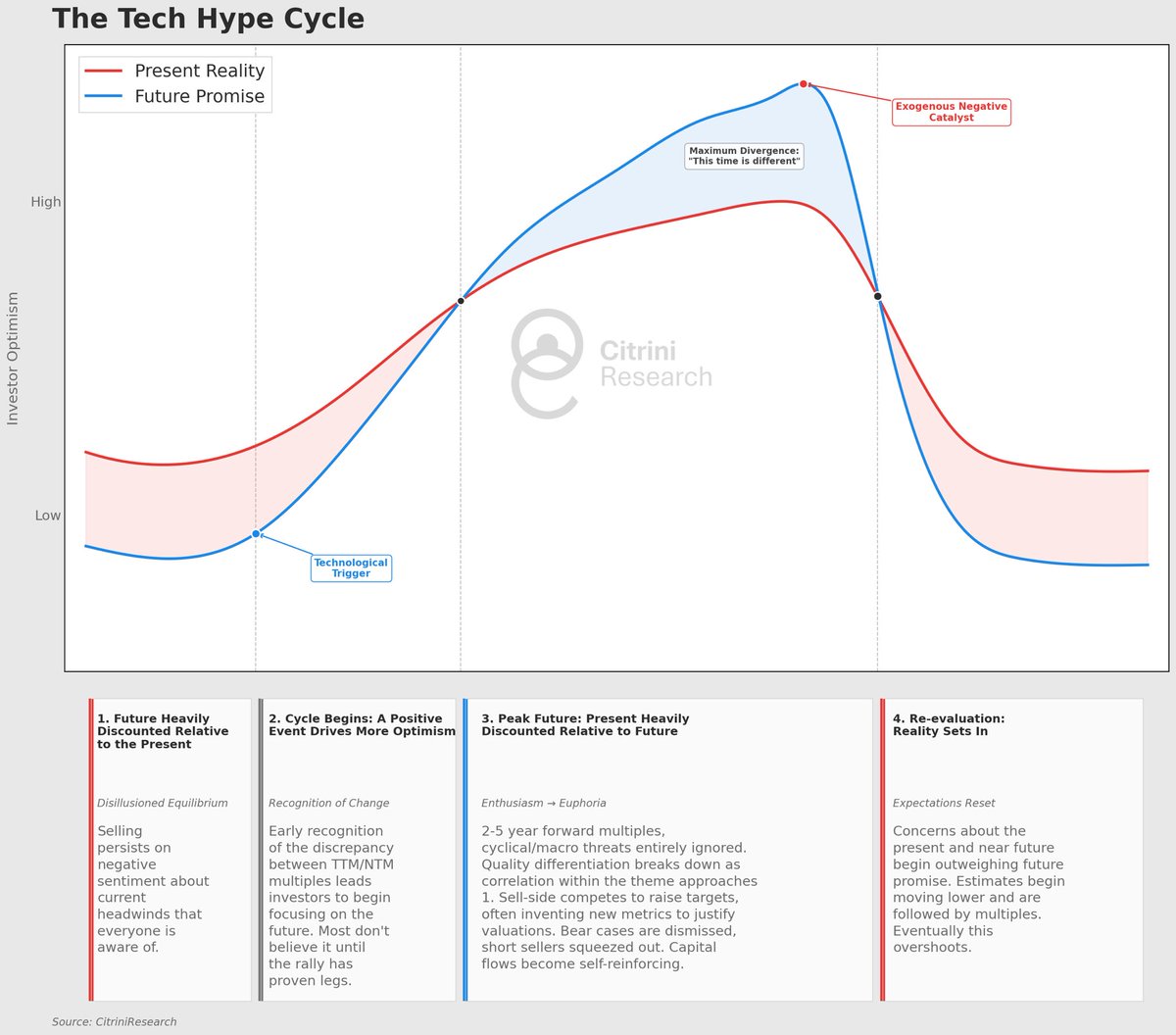
This is how I think about hype cycles in markets. It is basic, but that’s the point (frameworks shouldn’t be overly complex, I think).
Investors are always either discounting the promise of the future or the reality of the present. And they are never equally weighting them.
During the early part of a hype cycle, leading up to and directly following a technological advancement, investors are typically discounting the future while focusing on the present. A good example for this is Nvidia at the end of 2022: investors were solely focused on the headwinds presented by the crypto GPU glut, the anemic gaming PC market and the recent rise in rates causing fears about a near term recession.
Then, as the cycle begins, investors begin to shift to incorporate the future - they stop focusing so much on the present and see the promise. They move out in terms of valuing away from last twelve months current price / current earnings to next twelve months. Then, as price climbs and the technology becomes more exciting, their imagination takes hold. At a certain point they begin discounting the present much more heavily and the future becomes the only thing that matters. Valuation metrics over the next twelve months become useless in favor of 2, 3 or 5 years forward.
At the peak, the present is not considered at all, it is 100% driven by an imagined future (even when that imagination doesn’t necessarily align with a bullish outcome for the stocks driving the rally). Analysts aggressively raise estimates in ways that, at the time, seem fundamentally justifiable (if you take the assumptions at face value - for example, “everyone in the world will have two cell phones” was a good one from the mobile phone hype cycle). Capital is sucked in which ultimately forces performance chasing and crowds stocks with money that doesn’t really believe in the thesis. “A twilight period where people continue to play the game, but no longer believe in the rules” emerges, as Soros put it.
The valuation of SaaS stocks in mid-2021 is a great example of what happens when the future is overvalued relative to the present - nobody cared about climbing inflation, that rates had nowhere to go but up, that these companies were reliant on ZIRP or that software could become more competitive.
Then, a negative catalyst occurs - this can but doesn’t have to be related to the technology, macro, credit, underwhelming earnings. The estimates start to seem unattainable, and the present begins to matter more when the future seems more uncertain. That exact mechanism that drove future optimism to unsustainable heights mechanically reverses, everyone needs out. The future begins to be discounted until it results in a sense of disillusionment with not just the stocks but the technology itself. This overshoots to the downside, investors eventually become disillusioned and seemingly allergic to anything having to do with the technology. This happens in a very asymmetric manner to the climb (“stairs up, elevator down”).
This is the crucible in markets for truly transformative tech. If advancements persist, another opportunity to get long presents itself before capital once again begins flowing into the companies (the internet, for example). If they don’t - not necessarily “the tech goes away” but rather that it ceases to advance once the capital isn’t free or plateaus or the economics prove to be unfavorable - the cycle will still start again, just with a new technology.
Or maybe not…maybe this time is different.
Kalmar Nyckel (Swedish for 'Key of Kalmar') was a Swedish ship built by the Dutch[a] famed for carrying Swedish settlers to North America in 1638, to establish the colony of New Sweden.-wikipedia.
As claimed from day 1 of rhe MOU - Iran is highly unlikely to relinquish what it views as its sovereign rights in the Strait of Hormuz and / or allow unrestricted tanker traffic through the "Omani route".
Neither financial incentives nor limited U.S. strikes on Sirik Island are likely to alter that position.
If Washington's objective is to fundamentally change the reality in the Strait, it would likely require a far more ambitious strategy than limited military pressure, one aimed at changing the regime itself or establishing lasting control over the Strait. Short of that, Tehran is unlikely to revise what it sees as a core sovereignty issue.
This has important implications for diplomacy. If the United States seeks a comprehensive agreement with Iran, it may eventually have to decide whether to accommodate Tehran's position on this issue or accept that negotiations could stall If the United States insists on escorting tankers through routes that Iran rejects. As mentioned, from the Iranian leadership's perspective, this is not simply a maritime dispute but a question of sovereignty, credibility, and deterrence. Backing down would carry domestic and regional costs that the leadership is unlikely to accept.From Iran's perspective, this is not a bargaining chip.
That is why this issue has the potential to become a persistent source of confrontation. Unless one side fundamentally changes its objectives, the dispute over navigation in the Strait of Hormuz is likely to remain unresolved and could repeatedly undermine broader diplomatic efforts between Washington and Tehran.
#IranWar
Half the land area of Boston, a quarter of NYC, and 15% of San Francisco were raised from the sea before 1970.
Since then, land values have grown by 30x but land reclamation has ground to a halt.
This failure follows the spread environmental law around the world rather than any geographic, technological, or economic constraint.
Thus, our lack of land reclamation and the severe land constraints in our most important cities are self-imposed and avoidable. We should make more land!
https://t.co/J9zghvLkz2
Land reclamation was common practice in American cities in the 19th and 20th centuries. Seattle, Chicago, Boston, Charleston, San Francisco, New York, Philadelphia, Norfolk, DC, Oakland, and LA all had major land reclamation projects that extended residential living space or infrastructure or both.
The Bay Area alone reclaimed an area of land equivalent to ten Manhattans between 1850 and 1957, at an inflation-adjusted cost of $330,000 per acre. Today, an acre of single-family-zoned land in San Francisco County averages $24 million. Even if the cost of land reclamation grew faster than inflation, despite technological leaps in dredging and construction technology, there should be plenty of room for profitable arbitrage.
And yet, land reclamation is extinct in the Bay Area as well as in every other American city. This isn’t because we ran out of good spots to reclaim: Two thirds of the San Francisco Bay is shallower than Boston’s Back Bay was when it was reclaimed in the 1860s. Nor is it because of better transportation: We’ve used up all of the easy suburban expansions enabled by the train and the automobile so prices are rising even in outlying suburbs.
Instead, land reclamation’s death is due to environmental law. Evidence for this claim shows up in the coincident timing of land reclamation’s demise across dozens of cities in the US and in the environmental compliance process of the few reclamation projects still inching along today, but the best evidence is found internationally.
No country has more experience or more reason to reclaim land than the Netherlands. The Dutch built 5% of their country out of the sea over the first half of the 20th century and by 1975 they had another artificial lake in the Zuiderzee ready to drain at the flip of a switch, which would have made tens of thousands of acres of land just east of Amsterdam. But a 1969 environmental review law, similar to NEPA in the US, stopped the project before it was finished and the site is now a protected bird sanctuary. Their one major reclamation since, the Maasvlakte 2 extension of the port of Rotterdam, took 11 years and 6,000 pages of environmental review before construction began.
Inversely, countries without these laws, like China, Singapore, and Japan have continued major land reclamation projects into the 21st century. China has reclaimed over 5,000 square kilometers since 2000, including a city of half a million outside Shanghai and Singapore has grown by a quarter since 1975.
Every major American city has a land shortage. But we have more than enough shallow water, dredging capacity, and market incentive to make more land, just like we did 150 years ago. The only obstacle is our own choice to make making land illegal. The benefits of more land in our most productive cities are large enough to justify the effort of reforming the laws that currently prevent it. Let’s make more land!
Micron’s earnings were a slightly negative-sum event:
Apple and the hyperscalers shed more market cap then $MU, Sk Hynix, Samsung, $SNDK, $STX, and $WDC gained today.
Paper shorts are currently playing musical chairs at Cushing with absolutely no chairs.
We saw this exact physical deficit masquerading as a paper surplus in July 2008.
The last time the delivery hub drained this aggressively, crude spiked to $147 and systematically broke the global economy.
It is genuinely amusing watching retail bears short $WTI while the only marginal supply left is trapped on tankers in a geopolitical choke point.
'Iran insists that “passage is permitted only via" the designated route near Larak Island
"Several tanker owners using the southern route suggest that few believe the Iranian terms will provide a sustainable framework....It’s madness"'




![Buffett13's tweet photo. Kalmar Nyckel (Swedish for 'Key of Kalmar') was a Swedish ship built by the Dutch[a] famed for carrying Swedish settlers to North America in 1638, to establish the colony of New Sweden.-wikipedia. https://t.co/0k3zFB51kq](https://pbs.twimg.com/media/HM9MX-pWUAE6-6N.jpg)