10 GITHUB REPOS from Claude Opus 5.5 week, from motion graphics to full games 🎬
I’m also trying out some of these repos to see what’s possible with these repos...
1. PDoomVideo: the Opus 5.5 P(doom) music video, every frame in code (2k+ stars)
🔗 https://t.co/qaDrtVikRM
2. awesome-opus5-5-videos: 475 viral Opus 5.5 videos with their prompts (1K+ stars)
🔗 https://t.co/gQ3uAjGSIg
3. tidewater: a WebGPU fishing game built with Opus 5.5 (1k+ stars)
🔗 https://t.co/bFC94ShR2h
4. claude-opus-5-5-demo: three 3D web games, one prompt each (1.1k+ stars)
🔗 https://t.co/0sAXPp1Nw6
5. lemo-opuscar: 43 film styles, each a short film made in code (3k+ stars)
🔗 https://t.co/vS1wjxlOHN
6. ClaudeAnimationBase: starter kit for hand-painted cartoon animation (1k+ stars)
🔗 https://t.co/OLZ6fJL3Th
7. awesome-opus-5-5-videos: source-linked guide to 1,000+ videos (500+)
🔗 https://t.co/mIbljzsS40
8. shipvideo: paste a URL, Opus 5.5 writes an HTML launch video (100+ stars)
🔗 https://t.co/bMCNkCD2OZ
9. motion-graphics-music-video-skill: song in, motion graphics video out (170+ stars)
🔗 https://t.co/JWjOCCCpx1
10. opus-video-skills: one Claude Code skill per video style (250+ stars)
🔗 https://t.co/CF5AQvXe0G
Give these repos a shot yourself, and let me know in the comments which one you like the most! 👇
🔔 follow me for a new list every week: @buildwitharyan_
#ClaudeAI #AI #GitHub #ClaudeCode #SuperIntelligence
The best AI accounts to follow on X, by role
Best AI accounts for researchers and analysts
@karpathy for how models actually work
@simonw for building with LLMs
@emollick for evidence about AI and work
@swyx for the shape of the ecosystem
@demishassabis for frontier research milestones
Best AI accounts for designers
@ammaar for AI design tooling
@karinanguyen for where AI interfaces are heading
@Wattenberger for interfaces past the chat box
@fofrAI for generative image and video
Best AI accounts for product managers
@lennysan for how teams actually adopt AI
@saranormous for AI products before they launch
@joulee for judgment and craft
@OfficialLoganK for the Gemini ecosystem
@clairevo for the AI-augmented PM workflow
Best AI accounts for engineers
@bcherny for agentic coding
@gdb for the technical substance behind OpenAI
@leerob for making AI tools stick on a team
@jxnlco for structured outputs and evals
@trq212 for agents beyond code
which of these are you already following? and who did I miss? drop them below, I'll add the good ones.
follow @buildwitharyan_ for more AI accounts, tools and insights in AI worth your time.
quantum computing just got a little less theoretical.
@sundarpichai shared that @GoogleQuantumAI has demonstrated "magic state cultivation" on physical hardware for the first time. The result is published in Science.
First, why this matters. Useful quantum computers need a special resource called magic states to run certain operations. They're fragile, they get consumed, and making them clean has been one of the most expensive parts of the whole design. The standard approach for about 20 years has been distillation.
Cultivation is the alternative. Google researchers Craig Gidney, Noah Shutty and Cody Jones proposed it in 2024, and it works like a filter. You inject a noisy state into a small region of the chip, run a series of coordinated checks, and throw away any attempt that shows errors. The state that survives is then grown into a larger error corrected code.
Now it has been run on the Willow processor:
The error drops about 40x compared to states made without cultivation.
The prepared T-states reach a record logical fidelity of 99.99%.
The team also had to invent a new benchmarking technique, using cultivation to measure itself.
There's a trade off worth knowing. The preprint reports that only about 8% of attempts passed every check. The chip discards most tries to keep the clean ones.
This is also a proof of the technique on real hardware, not a finished quantum computer. Google says the next step is running cultivation at a larger scale.
Still, an idea that was a paper two years ago is now a measured result on a chip. That's the part I'd watch.
Source: https://t.co/o3Qzbg3K2A
#buildwitharyan #QuantumComputing #GoogleQuantumAI #Willow #QuantumErrorCorrection #DeepTech #Science #Innovation
Follow @buildwitharyan_ for more insights and updates in AI.
Some magical progress towards "magic state" in quantum!
Our @GoogleQuantumAI team has demonstrated "magic state cultivation" on physical hardware for the first time. The result is a 40x error reduction on our Willow processor vs. previous methods, achieving a state-of-the-art 99.99% logical fidelity.
It's another step towards useful, error-corrected quantum computers to help solve the hardest problems. The result is published in Science today, watch the video below to see how it works
Building a website and stuck on the design?
Bookmark these 8 websites. They'll save you hours of searching for inspiration 👇
1. https://t.co/QT7IUpG11X — 3D websites, scroll animations & ready-to-use prompts
2. https://t.co/PbEqdHTWo8 — Navbar inspiration
3. https://t.co/XanHaJszwj — Footer designs that stand out
4. https://t.co/YR9WtwP0g2 — Better call-to-action sections
5. https://t.co/mqd8p980in — Real product design systems & styles
6. https://t.co/9b7gkv9m1I — Hero section inspiration
7. https://t.co/7WcLSWGfzz — 3D icons for modern UIs
8. https://t.co/lUpeb2phle — Glassmorphism components & effects
Here's how I'd use them:
Find a design you like → give it to Claude Code or Cursor as a reference → adapt it to your product → ship.
You don't need to reinvent every UI component. Learn from great design, then make it your own.
Save this for your next website project. 🔖
Follow for more AI news, insights, and updates like this.
NVIDIA is using AI to build better AI hardware 🤯
Jensen Huang says AI has become essential to how NVIDIA designs chips and writes software
Their AI systems explore chip designs engineers might never consider, help improve performance while reducing power consumption, and detect bugs in code
But his bigger vision is even more interesting:
He wants NVIDIA itself to become one giant AI
Imagine every team, every workflow, and every engineer working alongside AI
The future isn't just companies building AI products. It's companies rebuilding how they operate around AI
Follow for more AI news, insights, and updates like this
Clueso just raised $10M in Series A funding to solve a problem almost every company faces: creating videos takes too much time.
1,000+ companies are already using it to automate product demos, marketing videos, tutorials, and employee training.
But here's the interesting part
Clueso isn't just generating videos. Its AI agents can record software workflows, handle editing, add voiceovers, and even update videos when products change.
Your product ships a new feature? Your tutorial doesn't have to start from scratch.
This is where AI agents get interesting: automating entire workflows, not just individual tasks.
Follow for more AI news, insights, and updates like this.
We’ve raised a $10M Series A to automate video creation for every company.
1,000+ organizations like Atlassian, GitLab, Samsara, Legrand, and Zendesk use @clueso to automate their videos for marketing, customer education, and employee training.
The struggle of video creation in companies is so real, that Netflix made a documentary about it
We’re entering a world where understanding AI outputs will matter as much as generating them.
A few ways to get more out of LLMs:
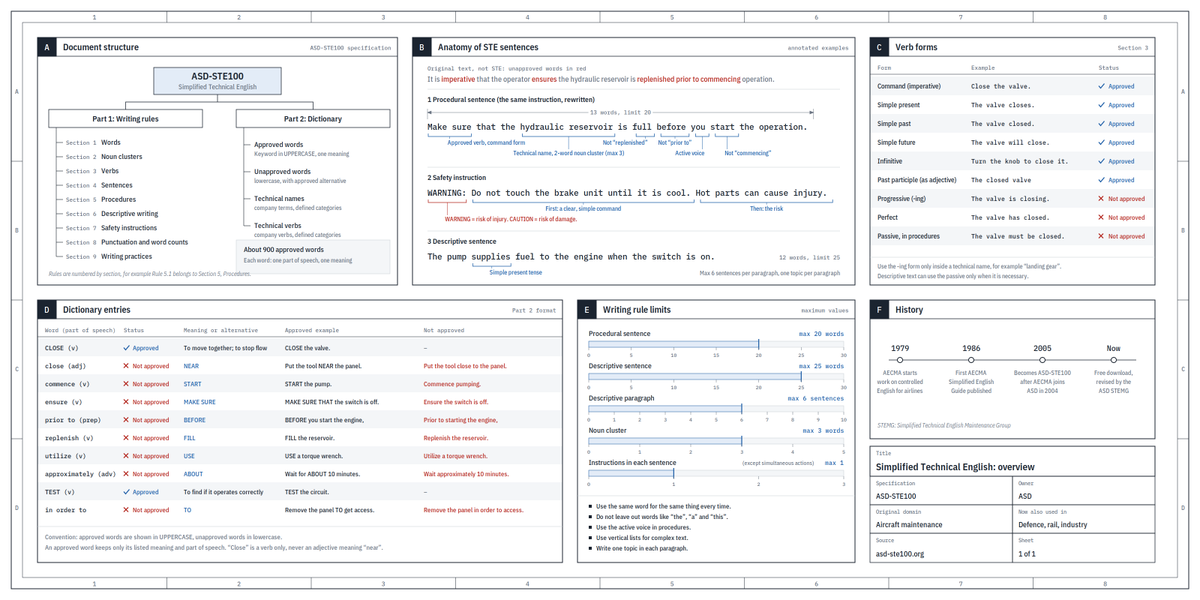
1. Writing: Ask AI to explain concepts using ASD-STE100, a controlled language standard designed for clear, simple technical writing. Even asking for “80% of ASD-STE100” can make explanations much easier to follow.
2. Diagrams: Sometimes, a visual beats a wall of text. Ask AI to turn complex ideas into diagrams or illustrations.
3. Web apps: Ask for an interactive HTML page instead of a written explanation. LLMs can now build surprisingly good interfaces, animations, and interactive experiences.
4. Explainer videos: This is where things get really interesting. Imagine generating a custom 3Blue1Brown-style video on virtually any topic, complete with visuals and AI narration.
The bigger shift?
As AI handles more of the execution, our role moves toward understanding, reviewing, and directing the output.
And when software becomes cheap to create, we can build custom tools, interactive explainers, and disposable apps that would never have been worth building before.
Stop limiting AI to text. Experiment with different output formats. You might be surprised by what’s possible.
Follow for more AI news, insights, and updates like this
Microsoft just introduced Decision-1, a model built for fast decision-making.
It outperforms LLMs and other decision models on structured tasks in both speed and quality.
They’re already testing it across incident response, quality control, and scientific discovery.
AI is moving beyond generating answers to making better decisions.
Follow for more AI news, insights, and updates like this.
Introducing Microsoft-Decision-1, our new model for fast decision-making.
It delivers top performance on structured decision tasks, outperforming both LLMs and other decision models in latency and quality.
We’re already testing it across Microsoft for everything from incident response and quality control to scientific discovery.
We’re entering a world where understanding AI outputs will matter as much as generating them.
A few ways to get more out of LLMs:
1. Writing: Ask AI to explain concepts using ASD-STE100, a controlled language standard designed for clear, simple technical writing. Even asking for “80% of ASD-STE100” can make explanations much easier to follow.
2. Diagrams: Sometimes, a visual beats a wall of text. Ask AI to turn complex ideas into diagrams or illustrations.
3. Web apps: Ask for an interactive HTML page instead of a written explanation. LLMs can now build surprisingly good interfaces, animations, and interactive experiences.
4. Explainer videos: This is where things get really interesting. Imagine generating a custom 3Blue1Brown-style video on virtually any topic, complete with visuals and AI narration.
The bigger shift?
As AI handles more of the execution, our role moves toward understanding, reviewing, and directing the output.
And when software becomes cheap to create, we can build custom tools, interactive explainers, and disposable apps that would never have been worth building before.
Stop limiting AI to text. Experiment with different output formats. You might be surprised by what’s possible.
Follow for more AI news, insights, and updates like this
We'll be spending a lot more time trying to understand the outputs of language models. A few thoughts, tips & tricks:
Writing. Something I've had success with: Ask your LLM to explain something in ASD-STE100, it's a controlled language specification originally developed for aerospace maintenance documentation. LLMs well-versed in this language and it comes with heavy constraints on clean writing style that I often find a lot more readable. Sometimes I've tried to soften it a bit e.g. ask for "80% of the way to ASD-STE100" because the spec is quite stringent. But even better:
Diagrams / images. Instead of writing, ask your LLM to create a diagram. These can be a lot easier to process, parse, and understand. But even better:
Web pages. Ask for output "in HTML" to get a beautiful, interactive webpage. LLMs are getting really good at frontend and can create beautiful experiences, animations, etc. But even better:
Explainer videos. The output format I am most bullish on is fully custom / bespoke explainer videos generated on any arbitrary topic. Experiment with things like "Create a 3b1b style video explainer on X. Use my ElevenLabs API key for audio narration". (you'd need an API key for the latter or you can ask your LLM to find you decent free alternatives that use your local compute). This is actually starting to work!
In summary:
- As LLMs get better, they will do more and more of the legwork autonomously, and a lot more of our work will rise up the abstractions into oversight and understanding.
- Luckily, LLMs can help here too because as intelligence and code are increasingly abundant, you can ask for large, custom, discardable software artifacts (e.g. web apps, video explainers) that would have never made sense to create before. Push the boundaries here and you'll be surprised.
Elon Musk predicts Tesla’s Optimus robot could become the world’s best surgeon within just 3 years 🤯
He also believes there could eventually be more highly capable robotic surgeons than human surgeons worldwide
If this prediction becomes reality, it could completely transform healthcare. But can robots really surpass the precision, judgment, and adaptability of the best human surgeons that quickly?
Follow for more AI news, insights, and updates like this
Claude can now turn your data into dashboards and your reports into animations 🤯
Anthropic just launched two new features in beta:
→ Claude Dashboards: Connect your data, ask questions in plain English, and get interactive dashboards with charts and live data updates.
→ Claude Motion: Turn reports, charts, and ideas into animated explainers you can edit and export as MP4s.
→ Every dashboard chart shows the SQL query behind it, so you can inspect how the numbers were calculated.
→ Motion is built with editable code, not an AI video generation model.
Availability:
• Dashboards: Paid Claude plans
• Motion: Team and Enterprise plans
They are moving from AI that generates answers to AI that creates the actual tools and visuals you need.
Follow for more AI news, insights, and updates like this.
Medical AI's first real breakthrough won't happen in hospitals—it'll happen with the everyday stuff people never bother seeing a doctor for.
Nolla Health is now the first US company cleared by regulators to let an AI prescribe meds solo, no physician required.
Their launch point? Acne treatment in Utah. Most sufferers there have never set foot in a dermatologist's office—not from lack of need, but because they simply never make it through the backlog.
The system covers everything end to end: diagnosis, prescribing, and follow-up care.
It was developed alongside researchers from Harvard, MIT, and Johns Hopkins, and has been running under clinician supervision for more than a year. Whenever a case looks uncertain, it automatically gets kicked up to a human.
Women's health is up next, with more specialties to follow after that.
The point isn't cutting doctors out of the picture. It's finally reaching all the people who were falling through the cracks to begin with.
Mark Zuckerberg shared a surprisingly wholesome conversation he had with his daughter after a Taylor Swift concert.
He had taken August to see Swift perform, and on the way home she told him she wanted to be like Taylor when she grew up.
Zuckerberg's response was:
“You can’t. That’s not available to you.”
August apparently sat with that for a moment.
Then she came back with a different idea.
She didn't want to grow up trying to be Taylor Swift.
She wanted to become someone other people would want to be like.
Someone called August Chan Zuckerberg.
And her dad's reaction?
“Hell yeah.”
Honestly, that's the part I find interesting.
She went to a concert inspired by someone she admired and came home thinking about creating her own identity instead.
Would you have answered your kid the same way?
Follow for more AI news, insights, and updates like this.
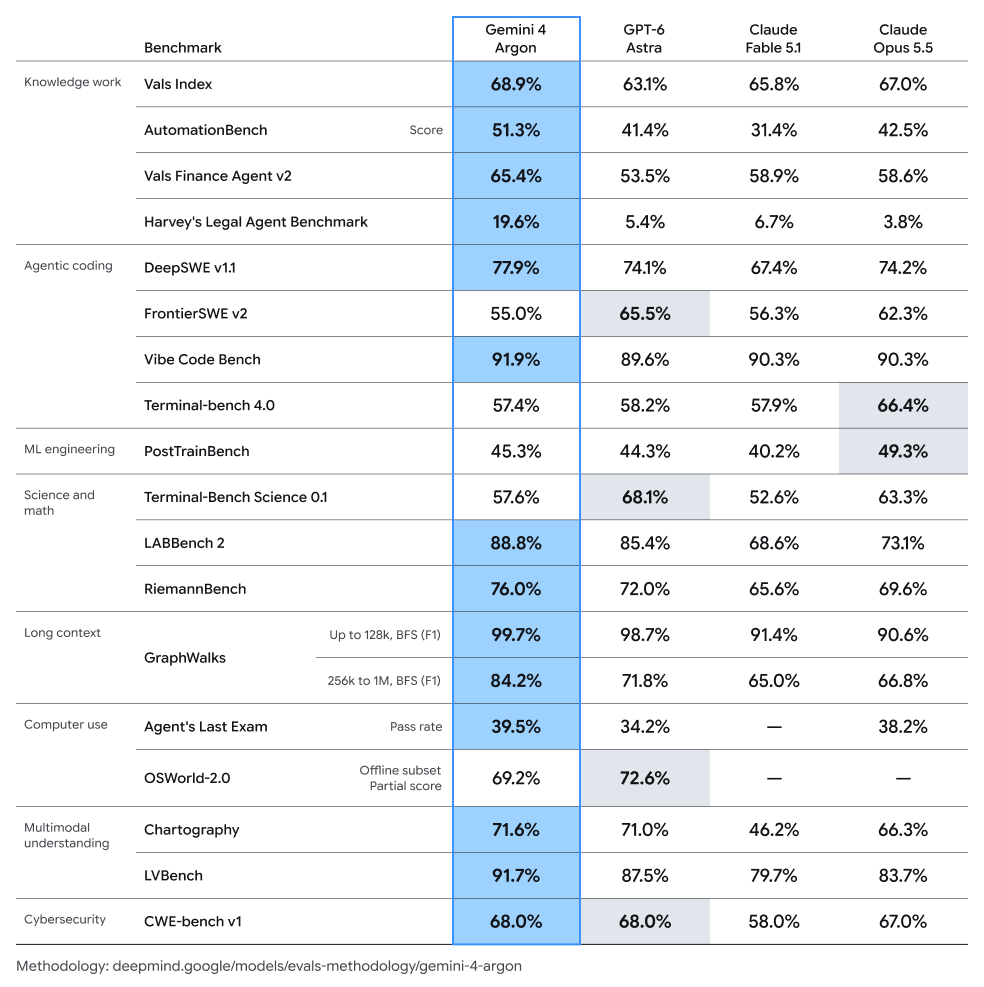
Google just dropped Gemini 4 Argon and the benchmark numbers are wild. 🤯
Google says Argon is its most capable model yet, built for long-horizon coding, research, enterprise work and cybersecurity.
Some of the numbers:
→ 77.9% on DeepSWE v1.1 — ahead of Claude Opus 5.5 (74.2%) and GPT-6 Astra (74.1%)
→ 51.3% on AutomationBench — #1 on the benchmark
→ 91.7% on LVBench for long-video understanding
→ 68% on CWE-bench v1 for vulnerability remediation — tied for #1
→ 1M-token output limit for extremely long-running tasks
→ Already being used inside Google for code migrations, debugging and data-center optimization
And Google says Argon agents have already helped free up 300+ TiB of memory across its data centers.
The interesting part?
This isn't just about answering questions anymore.
Argon is being built to take on long, multi-step jobs and actually finish them.
Follow for more AI news, insights, and updates like this.
What if OpenAI had never existed? Elon Musk says he helped make sure it did.
Musk has claimed that:
→ He contributed roughly $50M to the early organization
→ Google had a dominant share of the world's AI talent at the time
→ He repeatedly warned Larry Page about the potential dangers of advanced AI
→ A disagreement over human vs. machine consciousness became a turning point
→ He says he suggested the name OpenAI
→ His original vision was for an open-source, nonprofit AI lab
These are Musk's recollections, and some details of OpenAI's early history have been described differently by other people involved.
What is documented is that Musk was an OpenAI co-founder and early major financial supporter before leaving the organization.
Follow for more AI news, insights, and updates like this.
Google just sent AI chips into space to test whether the next generation of data centers could actually live in orbit.
On October 1, a SpaceX Falcon 9 carried Google's TPUs into orbit as part of the first test of Project Suncatcher.
Why space?
Solar panels in orbit could potentially generate up to 8× more power than on Earth.
The experiment is testing some serious challenges:
→ Can the chips survive launch forces reaching 50��100× Earth's gravity?
→ Can they handle radiation and extreme temperatures?
→ Can they stay cool? The current setup can run for only around 15 minutes before needing to cool down.
Google's next step is planned for 2027, with two more satellites.
The long-term vision?
AI compute clusters running in orbit.
But there's one massive hurdle:
Launch costs need to fall to roughly $200 per kg for the economics to make sense.
Are we looking at the beginning of the first generation of space-based AI data centers? 🚀
Follow for more AI news, insights, and updates like this.
Mark Zuckerberg was asked the question every AI skeptic wants answered: “Is AI going to kill us?”
His response:
“If we all do a good job and act responsibly, then no.”
Zuckerberg thinks much of the AI apocalypse narrative is exaggerated.
Instead of expecting the entire AI industry to coordinate on when to slow down, he believes each lab should take responsibility when it discovers serious problems.
Meta reportedly did this with Muse.
The company had a strong version months ago but chose to delay its release while it worked through privacy and security concerns.
And Zuckerberg's bigger prediction is interesting:
The next major AI breakthrough may not be better math or reasoning.
It may be trust.
Because even the most capable AI won't matter if people don't trust it enough to use it.
Follow for more AI news, insights, and updates like this.
Google just dropped Gemini 4 Argon and the benchmark numbers are wild. 🤯
Google says Argon is its most capable model yet, built for long-horizon coding, research, enterprise work and cybersecurity.
Some of the numbers:
→ 77.9% on DeepSWE v1.1 — ahead of Claude Opus 5.5 (74.2%) and GPT-6 Astra (74.1%)
→ 51.3% on AutomationBench — #1 on the benchmark
→ 91.7% on LVBench for long-video understanding
→ 68% on CWE-bench v1 for vulnerability remediation — tied for #1
→ 1M-token output limit for extremely long-running tasks
→ Already being used inside Google for code migrations, debugging and data-center optimization
And Google says Argon agents have already helped free up 300+ TiB of memory across its data centers.
The interesting part?
This isn't just about answering questions anymore.
Argon is being built to take on long, multi-step jobs and actually finish them.
Follow for more AI news, insights, and updates like this.
Introducing Gemini 4 Argon – our new frontier model.
It’s built for complex workflows across coding, enterprise knowledge work, and cybersecurity defense – rolling out today to a set of trusted testers through our Fairwind Program.