Serenity @aleabitoreddit has been digging into Korea’s AI supply chain.
But some of the most interesting names may simply be too small to talk about publicly.
I went down the rabbit hole and found 7:
$90M–$1.9B market caps.
HBM. Photonics. Testing. Materials.
Some are already on his radar. Others fit the same supply-chain thesis.
Here’s the map 🧵👇
First, the names Serenity has actually touched:
🔥 $138080 OE Solutions — ~$0.25B
Photonics / EML / CW Laser
800G/1.6T, EML and CW lasers → direct exposure to AI data center optics and CPO.
→ Serenity disclosed a position.
🔥 $093370 Foosung — ~$1.05B
WF₆ / Specialty Gas
WF₆ is critical for tungsten deposition. The thesis: memory expansion + potential supply constraints = bottleneck exposure.
→ Direct Serenity research; no position disclosed.
🔵 $322310 AUROS — ~$0.09B
HBM / Advanced Packaging Metrology
Hybrid bonding requires increasingly precise overlay control as packaging complexity rises.
→ Serenity previously owned it, then reduced exposure as hybrid-bonding timelines slipped.
Then there are the names further down the same supply-chain rabbit hole:
🟡 $104830 Wonik Materials — ~$0.30B
Specialty Gases
Samsung + SK Hynix supplier. Advanced DRAM/NAND → higher specialty-gas consumption.
🟡 $089030 Techwing — ~$1.29B
HBM Testing
HBM Cube Prober exposure. More stacked layers → greater testing complexity + higher yield-control value.
🟡 $357780 Soulbrain — ~$1.89B
Semiconductor Chemicals
High-purity etching and cleaning chemicals. More complex memory processes → greater material intensity per wafer.
⚪ $317330 Duksan Techopia — ~$0.19B
Semiconductor Precursors
HCDS, SiCl₄ and other deposition materials tied to DRAM/NAND capex.
The real hunt isn’t for “the next SK Hynix.”
It’s one layer deeper:
AI
→ HBM
→ Advanced Packaging
→ Testing
→ Materials
→ Photonics
Then look for the intersection of:
Small Market Cap × AI Revenue Inflection × Supply Bottleneck
The best picks-and-shovels businesses often sell something that represents only a tiny fraction of the final chip’s cost.
But if that component becomes scarce, billions of dollars of downstream capacity can get held up.
That’s what makes Korea’s AI semiconductor small-cap supply chain worth digging into.
🔥 Direct — explicitly researched / owned
🔵 Weakened — researched, but thesis weakened
🟡 Thematic — closely aligned with the research thesis
⚪ Candidate — supply-chain extension
I’ve actually entered positions in many tiny Korean companies recently…
That actively supply memory, test, machines, etc. to $MU, $SKHY, Samsung, and others like $SMTC + US companies.
It’s pretty interesting what you find in the $30-$250m range for optical components, CPUs, memory, and others that are inflecting due to AI.
I don’t share these names publicly since risks/volatility is enormous.
But one or two going from $40M -> $400m makes the risk/reward worth it for me personally.
The only core watchlist for the RWA + Stock Onchain cycle.
From $SECZ and $COIN to $ETH, $LINK, $UNI and ethereum:0xfaba6f8e4a5e8ab82f62fe7c39859fa577269be3 — this is the infrastructure stack we’ll be tracking as capital markets move onchain.
Save this map.
SEC Innovation Exemption Bags
The SEC’s Innovation Exemption opens a regulatory pathway for tokenized U.S. equities to enter onchain market structures.
Following the stack from Tokenization → Exchange → Settlement → Oracle → Liquidity → Credit, here are 7 stocks + 13 crypto assets on my watchlist.
Data as of Sep. 21, 2026, 17:00 UTC+8. Performance is measured from Sep. 17, the day the Innovation Exemption was issued.
STOCKS LIST
$SECZ | Tokenization / RWA | +21.6%
Securitize. One of the most direct tokenization infrastructure plays on this list, focused on bringing traditional securities onchain.
$COIN | Exchange / Infrastructure | +11.7%
Coinbase. Trading, custody and institutional infrastructure — with a potential long-term evolution from a crypto exchange into an Onchain Capital Markets Gateway.
$HOOD | Retail Distribution | +9.1%
Robinhood. A unified retail gateway for stocks, options and crypto, making it a natural distribution-layer exposure to TradFi → Onchain.
$BLSH | Crypto Exchange | +9.8%
Bullish. Institutional crypto trading infrastructure, with exposure to growing institutional trading and liquidity demand across digital markets.
$CRCL | Stablecoin | +7.9%
Circle. The USDC issuer. Its key exposure isn't tokenized stocks themselves, but the potential growth of Onchain Dollar Settlement infrastructure.
$MSTR | Crypto Treasury | +16.4%
Strategy. Less about tokenization infrastructure and more about regulatory clarity → institutional adoption → BTC demand. Think Crypto Asset Beta.
$BMNR | Crypto Treasury | +8.7%
BitMine. ETH treasury exposure and a second-order proxy for Ethereum's role as a programmable settlement layer.
CRYPTO LIST
$BTC | Monetary Asset | +6.3%
Less directly tied to tokenized equities, but a major proxy for broader Institutional Crypto Adoption as U.S. regulatory clarity improves.
$ETH | Settlement | +9.0%
The programmable settlement layer for smart contracts, tokenized assets and stablecoins — core infrastructure for the Onchain Capital Markets thesis.
$SOL | Execution | +11.6%
High-throughput, low-cost execution infrastructure with natural exposure to high-performance onchain financial markets.
$LINK | Oracle | +12.0%
The data and interoperability layer connecting TradFi with blockchains. Tokenized equities still need prices, corporate actions and real-world data delivered onchain.
solana:HZ1JovNiVvGrGNiiYvEozEVgZ58xaU3RKwX8eACQBCt3 | Oracle / Market Data | +8.9%
Real-time financial market data infrastructure, mapping directly to the growing demand for low-latency price feeds in onchain markets.
$UNI | AMM / Liquidity | +32.3%
One of the most interesting structural proxies. The SEC framework explicitly brings permissioned AMMs / liquidity pools into the tokenized-securities experiment.
solana:4k3Dyjzvzp8eMZWUXbBCjEvwSkkk59S5iCNLY3QrkX6R | AMM / Solana | +13.3%
Solana-native liquidity infrastructure. If more financial assets migrate to Solana, liquidity venues become a critical part of the stack.
solana:JUPyiwrYJFskUPiHa7hkeR8VUtAeFoSYbKedZNsDvCN | Aggregator / Trading | +24.8%
A major Solana trading and liquidity aggregation layer — essentially an Onchain Liquidity Aggregation play.
$AAVE | Credit | +15.6%
A second-order beneficiary of tokenized-asset financialization: Assets → Collateral → Lending → Onchain Credit
ethereum:0xfaba6f8e4a5e8ab82f62fe7c39859fa577269be3 | RWA / Tokenization | +14.7%
One of the clearest crypto-native RWA exposures, mapping directly to the long-term migration of traditional financial assets onchain.
$BP | Exchange / Distribution | +66.2%
The Backpack ecosystem token, representing crypto-native exchange, wallet and distribution infrastructure.
$AVAX | Blockchain Infrastructure | +46.6%
Institutional / RWA blockchain infrastructure, with exposure to customized execution environments for bringing financial assets onchain.
$ARB | Scaling / L2 | +27.6%
Ethereum scaling exposure. If more financial activity settles within the Ethereum ecosystem, L2s can provide the lower-cost execution layer.
From Sep. 17 → Sep. 21, the strongest performers on this watchlist were:
$BP +66.2%
$AVAX +46.6%
$UNI +32.3%
$ARB +27.6%
solana:JUPyiwrYJFskUPiHa7hkeR8VUtAeFoSYbKedZNsDvCN +24.8%
$SECZ +21.6%
One important distinction: Performance after the Innovation Exemption ≠ performance caused by the Innovation Exemption.
Four days is far too short to establish causality, especially with the broader crypto market moving at the same time.
What matters more is the infrastructure underneath this watchlist:
Tokenization → Distribution → Settlement → Execution → Oracle → Liquidity → Credit
If traditional securities increasingly become programmable onchain assets, these are the layers that need to be rebuilt — and potentially repriced.
I’ll keep tracking this watchlist as the Onchain Capital Markets thesis develops.
“Exposure” refers to our industry-chain mapping, not SEC endorsement of any company, protocol or token. Not investment advice.
Something changed after the US open.
Yields remain elevated. Tech remains under pressure. But crypto stopped following the selloff.
$BTC: $85.4K → $82.9K → $84.2K
The first move was simple: Higher yields → risk-off → long liquidation.
Then BTC started rejecting the lows.
It has now bounced ~1.5% from $82.9K, even as the pressure on US equities remains.
That’s the signal.
Earlier: Rates ↑ → Tech ↓ → Crypto ↓
Now: Rates ↑ → Tech weak → BTC bouncing
Not a full risk-on reversal yet. But the correlation is starting to break.
If BTC reclaims $85K while Nasdaq and semis remain weak, the divergence becomes much harder to ignore:
Crypto may be trying to lead the next risk-on rotation.
Watch the divergence, not the headline.
Quick update on Burry’s AI Big Short:
Here’s how his publicly traceable shorts are looking now:
$CAT +24.1% 🟢
$SOXX +11.4% 🟢
$ORCL +5.7% 🟢
$MU -0.2% ⚪
$NBIS -6.4% 🔴
$PLTR -7.3% 🔴
The interesting part:
His infrastructure shorts are starting to work, while some of his higher-beta AI shorts remain underwater.
And instead of covering, Burry added to $MU, $NBIS, $SOXX and $PLTR on 9/22.
The P&L is starting to move. The thesis is still being tested.
Estimated from publicly disclosed reference entry prices; not Burry’s actual portfolio P&L.
BREAKING: Michael Burry is shorting the AI boom.
His $NVDA + $PLTR puts once topped $1B in notional exposure.
And his shorts now span the AI stack.
The bet?
Depreciation. Debt. Overcapacity.
Here’s Burry’s AI Big Short — and what he thinks breaks first.
🧵
The next question is simple: what happens if the bad macro stops getting worse?
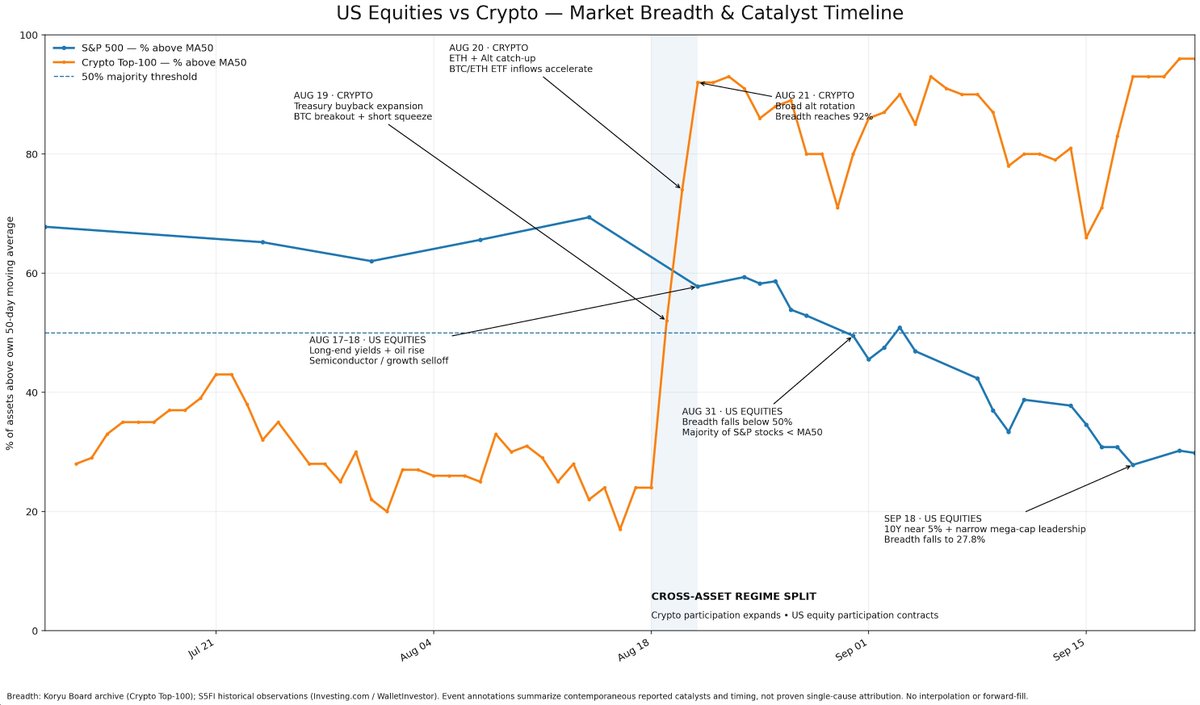
Crypto breadth has already expanded from 24% to 90%+ despite elevated Treasury yields.
If yields remain high but crypto stops reacting negatively, the macro headwind may already be getting priced in.
That’s when things get interesting.
This is why charts and signals are so fascinating.
Two months ago, crypto and U.S. equities were telling opposite stories.
In July:
U.S. stocks: ~70% above the 50DMA
Crypto Top 100: 28%
By September:
U.S. stocks: 30%
Crypto: 96%
The two markets had almost completely swapped places.
And the real reversal happened in just a few days.
Justin: Securitize in partnership with ARK Invest, has tokenized the ARK Venture Fund (ARKVX) and made it available on Ethereum.
Eligible investors access the tokenized version of ARK’s flagship disruptive innovation fund with a minimum investment of $500.
SEC Innovation Exemption Bags
The SEC’s Innovation Exemption opens a regulatory pathway for tokenized U.S. equities to enter onchain market structures.
Following the stack from Tokenization → Exchange → Settlement → Oracle → Liquidity → Credit, here are 7 stocks + 13 crypto assets on my watchlist.
Data as of Sep. 21, 2026, 17:00 UTC+8. Performance is measured from Sep. 17, the day the Innovation Exemption was issued.
STOCKS LIST
$SECZ | Tokenization / RWA | +21.6%
Securitize. One of the most direct tokenization infrastructure plays on this list, focused on bringing traditional securities onchain.
$COIN | Exchange / Infrastructure | +11.7%
Coinbase. Trading, custody and institutional infrastructure — with a potential long-term evolution from a crypto exchange into an Onchain Capital Markets Gateway.
$HOOD | Retail Distribution | +9.1%
Robinhood. A unified retail gateway for stocks, options and crypto, making it a natural distribution-layer exposure to TradFi → Onchain.
$BLSH | Crypto Exchange | +9.8%
Bullish. Institutional crypto trading infrastructure, with exposure to growing institutional trading and liquidity demand across digital markets.
$CRCL | Stablecoin | +7.9%
Circle. The USDC issuer. Its key exposure isn't tokenized stocks themselves, but the potential growth of Onchain Dollar Settlement infrastructure.
$MSTR | Crypto Treasury | +16.4%
Strategy. Less about tokenization infrastructure and more about regulatory clarity → institutional adoption → BTC demand. Think Crypto Asset Beta.
$BMNR | Crypto Treasury | +8.7%
BitMine. ETH treasury exposure and a second-order proxy for Ethereum's role as a programmable settlement layer.
CRYPTO LIST
$BTC | Monetary Asset | +6.3%
Less directly tied to tokenized equities, but a major proxy for broader Institutional Crypto Adoption as U.S. regulatory clarity improves.
$ETH | Settlement | +9.0%
The programmable settlement layer for smart contracts, tokenized assets and stablecoins — core infrastructure for the Onchain Capital Markets thesis.
$SOL | Execution | +11.6%
High-throughput, low-cost execution infrastructure with natural exposure to high-performance onchain financial markets.
$LINK | Oracle | +12.0%
The data and interoperability layer connecting TradFi with blockchains. Tokenized equities still need prices, corporate actions and real-world data delivered onchain.
solana:HZ1JovNiVvGrGNiiYvEozEVgZ58xaU3RKwX8eACQBCt3 | Oracle / Market Data | +8.9%
Real-time financial market data infrastructure, mapping directly to the growing demand for low-latency price feeds in onchain markets.
$UNI | AMM / Liquidity | +32.3%
One of the most interesting structural proxies. The SEC framework explicitly brings permissioned AMMs / liquidity pools into the tokenized-securities experiment.
solana:4k3Dyjzvzp8eMZWUXbBCjEvwSkkk59S5iCNLY3QrkX6R | AMM / Solana | +13.3%
Solana-native liquidity infrastructure. If more financial assets migrate to Solana, liquidity venues become a critical part of the stack.
solana:JUPyiwrYJFskUPiHa7hkeR8VUtAeFoSYbKedZNsDvCN | Aggregator / Trading | +24.8%
A major Solana trading and liquidity aggregation layer — essentially an Onchain Liquidity Aggregation play.
$AAVE | Credit | +15.6%
A second-order beneficiary of tokenized-asset financialization: Assets → Collateral → Lending → Onchain Credit
ethereum:0xfaba6f8e4a5e8ab82f62fe7c39859fa577269be3 | RWA / Tokenization | +14.7%
One of the clearest crypto-native RWA exposures, mapping directly to the long-term migration of traditional financial assets onchain.
$BP | Exchange / Distribution | +66.2%
The Backpack ecosystem token, representing crypto-native exchange, wallet and distribution infrastructure.
$AVAX | Blockchain Infrastructure | +46.6%
Institutional / RWA blockchain infrastructure, with exposure to customized execution environments for bringing financial assets onchain.
$ARB | Scaling / L2 | +27.6%
Ethereum scaling exposure. If more financial activity settles within the Ethereum ecosystem, L2s can provide the lower-cost execution layer.
From Sep. 17 → Sep. 21, the strongest performers on this watchlist were:
$BP +66.2%
$AVAX +46.6%
$UNI +32.3%
$ARB +27.6%
solana:JUPyiwrYJFskUPiHa7hkeR8VUtAeFoSYbKedZNsDvCN +24.8%
$SECZ +21.6%
One important distinction: Performance after the Innovation Exemption ≠ performance caused by the Innovation Exemption.
Four days is far too short to establish causality, especially with the broader crypto market moving at the same time.
What matters more is the infrastructure underneath this watchlist:
Tokenization → Distribution → Settlement → Execution → Oracle → Liquidity → Credit
If traditional securities increasingly become programmable onchain assets, these are the layers that need to be rebuilt — and potentially repriced.
I’ll keep tracking this watchlist as the Onchain Capital Markets thesis develops.
“Exposure” refers to our industry-chain mapping, not SEC endorsement of any company, protocol or token. Not investment advice.
⚠️ A macro regime shift is underway.
The pressure is now visible across markets:
🔴US 10Y → 5.11% ↑
🔴DXY → 101.10 ↑
🔴S&P 500 → 7,706 ↓
🔴Bitcoin → $84.4K ↓
Higher yields. Stronger dollar. Risk assets weakening.
Yet liquidity hasn’t fully rolled over:
🟢Stablecoin supply is still expanding
🟢BTC ETF flows remain positive
🟢VIX is still below 20
Macro is tightening before liquidity fully retreats.
That divergence is what we’re watching now.
한국 투자자 여러분, 안녕하세요 🇰🇷
Serenity(@aleabitoreddit)가 최근 **한국 AI 반도체 공급망**을 깊게 파고 있습니다.
그런데 시가총액이 너무 작아서 공개적으로 언급하기 어려운 종목들이 있다면, 어쩌면 이 리스트 안에 있지 않을까요?
제가 그의 리서치 흐름을 따라가며 7개 종목을 추려봤습니다:
$138080 OE Solutions
$093370 Foosung
$322310 AUROS
$104830 Wonik Materials
$089030 Techwing
$357780 Soulbrain
$317330 Duksan Techopia
**HBM → Advanced Packaging → Testing → Materials → Photonics**
한국 투자자분들이 보시기엔 어떤가요?
빠진 종목이 있다면 알려주세요. 👇
I’ve actually entered positions in many tiny Korean companies recently…
That actively supply memory, test, machines, etc. to $MU, $SKHY, Samsung, and others like $SMTC + US companies.
It’s pretty interesting what you find in the $30-$250m range for optical components, CPUs, memory, and others that are inflecting due to AI.
I don’t share these names publicly since risks/volatility is enormous.
But one or two going from $40M -> $400m makes the risk/reward worth it for me personally.
Breaking: Anthropic completes leap from computational biology to wet-lab experiments in under six months, unveiling first AI-driven fundamental biology result — a novel enzyme system resembling CRISPR
Claude has discovered a previously unknown enzyme system hidden in the DNA of bacteriophages. Beside the enzyme’s gene sits a long array of repeating DNA—a structure that looks somewhat similar to CRISPR.
We don’t yet understand what this system does, but only a handful of known systems share its features, and all of them are able to cut, copy, and paste DNA. Historically, the discovery of such programmable systems has helped revolutionize medicine. CRISPR, for instance, is now the foundation of genetic medicines. But it will take much more work to learn what this system does, and whether it can be put to similar use.
Read more: https://t.co/RuEosScSMb
Went down the Korea rabbit hole after reading your work.
Beyond OE Solutions / Foosung / AUROS, I found a few smaller names that seem to fit the same AI bottleneck / picks-and-shovels framework:
$104830 Wonik Materials — specialty gases
$089030 Techwing — HBM testing
$357780 Soulbrain — semiconductor chemicals
$317330 Duksan Techopia — precursors
Curious if any of these have crossed your radar.
The NVIDIA Accelerated Quantum Research Center (NVAQC) will have its first on-premise quantum computing deployment: an IonQ Superion 256 system.
“We see this as the beginning of an exciting era of hybrid quantum-classical computing," says our CEO @NiccoloDeMasi.
The NVAQC is designed to address the fundamental challenges of scaling quantum processors into a new class of accelerated quantum supercomputers.
Connecting IonQ’s full-stack quantum systems directly with @nvidia AI infrastructure will help drive the breakthroughs needed to turn qubits into useful, large-scale quantum supercomputers capable of solving the world's hardest problems.
Our quantum processing system will link directly with an NVIDIA GB200 NVL72 system via NVIDIA NVQLink. Workloads will be orchestrated by the open NVIDIA CUDA-Q platform.
Read the full announcement → https://t.co/YE1CUhe0CD
#IonQ #QuantumIsNow #QuantumComputing #QPU
BREAKING: Michael Burry is shorting the AI boom.
His $NVDA + $PLTR puts once topped $1B in notional exposure.
And his shorts now span the AI stack.
The bet?
Depreciation. Debt. Overcapacity.
Here’s Burry’s AI Big Short — and what he thinks breaks first.
🧵
4/
Then there’s $PLTR: A bet against extreme expectations.
And $QQQ: A bet that the risk has spread beyond individual AI names.
Burry trimmed shorter-dated NVDA / PLTR puts on 9/9.
Then on 9/22, he added shorts in:
$MU $NBIS $SOXX $PLTR
The trade is evolving.
The thesis isn’t.
Burry isn’t betting against AI.
He’s betting that Wall Street has wildly overpriced the returns on AI spending.
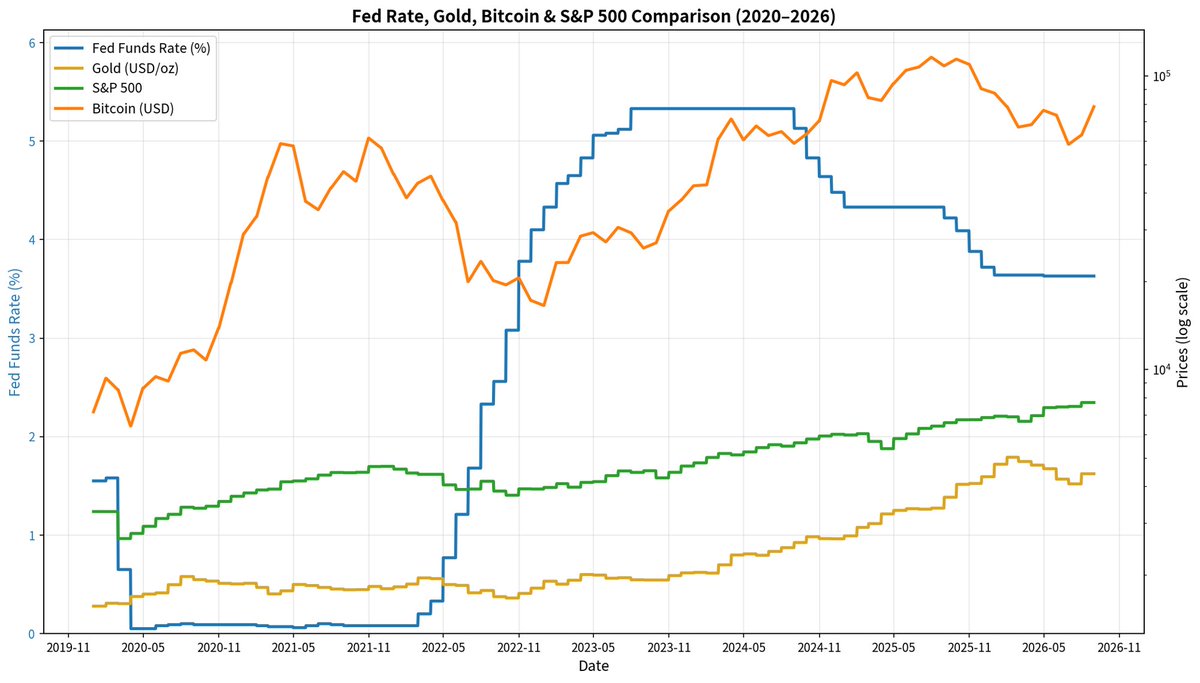
Every finance textbook says a 5% risk-free rate will crush risk assets.
Yet tech giants ARE printing ATHs, and $BTC shows zero respect for the Fed’s tightening.
The playbook didn’t break—it evolved. We’re watching a high-stakes liquidity tug-of-war that mirrors 1995 far more than 1999.
Here is why high rates can't kill this tech boom, and why $NVIDIA is not $Cisco🧵👇
High rates don’t always kill risk assets.
When AI earnings surprise, cut expectations stay alive, deficits rise, and ETF/institutional buying continues — stocks, gold, and $BTC can keep climbing.
It’s the path of rates (and real rates) that matters most.