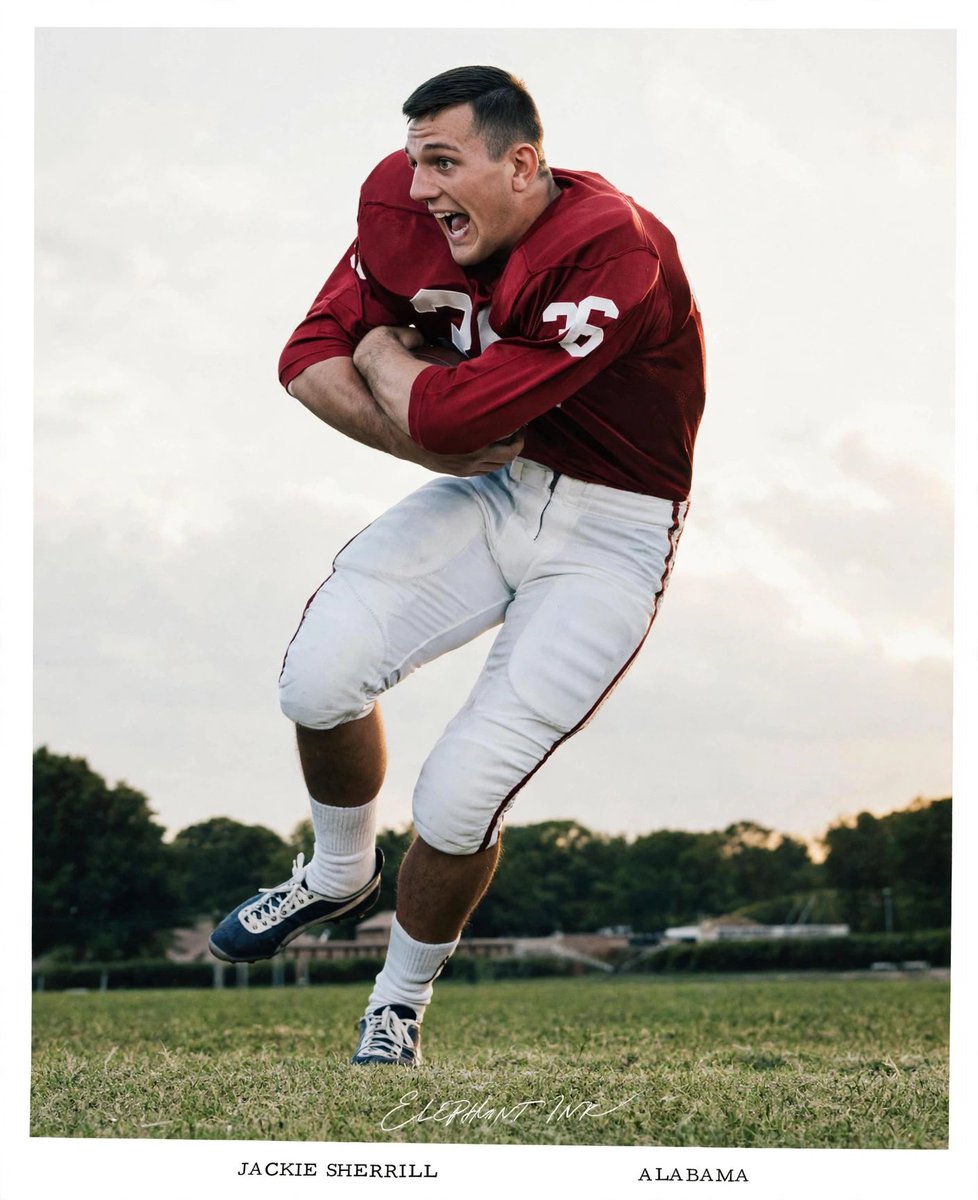
JACKIE SHERRILL
Before he became the coach, he was one of Coach Bryant’s players.
When I look back through Alabama football history, I’m reminded that some stories keep growing long after a player takes off his uniform.
Jackie Sherrill’s is one of those stories.
Before the head-coaching jobs, the championships, and the familiar place on the opposite sideline, Jackie was a young man learning the game under Coach Paul “Bear” Bryant.
His Alabama years ran from 1962 through 1965, and he was part of the Crimson Tide’s 1964 and 1965 national-championship teams. He later stayed to serve as a graduate assistant under Bryant in 1966.
The Mississippi Sports Hall of Fame credits him with playing seven different positions at Alabama. That is a remarkable reminder of how many ways one player could be asked to contribute.
Football eventually took him to head-coaching jobs at Washington State, Pittsburgh, Texas A&M, and Mississippi State. Across 27 seasons, his teams won 180 games.
But the part of his story that means the most to me today is not another number.
Jackie is still with us—and in a November 16 interview, he was talking about helping fourth- through sixth-graders learn football in Bryan, Texas. After all those years leading college programs, he is still finding satisfaction in watching a young player gain confidence and begin to understand the game.
I love that.
The stadium changes. The players get younger. But there is still something worth giving.
Now comes an honor that brings his story back to where so much of it began.
Jackie has been selected to receive the 2027 Paul “Bear” Bryant Lifetime Achievement Award. The ceremony is scheduled for January 27, 2027, in Houston.
His response says more than I could:
“Coach Bryant shaped my life as a player, a coach and a person. I’ve always believed that success is measured by the people you help develop and the relationships you build along the way.”
That is the connection I want to recognize.
Not simply a former Alabama player who became a successful coach, but someone who carried those early lessons into a lifetime of teaching—and is still sharing the game with another generation.
Congratulations, Coach Sherrill. Your football journey took you many places, but your Alabama chapter will always be part of the story.
Roll Tide.
— Elephant Ink
Nineteen straight years, the old people of a tiny Japanese village lost a tug-of-war.
This summer, Texas sent them an offensive line.
The village sits high up in Iwate, in northern Japan. 212 people. Every August, for about 400 years, it has held a tug-of-war. Upper village against lower village. The rope is 200 feet long and braided by hand from rice straw. It weighs roughly what a pickup truck weighs.
Legend says if the upper village wins, the rice harvest will be good.
The upper village has not won since 2006.
Their young people moved to Tokyo. The average age on the upper side of the rope is now 77. The lower side has a fire station.
My great-uncle, Mr. Sakuraba, is 91. He has pulled on that rope in 74 festivals. Every year he takes the very last spot, the anchor, and ties the tail of the rope around his waist. Every year, for nineteen years, he has been dragged across the line on his backside.
He says he would like to win once more before he dies. He has been saying this since he was 72.
The last time they won, in 2006, his wife was waiting at the line with a towel and a thermos of tea. She passed the next spring. Every year since, he has tied that rope around his waist and tried to win one for her.
The village's English teacher is a young man from West Texas named Cade. Last spring, my great-uncle explained the situation to him, mostly by pointing, plus a drawing of a sad rope.
Cade played left tackle in high school.
He made one phone call. To his old coach.
Coach Buford, 63, heard the whole story without saying a word. Then he said, "How heavy is the rope?"
His town back in Texas raised $14,000 in one weekend. Brisket plates. Ten dollars each. A church sold pies. A man auctioned his own deer stand.
In August, Coach Buford stepped off a bus in rural Iwate with five of his offensive linemen.
The smallest one weighed 270 pounds. The biggest was a 310-pound sophomore everybody calls Tater.
Tater almost didn't come. His granddaddy died in March. That man put him on a tractor at nine and showed him how to pull a truck out of a ditch at twelve. Tater hadn't said much since. His mom made him go.
Nothing like them had ever been seen in the village. The children followed them around in a silent group, like ducklings following a building. Every doorway in the village is about six feet tall. In one week, Tater's forehead met every single one. He apologized to each door.
The grandmothers decided the boys were too thin. They were not too thin. They were fed anyway. Five bowls of rice at breakfast. Tater cried at the pickles. Happy tears. Nobody is sure why.
Coach Buford studied the rope like game film. He watched nineteen years of festival videos. He drew diagrams. He made the 80-year-olds do drills. The grandfathers loved it. Nobody had yelled at them since their own fathers. An 84-year-old grandmother did eleven up-downs, asked for more, and has asked for more every day since. He taught the whole upper village to get low.
The lower village sent a spy to watch practice. The spy was 79. He stayed for lunch.
On festival night, the lower village lined up. Sixty men. The fire station.
The upper village lined up. Seventy grandparents. Five teenagers from Texas. And at the very back, rope tied around his waist, my great-uncle.
Before the signal, Coach Buford went down the line and told his boys one thing.
"You don't pull with your arms, son. You pull for whoever's behind you."
Tater turned around and looked.
Way down at the far end stood my 91-year-old great-uncle. Eyes closed. Praying. A skinny old farmer with big hands and a rope around his waist.
Tater told me later he looked exactly like somebody.
The drum hit.
It took four minutes. For the first two, nothing moved. The rope groaned. Somebody's grandmother lost a sandal.
Then Tater yelled something in his huge Texas voice. "DOWN! SET! HUT!"
And the whole upper village, seventy old people with no idea what it meant, yelled it back.
"HUT!"
The rope moved. One step. Then three. Then the entire lower village, fire station and all, came sliding across the line.
Nineteen years.
My great-uncle sat down in the dirt, still holding the rope. He tipped his head back toward the evening clouds and said one sentence to his wife.
"Sorry. Nineteen years late."
Then he cried. Then Tater lifted him up onto his own shoulders, all 91 years of him, and carried him around the festival grounds while both villages cheered. Even the lower side. Especially the lower side.
Underneath him, Tater was crying too. Six foot five, 310 pounds, sobbing, with a 91-year-old man's knees around his ears.
The lower village's captain walked over, bowed to Coach Buford, and said in careful English:
"Next year, we are bringing Oklahoma."
Coach Buford laughed until he wheezed.
At the end of the festival, it's tradition to cut a piece of the rope and take it home for luck. Each of the five boys took one.
Tater's piece is nailed to the wall of their locker room in Texas now. Under it, a sign in black marker:
PULL FOR WHOEVER'S BEHIND YOU.
They went 10 and 0 in the regular season.
The rice harvest was very good.
And every Saturday morning, on his grandson's iPad, a 91-year-old rice farmer in northern Japan watches Friday night football from Texas.
He doesn't understand the rules.
He gets to his feet whenever the offensive line moves. On every single snap, he yells the only football word he knows. "HUT!"
After every game, his phone rings. A big voice from Texas.
My great-uncle has learned exactly one more English word. He says it every time he picks up.
"Tater."
And a 310-pound boy in Texas always answers with two.
"Hey, Granddaddy."
Have a great weekend everyone! New show tickets on SALE now. Go to https://t.co/ZN2MVgrZ7d for upcoming shows and get your tickets. #ronwhite#standupcomedy#tatersalad#comedy
OTD 1977: While battling the flu and a 103-degree fever, my pops showed the world what heart, toughness, and determination look like. 40 carries. 275 yards. A then-NFL single-game rushing record.
That’s a different kind of toughness. That’s Sweetness. 🐻⬇️
#Bears@walterpayton
Jeffery Simmons does not play in Nashville anymore, and he spent part of his bye week this month inside a juvenile detention facility there anyway.
His foundation put the pictures out. He is sitting at a round table in a room with painted cinder block walls, arms folded, talking to a group of young men in grey.
Chicago traded for him in late October, so this was his first week off since. He could have gone anywhere and done nothing, which is what a bye week is for.
He went back to Tennessee and walked into that building.
None of this is new for him. The Nashville Juvenile Detention Center, the one that sits next to the stadium he played in for seven years, is listed as a partner of his foundation. He has been going in there for years.
In November of 2024 he went with about twenty other people from the Titans. They ate lunch with the kids, walked the building, saw the cells and the classrooms and the showers. Jelly Roll organised it, because he had been held in that same facility himself as a teenager.
One of the kids recorded a song in a studio Jelly Roll had paid to put in the building. One of the Titans got into a push up contest with another one.
Simmons spent about thirty minutes of it sitting with one teenager.
Jim Wyatt of the Titans website asked him about it afterward. He said it was heart touching and that it had left him close to speechless. Then he said the other thing.
"One decision can change your whole life."
He has been the Titans nominee for the Walter Payton Man of the Year award three years running. The list of what he does is long enough to be tedious. A football camp and a mental health session for about sixty students from the Martha O'Brien Center. A campaign where he pledged 980 dollars of his own money for every sack he recorded, to fund students in a program called HERO. Fishing days and suit fittings through Big Brothers Big Sisters. Turkey drives. Christmas shopping sprees. Honorary chair of a pediatric cancer fundraiser. Visits to the children's hospital.
Asked about the award in December, he did not seem interested in it.
"I don't do this for the publicity, and the awards that come with it."
He is 29 years old, in the middle of his first season with a new team, in a new city, learning a new defense, with two first round picks worth of expectation sitting on him.
He got one week off in the middle of all that, and he gave a piece of it to a room full of kids in a city that is not his job anymore.
Tomas Valincius could be one of the first names called in the 2027 #MLBDraft.
The @HailStateBB LHP went 11-2 with a 3.50 ERA and 134 strikeouts against just 20 walks in 97 2/3 innings last year. His combination of stuff, performance and pitchability gives him a sky-high ceiling.
"The decision was already made in all honesty. There was never a doubt in my mind, there was never even options for me to leave here."
Mississippi State QB Kamario Taylor speaks about his decision to return for the 2027 season 🏈
Love this 2022 clip of Gerald McRaney talking about what an incredible human being The Rockford Files star James Garner really was! Garner was famous for standing up for people—he even went toe-to-toe with Charles Bronson on the set of The Great Escape and nearly came to blows to force Bronson to pay up after disrespecting a young extra. Standing up to Charles Bronson was no easy task! 👍
Tom Selleck has commented about how great Garner was to people. Selleck got his big break with a guest shot on Rockford Files, which led to Magnum PI. He was so impressed with how generous and kind Garner was to everyone on the set and tried to emulate him with his own Magnum set.
via @RichEisenShow
BREAKING: Kamario Taylor is finalizing a $7.5M deal to return to Mississippi State in 2027, making him college football's highest-paid QB, @PeteNakos and @Clowfb report.
With incentives, the deal could potentially climb above $9 million.
https://t.co/LnYzUBfCLY
"I saw your wife on television too. She sure is an ugly bitch”
BREWSTER’S MILLIONS (1985)
JOHN CANDY nailing it — as ever — in this RICHARD PRYOR hit comedy.