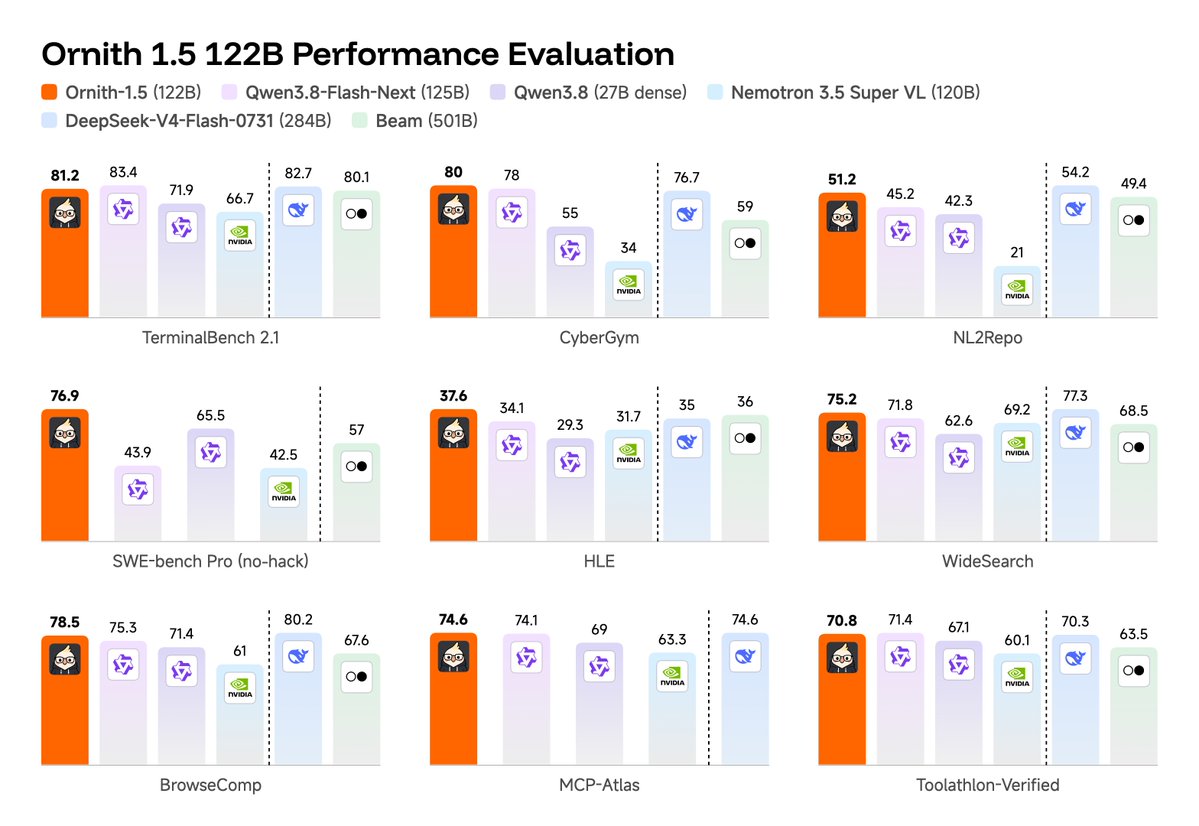
Aloha!🌺 Meet Ornith-1.5-122B: No Tradeoff Between Strong and Fast
Stronger. Faster. Leaner. Ornith-1.5-122B delivers frontier-level capabilities with exceptional inference efficiency. With superior instruction following, stronger task decomposition, and deeper understanding of real-world workflows, it achieves state-of-the-art performance among open-source models of comparable size, while running on a single NVIDIA DGX card!!
Open weights under the MIT license.
Coding
✅SWE-bench Verified: 0.845
✅TB2.1: 0.813
✅CyberGym: 0.800
✅NL2Repo: 0.512
Agentic
✅HLE: 0.446
✅BrowseComp: 0.785
✅MCP-Atlas: 0.746
✅Toolathlon: 0.708
🤗Hugging Face: https://t.co/w1hD6rra1o
We can’t wait to see what you build with Ornith-1.5-122B.
🚀 Introducing DeepInfer, our in-house inference framework, now fully open source!
Powering DeepSeek-V4.1-Flash at scale with high throughput and low latency. We’re sharing our production stack to help the community lower compute costs, reduce energy use, and make AI more affordable.
🔗 https://t.co/JGAik1kgk0
1/4
Dusting off this tweet from April because this gap in shared understanding of LLM capability is *widening*. It's now less "two groups of people speaking past each other" and more a sharp funnel.
- Napkin math somewhere around 6B people (~75% of the population) have barely come in contact with LLMs at all.
- Around 1-2B (~20%) are casual and infrequent users of free-tier ChatGPT-like products. This group sees derpy chatbots and treats them a bit like a better Google search, a writing aid, or etc. Maybe an agent tries to book you a flight. I have non-tech friends who (reasonably, imo) say they have not much use for it at all. Even many professionals outside of math&code are in this tier. For example, execs and many other functions spend a lot of their time talking to other people, so while they understand what is happening intellectually, it is still second-hand and a bit abstract.
- Now we get to professional use of frontier-grade LLMs in math&code. Somewhere around 20M people (0.2%) see first-hand that large, complex projects that used to take them weeks/months can now be completed by agents with a prompt. Building apps, copying apps, translating apps, decompiling apps from binaries... This has all happened very quickly and recently - less than 1 year ago, I was writing code manually by hand, typing memorized computer code commands into a code editor character by character, occasionally pressing Tab to autocomplete a little chunk of code.
- And finally we get to the ~5,000 people (~0.00006%) with access to frontier-grade systems internally. The external world has seen the preview. It looks like swarms of thousands of agents collaborating over weeks on software mega projects: minting zero days, running cyber attacks and defenses at machine speeds, discovering new science, advancing the frontier of mathematics. Things that would have taken top professionals in the industry years of work. Meanwhile, human review and comprehension are starting to fall behind. For example, people are still involved in the "archeology" of the OpenAI-HF incident from many months ago. Mathematicians may be poring over the 722 manuscripts on frontier mathematics for a while.
The funnel is driven by a combination of factors:
1. The impact scales with ambition, problem size, and horizon. A question with a paragraph answer barely stresses the system. You need a reservoir of big, difficult problems that you really care about. This aspect drives the consumer / professional dimension of the funnel.
2. The jaggedness of the system (which I have written about a lot separately). Capability peaks in domains that are digital, verifiable and economically valuable. This is because LLM capability emerges from reinforcement learning on verifiable rewards on a curated environment mixture driven by revenue potential. This aspect primarily drives the area (e.g. math&code) dimension of the funnel.
3. Access. Free-tier, paid-tier, internal.
So this is the weirdness of the moment. The general public has mostly not interacted with these systems. When they have, it looks like a derpy chatbot. The majority of professionals still see only a modest uplift. And a small sliver of professionals are experiencing the vertigo of the curve going vertical. And it is all happening at the same time.
I've published a new, general-purpose terminal specification that gives any program a way to tell the terminal what it's doing: idle, working, waiting, finished, or failed, and why. It is easy to implement on both sides. I've written more about why: https://t.co/2FfzNC3F8T
The problem this solves is generic and applies in compelling ways to all sorts of use cases (e.g. package managers, build tools), but it really rears a hideous head when it comes to AI and the "agentic inbox" problem.
I found over 250 different agent orchestrators (with various goals) that all individually implement a heuristic based approach to detecting whether things like Claude Code are working, blocked, done, etc.
If you look at @herdrdev's commit history, you can see around 10 compatibility changes to detect Claude Code within just the past 3 months. (This isn't a dig at Herdr! They're doing great work with what they have, and everyone else is doing the same thing).
Heuristics are not the way. And over-indexing on agentic use cases isn't the way, because this problem is really interesting for other tools too: Homebrew, Terraform, Cargo, etc. etc.
Proprietary protocols and out of band APIs are not the way. They have an O(N) integration problem and require extra work to work over SSH or within local VMs/containers.
The program status specification (OSC 7501) solves this in a reliable, deterministic way that is general-purpose and can be easily adopted by the entire industry.
Read more: https://t.co/2FfzNC3F8T
a weird inversion with LLMs is the models improve faster than the tinkerers
when i see people with custom workflows and setups they're all addressing problems that don't exist anymore
the person naively using vanilla codex is more likely to be experiencing state of the art
Nice model release.
Text, images, audio, and video in a single shared embedding space.. very handy for RAG and many other applications.
And Apache 2.0 licensed..
https://t.co/2sF1lpNoXi
All the grifters are completely wrong about Jev’s architecture so I decided I’d release an open-weight version. BUT training takes time, so while we all wait I decided I’d drop the sauce.
https://t.co/TK9FIiUxAJ
The right question for now isn’t “how do we generate more code?” It’s “how do we actually understand more of what we’re shipping?”
https://t.co/syaByLnqk7
We built giant probabilistic machines.
Now we wrap them in workflows:
skills, templates, verifiers, harnesses.
The promise was intelligence.
Production wants predictability and control.
If this is the way,
at least optimize the skills layer.
https://t.co/z9yoE7FAQr
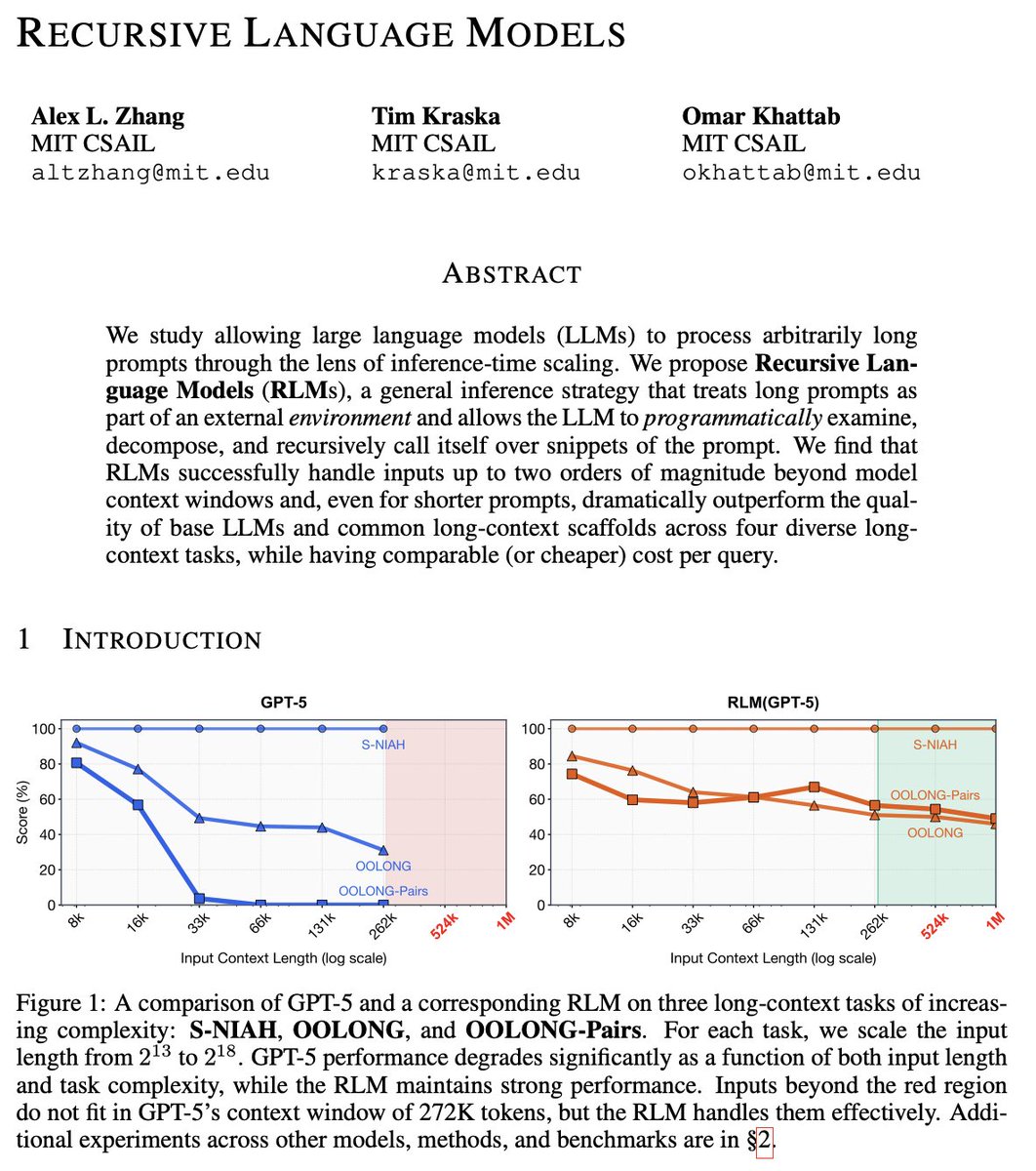
Much like the switch in 2025 from language models to reasoning models, we think 2026 will be all about the switch to Recursive Language Models (RLMs).
It turns out that models can be far more powerful if you allow them to treat *their own prompts* as an object in an external environment, which they understand and manipulate by writing code that invokes LLMs!
Our full paper on RLMs is now available—with much more expansive experiments compared to our initial blogpost from October 2025!
https://t.co/x47pIfIkTb
Thrilled to release our new paper MAP: Measuring Agents in Production ⚙️🚀
2025 is the year of agents… but do they actually work in the real world? Is it just hype?
A group of 25 researchers from Berkeley, Stanford, UIUC, IBM, and Intesa Sanpaolo investigated what makes agents deployable in the wild. So…
📈 Why agents? Productivity gains
➕ How to build production agents? Simple & controllable methods
🧑💻 How to evaluate agents? Heavy human oversight
🛑 Top challenge now? Reliability remains unsolved
We surveyed 306 agent builders and ran 20 in-depth interviews across 26 agent application domains to understand the current landscape of production agents.
Check out our latest paper: MAP - more in the thread 👇
(1/N)
+1 for "context engineering" over "prompt engineering".
People associate prompts with short task descriptions you'd give an LLM in your day-to-day use. When in every industrial-strength LLM app, context engineering is the delicate art and science of filling the context window with just the right information for the next step. Science because doing this right involves task descriptions and explanations, few shot examples, RAG, related (possibly multimodal) data, tools, state and history, compacting... Too little or of the wrong form and the LLM doesn't have the right context for optimal performance. Too much or too irrelevant and the LLM costs might go up and performance might come down. Doing this well is highly non-trivial. And art because of the guiding intuition around LLM psychology of people spirits.
On top of context engineering itself, an LLM app has to:
- break up problems just right into control flows
- pack the context windows just right
- dispatch calls to LLMs of the right kind and capability
- handle generation-verification UIUX flows
- a lot more - guardrails, security, evals, parallelism, prefetching, ...
So context engineering is just one small piece of an emerging thick layer of non-trivial software that coordinates individual LLM calls (and a lot more) into full LLM apps. The term "ChatGPT wrapper" is tired and really, really wrong.
The most minimalist creative coding environment is alive:
⟶ https://t.co/ykN6gxEdbD
Control the size and color of a 16x16 dot matrix with a single JavaScript function. The input is limited to 32 characters – but no limits to your creativity!
🔴🔴
🔴🔴