Almost a year into Solidity, first published article out.
Blockchain in German federal planning approval (Planfeststellung).
Smart contracts as process gates. Deployed on Sepolia.
ETR, May 2026
→ https://t.co/6YqR0KJXXU 🚂
Personal opinion, not an official EBA statement.
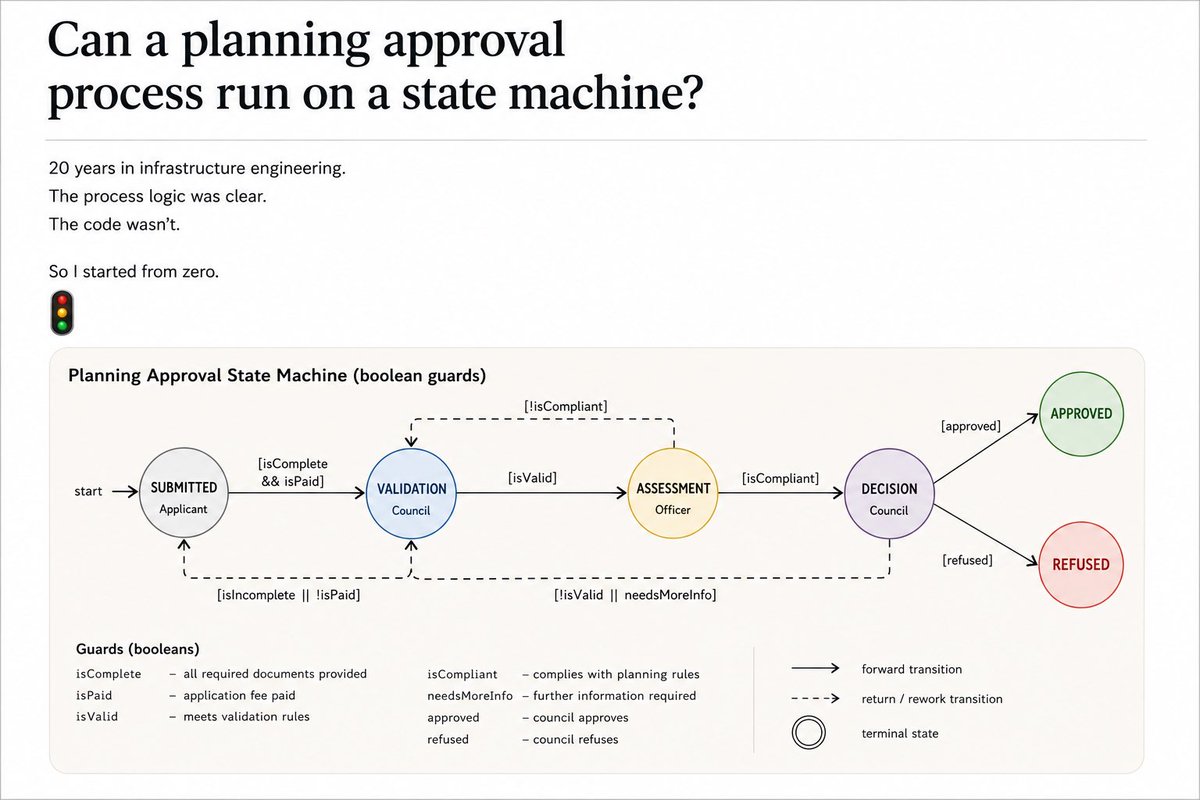
That article didn’t start with Solidity. It started with a question: can a planning approval process run on a state machine?
20 years in infrastructure engineering. The process logic was clear. The code wasn’t.
So I started from zero.
🚦
@ETHGlobal@chainlink Same principle applies beyond DeFi, any regulated domain where AI-assisted decisions create liability needs this. The question isn't what the model 'thought', it's whether the input and output pair is tamper-proof at the moment of decision.
This is exactly right, and the gap runs deeper than most builders realize. Compliance in regulated infrastructure (think rail, energy, public works) isn’t just KYC/AML. It’s 20-year audit trails, multi-party sign-off chains, statutory deadlines. I wrote about mapping this onto smart contracts in @ETR_Magazin 05/26. The trust layer isn’t optional, it is the product.
@chainlink@xStocksFi Chainlink nails the data layer. The next piece: verifiable credentials with the same reliability. Who is allowed to trade this onchain. KYC, accreditation, needs an equivalent infrastructure.
@plumenetwork@ether_fi The syndicated loan piece is the interesting risk. Bridge or other projects |typical candidates |don’t redeem daily. Construction phase alone runs 5–7 years. Liquidity sleeves don’t fix maturity mismatch.
20 years reviewing infrastructure approval files.
Every objection manually logged.
Every document version tracked by hand.
Every deadline monitored by someone remembering to check.
Then I discovered Smart Contracts.
States. Gates. Immutable logs.
Felt strangely familiar.
#Blockchain #GovTech #Planfeststellung
@MsMelChen Shipping product and writing regulation are different muscles. Europe has the engineers. The gap is whoever does both rarely talks to the other. Spent 20 years on the infrastructure side. The translation problem is real.
@brian_armstrong The list is finance-first. Real RWA also runs through approval processes, permits, title transfers. The bottleneck isn’t always tokenization, it’s the administrative procedure that decides if the asset can move at all. Different verification problem.
Day 8 | Built a learning path for domain experts | engineers, lawyers, public admin. No syntax first. If you think in workflows, you can read a smart contract.
https://t.co/6MpAq9MbpS
#Solidity#SmartContracts#Infrastructure
@chainlink Price feeds work. Legal doc verification doesn't exist yet. Title deeds, approval chains, multi-party sign-offs all still PDF and email. That's the RWA gap nobody has built for.
Start work on your computer, continue your local session anywhere. 📲
Remote control for GitHub Copilot CLI and @code sessions is now generally available.
https://t.co/wwSEBd5lqL
Day 7 | The second part:
state transitions and workflow logic.
Exploring how procedural states can be modeled onchain:
Draft → Review → Approved → Rejected
Small Solidity prototype in Remix:
https://t.co/vMY8kLIYCW
Long-term goal:
understanding how infrastructure and approval workflows could become traceable state systems instead of fragmented document chains.
#Solidity #RWA #Ethereum #SmartContracts