Everyone's calling @symbioticfi' Liquid Lane a faster-exit tool.
In my opinion it's bigger than that as it puts a live price on RWA risk for the first time.
Take tokenized credit funds, a $5.5B slice of a $42B market and the worst offender, most lock your money behind 60-180D exits and you can't see what that exit really costs until you're stuck in it.
Liquid Lane auctions the exit.
Market makers compete to quote your redemption on the spot, so a credit fund's real risk shows up as a number you can read. Here's where it goes👇
Once exits are priced live, the assets that are genuinely liquid get cheaper to hold and the ones that aren't get exposed. Capital flows to what can prove it.
This is how RWAs stop being onchain wrappers and start being real collateral.
h/t to @tokenterminal for the data
mETH Protocol: The Institutional LST That Actually Solves Liquidity
@mETHProtocol is Mantle's vertically integrated liquid staking on Ethereum.
It issues $mETH (liquid staking token) when you deposit ETH. $mETH accrues Ethereum PoS staking rewards + MEV + priority fees (plus additional yield generated through @aave via the Liquidity Buffer Pool).
▸ Core Engine: Buffer Pool
• 20-30% of TVL is dynamically allocated to @aave ETH market
• This creates a liquidity buffer that allows ~24h redemptions for most withdrawals (small ones near-instant, larger ones via Aave)
• Compare to Lido stETH or native staking: often 5-20+ day exit queues
→ This makes $mETH one of the more institution-friendly LSTs: corporates, DAOs, and funds that can't tolerate long lockups now have a realistic on-ramp to ETH yield without full illiquidity.
▸ Current Metrics:
• TVL: ~$383.07M
• APY: ~1.75-2.1% (base mETH yield)
• Fees (Annualized): $25.88M
• Revenue (Annualized): $2.59M
• Positioning: Institutional-grade LST with superior liquidity engineering
TVL drop context matters. The protocol peaked at $2.19B and is now ~$383M. The cmETH wind-down explains part of it: removing the higher-risk restaking layer and lets the protocol own the liquidity story cleanly.
→ It shows disciplined capital allocation, refocusing on what actually compounds (reliable liquidity + sustainable base yield) instead of chasing every restaking narrative → Strategic cleanup.
▸ Security Standards
mETH was built with institutional risk standards from day one:
• Validators: P2Porg, A41, Kraken Staked, Blockdaemon, Stakefish
• Custody partners: OSL, Copper
• Over $5.2M spent on audits + security programs
• Guardian network running alongside operators
• Zero slashing incidents to date
• Weekly Buffer Pool reports + onchain Proof of Reserves for transparency
→ The operator and custody stack is genuinely Tier-1, which matters when larger allocators evaluate LSTs.
▸ Institutional access x Onchain composability
Cuz $mETH is a standard ERC-20 on Ethereum (with deep Mantle integration), it can be used permissionlessly across DeFi:
• Crosschain bridging (Ethereum, Mantle)
• Collateral in lending protocols ( @Dolomite_io )
• Liquidity provision on DEXs ( @MerchantMoe_xyz, @Agnidex )
The key is that the Buffer Pool itself is an onchain mechanism. It gives institutions better UX + recycles institutional-scale capital back into Aave instead of letting it sit idle in a staking queue.
→ Institutions get liquidity + yield, DeFi gets additional ETH liquidity depth.
▸ Final thoughts
$mETH might sounds boring but it's the effective institutional LST. Not the highest APY, but one of the most usable for anyone.
The Buffer Pool is the bridge here. It turns a traditionally illiquid staking position into something that can move onchain efficiently while still earning yield.
That's the connection between institutional access and onchain composability.
Cards stopped being a hobby and became an asset class while most people weren't looking.
Onchain card platforms just set a record $227.6M in May, up from $148.6M in March. It's clear that the hobby is printing those numbers and it's moving onchain faster every month.
And now we've the catalyst and it's the biggest one that exists. Nothing on the planet pulls attention like a World Cup.
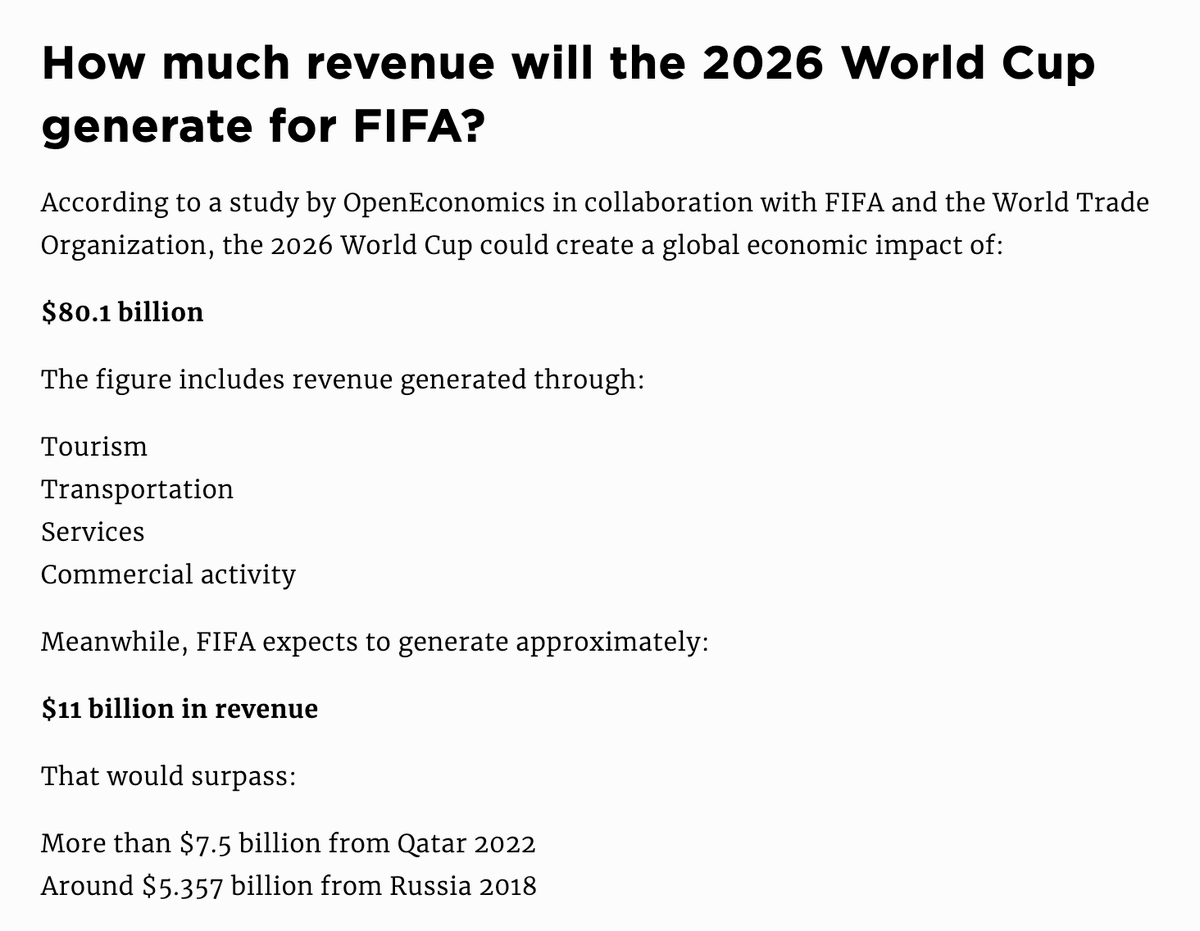
1. FIFA projects up to 6B people will engage with 2026
2. Across 104 games and a first-ever 48 teams
3. Around $80B in global impact
The Super Bowl draws ~120M. This is that, 50x over, for 39 straight days and this one's structurally different. 2022 in Qatar barely moved the needle abroad. 2026 runs across the US, Canada and Mexico, dropping the single largest event on earth into the biggest untapped card market there is and the reaction's already visible👇
➥ A Ronaldo 1/1 just sold for $1.35M, up from his previous record of $420K a month earlier, both into the World Cup squad announcements
➥ Messi 1/1s clear $400-520K, with seven separate Messi cards topping $350K since August
➥ The football card market sits inside a $9.2B sports card market forecast toward $20B+
Now the problem here is the cards that hold value are 1/1s running six to seven figures and the average fan gets funneled into printed base cards instead. Messi's base Prizm 10s fell 29-43% after Qatar while his 1/1 tier rose. The scarce held. The printed gave it back.
That gap is what @MarketCardsHQ is built into. A real 1/1, custodied, issued onchain as a token you can own a slice of for as little as $10. The tier that historically held, finally splittable.
Football's the entry on purpose. Top football cards trade at a quarter to a third of basketball, so the door in is cheaper and unlike most sports the leagues run year-round, so a player's value reprices continuously, not once every four years. Football first, then other sports, then anime and TCG.
Their first issuance is live now:
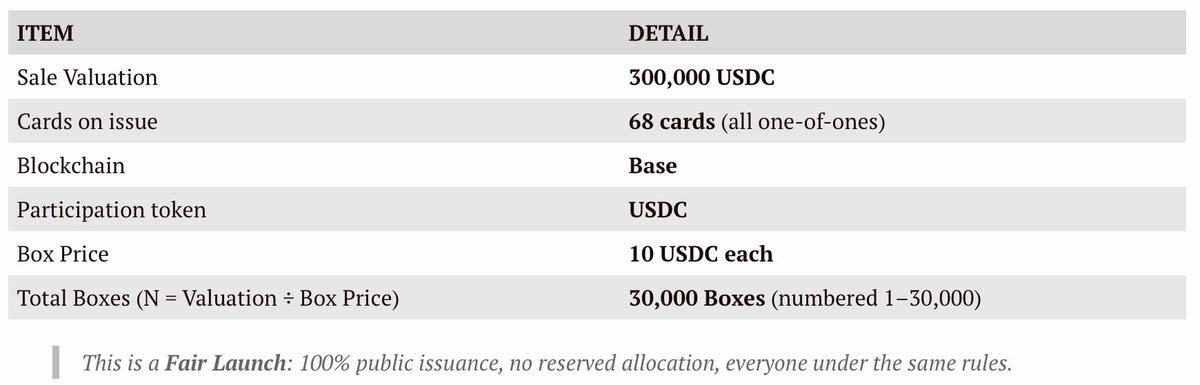
➥ 68 cards, all 1/1s, issued 100% publicly with no reserved allocation
➥ Commit USDC from $10, allocation by a verifiable draw seeded off the live BTC price, recomputable by anyone
➥ 30,000 boxes. Oversubscribed, earlier commits and more matches win first, the rest refunded in full
➥ If the raise target isn't hit, everyone refunded in full
➥ Participation closes June 8 and trading opens the same day
➥ Includes a Maradona, Batistuta and Messi triple oncard auto 1/1, a Ronaldo gold auto from the night he became football's all-time scorer and a Yamal Superfractor 1/1
The same tier that historically held, finally splittable.
Card sales are up nearly 50% year over year and the top ten athlete cards alone moved $175M in seven months, before the biggest demand event in the sport even kicked off.
Most people will watch the World Cup move these cards and do nothing, same as 2022. The difference now is the tier that actually held is finally splittable and the window is four days.
Solana already had its breakout card play in CARDS, the onchain card market is real and most of it has happened there. @jessepollak' Base now has a full World Cup 1/1 issuance going live on it. That's a market worth paying attention to.
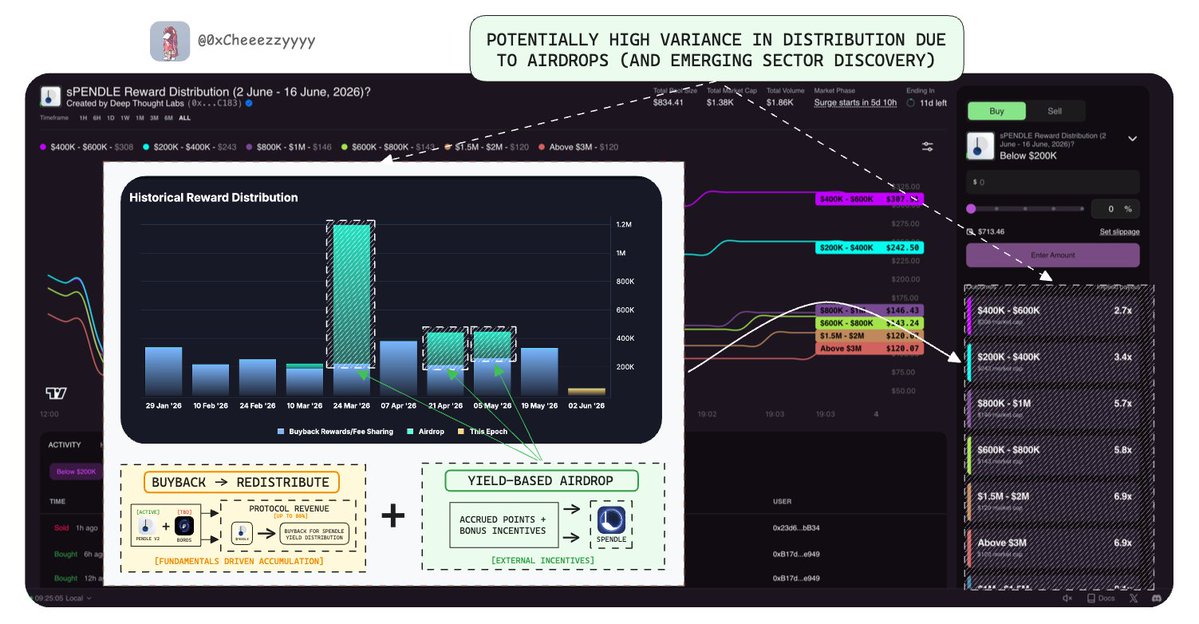
.@pendle_fi historical revenue reached $6.2M in Oct 2025 w/ $6.1M airdrop to vePENDLE holders at the EOY.
Even as Pendle transitioned into the $sPENDLE era, airdrop distribution time to time have been pretty rewarding:
🔸 24 Mar – 7 Apr: ~$970k
🔸24 Apr – 5 May: ~$230k
🔸 5 May – 19 May: ~$187.5k
And these figures exclude protocol-level $PENDLE buybacks, which have averaged roughly ~$237k per epoch.
What's cool here isn't really the abs number, but the variance.
Unlike your conventional DeFi primitives with relatively predictable cash flow, sPENDLE accrues value from a growing mix of revenue streams (yield + swap fees across all V2 pools) which translates to buybacks + ecosystem airdrops.
This creates a highly dynamic distribution profile where estimating the next $sPENDLE distribution is almost becoming a market of its own.
@42space's parimutuel model makes this possible, may the odds ever be in your favour 🫡