@ButchBaseball29 Tom Seaver said it well: “There is no set numerical value you can put on a pitcher. They're all different.”
Perhaps that's something worth remembering. There's always more to understand about the individual behind the pitch.
@ButchBaseball29 That's a great line from Jim Kaat. But perhaps there's more to the conversation than simply how much a pitcher throws. How the body moves, adapts, and handles the demands of the game matters too.
There's always more to the picture. #MotorBall
STOP calling structural breakdowns "bad luck." You cant out-manage a biological mismatch with a pitch-count limit. If you block an athlete's natural organization, the arm will break. Read the player! Respect the wiring! Stop forcing the model! @jaegersports@ButchBaseball29
So good explaining this. IF is a no no. Every scout learns the hard way and never repeats it. Evaluate, project and pass to developmental. Coaches struggle with scouting because of the ‘IF’ word. Jeff has done a great job of explaining scouting with series. So well done.
THE SCOUTING CLASSROOM
Stories Behind the Report
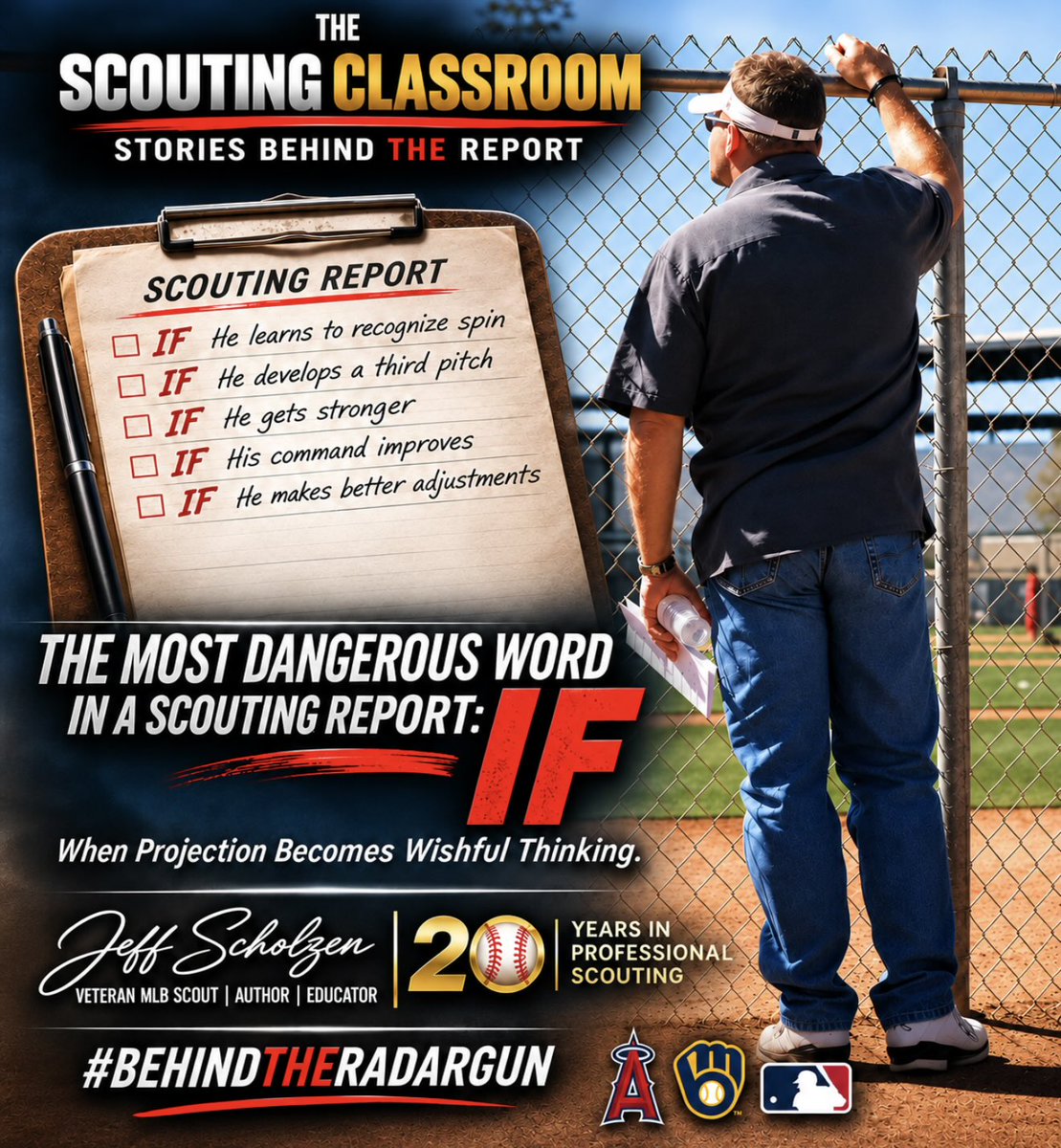
THE MOST DANGEROUS WORD IN A SCOUTING REPORT: IF
When Projection Becomes Wishful Thinking.
During my 20 years scouting for the Angels and Brewers, I learned that one of the most dangerous words in a scouting report was also one of the most commonly used.
IF.
If he learns to recognize breaking balls. If he develops a third pitch. If he gets stronger. If his command improves. If he learns to make adjustments against better competition.
Before long, a player with several significant deficiencies starts sounding like a future Major Leaguer.
That’s where scouts can get themselves into trouble.
PROJECTION VS. WISHFUL THINKING
Our job as amateur scouts wasn’t simply evaluating what a player was today. We were projecting what he could become three, four, or five years down the road.
But projection requires evidence.
A young hitter might lack present strength, but his bat speed, barrel control, athleticism and physical frame could support future power. That’s a reasonable projection.
A pitcher might lack consistent command, but his delivery, arm action, athleticism and ability to repeat his mechanics could suggest improvement.
Those are ingredients we can evaluate.
But projecting a hitter to recognize spin, develop power, improve his approach and make consistent contact against professional pitching creates several different questions.
Each improvement carries its own degree of uncertainty. They don’t all happen simply because we want them to.
THE PROBLEM WITH STACKING IFS
Here’s where evaluations can become misleading.
A scout sees a player with a 40 present hit tool and projects a future 60 because he believes the player will improve his pitch recognition, shorten his swing, develop better timing and learn to handle velocity.
That’s four separate improvements being used to justify one future grade.
What evidence supports each one?
Has the player demonstrated an ability to make adjustments? Does he recognize spin early? Is the swing mechanically sound? Does his athleticism translate into barrel control?
Or are we simply hoping everything comes together?
The more improvements a player needs, the more carefully we must evaluate the probability of reaching his ceiling.
GRADES = WORDS. WORDS = GRADES.
One principle I followed throughout my scouting career was that numerical grades and written evaluations had to tell the same story.
If I put a future 60 on a tool, my words needed to explain why.
Not what I hoped would happen.
What I actually saw that supported the projection.
A 60 future grade shouldn’t be built on assumptions. It should be supported by present ability, physical projection, movement patterns, aptitude and a realistic developmental path.
There’s a difference between identifying upside and manufacturing it.
CEILING DOESN’T EQUAL PROBABILITY
Two players can have the same projected ceiling and very different chances of reaching it.
One might already possess the foundational skills, with only physical maturity remaining.
The other might need significant mechanical changes, better instincts and improved baseball skills.
Same ceiling. Different risk.
That’s why probability matters just as much as future value when building a draft board.
The question isn’t only, “What could this player become?”
It’s also, “How much has to go right for him to get there?”
THE LESSON
Projection is essential. But every projected improvement needs evidence, not assumptions.
A scout must distinguish between what a player is, what he could become, and the probability of getting there.
Projection identifies potential. Wishful thinking assumes development.
Every IF needs evidence.
#BehindTheRadarGun 🔎