How do I know media brainwashing is real?
Obama’s ICE Chief received an award for removing over 900,000 illegal aliens.
Trump’s ICE chief was called a Nazi.
It is the same person - Tom Homan.
The difference? What the media told people to believe.
Here’s a chart you almost never see in electricity circles: inflation adjusted average cost of electricity from the very beginning.
We’ve been flat for 56 years since 1970. Utter failure.
We must unlock cheaper electricity.
Regardless of where you stand on Balogun-Gate, the whole reaction to both sides highlights some very key differences in the American vs European mindset.
In the American mind, "getting it right" is the most important thing. Thats how justice is served, is by getting to the correct result based on the play on the field.
The European mind is different though. They have an instinct towards bureaucracy and are obsessed with process. The Process must be respected. Respecting process is more important than the specifics of what happened on the field.
And thats why you get this wild take thats fairly common where a Euro will say something like "He didnt deserve the red card, but once it was given it cannot be overturned!".
To the American mind, justice is served by getting the call right, regardless of process. To the European mind, justice is served by respecting process, regardless of the result.
Its a fascinating look into the psyche of both, and if I'm permitted a little armchair psychoanalysis of both groups, id say the reason lies in their history. The Europeans spent centuries as the peasant class of Europe, essentially being forced to accept whatever shit the aristocracy piled up on them. There was no "appeals" process, they took what they had too, because there was no other option. In this environment, a certain "acceptance of one's fate" or immunity to overt injustice likely seeped into the national psyches. No one had success by "fighting the power", the power imbalance was simply too great. What eventually saved them though, was process. Rules-based orders were the only thing that gave them a semblance of power vs the aristorcracies of their upper classes. And so they came to revere Process as the Ultimate Good and working OUTSIDE process as the Ultimate Evil.
The Americans, on the other hand, never developed their national psyche in the world of Kings and Aristocrats. Class was far less rigid in the new world, and risk-taking WAS highly rewarded there. "Fighting the power" to "do what was right" WAS greatly rewarded during the American Revolution when a few great men "fought the power" and were gifted with what would become the most powerful, prosperous country on Earth. And so a certain disdain against "process" took hold, a general feeling that "process" was only as good as long as it provided fair and just outcomes. As opposed to the European model, where "process " was the only thing that had given them anything close TO "fair and just outcomes".
So in that context, the massive gap between both sides makes sense
Or maybe this is all nonsense and its just anti-American, pro-Euro tribalism, who knows 🤷🏼♂️
The US Navy operates a 50,000 acre forest in Indiana whose entire job is keeping one wooden ship from 1797 afloat.
The ship is USS Constitution, still a commissioned warship with an active-duty crew. Cannonballs bounced off her in 1812 because the hull sandwiches a wall of live oak ribs between two layers of white oak planking, nearly 2 feet of solid wood so dense it barely floats. British 18-pounders hit it and dropped into the sea. A sailor yelled "her sides are made of iron" and the nickname stuck.
Here's the problem with owning a 229-year-old wooden ship: you can't buy the parts. Hull planks run up to 40 feet long and 7 inches thick, cut from single white oak trunks. A white oak takes over a century to grow that big. No lumberyard on earth stocks it.
So the Navy grows its own. Constitution Grove at Naval Support Activity Crane holds trees over 100 years old, reserved exclusively for this ship. Foresters there are managing oaks today that will become hull planking in the 2100s. The maintenance plan literally runs on tree time.
Every 20 years or so she enters dry dock and shipwrights swap out rotted timber. After two centuries of this, estimates put original 1797 wood at maybe 10 to 15 percent of the ship. The Navy keeps replacing her plank by plank because Congress mandated her preservation and because she's the only active US warship that has sunk an enemy vessel.
Every other asset in the Navy has a decommission date. This one has a tree farm.
@BenjaminNorton Your skew is off as well. If you look at income per capita, you are back up to 4th for the US.
Wealth mixes tax laws, real estate, debts, and many other things that skew results.
There's a wild economics phenomenon behind the decline of every venue in these charts. Almost nobody knows its name.
Start with what it isn't. It isn't an American problem. Britain, the country that invented the pub, has lost 16,150 of them since 2000. Over a third, gone. Same slope, different continent, no car culture to blame.
The actual culprit was discovered by accident in 1966. An economist named William Baumol was hired to answer a boring question: why were symphony orchestras always broke? Sold-out halls, rich patrons, government grants, and the books never balanced. Any city. Any decade.
Then he noticed the thing hiding in plain sight. A Beethoven string quartet took four musicians and 40 minutes to perform in 1826. In 1966, it took four musicians and 40 minutes. Productivity gain across 140 years: zero. But those musicians live in the modern economy, where the factory worker's output grew 20x. Pay them like it's 1826 and they leave to work in the factory. So their wages rise while their output stands still, and costs climb forever.
Baumol called it cost disease. Every bar, bowling alley, and movie theater in these charts has a terminal case. A bartender pours the same drinks per hour as in 1980. A theater fills the same seats per screen. Flat output, compounding rent, labor, and insurance.
Your couch caught the opposite condition. Quality-adjusted TV prices fell 97% since 2000, per BLS. Streaming ships infinite content for $15 a month. One more night in costs approximately nothing.
Tickets up 42%. TVs down 97%. Americans and Brits both read those price tags every Friday for 25 years. The charts show the verdict.
And here's Baumol's grimmest finding: cost disease has no cure. Nothing makes a bar 10x better at being a bar, because the inefficiency IS the product. Humans, in a room, taking their time.
The couch just keeps getting cheaper.
This is one of the worst things I’ve ever seen.
Mbappe could have lost his entire career and maybe even his life from this savage and brutal light kick against his shin guard.
@FrancoPanizo It is an admission everyone already knows—it was a bad call.
You are probably one who thinks faking injury is a normal part of sports—it is a sign of poor refereeing, but it is so effective everyone has to do it.
This is because the anti-capitalist left is not actually against people being crazy rich. They're against certain types of people being crazy rich.
Artists and athletes make sense to them because they've played music and sports and because their success can be explained by "luck" and "talent". Messi's wealth is not offensive to them because they understand Messi is much better at football than they are.
But when it comes to business, the anti-capitalist leftist has no framework for understanding why Jeff Bezos might be super rich since 99% of them have never ever created a product, business or service that was of value to other people. They've never taken entrepreneurial risk. They've never employed people and felt the burden of responsibility that comes with that. They've never pick up a business and given it a play in the way they've picked up a ball or a guitar.
They *literally* don't understand wealth creation. They think there is a fixed amount of money and the only thing a business does is split it unfairly.
It's why they rage at Elon and other successful business leaders. Because they genuinely don't understand why they're wealthy.
Also, and this is just as important, athletes and artists are disproportionately young, attractive, "diverse", left wing etc. Business leaders are "evil" middle aged white men whose success offends the average anti-capitalist leftist because they don't understand a) what it is they do and b) that Elon Musk has the same talent advantage on them as Messi does, it's just harder to measure.
🚨 WOW! Japan has just launched a BEAUTIFUL fireworks display for America's 250th birthday in Tokyo, after lighting up both the Tokyo Tower and Rainbow Bridge red, white and blue
Japan honors America with pride!
Democrats raise the Somali flag while JAPAN is even more patriotic than the left.
Blue cities that are canceling their 250 celebrations should watch this and TAKE NOTES! 🇺🇸🇯🇵
Fireworks video via @mykatsu7
Hier j'ai fait un post pour expliquer comment j'en suis arrivé à écrire sur la French Theory — ce post qui m'a valu un follow d'Elon Musk et de Javier Milei, et qui a fait 80 millions de vues.
Mais la French Theory n'était que la conséquence. La cause première, celle qui m'a poussé à creuser tous ces sujets aussi profondément, c'est l'économie.
Et quand je vois Lecornu déclarer qu'« il y avait un sentiment d'inégalité dans la répartition de la richesse, et que ça, il faut bien le traiter », je me dis qu'on tient là, en une phrase, tout ce qui ne tourne pas rond dans ce pays.
Parce que ça fait 50, 60, 70 ans qu'on SAIT. On sait exactement ce qu'il faut faire pour générer de la prospérité et rendre un pays fonctionnel. Ce n'est pas un mystère, ce n'est pas une opinion de comptoir, c'est démontré empiriquement sur tous les continents et à toutes les époques : libéraliser à fond, baisser les impôts au maximum, réduire le poids de l'État partout où c'est possible.
Pourquoi réduire l'État ? Pas par idéologie. Par mécanique pure.
Un bureaucrate est structurellement incapable d'allouer du capital efficacement. Ce n'est pas une question de méchanceté ni d'incompétence individuelle — c'est mathématique. Il n'a pas les signaux de prix, il n'a pas le retour du réel, il n'a pas de skin in the game. Il dépense l'argent des autres, pour des gens qu'il ne connaît pas, sans jamais payer le prix de ses erreurs. Hayek et Mises avaient tout expliqué il y a un siècle : sans marché, tu es aveugle. Tu ne peux pas calculer. Tu ne peux qu'improviser à l'échelle de 68 millions de personnes.
Résultat : des services publics qui s'effondrent, un pays qui décroche, des gens qui galèrent pour de vrai. Et devant ce désastre, on leur explique que le coupable, c'est le voisin qui a réussi. Que si l'hôpital ferme, si l'école ne forme plus, si tu n'arrives plus à te loger, c'est parce qu'il existe des gens riches.
C'est faux. Radicalement faux.
Le problème n'a JAMAIS été qu'il existe des gens riches. La richesse des uns n'a appauvri personne — un euro gagné en créant de la valeur n'est pas un euro volé à quelqu'un d'autre, c'est un euro qui n'existait pas avant. Le vrai problème, c'est un État qui te prend la moitié de tout ce que tu produis pour le cramer dans une machine qui ne fonctionne pas, puis qui vient te dire que ton sentiment d'injustice, c'est la faute du type d'en face.
Taxer davantage, ce n'est pas « traiter le sentiment d'inégalité ». C'est nourrir la bête qui l'a créé.
Le sentiment d'injustice est réel. Mais il ne vient pas de ceux qui créent la richesse. Il vient de ceux qui la confisquent pour la gaspiller — et qui ont besoin que tu regardes ailleurs pendant qu'ils le font.
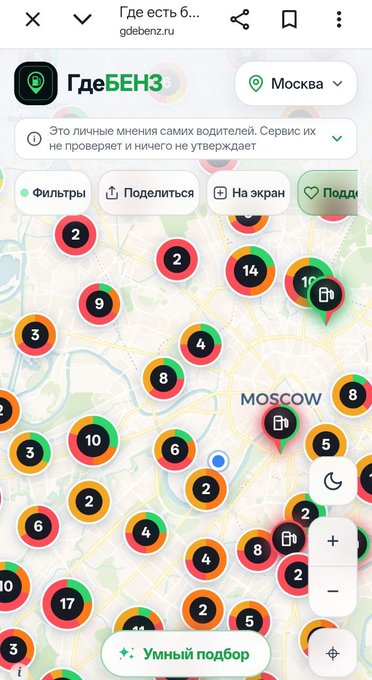
🇷🇺🇺🇦Les Ukrainiens ont trouvé une nouvelle manière de perturber le quotidien en Russie.
En modifiant les informations affichées sur les cartes en ligne, ils font croire que certaines stations-service sont approvisionnées alors qu'elles sont à sec, et inversement.
Des milliers d'automobilistes se dirigent alors vers les mauvais endroits, ce qui désorganise complètement les déplacements et crée des tensions partout dans la ville. Cette opération illustre parfaitement ce que l'on appelle une action de guerre informationnelle. Plutôt que de s'en prendre directement à des infrastructures, elle exploite un outil numérique russe.
L'intérêt de ce type d'action est qu'elle crée du chaos gratuitement et n'importe qui peut le faire. Les automobilistes consomment davantage de carburant, saturent les routes, encombrent les stations-service et alimentent eux-mêmes la confusion.
Même si les conséquences restent limitées individuellement, leur accumulation peut avoir un impact réel sur le fonctionnement d'une grande ville. L'information est devenue un véritable levier stratégique : lorsqu'une population ne peut plus faire confiance aux applis qu'elle consulte au quotidien, c'est toute l'organisation de la vie civile qui peut être perturbée.
Le résultat c'est que cela permet d'aggraver encore les tensions autour de la pénurie d'essence en Russie. Et comment est-ce que les autorités russes peuvent contrer cela ? Honnêtement, je n'en ai aucune idée, ils ont déjà attaqué l'Ukraine.
Les Ukrainiens sont vraiment au top niveau innovation.
@schadjoe This is an excellent idea. I love how mostly non-Americans fail to understand that changing rules can improve the game.
The game should always try to be improved. It is okay to make it better.
@JamesNewbon@schadjoe This is obviously from someone who hasn’t played the game much—it would make a huge difference.
All defenses now are an offside trap—that is it because it works best. And it is the most boring thing about soccer.