2026 question for AI builders:
Are you optimizing for generation or verification?
For customer-critical systems:
- More capable models won't unlock deployment
- Faster, provable verification will
The bottleneck isn't model power.
It's verification infrastructure.
Build verification systems, not just orchestration.
That's how we bridge @satyanadella's overhang.
The "model overhang" @satyanadella describes is the defining challenge of 2026.
But it's not just capability > utilization.
🧵From building systems where customer safety depends on correctness, here's what most miss:
Moving from spectacle to substance in high-stakes domains means:
- Provable correctness
- Auditable decisions
- Reliable deployment
- Regulatory approval
Diffusion requires verification infrastructure, not just model capability.
The gap isn't adoption willingness.
It's deployment safety.
Building for verification-first changes everything:
NOT: Maximize model capability
BUT: Maximize verifiable correctness
NOT: General-purpose flexibility
BUT: Domain-specific reliability
Complexity budget shifts from "what can it do?" to "how do we know it's right?"
Different optimization target. Different architecture.
Three principles for 0→1 building:
Selection > Optimization (choose what to build)
Falsification > Validation (find what fails)
Measurement > Speculation (verify assumptions)
0→1 isn't about mastering playbooks.
It's about discovering what hasn't been written yet.
That's the game.
Most AI learning advice optimizes for depth in existing paradigms.
Standard: Courses → Practice → Papers
Works great for joining teams, building with known patterns.
But 0→1 products need constraint discovery:
Ignorance → Verifiers → Measurement
🧵 Framework for building what doesn't exist yet:
Before choosing what to learn, map your ignorance:
1. What do courses teach? (Known knowledge)
2. What do you know you don't know? (Articulated gaps)
3. What patterns do you sense but can't explain? (Implicit knowledge)
4. What's outside your frame? (Unknown unknowns)
Breakthrough products live in (3)→(2) transitions.
Courses expand (1). Building reveals (3).
Why is verification the bottleneck?
Generation is automated.
Verification often isn't.
Examples:
- Healthcare: Need clinical validation
- Legal: Need expert review
- Safety systems: Need formal verification
The asymmetry is the problem.
This fundamentally changes how you build AI systems.
Standard approach: Model → Orchestrate → Add safety
Safety-critical approach: Verify → Build → Deploy
"Rich scaffolds" assume reliability can be added later.
Reality: For high-stakes domains, reliability must be architectural from day one.
You can't add correctness to incorrect foundations.
Model overhang = capability exceeding verifiability.
We can generate outputs at 10x speed.
We can't verify they're correct at 1x speed.
For production systems where errors cost money, health, or trust:
- Can't deploy what we can't verify
- Can't scale what we can't trust
- Can't regulate what we can't audit
Generation speed >> verification speed = deployment bottleneck.
The agentic coder trap:
They make building FAST easier.
Not building RIGHT easier.
10x code generation = 10x verification burden.
So build verifiers for every layer BEFORE accelerating features.
Verification infrastructure > velocity.
@sama@sama does OpenAI treat the epistemology of preparedness itself as an engineering problem?
Framework v2 is rigorous, but it appears to treat ignorance as residual. Sandbagging feels less like an eval gap and more like a failure mode of the measurement pipeline itself.
So many people keep asking me about Continue. What is it? What are you up to? Here you go...
Continue started as a research effort two years ago, with the belief that if the human body is a system, it should also have its leverage points. The simple levers that, when adjusted, could fundamentally alter how we age and live.
Along with a team of initially skeptical researchers, we've been investigating a penny-drop insight about human aging. Something that's been hiding in plain sight for eternity. But more on that in a few weeks. We are at the tail-end of the research on this hypothesis, which if true, could fundamentally change our understanding of biology and aging.
But today isn't about that. It's bigger than that.
Today, we are expanding Continue Research to include a $25 million fund (entirely personally backed) to support researchers across the world who dare to ask simpler questions than anyone else. Who believe biology might be far simpler than we've made it.
For over a decade, I have believed that most of the world’s problems stem from our short human lifespans. Continue Research’s goal is to extend healthy human function long enough that humans stop making short-term decisions.
Read more about Continue’s purpose at – https://t.co/2jbRl1CHvq
This will be a multi-decadal journey. Our goal here is to become a small catalyst in humanity's journey of conscious evolution. To lead us into the Post-Darwin era.
Researchers, please look us up and apply for funding/grants at – https://t.co/3bbtOyXEPf
———
PS: Continue is not a part of Eternal
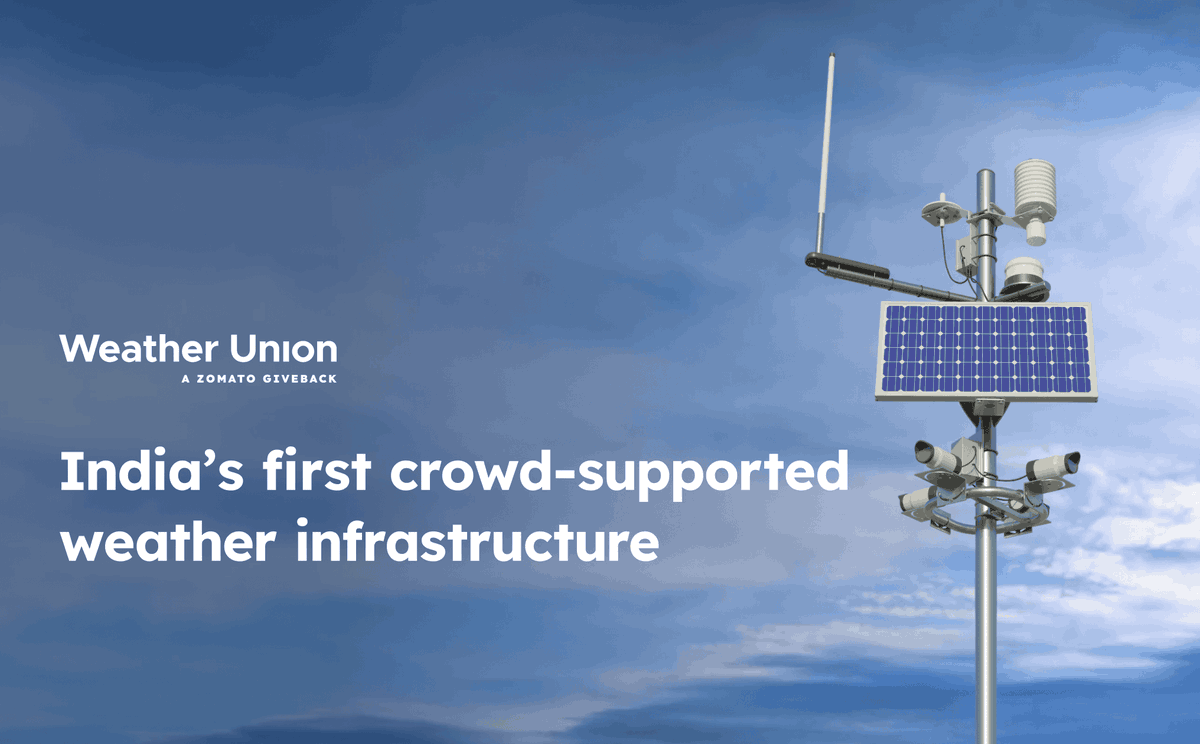
Excited to unveil India's first crowd-supported weather infrastructure, https://t.co/qE9kkfoisG. A proprietary network of 650+ on-ground weather stations, it is the largest private infrastructure of its kind in our country.
These weather stations, developed by Zomato, provide localised, real-time information on key weather parameters such as temperature, humidity, wind speed, rainfall etc. Currently available across 45 large cities, we are expanding this in other Indian cities very soon.
This rich data holds significant potential in unlocking weather use cases for enterprises and research institutes. Having already collaborated with CAS - IIT Delhi, we expect more institutions and companies to benefit from this and contribute towards the greater good of our economy.
At Zomato, it was crucial for us to have access to precise and real-time weather information to make the right business decisions to serve our customers better. Hence, we took it upon ourselves to develop a solution capable of empowering us on this front.
We are now opening up free access to this (through an API) to all institutions and companies in the country. Wait. What? Free? Really? Yes, we believe that this data is too valuable to keep to ourselves or to monetise; therefore, as a Zomato Giveback, we are opening up access to this data to everyone for public good. Multiple companies and public institutions should use real-time weather data, to boost the productivity of our economy.
Also, a lot of Zomato employees have hosted weather stations at their homes. As we look forward to further expanding this infrastructure, we welcome volunteers who want to provide us space on their premises to install these weather stations and contribute to nation building.
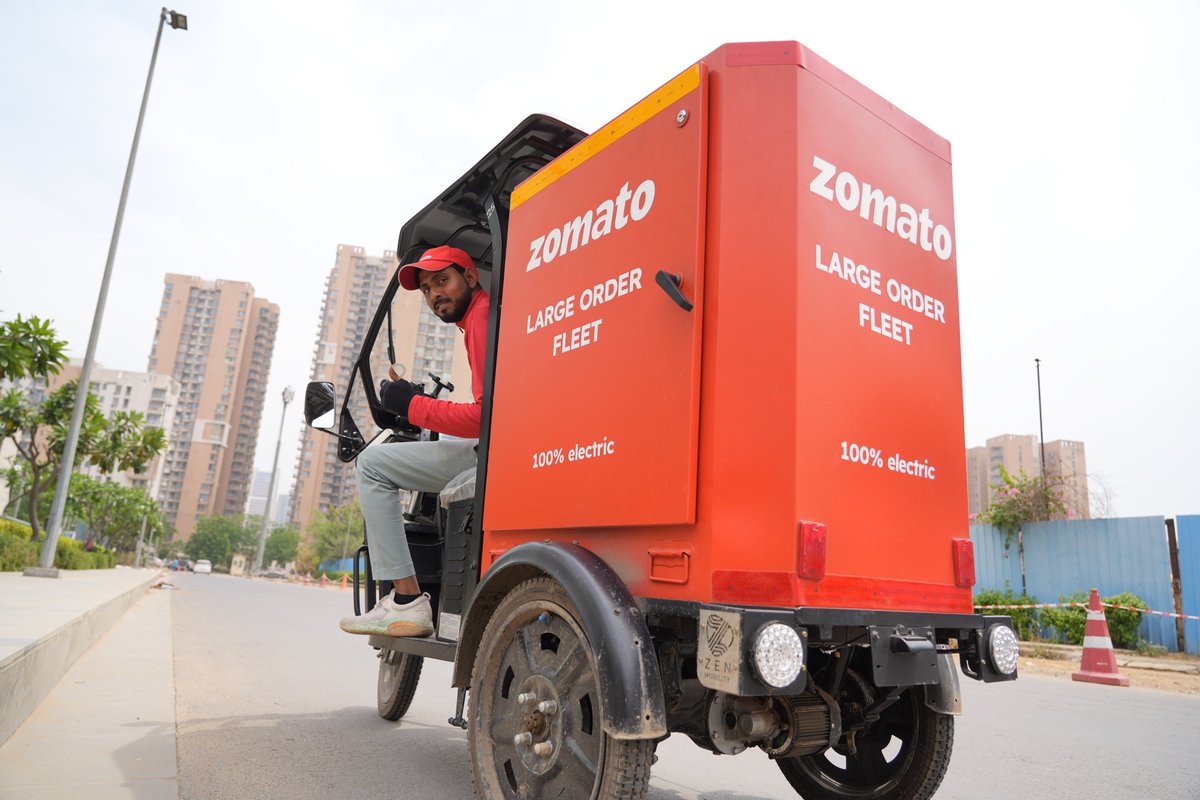
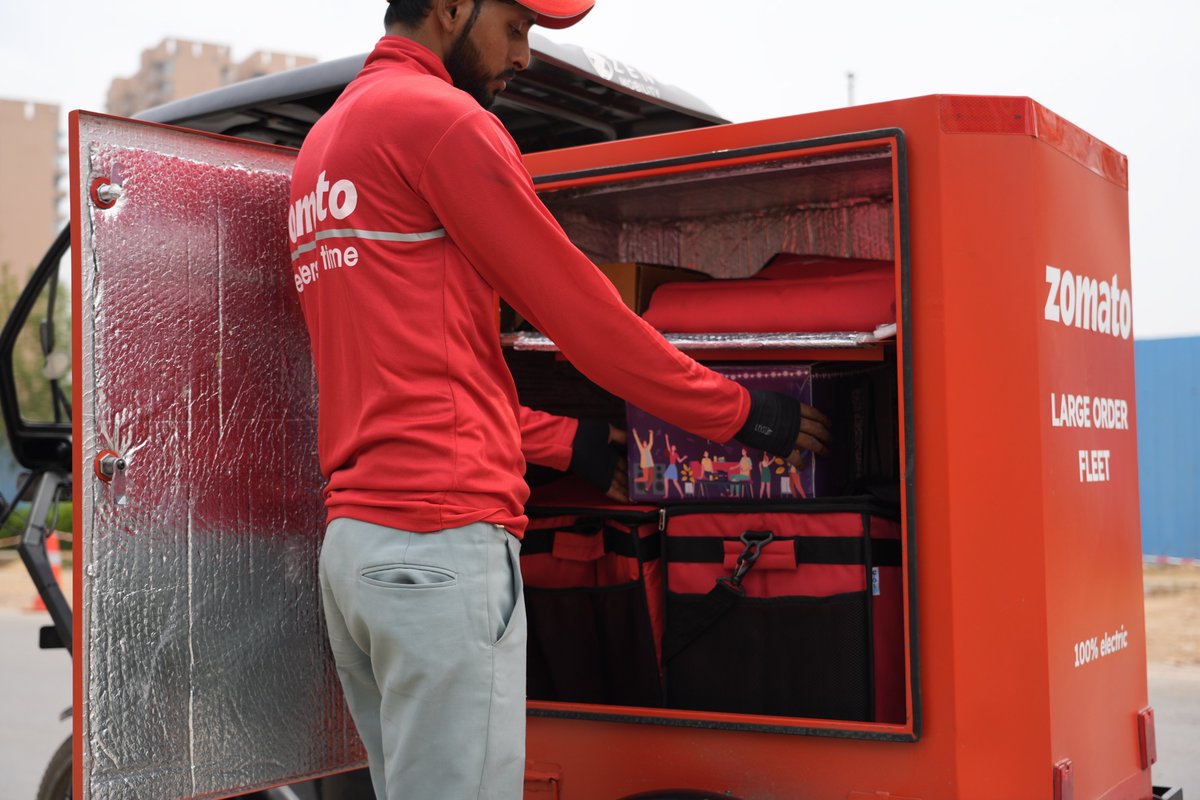
Today, we are excited to introduce India's first large order fleet, designed to handle all your large (group/party/event) orders with ease. This is an all electric fleet, designed specifically to serve orders for a gathering of upto 50 people.
Thank you so so much sir. Means a lot coming from you.
We are proud to continue building Zomato in the service of our nation.
We aim to make profit to build better services, not build services to make profit.
#MadeInIndia