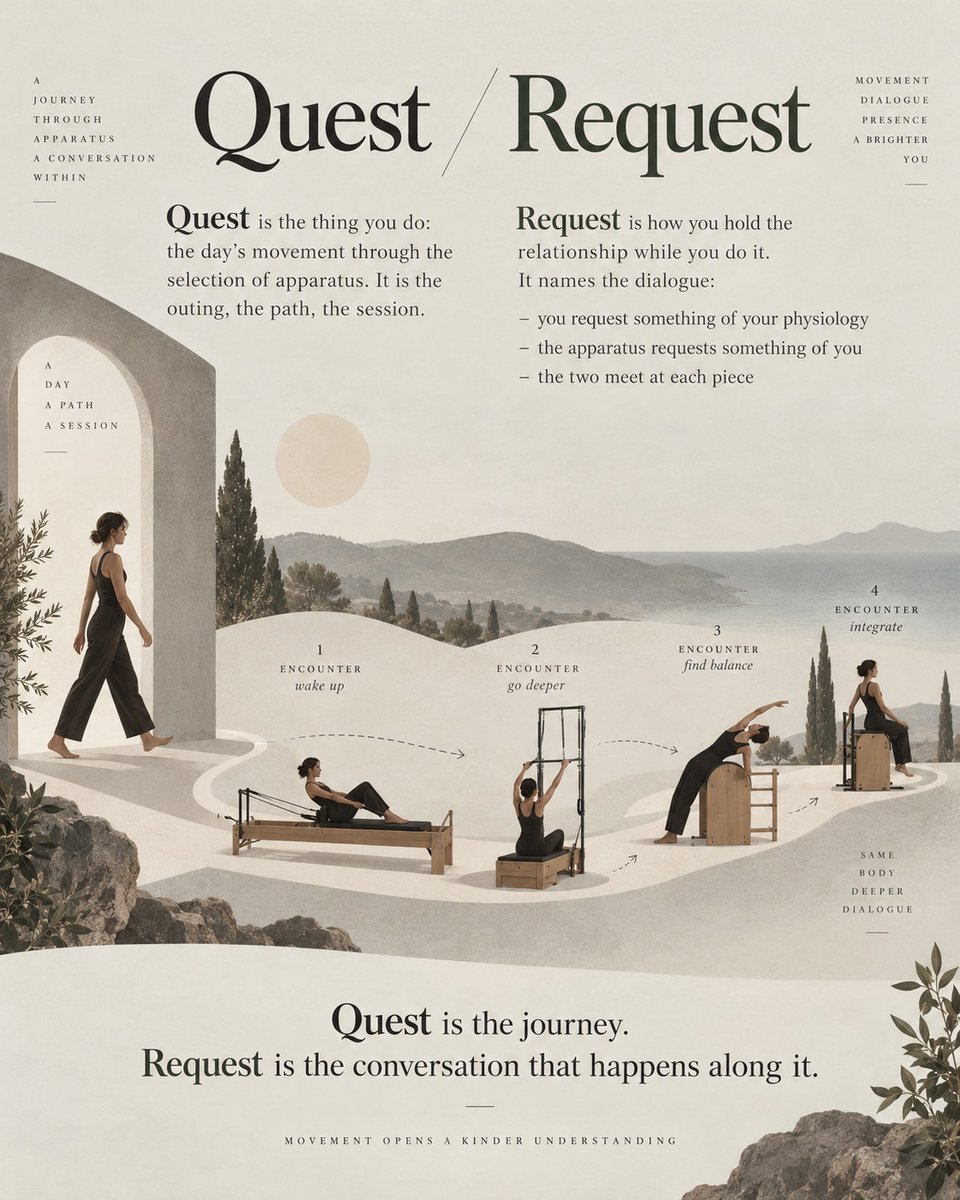
Quest is the thing you do: the day’s movement through the selection of apparatus. It is the outing, the path, the session.Request is how you hold the relationship while you do it. It names the dialogue:
- you request something of your physiology
- the apparatus requests something of you
- the two meet at each piece
Quest is the journey. Request is the conversation that happens along it.
Impetuous impermanence is not a synonym for “things change.” It names a particular character of change: not the slow wearing of stone, but the onset. The first word is kinetic and aggressive. The second is metaphysical. Together they refuse the polite story in which the world fades while we watch.
Two words, one collision
Impetuous comes from Latin impetus: an attack, an assault, a rushing-upon. Related senses in English include sudden violence of movement—“an impetuous wind”—and impulsive vehemence of character. The root is impetere, to fall upon, from in- + petere (to seek, to rush at). The word is not “quick.” It is onset.
Impermanence is the English stand-in for Pali anicca, Sanskrit anitya, Chinese wúcháng, Japanese mujō: the claim that every conditioned thing is transient, evanescent, inconstant. In early Buddhism it is the first of the three marks of existence, alongside dukkha (unsatisfactoriness) and anattā (no lasting self). The stock formula is blunt: whatever is of a nature to arise is of a nature to cease.
Ordinary speech treats these as different registers. Impetuous describes a person or a gust. Impermanence describes a cosmos. The compound yokes them: the cosmos itself behaves like the gust. Change does not request an appointment.
From “everything changes” to “nothing lasts a moment”
Early Buddhist teaching on anicca can still sound gradual: bodies age, seasons turn, kingdoms fall. Later Abhidharma and logicians sharpened it into kṣaṇikavāda, the doctrine of momentariness. A thing does not persist for a while and then perish. It exists only for a kṣaṇa—an instant—and is already gone, succeeded by a causal heir that looks like “the same thing.” Vasubandhu’s definition is almost violent in its economy: that which comes into being and vanishes immediately, with no interval, is momentary.
Schools disagreed about the anatomy of that instant. Some split a dharma into arising, brief subsistence, and cessation. Others denied even a real “stay.” The important point for this phrase is not the scholastic clock. It is the claim that impermanence is not delay plus ending. It is continuous destruction-and-replacement. What we call a river, a face, or a self is a santāna—a series—not a substance that endures through change. Persistence without identity.
That is already close to “impetuous.” Gradual anicca is the mountain weathering. Momentary anicca is the thought that dies before you finish naming it. Commentarial traditions even distinguished gradual impermanence (birth, aging, seasons) from momentary impermanence (the rise and fall of each mental event). The second is the one that feels like assault.
Thich Nhat Hanh’s correction still holds: it is not impermanence that makes us suffer; it is wanting the momentary to be permanent. The compound adds a further sting. We do not only want things to last. We want change to be courteous. Impetuous impermanence is change that does not wait for our consent.
The violent stream
Western antiquity already had the river. Heraclitus’s surviving fragments do not quite say the postcard version—“you cannot step in the same river twice”—as a simple slogan of universal flux. The more careful reading of fragment B12 is paradoxical in the other direction: on those stepping into rivers that stay the same, other and other waters flow. The river remains a river because the water never stops. Identity, such as it is, is the pattern of the rush, not a lump behind it.
Plato and later popular memory flattened this into “everything flows, nothing stays.” The flattening is useful for our phrase. Marcus Aurelius, writing as a man trying to live inside that current, made the violence explicit:
Time is like a river made up of the events which happen, and a violent stream; for as soon as a thing has been seen, it is carried away, and another comes in its place.
The comfort and the cruelty are the same fact. Grief will be carried off. So will the afternoon you would have kept. The stream does not sort.
Alfred North Whitehead, twenty-three centuries later, treated this as the metaphysical problem, not a mood. “That all things flow” is the generalization around which his system is built; yet ���in the inescapable flux, there is something that abides; in the overwhelming permanence, there is an element that escapes into flux.” Permanence, if it exists, is snatched out of flux. The passing moment gets intensity only by submitting to something that outlasts it. Impetuous impermanence is the side of that polarity we usually lie about. We build philosophies and institutions as if substance were first and process a defect. Process thought inverts the order: becoming is more basic than being; a “thing” is a relatively stable society of occasions.
When beauty is the blizzard
Japanese aesthetics took Buddhist mujō and made it a sense, not only a doctrine. Shogyō mujō—all compounded things are impermanent—opens The Tale of the Heike with a temple bell. Cherry blossom is the emblem because the blossom is not admired merely for blooming. It is admired because it falls, and because it can fall all at once.
There is a word for that suddenness: sakura fubuki, a cherry-blossom snowstorm. Wind lifts the petals in a single rush. For a few seconds the air is a body. Then it is over. That is closer to “impetuous” than the postcard of one petal drifting. Mono no aware is the ache that answers mujō: not despair, but the exact feeling of watching something complete itself by leaving. Zeami, asked the essence of transience, said “scattering petals, falling leaves.” Asked the essence of eternity, he gave the same answer. The annual return does not cancel the fall. It makes the fall the form of return.
Wabi-sabi works the slower edge of the same fact—crack, patina, weather. Impetuous impermanence works the fast edge: the gust, the shatter, the instant the pot becomes a teacher by breaking. Milarepa’s cooking pot rolling down the mountain is the comic and perfect image. The last possession does not politely thin. It detonates into instruction.
Science’s version: gradually, then suddenly
Physics does not use the phrase, but it keeps rediscovering the pattern. Entropy is the slow ledger. Phase transitions are the raid: water does not become ice by a little more “icenness” each minute. At a critical point the system reorganizes. Hemmingway’s bankruptcy joke—“gradually, then suddenly”—is the folk version of a hysteresis loop. Small pressure does nothing; then a threshold, and the structure is different.
Biology is full of the same rhythm. A cell line looks stable until apoptosis. An ecosystem looks persistent until it tips. A person looks like yesterday’s person until a hemorrhage, a diagnosis, a sentence that cannot be unsaid. The “self” we defend in court and in love is a statistical weather system that we treat as a building.
Neuroscience is even ruder to the myth of duration. A percept is not a still photograph updated now and then. It is a cascade of firings that must be re-created to continue existing. Memory is not a file; it is a reconstruction that alters the thing reconstructed. The Buddhist momentarists were metaphysically extreme. They were not empirically silly.
The psychology of the onset
Slow change can be metabolized. Sudden change hijacks the nervous system because prediction error spikes. Attachment theory, grief research, and trauma literature all distinguish anticipated loss from ambush. The second is what “impetuous” names from the inside: the world did not give you a slope. It gave you a drop.
That is why the phrase is morally double-edged.
On one side, it is a warning against the fantasy of infinite delay—“do not trust tomorrow” as a contemplative slogan, not a productivity hack. Life like morning dew is not poetry first. It is a correction to the mind that schedules awakening for later.
On the other side, it is a warning against living as if only crises were real. If every moment is already an onset, then the ordinary is not a waiting room. The cherry tree does not become impermanent when the wind hits. It was already a blizzard in slow motion. Impetuousness is how the structure occasionally shows.
People who have been hit by the sudden version often make two opposite mistakes: they either freeze, trying to bolt the next moment in place, or they aestheticize chaos and stop making anything that could be lost. Both are refusals. The first denies flux. The second denies that flux is also the condition of any good that can be loved.
What the compound forbids
Three cheap readings should be set aside.
It is not nihilism. Nihilism says nothing matters because nothing lasts. The older traditions say the opposite: because nothing lasts, clinging is irrational and attention is urgent. Death is the mother of beauty only if beauty is actually seen.
It is not a brief for impulsiveness. “Impetuous” here is a description of time’s manner, not a lifestyle recommendation. Acting without thought is one more conditioned event in the stream. It does not master the stream.
It is not only melancholy. Without impermanence there is no growth, no political unseating of a bad order, no child becoming someone new, no wound closing. Thich Nhat Hanh’s “long live impermanence” is not irony. It is the condition of any transformation at all. The impetuous part is simply that transformation does not ask whether you have finished with the previous form.
A working definition
Impetuous impermanence is the fact that conditioned existence does not merely pass; it strikes. It is momentariness felt as onset rather than as fade. It is the river as violent stream, the blossom as blizzard, the dharma that ceases as it arises, the phase transition after a long false calm.
The still lantern in a storm of petals—the image the phrase seems to want—is not a symbol of what escapes the law. It is a symbol of attention inside the law: one constructed thing, already wet, already aging, briefly holding a flame while the air around it is nothing but departure.
The only thing that does not rush away is the rushing. That is not consolation in the soft sense. It is the one permanence the phrase will allow.