Radical cross-coupling, simplified. No specialized equipment. No exogenous redox. No stoichiometric organometallics. The best part is no part.
A perspective on the field, appearing today in @ChemRxiv : https://t.co/g65WPyAVSx
We report an Et₃N-enabled electrochemical platform for deep PFAS defluorination and scalable fluoride recovery. Turning forever chemicals into fluorine resources. Now out in JACS! https://t.co/DQ9g1ou7eW
🚨RADICAL RETHINK: STEREORETENTIVE CROSS COUPLING UNLOCKED🚨 Today in @ChemRxiv (https://t.co/zGZFCsK7aK) the first method for stereoretentive radical cross-coupling is disclosed. No fancy ligands or redox needed—just a Ni-diazene twist. 120 years after Gomberg, a new chapter begins.
Quick summary:
Since Gomberg discovered free radicals over 120 years ago and Kochi pioneered radical cross-coupling in the 1970s, this field has surged with interest for linking C(sp3) fragments. Unlike traditional polar methods (e.g., Suzuki), radical cross-coupling excels with saturated systems, offering mild conditions and chemoselectivity to build complex molecules from common fragments. Until now, enantiospecific radical cross-coupling was deemed impossible due to rapid racemization, but today that changes with readily available sulfonylhydrazides and a simple Ni-catalyst. This stereoretentive approach, enabled by a unique Ni-diazene transition state and driven by loss of N2, skips chiral ligands and redox steps, opening new possibilities for synthesis.
Finally, RADICAL CROSS COUPLING without the exogenous REDOX. We disclose in @ChemRxiv (https://t.co/FYy6i1J7p9) a broadly general platform for achieving transformations that normally required excess metallic or chemical reducing agents or photochemical setups (and their requisite catalysts) or potentiostats for electrochemistry. Now, such transformations can be accomplished with the same ease that one conducts a Suzuki coupling. You can scale up (its homogeneous) or scale down (use cheap parallel screening plates). Moisture is tolerated and base metal catalysis is used. As the best engineers like to say, "The best part is no part". Now, chemists have the option to remove the redox part from radical couplings.
Quick Summary: Sulfonyl hydrazides are disclosed as versatile radical precursors as exemplified with seven new C–C bond forming, redox-neutral cross-couplings with: (1) activated olefins, (2) alkyl halides, (3) redox active esters, (4) aryl halides, (5) alkenyl halides, (6) alkynyl halides, and (7) a trifluoromethylating reagent to forge C(sp3)-C(sp3), C(sp3)-C(sp2), and C(sp3)-C(sp) bonds. Sulfonyl hydrazides are stable and usually crystalline substances that can be accessed in a variety of ways including transiently from hydrazones to achieve a net reductive arylation of carbonyl compounds. Exogenous redox (chemical, photo/electrochemical) additives are not necessary as these functional groups serve the dual role of radical precursor and electron donor. The operational simplicity (homogeneous, water tolerant, dump-and-stir) and practicality of the method are demonstrated as well as applications to streamlining synthesis and mild late-stage functionalization.
MEDICINAL CHEMISTS: Looking to increase your Fsp3? Synthesize in 3D just as you have been doing in 2D for eons by combining biocatalytic C–H oxidation and radical retrosynthesis (enabled by electrocatalysis). Appearing today in @ChemRxiv : https://t.co/HdWKuwseWy . A fantastic collaboration with @hanzyduzit@YuKawamata
After three years of postdoc research, I’m leaving the Baran lab at Scripps to start my own research group at SIOC. Huge thanks to my fantastic advisor @BaranLabReads and all my colleagues for their support and collaboration!
Scripps Research is home to some of the world’s leading chemists, who advance our ability to design and produce molecules, develop life-changing therapies, and tackle global sustainability challenges.
Learn more: https://t.co/tsCxVsmpmY
See just how easy this reaction is for yourself, as our high school intern Asha turns a 5 step, 7% yield procedure with 3 Pd steps to one-step, 71% yield.
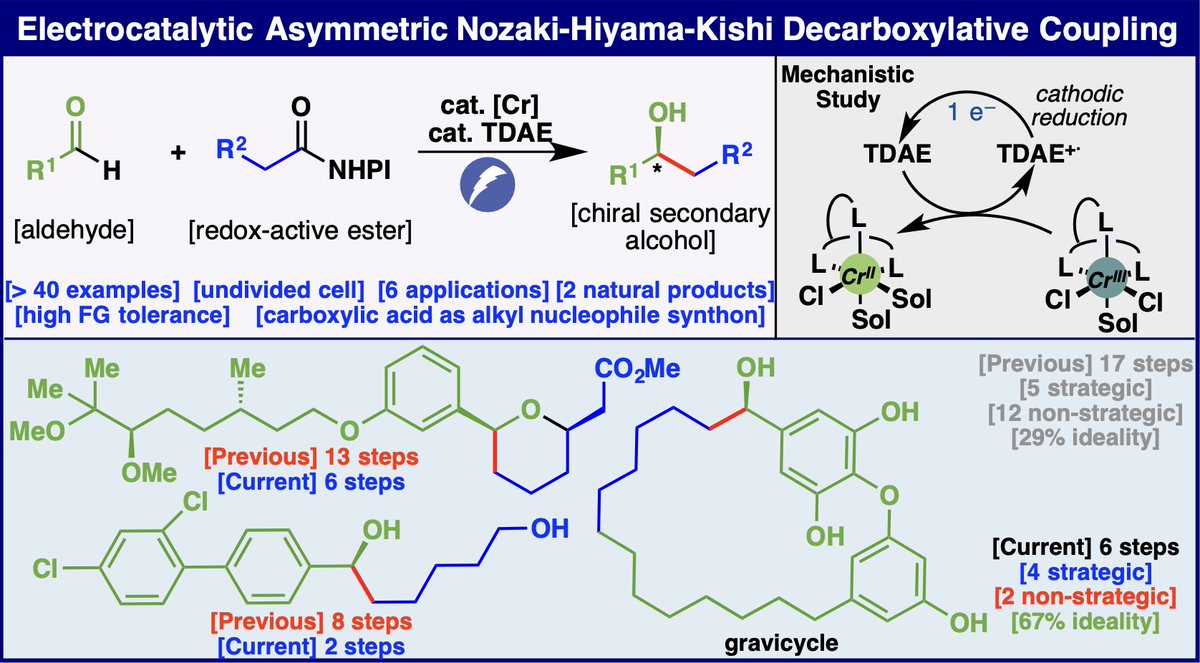
Electrocatalytic Enantioselective Alkyl-NHK reactions, appearing today in @ChemRxiv : https://t.co/NrEjsSMe3E. A fun @NSF_CSOE collaboration with the amazing @sarah_reisman, @Sigman_Lab, and @MinteerLab
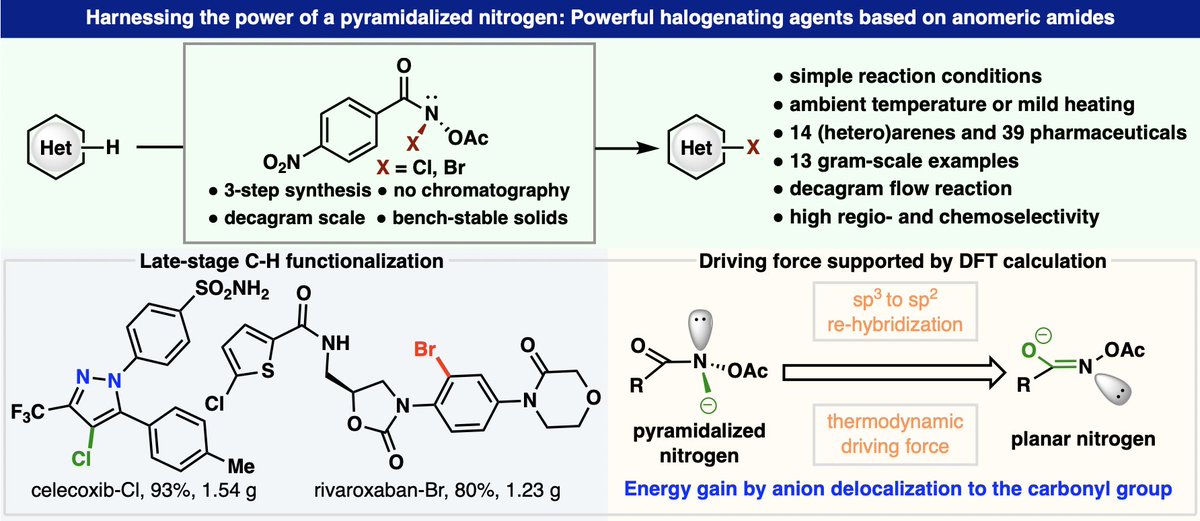
Anomeric Amides to the rescue! Halogenate even the most stubborn systems with a new class of reagents. Appearing today in @ChemRxiv - a fun collaboration with Abbvie, BMS and Pfizer. https://t.co/5UlWhB8dyK