ByteShape is at #EMNLP2026 in Budapest!
Come see our Industry Track poster, "Displacement Is Not Direction", in Poster Session D!
📍 Hall H, HUNGEXPO
📅 Mon, October 26, 11:00–12:30
Can't make it? Find us anytime October 25–29!
📄 https://t.co/CuNdbUv14x
#NLProc#ByteShape
ByteShape is a Startup Sponsor at #PyTorchCon 2026!
Come visit us at Booth #52 for fun interactive demos, conversations about efficient AI, and a special surprise!
📸 Take a photo and bring home a printed keepsake!
📍 San Jose Convention Center
📅 October 20–21
See you there!
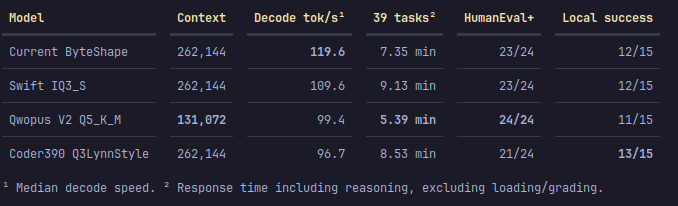
Trying out a handful of Qwen 3.8 27B quants tonight on my 4090 (custom lovelace runtime). Tests included HumanEval+ and a custom suite from my local harness sessions.
@ByteShape came out on top. Well done!🎉
Any other quants I should check out?
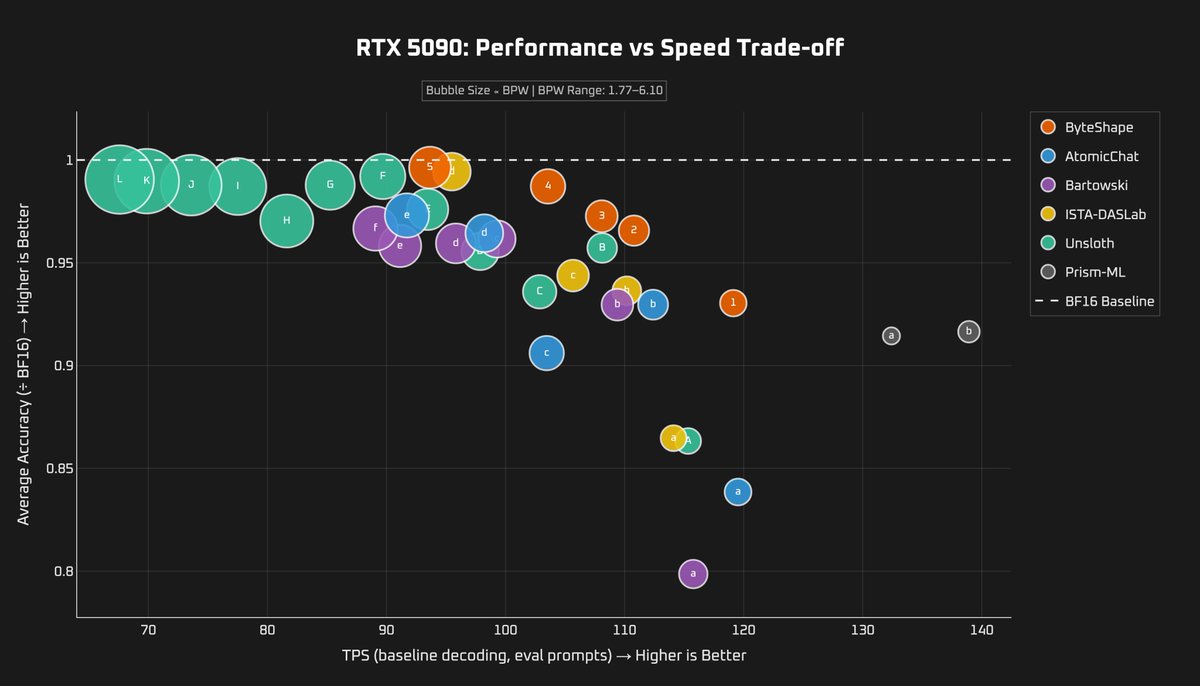
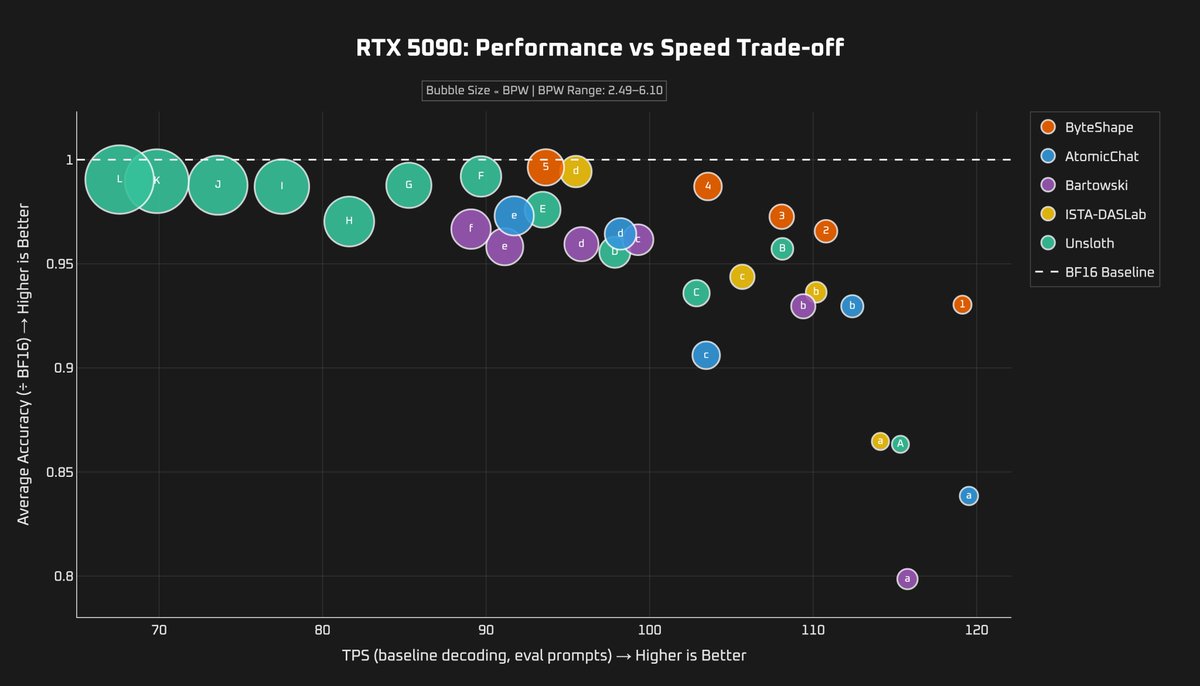
@gapDEEPry This is performance measured on llama.cpp and specifically on an RTX 5090 using llama-bench. It’s non-MTP performance. We have more benchmarks on more GPUs on our blog post: https://t.co/qVCl3iPD3J
1/3 We updated our Qwen3.8 benchmarks to include Prism-LM’s new Bonsai 2 QAT models.
These are our results, not the benchmark numbers reported by Prism. We ran Bonsai 2 using Prism’s runtime, while keeping the rest of the setup consistent with our other Qwen3.8 evaluations.
2/3 For Thinking benchmarks, we use medium thinking effort with the recommended sampling parameters.
Bonsai 2 reaches ~91.5% on our composite benchmark and shows a strong quality/throughput trade-off.
The goal is simply to provide a common reference point across Qwen3.8 quants
@Capetlevrai 2/2 I’d start by trying Models 2 and 4 to get a feel for the tradeoff. If 4 still isn’t good enough quality-wise for your workload, go with 5.
If 2 already meets all your expectations, try 1 for the fastest option.
We released ShapeLearn-Lite days after Qwen 3.8 27B, and it already delivered some of the best quality/speed trade-offs we tested.
Now full ShapeLearn is even better: 99.63% of BF16’s aggregate benchmark score at just 3.84 bpw.
Models & results: https://t.co/qVCl3iPD3J
@Capetlevrai 1/2 We haven’t benchmarked these models on Windows, but on cards like the RTX 4090 this model is extremely memory-bound, so the smaller the model, the faster it should generate tokens.
The real question is how much quality you’re willing to trade for speed.
@atarl666028 It’s hard to tell without enough information to reproduce it. We didn’t notice this in our tests. You can also follow up on this Reddit post: https://t.co/VPz567CofV. The community there would definitely be able to help troubleshoot it.
@NekoWitchMary ShapeLearn has, in fact, been sicced 😄
We dropped a ShapeLearn-lite Qwen3.8 yesterday, and it’s looking pretty good.
Give it a spin and tell us what you think:
https://t.co/rC5T8wsmOM
- GGUF: broadly compatible and easy to run across different hardware
- vLLM-Omni: around 2× faster, using our optimized backend on NVIDIA GPUs
Qwen-Image-2512:
https://t.co/rHdlCAKQZx
Krea-2-Turbo:
https://t.co/ayguFk2sjd
We recently released two optimized image-generation models: Qwen-Image-2512 and Krea-2-Turbo.
We pushed both into the ~3 bpw range while preserving their ability to generate high-quality images.
Each model comes in two flavors:
(1/2)
These @ByteShape models likely don't get enough attention (they don't seem to be loud like many others!). I've been running for a couple weeks, so well tested. Worth trying if you run Qwen3.6. Quite a lot faster for me, on my setup as well.
https://t.co/CbjQVXlT7u
We released Qwen 3.6 35B A3B GGUF quants in both NTP and MTP.
The benchmark results made one thing clear: size, speed, and quality do not move in a straight line.
GPU-5 was hard to beat. If it fits, try it first.
Blog: https://t.co/WJrOEKPjfk