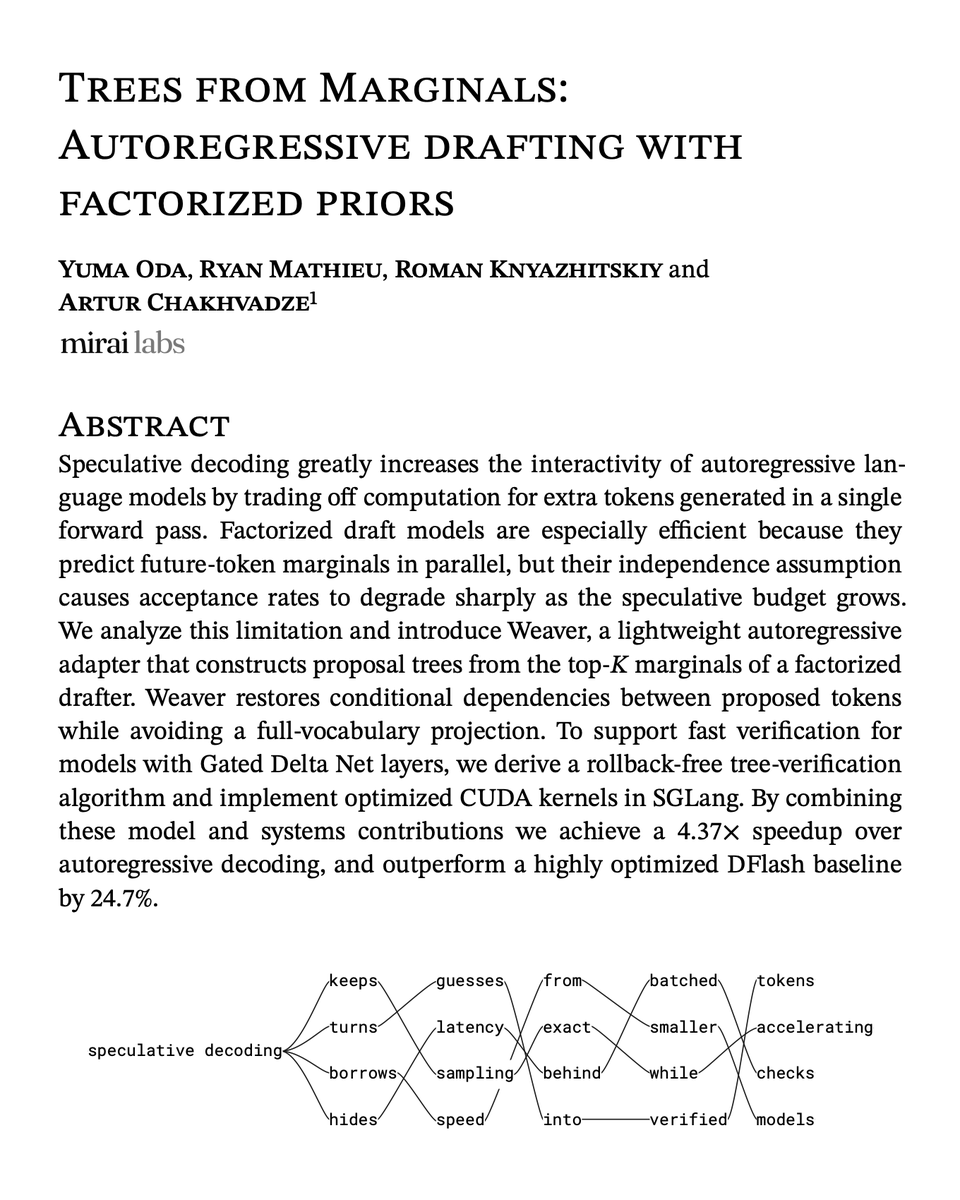
Glad I can finally share another project we have been cooking! We built Weaver to make speculative decoding practical( and SOTA😉) for Qwen3.5-27B… we’re ready to share the paper, draft model, and SGLang reference implementation.
It will be in our own inference engine soon but in the meantime test and play with it on your own!
Paper: https://t.co/SHUNeiyKA8
Model: https://t.co/yqWjG4y4Mx
Code: https://t.co/aHESLdaWIt
We are releasing our speculative decoding approach, together with the draft model for Qwen3.5-27B and the reference implementation in SGLang.
Paper: https://t.co/8m4mOl00CB
Model: https://t.co/b7aCNT7D8f
SGLang implementation: https://t.co/yK9nRI2aZu
@kamilskowron Hey got to run it overnight, looks amazing wanted to get our models and format out there! Seems like we do a good job of keeping up with the pack at much lower memory.
check out our models if it interests you:
https://t.co/hipPrh2aWx
https://t.co/iafkMCqXkF
@teortaxesTex I think quhawk or quduck are max models sadly assuming quduck is more like max preview … people are really wanting 27b to be that powerful (would be lovely but unlikely), in any news we should find out soon
Mirai Labs has been named to the first-ever Emergent List from @EricNewcomer and @felicis , following a nomination from @mati from ElevenLabs.
We’re a frontier on-device AI lab building models, runtime, and infrastructure to make personal intelligence interactive, ambient, and continuous -with a focus on automating everyday work and life.
Thank you to Mati for the nomination, to Newcomer and Felicis for the recognition, and to our team for the work that made it possible.
Meet the companies on the list:
https://t.co/bIdfGMLW71
Mirai made Qwen3.8 Flash-Next 2-bit, I made it UNCENSORED, and now it does 91-103 tok/s on ONE 3090 with the experts in system RAM. 41 GiB of RAM, 262K context, vision.
I ported their Strata patch to Strata 0.2 and put the weights on HF, so you can run it today.
@trymirai gave me early access and said I can publish my own versions. The hard work is theirs: the quant, the Strata format, the kernels and the converter. The S files in my repo are their files byte for byte. I moved the patch from Strata 0.1.43 to 0.2.0, converted their 32 GB S-small with their converter and added the refusal vector and the MTP draft layer.
On my fork, S on 1 card at 300W:
4K: 91-102 tok/s
32K: 99-101 tok/s
131K: 100-103 tok/s
Prefill is the weak part, 0.9-1.6K tok/s on 1 card depending on prompt length.
Earlier I ran it on 0.1.43 with Mirai's patch, same rig. There it did 80-88 tok/s on 1 card, and the IQ3_S GGUF I use daily did 74-84 and needed 53 GiB of RAM. On 2 cards S did 104-113 with 42 GiB, IQ3_S 95-108 with 80 GiB. I gave it a 217K token document with 3 hidden codes on 2 cards, it read it in 86 seconds and found all 3. S-small needs only 33 GiB of RAM and did 88-98 on 1 card, 100-118 on 2.
The refusal vector I made from Huihui's abliteration works on it without changes: 2 refusals out of 146 harmful prompts, the stock model refused 141. The quality numbers are Mirai's and I didnt check them, KL 0.040 to bf16 and 0.303 for the IQ2_XS GGUF.
On 2 cards their first patch just repeated one token forever. The rotation constants were uploaded only to the first GPU, so the second card had zeros. 7 lines fixed it, Mirai merged the fix and put my name in their README.
Upstream Strata cant read these files yet. The port is a draft PR to Niko, until it lands build my fork:
https://t.co/0OyQfOGdPh
https://t.co/4yTFerKySl
PR: https://t.co/T7cXIQ0iDr
Original quant by Mirai: https://t.co/5VDY8q3gcY
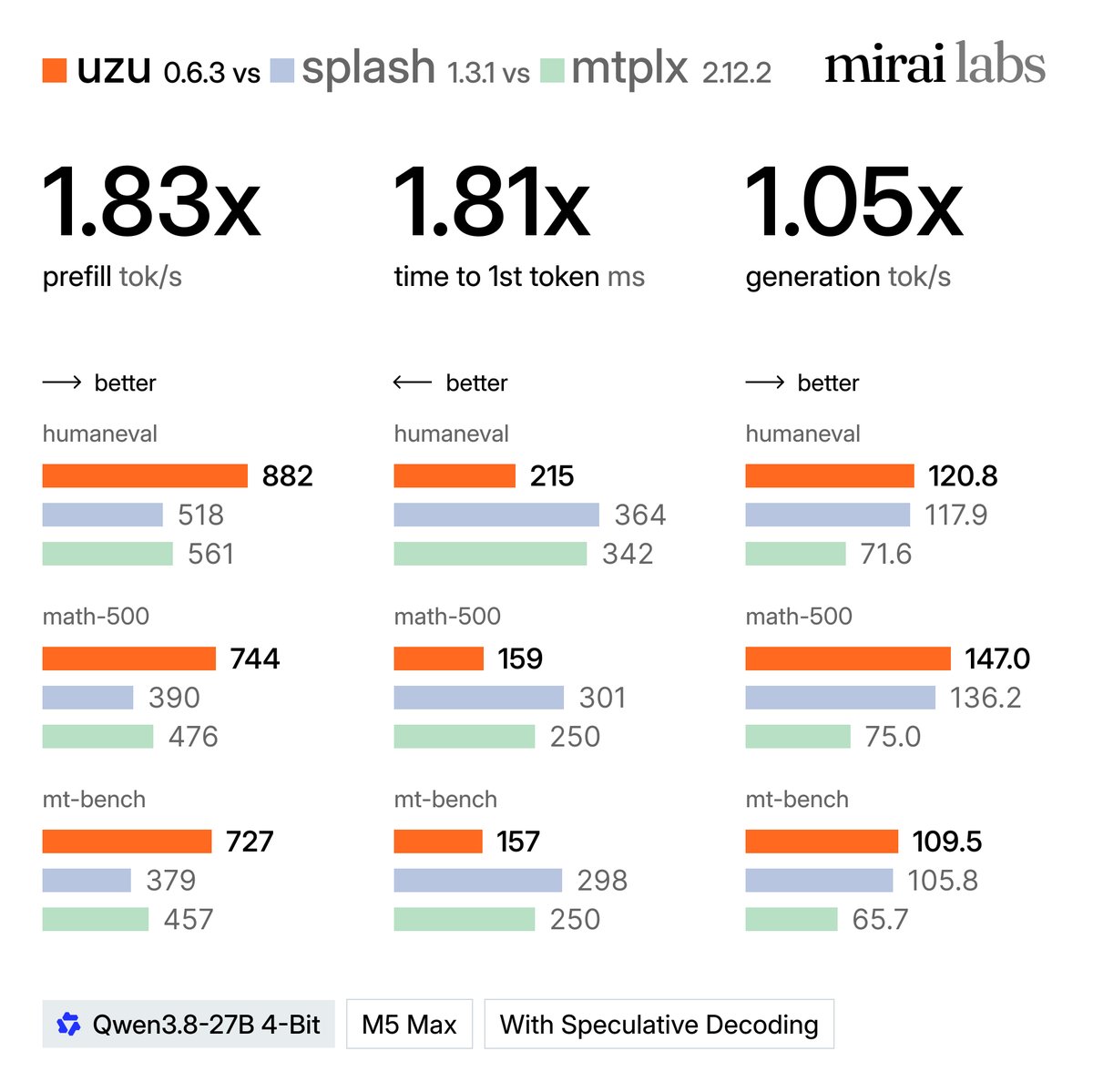
882 tok/s prefill on M5 Max for Qwen3.8-27B, with uzu.
Compared to Splash:
prefill: 1.83x faster
time to first token: 1.81x faster
generation: 1.05x faster
Measured on MT-Bench, MATH-500 and HumanEval.
A 27B model in 12 GB of VRAM. Full 262K context. 70 tok/s. And now it is UNCENSORED.
I ran it on my own RTX 3090, held to 12 GB. This is Mirai S Qwen3.8-27B, 2.4 bits per weight, an 11 GB file.
With my llama.cpp port the same card did 82K context at 38 tok/s inside 12 GB. Then @CaryPalmerr took the port and did the hard part. Same card, same file, his serve:
- context: 82K -> 262,144 with q8 KV
- decode: 38 -> 69.9 tok/s
- VRAM peak: 11.7 GB
- prefill: 1,124 tok/s
He keeps part of the KV cache in VRAM and the rest in pinned RAM, and he drafts with MTP at every depth. He checked every kernel against my fork token for token and wrote down every experiment, the failed ones too. On his real 12 GB RTX 4070 it does 76.6.
My part is small. I added abliteration. You cant edit these weights, they are compressed codes, so I measured the refusal direction on the quantized model and the engine removes it while the model runs. A 1.3 MB file and 1 flag:
- harmful prompts refused: 64 of 64 -> 0 of 64
- held-out set: 78 of 82 -> 0 of 82
- decode: 69.9 -> 69.7 tok/s
Counted by a regex, and with thinking on 1 of 24 still refuses. Deep in the context it gets slower on my card: 27.9 tok/s at 60K.
So thats 12 GB of VRAM, 262K context, 70 tok/s, abliterated. Open weights, open code, runs on your desk.
Cary did a genius amount of work and almost nobody has seen it. Go follow @CaryPalmerr right now, I mean it.
serve: https://t.co/TNmpeShz06
weights + vector: https://t.co/EOEr7bXSL1
This inference engine runs LLMs 4x faster than llama.cpp:
(Qwen3.5-9B at 92 tokens/s on 16GB Mac)
I ran Qwen3.5 9B on a base M5 MacBook Pro using three local inference engines, one at a time.
→ llama.cpp reached 22.0 tokens/s
→ MLX reached 25.1 tokens/s
→ Uzu reached 92.1 tokens/s
The video shows all three runs side by side.
The first two results do not mean llama.cpp or MLX are poorly optimized. Both are approaching a physical limit of ordinary local decoding.
Generating each new token normally requires another pass through the model. That pass streams roughly 5.2 GB of weights through memory.
A base M5 provides about 153 GB/s of memory bandwidth.
At one token per pass, the theoretical ceiling is roughly 153 ÷ 5.2, or 29 tokens/s, however fast the GPU computes.
Uzu gets past that ceiling by optimizing speculative decoding for Apple Silicon.
Speculative decoding uses a smaller drafting system to propose several future tokens. The full 9B model then checks those proposals together instead of generating every token through a separate pass.
Uzu pushes this further in two ways.
→ It drafts up to 16 positions and uses Weaver to turn independent guesses into coherent sequences.
→ It verifies several possible sequences as a tree, then commits state only for the path the full model accepts.
The 9B model remains in control of the final output. Uzu simply gives it more useful work to approve in each pass.
In my run, every pass of the 9B model produced 7.5 output tokens on average.
Ordinary decoding produces exactly 1.
That is how Uzu reached 92.1 tokens/s on hardware whose one-token-per-pass ceiling is roughly 29.
The rest of the engine is designed around this path too. Uzu ships its own quantized checkpoints, and on M5 chips its Metal kernels run verification through the GPU’s accelerated int8 matrix path.
It is an open-source inference engine from Mirai, with bindings for Rust, Swift, Python, and TypeScript.
The repository is here: https://t.co/CayueSO3B9
(don't forget to star 🌟)
I wrote the full breakdown of why local inference is memory-bound and how Uzu gets past that limit, with reproducible results and code.
The article is quoted below.
A 27B model in 12 GB of VRAM. Full 262K context. 70 tok/s. And now it is UNCENSORED.
I ran it on my own RTX 3090, held to 12 GB. This is Mirai S Qwen3.8-27B, 2.4 bits per weight, an 11 GB file.
With my llama.cpp port the same card did 82K context at 38 tok/s inside 12 GB. Then @CaryPalmerr took the port and did the hard part. Same card, same file, his serve:
- context: 82K -> 262,144 with q8 KV
- decode: 38 -> 69.9 tok/s
- VRAM peak: 11.7 GB
- prefill: 1,124 tok/s
He keeps part of the KV cache in VRAM and the rest in pinned RAM, and he drafts with MTP at every depth. He checked every kernel against my fork token for token and wrote down every experiment, the failed ones too. On his real 12 GB RTX 4070 it does 76.6.
My part is small. I added abliteration. You cant edit these weights, they are compressed codes, so I measured the refusal direction on the quantized model and the engine removes it while the model runs. A 1.3 MB file and 1 flag:
- harmful prompts refused: 64 of 64 -> 0 of 64
- held-out set: 78 of 82 -> 0 of 82
- decode: 69.9 -> 69.7 tok/s
Counted by a regex, and with thinking on 1 of 24 still refuses. Deep in the context it gets slower on my card: 27.9 tok/s at 60K.
So thats 12 GB of VRAM, 262K context, 70 tok/s, abliterated. Open weights, open code, runs on your desk.
Cary did a genius amount of work and almost nobody has seen it. Go follow @CaryPalmerr right now, I mean it.
serve: https://t.co/TNmpeShz06
weights + vector: https://t.co/EOEr7bXSL1