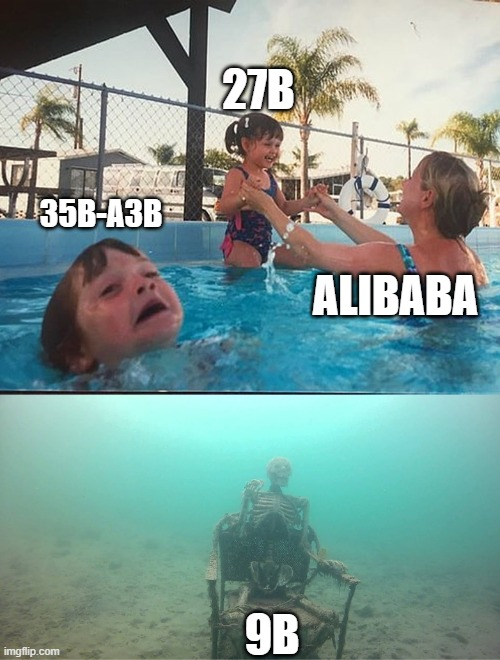
@sudoingX You are the only person on my timeline who keeps recommending Bonsai. For 12GB of VRAM, I had always believed that 27B-GSQ-RCO was the only real option. What is it about Bonsai that you find so satisfying? It’s possible that I simply haven't been using it correctly.
Please welcome GPT-6 Sol and GPT-6 Luna to the GPT-6 universe.
GPT-6 Sol and Luna build on the advances behind GPT-6 Astra, bringing much of its strengths into faster and more affordable models to support work at scale.
We’ve also made caching and inference more efficient, and we’re passing the savings directly to you: 50% lower API prices for Sol and Luna compared with GPT‑5.6 promotional pricing.
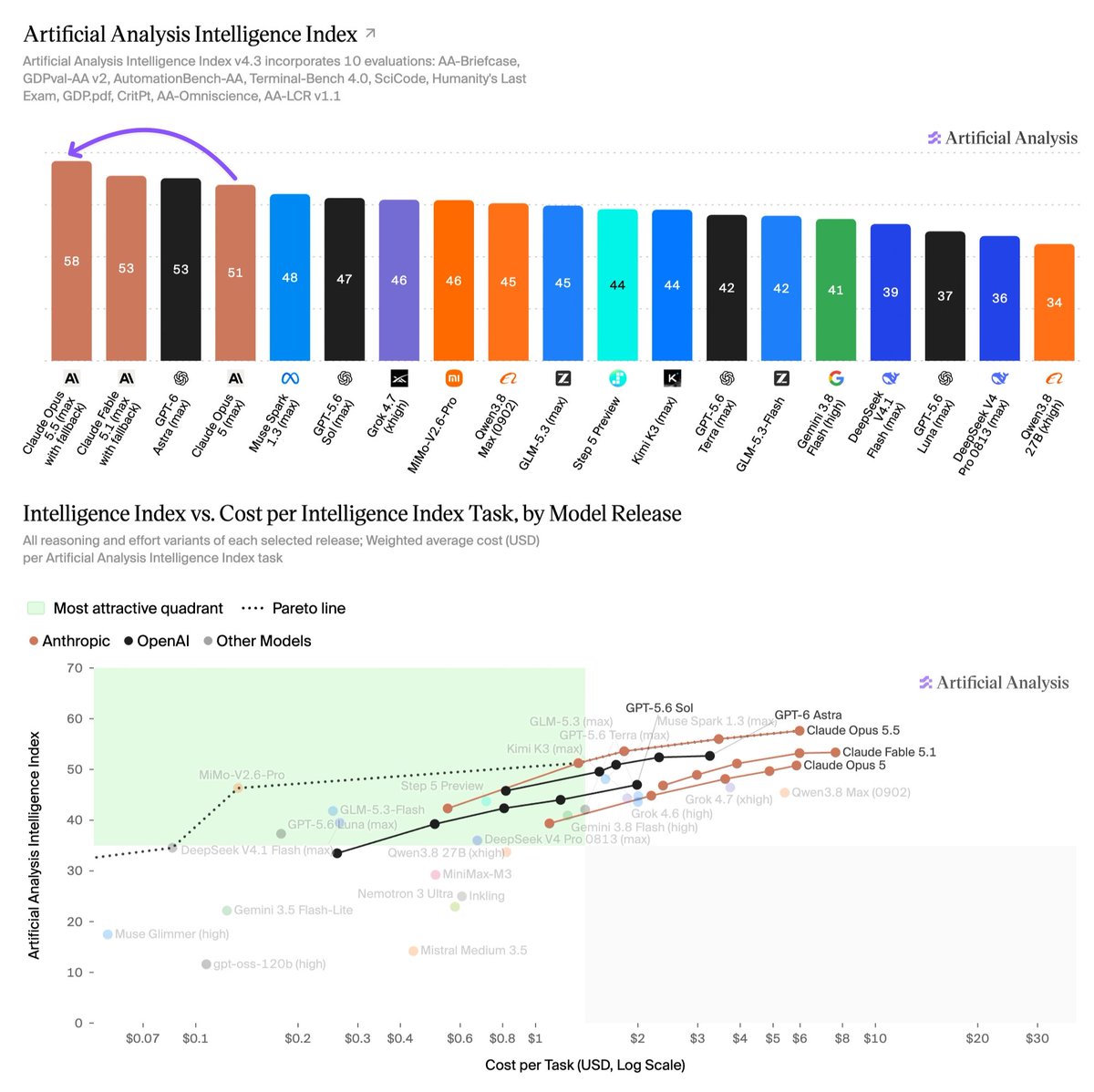
Claude Opus 5.5 takes the top spot on the Artificial Analysis Intelligence Index, along with a 20% price cut and larger cache hit discount
Claude Opus 5.5 brings Anthropic to parity with GPT-6 Astra on evaluations like Terminal-Bench 4.0 and AutomationBench-AA, while extending Anthropic’s lead in agentic knowledge work.
At max effort it scores 58 on the Artificial Analysis Intelligence Index, the highest score we have measured by several points. Anthropic has cut Opus pricing to $4/$20 per 1M input/output tokens (Opus 5: $5/$25) and cache reads from $0.50 to $0.20.
Key takeaways:
➤ Consistent strong performance, with leading scores on six of the ten Intelligence Index evaluations: Humanity's Last Exam 61.4% (previous best 59.1%, Claude Fable 5.1), SciCode 66.9% (63.1%, Fable 5.1), GDPval-AA v2.1, AA-Briefcase v1.1, AA-Omniscience and AutomationBench-AA. On Terminal-Bench 4.0 it scores 59.6%, level with the leader GPT-6 Astra (xhigh) and +11 points over Opus 5. It remains slightly behind on CritPt, AA-LCR, and GDP.pdf
➤ Leads in agentic knowledge work: On AA-Briefcase, our private frontier knowledge work evaluation, it reaches an Elo of 1822. This is +143 over Fable 5.1, ahead on both analytical quality and presentation, and is the first time Anthropic has reached presentation quality surpassing GPT-5.6 Sol. This evaluation tests whether models can produce accurate and well-presented professional outputs using our open source reference agent harness, Stirrup
➤ Level with Opus 5 on cost per task despite 1.6x the output tokens: Opus 5.5 (max) uses ~119k output tokens per Intelligence Index task, against ~73k for Opus 5 (max), ~78k for Fable 5.1 (max) and ~27k for GPT-6 Astra (max)
➤ Four of five effort levels sit on the Intelligence vs Cost per Task frontier: Opus 5.5 max, xhigh, high, and medium all sit on the Pareto frontier, costing less or outperforming other models scoring 50+ (GPT-6 Astra, Claude Fable 5.1, and Claude Opus 5)
Other model details:
➤ Context window: 1 million token context with image and text input support, unchanged from Opus 5
➤ Pricing: $4/$20 per 1M input/output tokens, down 20% from $5/$25 for Opus 5. Cache writes $5 per 1M tokens for the 5 minute TTL, down from $6.25. Cache reads have been further discounted to $0.20 per 1M tokens, down 60% from Opus 5’s $0.50. This is a 95% discount compared to uncached input pricing, up from 90% on previous Opus models
➤ Effort settings: Five effort settings (low, medium, high, xhigh, and max). Intelligence Index evaluations were run at all five with Anthropic's default fallback enabled
Introducing Claude Opus 5.5, the first model in our new Claude 5.5 family.
It performs at the level of Claude Fable 5.1 for most tasks, and costs 40% less to run than Opus 5.
Introducing Claude Opus 5.5, the first model in our new Claude 5.5 family.
It performs at the level of Claude Fable 5.1 for most tasks, and costs 40% less to run than Opus 5.