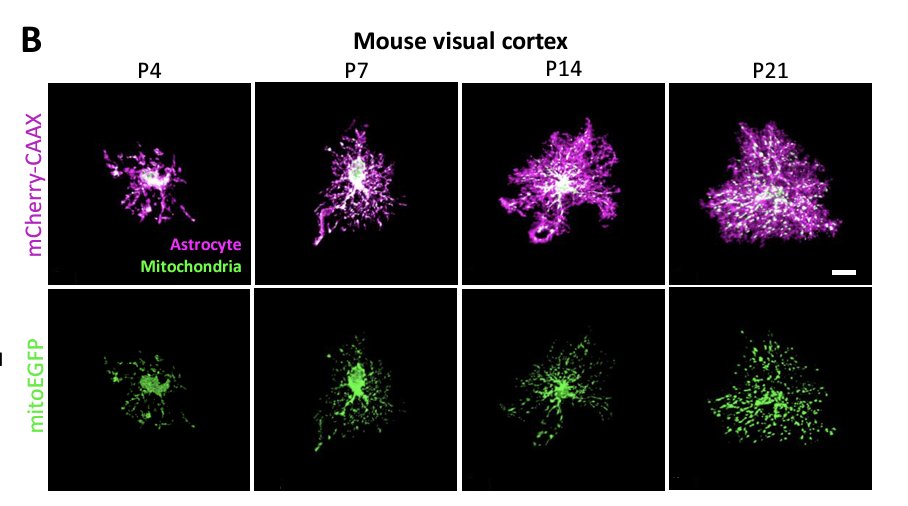
Hot preprint alert!!! Please check out our study led by the amazing @piasglia on how mitochondrial fission regulates astrocyte morphogenesis! Unexpected findings linking astrocyte mitochondria to tiling and gap junction coupling!!! https://t.co/7S5wFZ4ymf
Rodriguez Salazar, @c_eroglu et al. @DukeHealth show that Drp1-mediated mitochondrial fission is necessary for peripheral #astrocyte process formation. Loss of Drp1 induces astrocyte reactivity & disrupts cortical astrocyte organization https://t.co/8gMUXvShFD
I am very excited about our new paper just published in PNAS.
Dense Associative Memory is a versatile family of models that allows to store large amounts of information, have strong error-correcting capabilities, and other desirable properties. But is it possible to build it in biological “hardware”? This is a tricky question since DenseAMs have many-neuron couplings (more than 2 neuron couplings). This, at face value, may seem contradictory to pairwise neuron connectivity: pre-synaptic neuron and post-synaptic neuron couple at the synapse.
Our paper describes an interesting way of building DenseAMs using astrocytes, which is a prominent cell type in the glia family. The unique anatomical connectivity of astrocytes, which couple to neurons through tri-partite synapses (pre-, post-synaptic neurons, and the astrocyte’s process) create an elegant theoretical possibility of coupling more than two neurons and mediating the information transmission between those neurons.
Key takeaways:
🔷 Astrocytes compute.
🔷 Dense Associative Memories (and other AI architectures) can be built using astrocytes.
🔷 From the computational perspective astrocyte is not just a single entity, rather it is a network of processes.
🔷 Memories can be stored, at least partially, in the biochemical machinery inside the astrocyte, as opposed to just synapses.
It was a pleasure to work on this idea together with Leo Kozachkov @Leokoz8 and Jean-Jacques Slotine.
Paper: https://t.co/IEGzuOPs0u
The image below summarizes the main message of our paper: astrocyte = network of processes that engage in information exchange and computation. The image shows a 3D reconstruction of an astrocyte from the visual cortex using Imaris Bitplane 9.9. A custom Imaris extension, 3D Sholl Analysis, was used to quantify the number of process intersections at 5 μm intervals from the cell soma, marked by the sphere, thereby visualizing the highly complex network of processes of the astrocyte. The raw image was captured in October 2023 using an Olympus FV 3000 confocal microscope with a 60x objective lens and a z-step size of 0.5 μm across a 50–60 μm z-stack for high magnification and resolution. The overlaid network illustrates a mathematical model, which represents the astrocyte as a network of processes that enables heterosynaptic communication and supports high information storage associative memory function.
Experimental data credit: Leyka Nagendren @LNagendren , Cagla Eroglu @c_eroglu, Duke University.
Artist Credit: Annette Hui, IBM Research, https://t.co/blBcM4BguS
Delighted to see not one, not two, but three papers about astrocytes in Science today! Here's our contribution to that collection.
Come follow us on bluesky! Papouin lab twitter/X: over & out...
https://t.co/NYLnRzqEFh
This preprint also features a new computational method, Seg_Astro, developed by our collaborators Boyu Lyu and @yu_guoqiang to analyze astrocyte branching.
Hot preprint alert!!! Please check out our study led by the amazing @piasglia on how mitochondrial fission regulates astrocyte morphogenesis! Unexpected findings linking astrocyte mitochondria to tiling and gap junction coupling!!! https://t.co/7S5wFZ4ymf
Congratulations, Salk Associate Professor Nicola Allen! 🎊
Allen has received a 2024 @NIH_CommonFund Director's Pioneer Award for her exceptional creativity and innovative research. She will use the $3.5 million prize to study whether plasticity can be enhanced in adult brains 🧠 #NIHHighRisk
https://t.co/FpxhwP9Rqi
I am sad to miss #sfn2024 this year. Please stop by Eroglu lab posters by Daniel Quintero - October 5, 6:30—8:30 p.m. Hall A - Early Career Poster Session - Poster A45 and @ShiyiWang10 - Oct. 6th, 1-5pm, MCP Hall A - Poster LBA003.072 / LBA70.
Excited to share our work on data science in large neuroscience collaboration published in Neuron. We found some challenges but also opportunities on data integration, sharing and research training. Hope it paves the way for further advancing the field. https://t.co/0m8ihhKoy2
scRNA-seq explores cellular/tissue heterogeneity but struggles with noise and dropout effects. Guoqiang Yu & Yue Wang’s groups from the U19 Astrocyte-Team have developed a GO-term activity model to transform scRNA-seq data into a GO-term activity score matrix, making downstream analysis more robust.
More here: https://t.co/FIkGopmUBk
@animmerj@c_eroglu@yu_guoqiang@LinTianPhD@Tsinghua_Uni@virginia_tec
@LucasCheadle Agghh Astrocyte Cre's are very problematic. Particularly in the hippocampus. Do you need it for early development or for adults? Try @amy_gleichman 's GFAP-Cre virus. If administered carefully and in appropriate titer, it is astrocyte-specific. You can use S100beta as a marker.
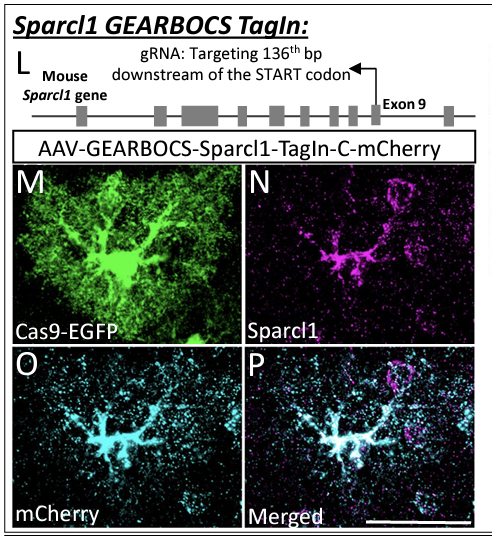
The new and improved version of GEARBOCS, an AAV tool for in vivo genome editing in astrocytes, is here, and the plasmids will be available in @addgene soon! Check out the preprint by amazing @danineura and co! https://t.co/iAHvlT9Den
Pls RT📢We are hiring! Join the @HHMINEWS Science Department as a Scientific Officer. This is perfect for you if you have been running a lab for 7+ years and would like to broaden your impact in science. Help us administer the #HHMIInvestigators#FHScholars#HannaGrayFellows programs and move science forward
-Remote work eligible
-Keep your lab - HHMI provides research support
https://t.co/OFr6hBn5yL
The U19 Astrocyte-Team has released CAM3.0, an algorithm for performing fully unsupervised deconvolution of complex tissues. Developed by Yu and Wang’s groups, CAM3.0 more accurately identifies known or novel cell markers, determines cell proportions, and estimates cell-specific expressions from bulk tissue data.
Learn more: https://t.co/FIkGopnsqS
@animmerj@c_eroglu@yu_guoqiang@LinTianPhD@Tsinghua_Uni@virginia_tech