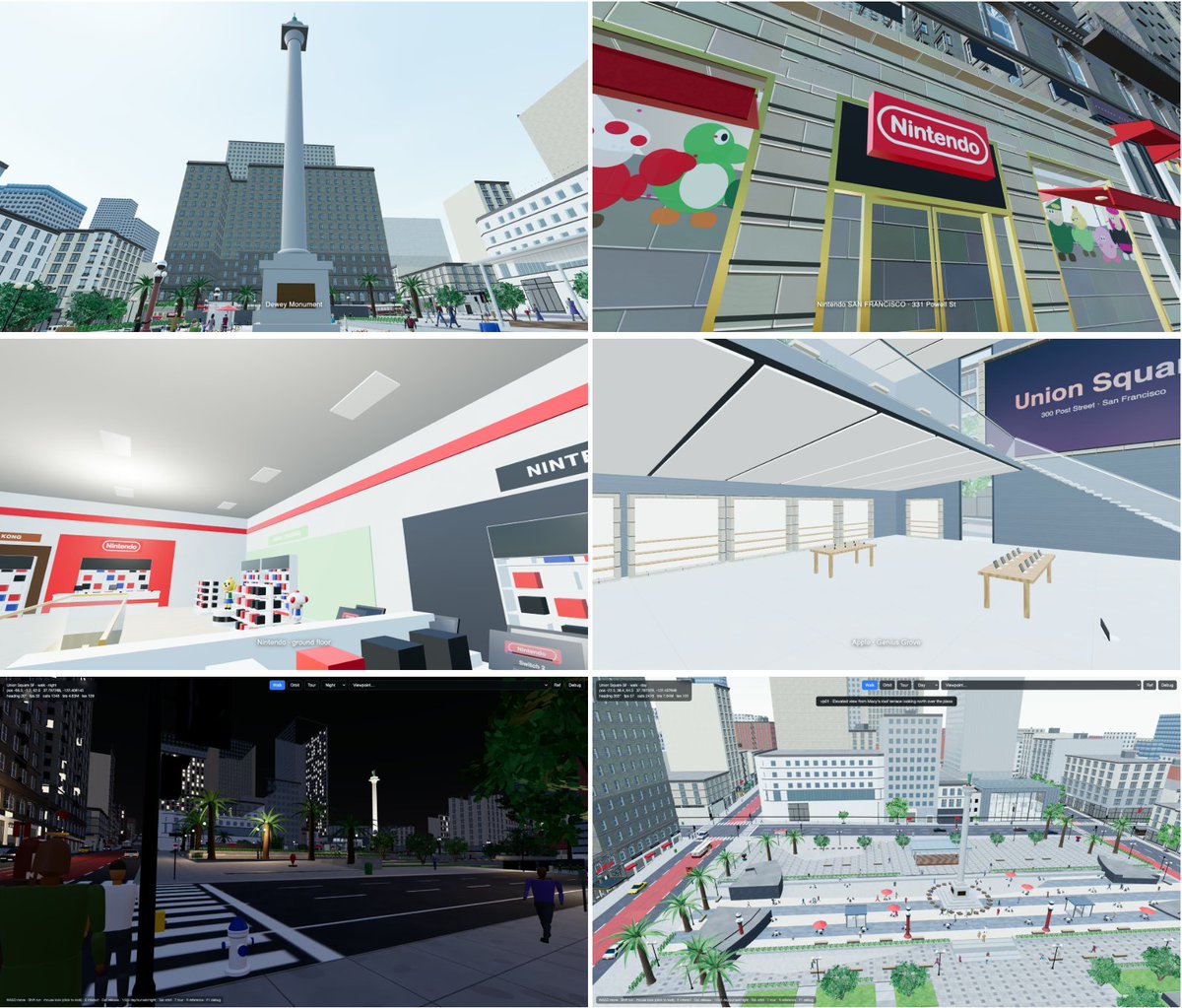
fable51-worlds hit the HN front page yesterday!
the best outcome wasn't the stars, it was the number of people who reached out excited about the same direction we are: using code as the interface for generating 3D worlds, animation, and video.
we're writing a survey on this direction, what papers should we cite and discuss?
fable 5.1 generated an interactive 3D union square, and the agent filmed its own tour guide vid inside it. you can walk Powell to Stockton, read the actual storefronts, cross a working intersection, watch a cable car go by. went inside Apple and the Nintendo store, lower level included
source code + more worlds soon: https://t.co/YW5RPvvjfr
@karpathy@AnthropicAI
Niu Lai cost $200 and has made $6.8M.
A mother and son, five years, and people can feel it in every frame. Art made out of love still finds people.
It made me want to try something. I gave our agent one prompt and walked away.
Five hours and ~$10 of compute later, it handed back an 86-second animated film. Claude Opus 5, running inside our harness, wrote every line in Three.js.
The film is about a crab too small to keep. He's pulled out of San Francisco Bay, sees the Golden Gate Bridge once, and gets thrown back. He has no way to tell anyone what he saw, so he builds his own.
No video file. No images. No 3D models. No fonts. Nothing fetched. The whole film is 1.46 MB.
Because it's code, not just pixels, every decision in the frame is explicit and inspectable: lighting, motion, geometry, camera. That's the difference between generated video and verifiable video.
I wanted to be a director when I was a kid. Watching this crab build his bridge, it feels like the same wish, arriving from the other direction.
The taste is still human. The cost isn't.
AI agents can write code.
AI agents can browse the web.
AI agents can pass the bar exam.
Can they edit a video?
We gave the 7 best frontier models 100 real-world post-production tasks, scored by 20 industry experts.
Best agent: barely crosses 30%
Human experts: 89%
Introducing AgenticVBench. 🧵
What's actually breaking?
Repurpose: 83% of failures are long-context information loss. Agents burn the rollout budget on whisper transcription and never reach the assembly step.
Repair: 65% of failures are temporal reasoning. Agents render a valid .mp4 with the wrong cut window.
These are not the same problem.
How we built it: 20 post-production experts, avg 6 years of post-production experience, from traditional film studios, AI film studios, and agent companies.
Each task: realistic brief + verifiable rubric.
Each rubric: binary yes/no items.
This is a benchmark editors can defend.
The most surprising result: the *harness matters as much as the model*.
GPT-5.5 on Codex: 38%
GPT-5.5 on OpenCode: 36%
GPT-5.5 on OpenClaw: 18%
Same model. 20-point swing.
Most benchmarks today are still model-based. That's wrong. Agent = model × harness.
AgenticVBench has 100 expert-authored tasks across the 4 stages of real video post-production:
→ Assembly: pick the right shots to match a storyboard
→ Repair: find and fix defects in a rough cut
→ Sequencing: recover narrative order from shuffled clips
→ Repurpose: turn a long source video into a short deliverable
Tasks span 30 min to one week of human work. Running all 7 frontier models across 100 tasks × 3 rollouts each cost ~$8,000 in API calls - these aren't write-a-haiku tasks.
Introducing Mirage, a unified virtual filesystem for AI agents!
6 weeks. 1.1M+ lines of code. We rewrote bash from the ground up so cat, grep, head, and pipes work across heterogeneous services. S3, Google Drive, Slack, Gmail, GitHub, Linear, Notion, Postgres, MongoDB, SSH, and more, all mounted side-by-side as one filesystem.
Bash that AI agents already know works on every format! cat, grep, head, and wc parse .parquet, .csv, .json, .h5, even .wav! One pipe can stitch S3, Drive, GitHub, Slack, and Linear together, same Unix semantics throughout.
Workspaces are versioned too. Snapshot, clone, and roll back the whole thing with one API call. A two-layer cache turns repeated reads into local lookups, so agent loops stay fast and cheap.
Drop a Workspace into FastAPI, Express, or a browser app. Wire it into OpenAI Agents SDK, Vercel AI SDK, LangChain, Mastra, or Pi. Run it alongside Claude Code and Codex.
Site: https://t.co/zo1orc2wA9
GitHub: https://t.co/zeRAKri7I9
#AIAgents #OpenSource #AgenticAI #Strukto #Filesystem #VFS
It’s extremely good that Anthropic has not backed down, and it’s siginficant that OpenAI has taken a similar stance.
In the future, there will be much more challenging situations of this nature, and it will be critical for the relevant leaders to rise up to the occasion, for fierce competitors to put their differences aside. Good to see that happen today.
@googleaidevs Also, the API’s processing speed is abnormally slow - much slower than the Gemini app. I also tried calling this model from OpenRouter and it failed completely for larger videos. Are there any optimizations available?
@googleaidevs Just wondering if any of you have tried building a video understanding pipeline with Gemini 3 Pro. Even for smaller videos, the inline data upload fails (~4 MB), which is different from what the docs suggest for videos < 20 MB: https://t.co/lWkpIZk4s4.
1) The 4-Step Blueprint (It's Not Magic):
1️⃣ Extract: Doc understanding module extracts figures
2️⃣ Caption: comprehensive descriptions for each figure
3️⃣ Match (The Key): blueprint gen
4️⃣ Design: nano banana pro
We’re seeing this clearly in our exploration of Generative UI for academic slides. It’s all about the joint optimization of layout and content. We used to think extracting images was key (doc understanding), but "Nano Banana" just proved that AI images are finally ready