My conversation with Tobi Lütke (@tobi), co-founder and CEO of Shopify.
0:00 Companies as Social Technology
5:27 The Value of Reading Books: Cheat Codes for Life
7:28 Post-IPO Crisis: Cosplaying as a CEO
7:54 Competition vs Rivalry: The Power of Healthy Competition
16:02 COVID as a Turning Point: Rebuilding the Executive Team
18:21 Hiring Founders: Building a Team of High-Agency People
26:49 Shopify OS: Engineering the Company from First Principles
36:48 Compensation Innovation: Giving Employees Full Agency
40:41 The Psychology of Identity and Affirmations
48:43 Differentiation Over Perfection: Making It Your Own
50:31 Context Podcast: Documenting Decision-Making
1:26:36 The IPO Decision: Going Against Silicon Valley Orthodoxy
1:35:08 Building a Company Worth Working For
1:41:50 Hiring for Spikiness: Finding Non-Conformists
1:48:28 Office Design Philosophy: Creating Space for Excellence
1:58:54 Video Games as Business Training: StarCraft Lessons
2:07:06 AI Revolution: 2026 and Beyond
2:11:44 Focus on Craft: The Unquantifiable Elements of Excellence
2:21:08 Survivorship Bias: The Importance of Entrepreneurial Exposure
2:23:22 Closing
Includes paid partnerships.
Shopify billionaire co-founder & CEO Tobi Lütke — one of the most analytically rigorous founders alive — uses affirmations.
His exact words:
"If you tell yourself or write down something about yourself 100 times, it writes into the neurofrontal cortex at such a deep level that your brain will start reconciling you to that. It just works."
His personal example:
He was terrified of public speaking.
For one week he sat down every day for 10 minutes and wrote: "I love public speaking."
A week later the fear was gone.
"It's not like a placebo. You just actively change your neurofrontal cortex in this moment."
Your brain starts shaping your behavior around the identity you rehearse most.
India tried to build battery cell factories with Rs 18,100 crore in subsidies starting 2021. After 5 years, only 2.8% of target capacity got built
Reliance stopped cell manufacturing plans when China blocked battery tech transfer. Ola Electric reached 1.4 GWh against 20 GWh target. Problem was simple. India had no domestic supply of battery parts. Every piece came from China.
New Rs 13,000 crore scheme targets 5 parts that go into cells, cathode materials, anode materials, electrolytes, copper foil, separators. Fix inputs first, then fix outputs
China makes 85% of global anodes, 82% of electrolytes, 74% of separators, 70% of cathodes. Chinese companies hold 80% of copper foil capacity worldwide.
Indian battery makers import all 5 of these parts from China. Old PLI told companies to build giant cell factories. Reliance wanted to license battery tech from Chinese company Hithium. Beijing blocked it by tightening technology export rules.
New scheme says build parts first, cells later. Going from raw inputs upward instead of finished cells downward makes more sense for where India stands.
India will need 700 GWh of battery capacity by 2030, up from 40 GWh in 2025. Grid storage alone requires 236 GWh by 2032.
Country will consume 400,000+ tonnes of cathode materials and 200,000+ tonnes of anode materials yearly by 2030. HEG is building graphite anode plants. Graphite India signed deal with Maharashtra government.
Hindalco is setting up copper foil manufacturing. Rs 13,000 crore component scheme arrives when real manufacturers exist to use it.
In 2021, nobody was ready. In 2026, few companies have started building.
https://t.co/Qf5NmcJwNW
Bank of Baroda lent $250 million without strong collaterals to BR Shetty's NMC Health. NMC was under $6 billion debt. NMC collapsed. Now Bank of Baroda has paid $600 million to settle litigation that rightly accuses the bank of oversight.
$850 million of taxpayer's money. Gone.
❗Major Floods Hit Northern Nepal, Rescue Ops Underway
Flash floods have swept through Timure and Syabrubesi in Rasuwa district, with terrifying visuals emerging from the affected areas.
Nepal PM Balendra Shah said the Army, Armed Police and police have been deployed for rescue operations, while helicopters and additional ambulances and medical teams are being sent to the region.
Residents in low-lying areas have been urged to move to safety.
📹 Social Media
India Proposes New Charge On Electricity Sent To Bangladesh
India has proposed a ₹0.005 (half-paisa) charge per unit on 1,160 MW of electricity supplied to Bangladesh. The rate was cut from the original 1-paisa proposal after Bangladesh pushed back.
Bangladesh currently has arrangements to import up to 2,656 MW of electricity from India. The new charge would apply to power supplied through India’s state-run NVVN, not the entire 2,656 MW.
The new charge may look tiny, but it would add up to about ₹5.1cr annually. Nepal and Bhutan already face the same charge for cross-border electricity trade with India.
Without abusing PM or CM
Without any stone pelting
Without any Azaadi slogans
Without any attacks on police
Without any food, reel sponsors
Without any Antihindu Statements
Jharkhand Students have won!
They have shown what a real fight looks like.
The MMDR Amendment Bill, 2026, A landmark step towards a more progressive, efficient and future-ready mineral sector.
The MMDR Amendment Bill, 2026 strengthens the framework for responsible mineral development, greater efficiency and enhanced participation, supporting India’s journey towards a resilient and self-reliant mineral economy.
#MMDR2026
Stronger States. Stronger India. 🇮🇳
The MMDR Amendment Bill, 2026 aims to create a more stable, predictable and future-ready mining ecosystem.
With greater certainty, stronger mineral exploration and increased domestic production, the Bill will help unlock new opportunities for States and accelerate growth in the mineral sector.
More investment. More opportunities. More growth.
#MMDR2026 #States #Minerals #Revenue #Mining
@airnewsalerts
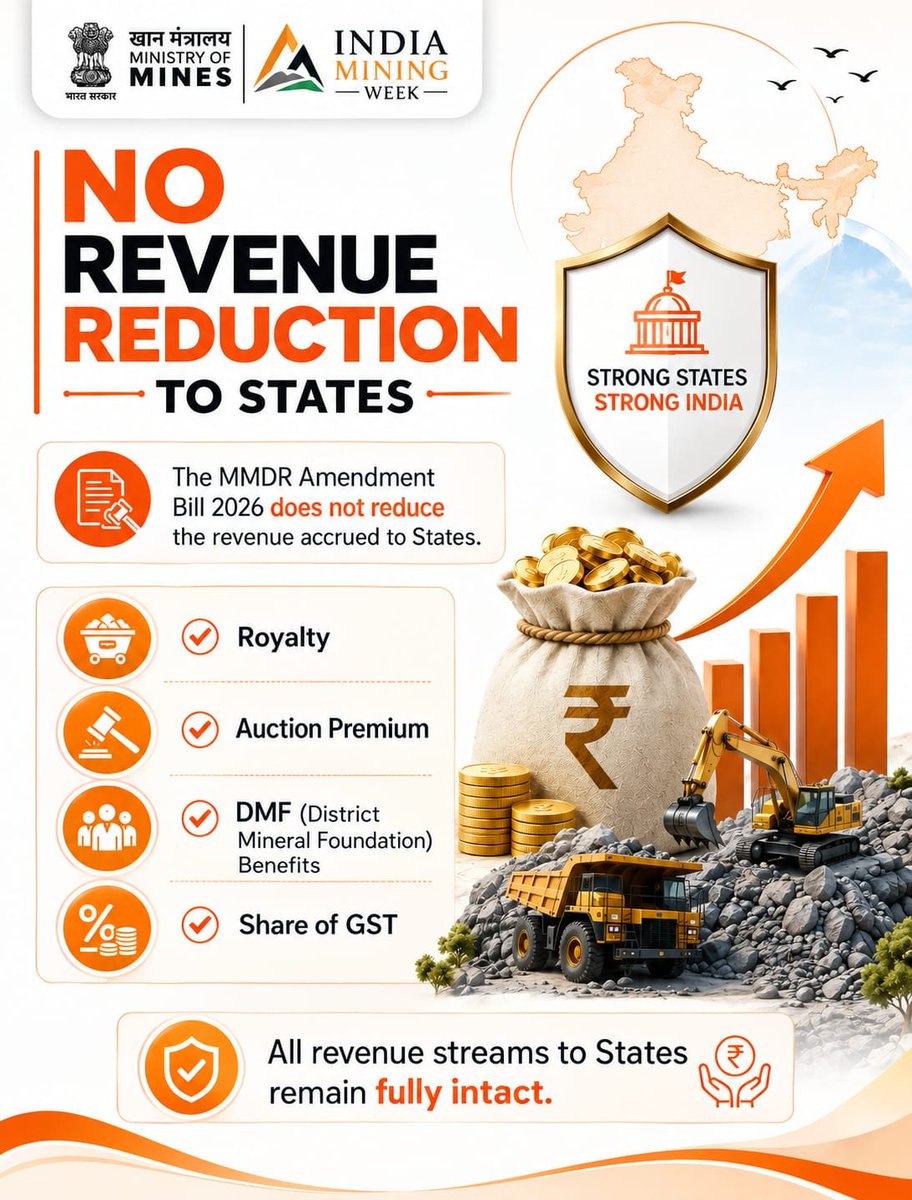
The Ministry of Mines (@MinesMinIndia) has issued a clarification regarding the amended Mines and Minerals (Development and Regulation) Bill-2026.
➡️MMDR Amendment Bill 2026 addresses taxation on mineral-bearing land, not land rights.
➡️No State will suffer any financial loss.
➡️State revenues remain with the States. Royalty, Auction Premium, DMF benefits and GST share continue to flow to mineral-bearing States.
➡️The objective of the amendment is stable mining, sustainable State revenue, and stronger growth.
A 20-year-old Delhi techie, Aryan Nishad, has launched https://t.co/rlW7xL7nnF, a platform where citizens can anonymously report bribe demands.
Users can log the amount, location, department and the service involved. These reports build a public database that exposes bribery patterns across government offices in India.
The site even helps people turn their reports into formal complaints for anti-corruption authorities.
The response has been huge, 25 lakh requests in just 10 hours.
Anupam Mittal called it a potential game-changer for governance and accountability.
One simple website is giving common citizens the power to document corruption and make it visible.
Note: These are crowdsourced allegations, not confirmed proof against any official.
#Delhi #Techie #Bribes #Corruption #PublicDatabase #India
Modi ji, look at what your NTA has just done.
UGC-NET exams for Sociology, English and Commerce were held between 22 and 30 June. Nearly two months later, NTA has cancelled all three because it set faulty papers and repeated old questions.
Thousands of candidates who prepared for years, filled forms, paid the fees, travelled to distant centres, must now do it all again in September. NTA makes the mistake but the student serves the sentence.
I said this in Kota, in Dehradun, in Prayagraj, and I will keep saying it - this is no longer an education system. It is an extraction machine. It takes your money, your years, your mental health, and your confidence and returns nothing. Not even a job.
NTA still won’t answer the real question - were these papers leaked before the exam?
Just like every other arm of the Modi government, NTA never says it’s their fault. Just like every other compromised paper, I am absolutely sure there will be no accountability.
Dharmendra Pradhan’s resignation was the first step, not the last. NTA’s leadership must be held accountable too.
To every student sitting this exam again in September - you are not the problem. PM Modi built a system that cannot run an exam and then blames the students who take it. Your years are being stolen and we will not stop until PM Modi answers for it.
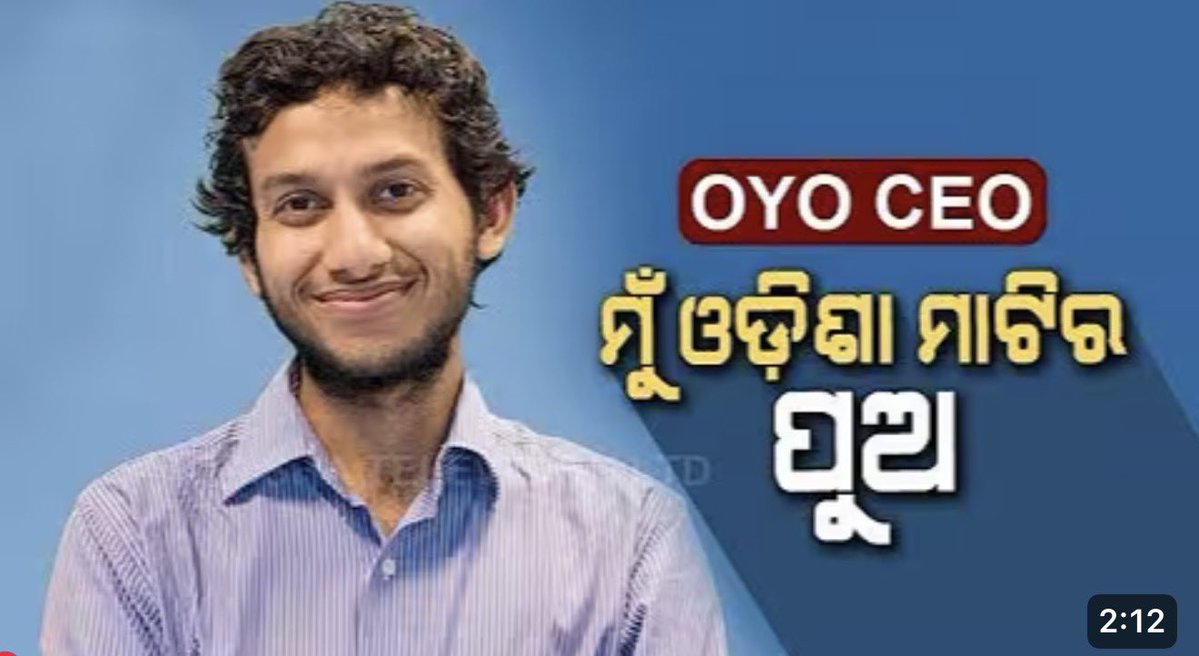
At just 26, Ritesh Agarwal became the world’s second-youngest self-made billionaire. Even Microsoft has invested in his company.
From a small town in Odisha to building OYO into a global hospitality brand - his journey is remarkable.
Born in Bissam Cuttack and raised in Rayagada, Ritesh developed an interest in computers and programming at a young age. As a teenager, he sold SIM cards and wrote a book on India’s top engineering colleges.
He moved to Delhi for college but dropped out to pursue entrepreneurship. At 18, he founded Oravel Stays and travelled across India, staying in more than 100 budget hotels. He saw a huge gap - affordable hotels existed, but quality and standards were inconsistent.
That insight led to OYO.
At 19, he became the first Indian to receive the Thiel Fellowship, receiving $100,000 to pursue his startup.
In 2020, at 26, Ritesh Agarwal became the world’s second-youngest self-made billionaire, with an estimated net worth of $1.1 billion.
Today, PRISM, the parent company of OYO, has been backed by marquee investors including Microsoft, Airbnb, SoftBank, Peak XV Partners and Lightspeed.
PRISM builds technology products and services from India for around 185,000 hotels and homes across 35 countries, empowering millions of small business owners and entrepreneurs worldwide.
From Rayagada to the world - a remarkable Odisha-born startup story.