@MOSSADil Imagine being stuck down here for months. Picture I took inside a Hezbollah-style tunnel. Surprisingly, they’re not that hot because the surrounding rock keeps temperatures relatively stable.
Either way…. rough life sleeping on dirt, bozos.
The Nimitz LiDAR situation highlights an interesting opportunity in defense tech: automated OPSEC through localized AI agents.
Secure sensitive point cloud data at the source, then deploy agents to monitor public sources and accessible forums, detect leaks through point cloud matching, assess exposure risks, and coordinate takedowns or escalate to CYBERCOM.
During the research for this project, Opus agents made an interesting discovery: a LIDAR scan of the aircraft carrier.
On their own initiative, they realized that in 2024, Washington State DNR did an aerial LIDAR survey... which included Puget Sound.
"Could this LIDAR data include the Nimitz?" they wondered. They investigated. Sure enough, they matched raw LIDAR point data to what could only be a huge ship.
It was the Nimitz.
Nimitz was alongside at Puget Sound Naval Shipyard in Bremerton, Washington, for a maintenance period. She happened to be under the survey aircraft's flight path, so she's in the public Geospatial data.
(sources in comments)
With that public-but-buried data, Opus was able to match the model to nearly-exact dimensions from the laser scan.
How much other data like this is hiding in plain sight?
The Army's Manufacturing Rodeo is a fantastic idea. I'll be looking for one thing: are we testing our ability to manufacture IN America or FROM America?
Neodymium for motors, titanium sponge for aerospace, gallium for electronics, tungsten for tooling. All have major foreign supply dependencies.
Are we allowing imports, issuing waivers, or actually exposing these bottlenecks?
Domestic assembly ≠ domestic supply chain resilience.
Will be curious what this stress-test actually looks like.
BREAKING: The U.S. Army is preparing to stress-test America’s manufacturing capacity and supply chains. In early 2027, Army facilities and private manufacturers will compete in the first-ever “Manufacturing Rodeo,” designed to expose bottlenecks in America’s defense industrial base.
I think there's a serious bubble forming around Ukraine style defense tech. We're increasingly shaping US defense priorities around Ukraine's battlefield requirements rather than our own.
Ukraine is projected to produce 6-7 MILLION FPVs this year. The Pentagon's Drone Dominance program is targeting just over 200,000 purchases by 2027.
For some reason American companies are racing to build factories capable of producing at Ukrainian wartime scale. Maybe its because the OSC has even offered up to $820M in conditional financing to expand domestic drone component production.
Can someone please help me understand who's actually going to buy all this capacity, given we won't even have the price advantage?
Ukraine consumes millions of FPVs because it's fighting a continuous land war against a neighboring country. Its UGVs perform tens of thousands of frontline resupply and evacuation missions for the same reason.
The US shares land borders with Canada and Mexico. Neither is (yet) a conventional military adversary.
Our biggest challenges are overseas. A war with China or the middle east, involves thousands of miles of ocean, contested logistics, proxy wars, naval warfare, missile defense, hopefully low cost ballistic missiles, and protecting forward deployed forces. A fiber optic FPV with a 10-20km spool does not solve those challenges nearly as much as it helps Ukraine's problem set.
Short range FPVs have applications once forces or infrastructure are forward deployed. UGVs do too. But Ukraine needing millions of them annually doesn't mean the US does at all.
An area I believe the Pentagon is moving correctly on defense: JIATF 401 is accelerating cUAS procurement to protect American facilities and forces. That's a very perpendicular mission from producing millions of one way drones to attack targets along a static frontline.
My concern is that we're heading toward what I like to call "the Great FPV Consolidation," potentially mirroring the wave of M&A activity we saw in the 90s. Companies are scaling production around Ukrainian wartime consumption rates, but it's unclear to me whether sustained American demand will be enough to support them all.
There's an argument for building surge capacity ahead of demand, particularly given our dependence on foreign components. But surge capacity and a sustainable business model aren't necessarily the same thing.
@PalmerLuckey@JTLonsdale@jamoses92@davidu - Would really value your perspectives on the unit economics and long term demand here given your experiences building and investing in defense. Am I underestimating the long term market, or do you see significant consolidation and company failures as the Ukraine driven defense tech sector matures?
What half of people don’t realize is that not all terror/war tunnels look like Hamas, Hezbollah or even the Viet Cong.
Major players build HUGE tunnels that can fit missiles, vehicles, etc.
Look at the 5km+ of tunnels used by China’s PLA to pass ballistic missiles concealed from surveillance.
DIA's “Analyzing Will to Fight” gives analysts a framework to determine an actor’s ability to survive and sustain combat, accomplish the mission, and prevail over the adversary.
Find the framework and background:
https://t.co/01Ew4RlvKy
Boeing wins.
“The contract is valued at more than $20B for the full-scale development phase.”
The most interesting part to me is this isn’t another Joint Strike Fighter program.
The F-35 was one competition producing variants for the Air Force, Navy and Marine Corps. F-47 and F/A-XX are two separate competitions, run by two different services, for two supposedly different sixth-generation aircraft.
Boeing swept both.
Although I have my doubts about just how “different” those two aircraft actually are under the skin.
Robotics has a creativity problem when it comes to morphology.
We build humanoids, dogs, cheetahs, snakes, insects, etc. Obviously there’s a reason for that. Evolution spent hundreds of millions of years figuring out how to move through complicated environments, and there’s a lot worth stealing from it.
But evolution also had a ridiculous number of constraints that engineers don’t have.
A robot doesn’t need bones or muscles. It doesn’t need permanent hands and feet, bilateral symmetry, or even a fixed body shape.
It feels like we spend a ton of effort figuring out how to control a body we already decided on, instead of asking what the optimal body for the problem actually is.
The best morphology for a robot might look like absolutely nothing that has ever lived.
Brings me to the question… can we imagine a color we’ve never seen?
Hilarious that a company under scrutiny for constant surveillance is threatening legal action over a map of its own surveillance devices. Apparently the surveillance network has a right to privacy too???
The Mispriced Assets pod is on Spotify (and Apple Music).
See episode 4 with @liamdaltonjr where we talk about the next turn in AI and what could derail ALL of it.
https://t.co/9YcJfsnMC0
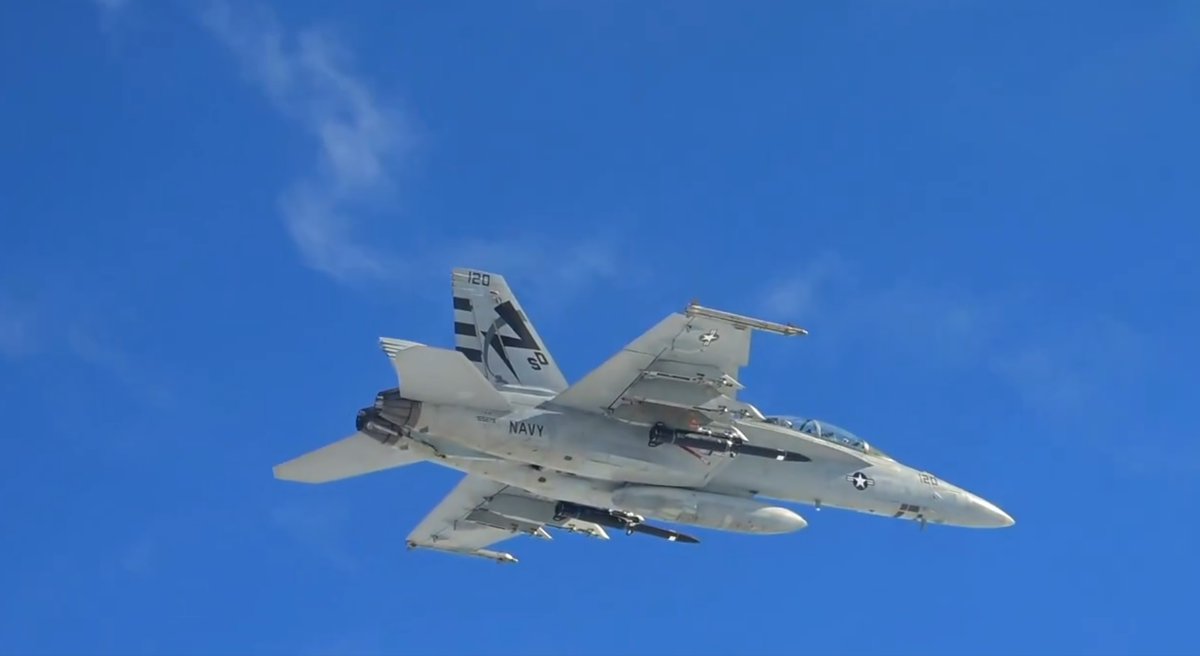
Anybody remember that scene in Top Gun Maverick where they know it’s an F14 flying through enemy airspace (although its Maverick and Goose)?
Radar energy entering a conventional intake can reflect off the compressor face, while the spinning blades create a distinct micro Doppler signature known as Jet Engine Modulation (JEM), which can help characterize or classify the aircraft.
That’s part of why aircraft like the F22 use serpentine inlets designed to hide the compressor face from direct radar line of sight. Pretty sick engineering evolution.
I’ll tell you right now: capabilities to clear tunnels are extremely scarce. How do I know? I’m building one of the very few companies focused specifically on robotics for tunnel operations.
Dogs don’t solve it (30 dead dogs since Oct 7). Humans can, but at enormous risk. You’re dealing with blast doors, rubble, vertical shafts, comms denial, traps, IED shape charges tied to fiber optic camera systems. Terrorists are creative in killing you.
Clowns are still fighting the “short war” they started in February 2022, but sure, tell us about NATO next.
Remember when Russia was supposed to be scary? 🤣