My RE developer rules:
1. You don’t need to make all your $ on one deal
2. Maximize your “at bats” b/c:
3. Some deals will pleasantly or painfully surprise you.
4. Lots of guys miss big profits due to lack of staying power
1/2
Some of the most profitable deals in our company's history never went to construction.
We put the land in escrow, completed the entitlements and design and subdivision mapping, then sold to a builder who took on the financing and construction risk. We captured the entitlement premium. We skipped the construction cycle entirely. We moved fast.
Slow kills in real estate development. The longer you hold pre-
development capital in a deal, the more interest, overhead, and opportunity cost eats your return.
The entitlement sale exit, buying raw, selling entitled, is a legitimate and underused strategy.
Not every deal has to become a building.
All capital invested into many real estate deals from 2021-2024 has been lost.
In many cases, the operator executed the business plan well, maintained strong occupancy, and increased rents more than projected.
Rising interest rates destroyed the deals anyway.
The same is true in the opposite direction.
Terrible operators will completely fail on the business plan and underperform every expectation.
Yet they’ll make insane amounts of money because declining interest rates drove up property values and prevented their incompetence from being exposed.
This causes people who have no business operating real estate to look like geniuses. So they raise a ton of money.
Then rates go up….
And the cycle repeats itself.
As a sponsor, one of the most frustrating parts of long-term real estate investing today is that most investors think long-term is anything over 5-7 yrs…when in reality it’s 20+ yrs (something the big NYC families understood a few generations ago…)
Learn from my mistakes:
If you raise capital from outside investors and want to hold real estate long term, whatever you think the appropriate level of leverage is, it's lower.
(For estate planning and other reasons, we have a decently sized unlevered portfolio, in addition to our levered one, and I can tell you I feel much better about the former than the later right now!)
What’s going to be absolutely hilarious is if rates actually come down and all the folks who bought at 6% cap rates
(“generational opportunity, buy when others are fearful”)
- with 10-year fixed debt -
get smoked by yield maintenance on exit.
Here’s the thing, if you’ve been through a few CRE cycles, you KNOW that when interest rates are sub-4% that’s an anomaly and you lock in your debt (fixed rate) FOR AS LONG AS HUMANLY POSSIBLE.
End of story.
Every real estate account has weighed in on the @BeardyBrandon situation. Here are my two cents as someone who focuses on debt origination.
// The deal //
In December 2021, Open Door Capital and Disrupt Equity bought a 388-unit Class A multifamily asset in Houston with a $52.8M floating-rate bridge loan (~75% LTV).
They bought a rate cap to hedge the floating rate exposure and planned to refi or exit in 3-5 years after the value-add was complete.
// What went wrong //
The Fed hiked rates 525 bps in 16 months. SOFR went from almost zero to 5.3%+ by mid-2023. When the rate cap expired, the replacement cost was 100x the original cost.
Interest expense doubled while NOI declined. Texas insurance doubled. The submarket flooded with new supply. Occupancy was overstated, so the value-add never materialized. Cap rates expanded from 5% to 6.3%, dropping the property value below the loan balance.
Refinancing was mathematically impossible, and a sale wouldn't cover the debt. Equity was wiped.
// What this could've looked like with fixed-rate debt //
Same $77M total basis. Call it 60% LTV instead of 75% LTV, so $42M of debt instead of $52.8M. Would've needed $11M more equity at closing. Fixed rate at ~4.0% for 10 years instead of floating, 30-year amortization.
Even with NOI compressing from ~$3.5M to ~$3.3M and the property value falling to ~$52.7M today:
Year 3 DSCR: ~1.35x. Still covering debt service. No covenant breach. No forced sale.
Year 3 LTV: ~$40M loan vs. $52.7M value = ~76%. Above original but the loan is fully covered.
Class B common equity still gets impaired but it's not zeroed out.
Fixed-rate LifeCo execution doesn't turn this into a winning deal, but it absorbs the market shocks instead of being destroyed by them.
The sponsor isn't forced to sell at the bottom and can hold to 2028-2030.
// Learning Lessons //
1. Fixed-rate debt at lower LTVs is the discipline that survives cycles. Yes, IRR looks worse. Yes, investors will push back on higher equity requirements. But, that cushion is what keeps the deal alive when rates run.
2. Underwrite today's rents as your pro forma rents. If the deal only pencils on 4% rent growth, it doesn't pencil.
3. Reserve for rate cap replacements, insurance, capex, etc. even when you don't think you need to.
4. Bridge debt isn't bad by default. There are circumstances where it can make the most sense.
5. Levering to the gills is rarely a smart move.
6. LifeCo perm debt exists for a reason. Use it.
---
P.S. - none of this is a knock on Brandon. I appreciate his accountability. Just wanted to share my thoughts.
Story time:
In early 2021, I got pitched on a multifamily deal. Big one. 300+ units, newer vintage, in Texas.
Not your average syndicator bread-and-butter value-add play..
The group pitching it was relatively new. Naturally, there was an obligatory doctor capital-raiser on the team.
They were very proud of winning the deal despite their short track record, and raising equity apparently wasn’t an issue.
So I asked who the second-highest bidder was.
A non-traded REIT.
Now it gets even better.
They wouldn’t share their “proprietary” underwriting model, but you could see errors in it with the naked eye.
One line item was broadly labeled “economic vacancy.”
When asked what exactly was included in that number, nobody knew.
They just used a flat 8%.
If you’re a passive/retail investor putting money into a multifamily syndication that’s buying an institutional-size property, you have to ask yourself…why aren’t institutions putting their money into the deal?
@LeylaKuni
Have been through multiple cycles over the last 20+ yrs and without question this downturn is FAR worse than 2008-2010…and it’s not nearly over.
Patience (and modest leverage only) is required…
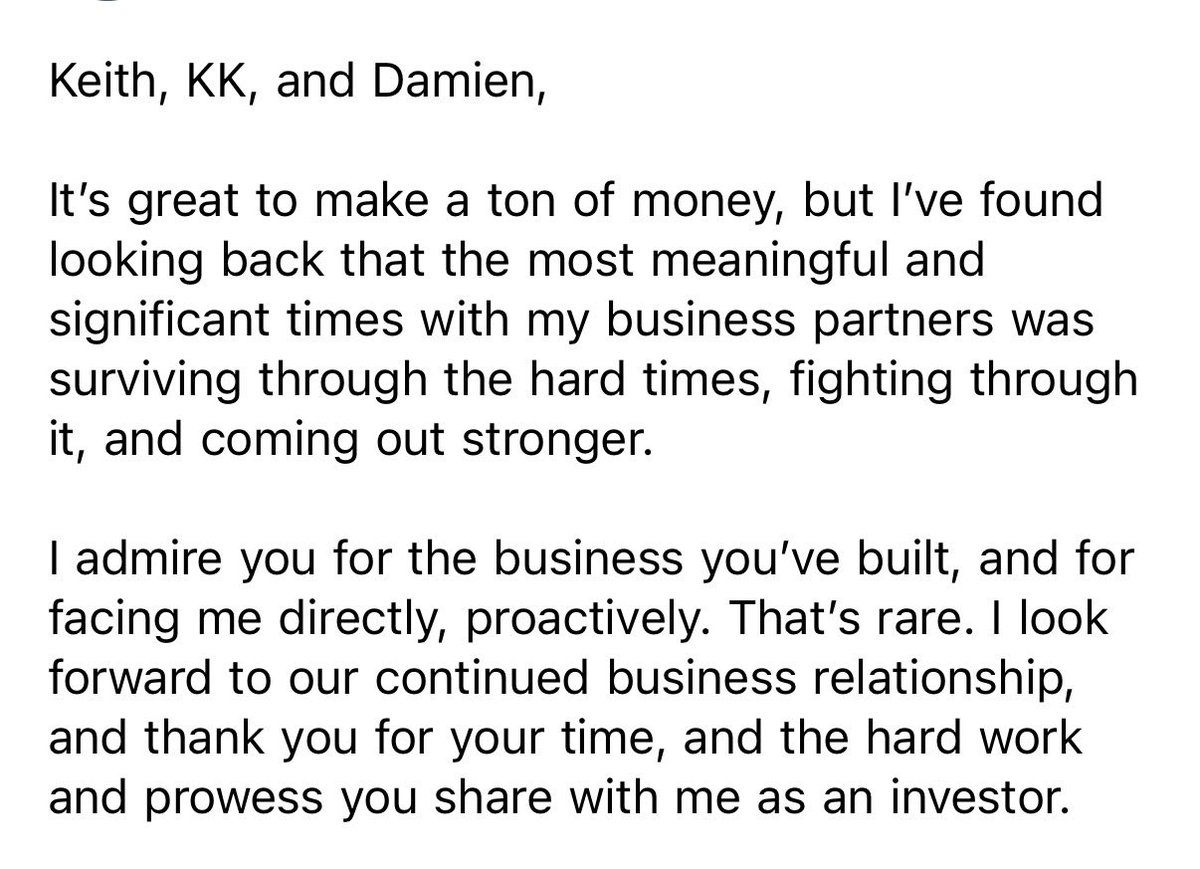
Real estate GP’s, this has been a vicious cycle. I spoke to one of the largest real estate owners in Los Angeles the other day. I asked him which cycle was tougher… 2009 or this current one. By far this one he said. 2009 bounced back faster. This one is definitely deeper and longer. I’ve had two industry friends take their own lives during this current cycle who were magnificent developers and even better people/mentors). We definitely have our own internal struggles in the Gelt portfolio. That being said, those that make it through unscathed (maybe with some deep battle scars) and continue to play defense with existing assets and not forget offense acquiring assets when the liquidity has exited the building will be handsomely rewarded in the long run. Definitely more fun when there were no fires and everything was going up and to the right. But these times are the times to double down on transparency with investors, double down on new acquisitions, and work hard on preserving investor capital. Brutal time to find good deals and then put them together. Investors might not be happy now, but if you make it out unscathed and preserve capital you will be greatly lauded in the long run. Wanted to share the below message we received from a long term LP that makes us want to dig in and continue our track record of never having a capital call or losing a single dollar of principal for investors over 17 years.
One thing that’s becoming very clear in commercial real estate right now:
A lot of people want to explain what happened.
Very few want to admit what they participated in.
Everyone suddenly has a list of excuses:
- rates went up
- insurance exploded
- rents flattened
- the Fed changed everything
But the truth is, most of this behavior didn’t start in 2022.
The seeds were planted years earlier when people stopped caring about what an asset was actually worth.
Back around 2014–2016, while working at Marcus & Millichap, multifamily deals commonly traded at 8–10 caps. Deals actually penciled. There was room for error. Basis mattered.
Then I saw something that completely changed the tone of the market.
We had listed an overpriced and rough 1960s vintage deal that everyone knew was overpriced. Then a buyer came in around a 5.5 cap and justified it by saying:
“The banks are lending at 4%, so that spread makes the deal works.”
That was the first time I heard someone justify permanently overpaying for an asset because of a temporary interest rate environment.
And that mentality slowly became the entire industry.
At first the logic was:
“Lock in a low rate for a long term and the deal will work.”
Then in 2022, even that wasn’t enough anymore.
People started justifying to buy with *negative* leverage while assuming rents would continue growing 10%+ annually forever.
Underwriting went from aggressive to complete fantasy.
And here’s the uncomfortable part:
Most GPs weren’t creating some revolutionary business.
They weren’t inventing technology.
They weren’t building anything unique.
Their actual skill was raising money and telling a compelling story around a deal.
Which is fine, IF your number one responsibility is protecting investor capital.
But then another layer entered the picture: feeder funds.
When you raise money from friends, family, neighbors, or your community, there’s emotional accountability. You know exactly whose money is at risk.
Feeder funds created distance from responsibility.
Now people were:
- overpaying because rates were low
- accepting negative yield because “rents always go up”
- and doing it with money that no longer felt personally connected to real people
That combination destroyed discipline.
Fast forward to today:
Many of the same people who bought absurd deals with negative leverage and fantasy assumptions are now acting like nobody could have possibly seen this coming.
That’s nonsense.
The entire job of a GP is risk management.
You don’t get to call yourself a genius during the run-up and then blame “unexpected conditions” when the cycle turns.
And honestly, watching all of this unfold has likely twisted a lot of the love we all once had for this industry.
Somewhere along the way, too many people stopped respecting the basic math and replaced discipline with narratives.
But the only way this industry actually heals is if people stop rewriting history and start telling the truth about what happened.
@xwanyex We build and own rental apartments, some of which have a lot of lower-income residents, and I can tell you, until you really see and experience how some (not all) of the American underclass lives and thinks, you just won’t believe it.
Empty words from @RegentHubbard …yes it’s very difficult to control tenured faculty but UMich Regents and administrators knew his views before they OFFERED him the commencement speaker spot.
Pathetic.
@hitsamty That, plus the ideologically motivated “tenant protection” laws that now allow renters to effectively live rent-free for 5-6 months before eviction.
David Lichtenstein is always good for a banger CRE quote. In conversation with him last week:
Voltaire said, 'It is dangerous to be right in matters on which the established authorities are wrong.' Politics has become a line item on your underwriting these days.
An updated list of all the differences I have encountered after working at an institutional multifamily developer (I) for the past ~2 years vs. doing the same thing at a family office (FO) the previous 5 years:
Celebrating a deal:
I: regularly, including after getting a deal through internal committee process
FO: Literally never - not once
Noncompete:
I: required, very restrictive, tough to negotiate
FO: not required
Ability to invest in deals:
I: VPs and higher can put up to a certain amt into an employee fund that invests directly in all the deals that close that year (gp position)
FO: not allowed
Vacation:
I: i think its 2 weeks but I have not been tracking and just waiting to get yelled at
FO: whatever I wanted
Private Jet:
I: small company jet for c suite and sometimes the peasants get to join if there is space
FO: I think the ceo tried netjets for a while for personal use
CEO personality type:
I: charismatic, smart, no ego, all business, a little stiff
FO: charismatic, smart, no ego, all business, a little stiff
Annual Reviews:
I: formal reviews twice a year where I fill out a form online, then a manager fills out a form then you discuss the form together
FO: did not exist in 23 year history before I came. had to beg for them
Required browser on company computer:
I: Edge (recently enacted. hate it so much.)
FO: Chrome (I miss her)
Underwriting retail rent:
I: not allowed
FO: not allowed
Rules:
I: so. many. rules. procedures & protocols & processes. can’t keep track of them all
FO: no rules. Everything was negotiable with CEO
Major decisions:
I: department heads must sign off on each assumption in my underwriting, several committees to get through to move deals forward and spend money. 3 ppl between me and ceo
FO: made by always available CEO, instantly
Expenses:
I: annoying submission process, rejected if not in certain format
FO: easy, no one questioned them, often missing receipts
JVs:
I: one of the main ways we can be competitive
FO: not allowed
Team meetings:
I: Multiple each week - one for active deals with larger team, one for new deals with dev team
FO: ceo didn’t find value in catching up on anything unless I was at a major milestone or had a problem I couldn’t solve myself
Dead deal costs:
I: I have to pay a % of any dead deal costs out of my future fees
FO: did not affect me at all
Prelim Site layouts / density study:
I: submit a form then an initial call with preferred planning firm then they get it back in a week and we review and charge 4-6k
FO: free from external architect in a few days
Growth opportunity:
I: formal ladder to climb, company goal to continue expanding in various capacities. Growth = opportunity.
FO: no formal path, company growth based on owners appetite / interest in growing that could change at any moment
Bandwidth / capacity:
I: told unlimited when hired and truly feels that way. If a deal hits metrics, the money, resources, and personnel will be available to execute
FO: told unlimited when hired but didn’t always feel that way. we would be more or less aggressive depending on pipeline / local market / macro market at the time
WFH Policy:
I: v flexible wfh policy mainly because md likes to himself
FO: ceo liked ppl in office and I tried to be in because of that, but no strict rules for my role
Compensation:
I: higher base, plus a % of both fees we charge paid out over deal life cycle and small piece of promote at end
FO: lower base plus discretionary bonuses sometimes, plus 3-5% of land price at closing
Negotiating compensation:
I: opaque, drawn out
FO: easy. direct with CEO. He was reasonable and open minded and usually ended up agreeing with me esp if I had backup / support of my request
Resources / support:
I: Wild amount of people in every dept. Formal mentor program. Everyone wants to help all the time.
FO: the opposite… for example: one person was cfo, head of accounting, hr, legal. Everyone spread thin.
Company parties:
I: 2025 holiday party was a box at rangers game. 30th year anny was at a casino in Vegas with ~900 of my closest colleagues
FO: last holiday party was in the lobby of one of the firms local hotels.
Position on Paperless Office:
I: truly paperless (printer regularly broken)
FO: loved paper. millions of filing cabinets all over office.
Rent Comp data source:
I: Costar, aptIQ AND RealPage accounts
FO: property websites
CRM / Deal tracking tool of choice:
I: @DealNav
FO: @DealNav
@caisson68@michelletandler And btw there is no way it will even come in at 30 mil. They will certainly go over budget. Nor will it be finished in three years.