1/ The @taikoxyz exploit is part of a much bigger shift in Web3 security.
Whether or not AI was used in this specific attack, the direction is clear:
attackers can now explore codebases, infrastructure and trust assumptions at a scale humans could not manage even a few months ago.
“Open source” AI doesn’t work.
For one, open weight models are not transparent about their training data, cleaning pipelines, or training architecture. These things are kept proprietary even by companies producing open models.
Far more importantly, open models are not economically viable, and certainly not at the frontier. Someone has to pay billions for the public domain.
The superior approach to AI transparency is public models — those trained, maintained, and tokenized on open decentralized networks.
The US government, citing national security authorities, has issued an export control directive to suspend all access to Fable 5 and Mythos 5 by any foreign national, whether inside or outside the United States, including foreign national Anthropic employees.
The net effect of this order is that we must abruptly disable Fable 5 and Mythos 5 for all our customers to ensure compliance.
Access to all other Claude models is not affected.
We apologize for this disruption to our customers. We believe this is a misunderstanding and are working to restore access as soon as possible.
Read our full statement: https://t.co/bwn0sximKZ
Looks like the options thing is happening already!
See also: various people thinking through and building different versions of the idea in the thread: https://t.co/gFNEvCbHct
Though I do strongly urge that if any of these get on mainnet quickly, we formally verify it first. I hope @vyperlang and/or https://t.co/OMFlWRqJda folks ( @Fricoben) can help!
(Also, now is a good time to be thinking about robustness-optimized oracles)
https://t.co/j1dxLV4Pn4
We just had our biggest day with Azimuth:
130+ repos scanned
897 vulnerability hypotheses generated
Azimuth helps DeFi protocols and auditors finding critical issues in real time.
Security at scale. Not at luxury prices.
→ See what's hiding in your repo: https://t.co/ipYvpPSVii
2.7% false positive rate on Azimuth’s detection algorithm.
AI smart contract security is notoriously noisy. It is one of the most predominant issue we’ve seen across AI auditing tools.
To combat this, Azimuth has a smart filtering system that separates real vulnerabilities from false alarms.
It explores every path, scores each one based on criticality, and only confirms what's real.
14 explored 🤝 1 confirmed 🤝 0 false positives.
Watch us exploit crypto protocols in real time - https://t.co/5uktMMHJRB
Addicted to watching this thing try to find on-chain vulnerabilities
It scanned over 150 protocols yesterday and generated 400+ hypotheses. With validation, this thing is going to be a beast
1/ 🚨 2 findings. Years-old vulnerability.
ZEC down 40% & $116M liquidated in 24 hours.
We ran Azimuth against Zcash's Orchard implementation and independently surfaced the attack path behind the issue.
🧵This is what AI-powered security looks like 👉 https://t.co/0Ad9ocV5Oh
watch out for this guy @kianmorikawa - scammer along with all of @BlockLayerPods. Trying to build and have productive conversations. Its sad when you get jokers like this
why i am so bullish on crypto, in "defense of the ideological"-
i recently watched the video of the first public appearance for jensen and elon together, which was at GTC 2015 more than ten years ago. by this time, jensen had already made his iconoclastic bet on parallel graphics processing for over twenty years, and on CUDA since 2006. musk had his hassabis moment in 2012. yet openAI was not yet founded (would be ~9 months later), and GDX-1 would be announced at GTC the following year too
this is that narrow window where a revolution is visible to some but not others, in which both of these geniuses had early inklings of recognizing AIs pervasive potential, but the broad public was not yet made aware. it would take another 10 years for it reach mainstream applications of course
i broadly think of the crypto industry being the same place today. just as there were brilliant minds who understood the revolution that would come from the GPU paradigm, there was simply no large scale consumer demand that required its objective superiority for decades to come. instead, it was picked up by hobbyists (ie gamers) who enjoyed a sense of self-determination by pushing the boundaries of their passion, tinkering, sharing, and researching. in a rather strange way, gamers subsidized AI's development, just like early defi subsidized the institutional tokenization development.
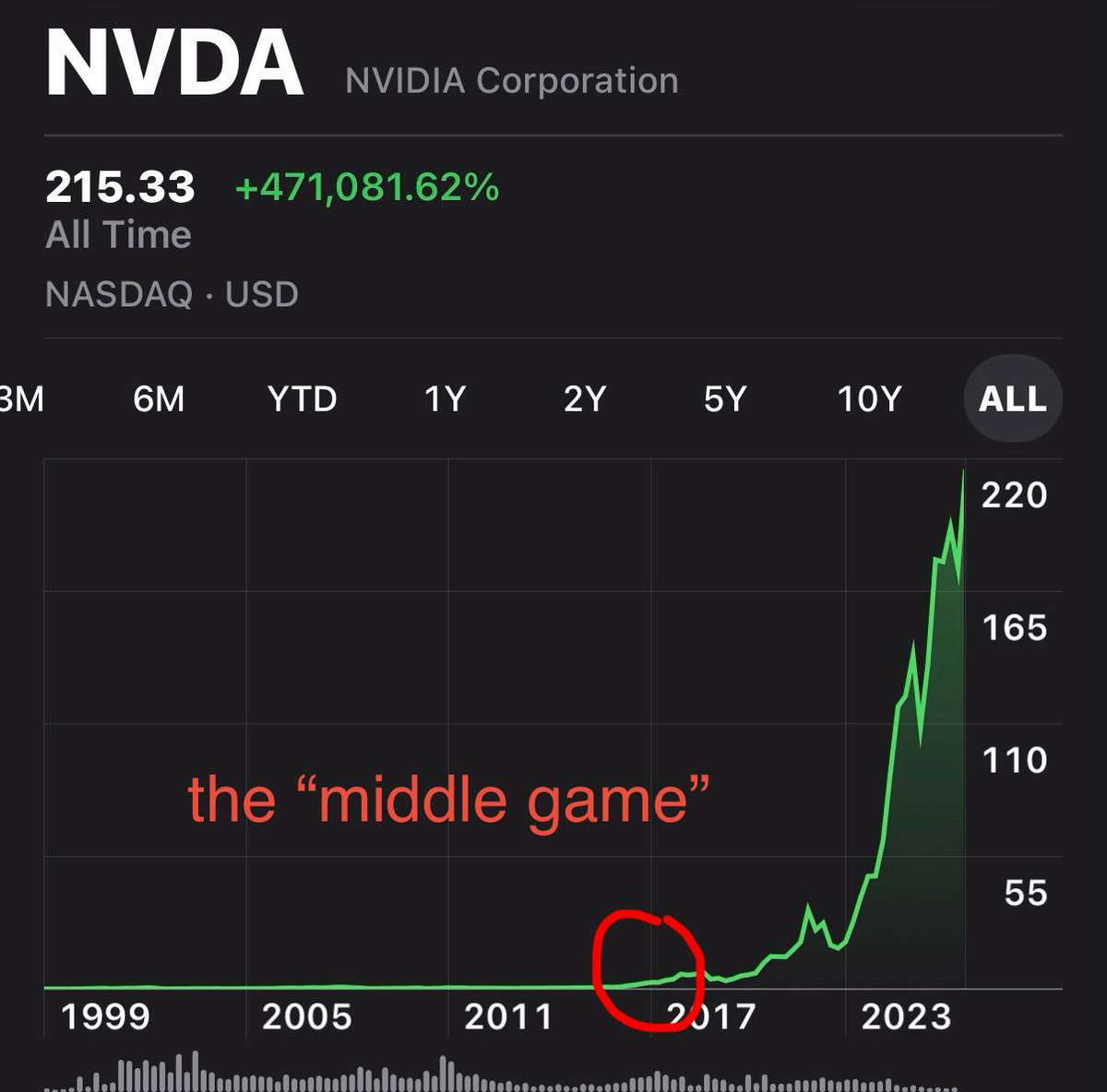
during the GTC 2015 interview, elon tells jensen something interesting: the 0-10 mph autonomous driving is very easy to solve because the car can be stopped. the 50+ mph zone is also easy to solve because there are rules of engagements at that speed that dont have as many randomness. the hardest part to solve is actually the 10-50mph, what i call the "the middle game" where a car in an urban setting with bikes, children, cones, manholes, create all kinds of need for precision and speed that sensors today need to develop further. it's fundamentally solvable, but this is the most challenging portion of fulfilling the dreams of autonomous driving
this is where crypto is today. the 0-10mph was easy because people can understand why permissionless money is useful from a practical sense to start developing. the 50mph+ will also be really easy because by that point, onchain capital markets is going to be so obvious that you could never go back with all the benefits of self custody, capital efficiency, money velocity/rest optimizations. but its the 10-50 thats hard, where money in a pre-internet financial infrastructure is hitting AML/KYC, offshore capital conduits, discretionary bank risk models, lagging reporting regimes create all kinds of need of need for precision and speed that institutional infrastructure today needs to develop further. its fundamentally solvable, but this is the most challenging portion of fulfilling the dreams of onchain capital markets
i love bitcoin. but contrary to some opinion, i believe its possible to love crypto too, because bitcoin is a monetary experiment enabled by the evolution of technology, while most of crypto is the inverse: a technology experiment enabled by the evolution of money. they are fundamentally solving different problems, though rooted in one ideal: to make its access as much of a public good as possible
this is why crypto is going to be such an important force for the future during this "narrow window" for those can can see it. and while most early pioneers got into the game because of the ideology behind decentralization, it's time to admit that the winning ideology is technological financialization: it is hyperfinancialization with elements of decentralization that exports sovereign finance as a public good, decentralizes agentic rails for humanity as a public good, promote self-determination as a public good.
this is worth fighting for, and im excited to recommit my focus to these ideals that began my crypto journey. this "middle game" period will be remembered as the most critical juncture for the industry and for anyone who is doubting the industry at this time, i hope reading this helps you reanchor your beliefs for what you are actually fighting for, and more importantly, know that you can play a meaningful part in the revolution too
the future belongs to those who recognized it was always ideological
We recently scored 75.2% on EVMBench!
Thanks to @OpenAI and @paradigm for putting the benchmark together to test agentic smart contract vulnerability detection.
Check out our writeup: https://t.co/FmhNzrgpQv+