@natoversteher@PaetzoldJohann MTU (RR) kann da schon was produzieren.
Wäre sowieso sehr praktisch wenn man das gleiche RR Triebwerk wie in GCAP benutzen könnte
Military flight training: Sweden orders @Grob_Aircraft#G120TP. Contract also includes computer based training, simulators:
https://t.co/MA6KUja3qr
@Forsvarsmakten
Herrje, wie oft haben wir gehört, wir müssten uns bei Lieferung von Waffen an die Ukraine zurückhalten, um keine ESKALATION des Krieges zu provozieren. Putin braucht keinen Vorwand. Er eskaliert am laufenden Band. Nur militärische Stärke (👉Abschreckung) kann ihn davon abhalten.
Hat schon jemand die ukrainischen Drohnen auf St. Petersburg als „Vergeltung“ für die Schläge auf Kyjiw bezeichnet oder macht man das immer nur umgekehrt?
Die Ukrainer haben geflügelte Quadcopter-FPVs entwickelt. Die Russen werden sie vermutlich binnen Wochen kopieren, wonach funkgesteuerte FPVs bis 100 km Reichweite haben können.
Das ist so ein gutes Beispiel, warum überhastete Großbestellungen von FPV durch NATO-Staaten aktuell kompletter Unsinn sind. Weil der heutige technische Stand binnen Monaten überholt und binnen eines Jahres nicht mehr zu gebrauchen ist.
Die einzige Chance, Schritt zu halten, besteht darin, die Produktion hochzufahren und die Ukraine zu beliefern. Dort gibt es unmittelbares Einsatzfeedback und laufende Entwicklungsimpulse aus der Praxis. Die so hochgefahrene Produktionskapazität kann später jederzeit für die eigenen Streitkräfte genutzt werden – bis dahin unterstützt sie die Ukraine.
@LarsBStruwe Jeg er enig!
Jeg savner dog noget om offensive dronekapaciteter.
Om noget har Ukraine vist, at det er sådan med sænker den russiske kampevne markant.
Der TANKRABATT war in Deutschland mit 1,5 Mrd.€ Steuerausfall sehr teuer und perfekt wirkungslos.
Die gesamte EU erlebt einen dramatischen Inflationsschub.
Warum?
Weil Europa immer noch nicht dekarbonisiert ist. Fossile Energie ist der Preistreiber!
https://t.co/MLLl4k5wxf
@N_Schmid Die Fahrgastzelle soll steif sein, die Knautschzone davor die Energie aufnehmen!
Problematisch sind eher immer mehr Gewicht (=Energie) der neuen Autos.
#Erdgas gilt oft als klimafreundliche Alternative zur Kohle. Doch bei Förderung und Transport entweichen erhebliche Mengen des extrem klimaschädlichen Methans. Dadurch schrumpft der Klimavorteil deutlich. Echter Klimaschutz braucht den schnellen Ausbau von Solar- und Windkraft.
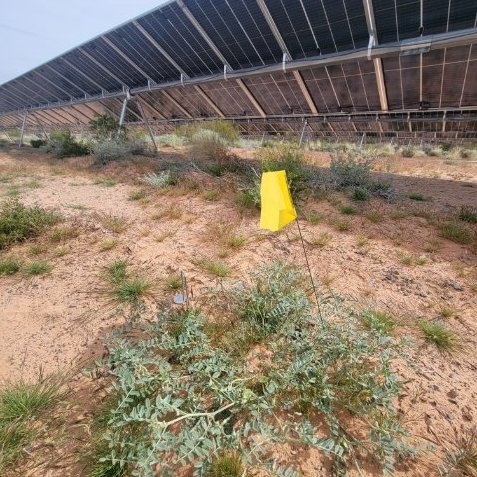
A critically endangered desert plant exploded in numbers right underneath a solar farm.
The plant is called threecorner milkvetch. It's a small annual in the pea family that grows in only a few corners of the Mojave Desert. Nevada lists it as Critically Endangered and Fully Protected.
Ecologists surveying the Gemini Solar Project site northeast of Las Vegas in 2022 found 12 individual plants growing. After construction finished and the array started running, a 2024 survey found 93.
The plants growing inside the array were also taller, wider, and produced more flowers and fruits than the ones in the unbuilt land next door.
Most utility-scale solar projects use a construction method called "blade and grade." Bulldozers scrape away vegetation, level the soil, and remove the upper layers entirely. This destroys the seedbank and makes natural recovery difficult even when conditions improve.
Gemini chose not to do that. They used a lower-impact construction approach that preserved existing vegetation patches, soil structure, and biological soil crusts wherever possible. The milkvetch seedbank survived the process.
When the panels went up and started shading the ground, evaporation slowed after each rainstorm, and the soil under the array stayed moist longer than the surrounding desert. Seeds that had been waiting for years finally got the moisture conditions they needed and germinated.
A peer-reviewed study, led by ecologist Tiffany Pereira at the Desert Research Institute and published in Frontiers in Ecology and Evolution in late 2025, is now being used as evidence that solar build-out and desert biodiversity aren't necessarily opposed.
The next decade is going to see millions of acres of desert placed under solar arrays. Every one of those sites is a choice between the cheap method that kills the seedbank and the slightly slower method that doesn't. Gemini proved the slower method works, and the milkvetch was the benefactor.
The future doesn't have to be humans vs. nature.
This is wild... Russia seems to be threatening a *commercial* satellite that provides imaging services to Ukraine:
▸ starting about two weeks ago, Russia started maneuvering five (!) of their classified satellites to the same orbital inclination as the ICEYE satellite
▸ these burns were big, on the order of 100 m/s, clearly using chemical propulsion given the speed of the burns — very expensive and deliberate maneuvers
▸ as of last Friday, all five Russian satellites are now co-planar, at ~97.8° inclination, with three of ICEYE's satellites, and aligned in other orbital elements (e.g. RAAN) that make it clear they're specifically targeting this set
▸ I am a little skeptical that Russia is specifically targeting -X36 — there are two other satellites at the same inclination/RAAN (-X37 and -X38) — but the Russian sats are now all within striking distance of -X36, which is why people are concerned about it specifically; the closest cross-track distance is an estimated 500 meters (!!), all while the satellites are orbit 550 kilometers above Earth
▸ Russia has unleashed a cyberattack on a commercial satellite before (Viasat), and it is official Russian policy that commercially-owned infrastructure that aids in military efforts "may be legitimate target[s] for a retaliatory strike.”
▸ there's speculation that this could be a precursor to an RPO mission (meaning: physically grabbing the satellite or some other kind of non-kinetic attack like blinding/jamming)
Worth tracking closely. And unfortunately more evidence that space is militarizing, fast.







![pronounced_kyle's tweet photo. This is wild... Russia seems to be threatening a *commercial* satellite that provides imaging services to Ukraine:
▸ starting about two weeks ago, Russia started maneuvering five (!) of their classified satellites to the same orbital inclination as the ICEYE satellite
▸ these burns were big, on the order of 100 m/s, clearly using chemical propulsion given the speed of the burns — very expensive and deliberate maneuvers
▸ as of last Friday, all five Russian satellites are now co-planar, at ~97.8° inclination, with three of ICEYE's satellites, and aligned in other orbital elements (e.g. RAAN) that make it clear they're specifically targeting this set
▸ I am a little skeptical that Russia is specifically targeting -X36 — there are two other satellites at the same inclination/RAAN (-X37 and -X38) — but the Russian sats are now all within striking distance of -X36, which is why people are concerned about it specifically; the closest cross-track distance is an estimated 500 meters (!!), all while the satellites are orbit 550 kilometers above Earth
▸ Russia has unleashed a cyberattack on a commercial satellite before (Viasat), and it is official Russian policy that commercially-owned infrastructure that aids in military efforts "may be legitimate target[s] for a retaliatory strike.”
▸ there's speculation that this could be a precursor to an RPO mission (meaning: physically grabbing the satellite or some other kind of non-kinetic attack like blinding/jamming)
Worth tracking closely. And unfortunately more evidence that space is militarizing, fast.](https://pbs.twimg.com/media/HJWAMSpbwAAyxMc.jpg)





