Founder, Arjavam Partners LLP (APMI-registered PMS distributor). Madly into music, bellicose in Bombay, sucker for stock markets and craving for Calcutta!
Some folks have asked me what this new startup Arjavam Partners is all about...
It's the name of my new startup (in the wealth management and investment product distribution space). We've recently become an APMI-registered PMS distributor. We will analyse, evaluate, quiz and curate a SMALL list of alternative investment managers and their products in the listed equities in India (PMSs and AIFs). Small, because we will be choosy. No spray and pray, no chasing commissions, only client interest matters...
Arjavam (or aarjavam) is a quality, guna or virtue that implies complete alignment of Thought (vichaar), Speech (vaani) and Actions (karma). This alignment is a non-negotiable aspect of the value proposition of Arjavam Partners LLP and provides the foundation that long term trust is built on. All the brainpower in the world is worthless (and actually counter-productive) unless we think, speak and act consistently, only in the best interests of our clients.
Looking forward to (yet) another journey of commitment, learning and discovery with clients, co-workers and the investing community at large!
This darling suhrawardy Sir ji of yours was a British stooge. Lieutenant Colonel Hassan Suhrawardy Sir ji, the Vice-Chancellor of the university at the time, intervened and physically overpowered Bina Das, a freedom fighter who was trying to assassinate the British governor of Bengal.
Communists are beautifully proving themselves to be British stooges and lover of Islamists!
Market buybacks are back, as SEBI notes in its meeting. As usual, I will write a Bill Ackman length post on this. You have been warned.
Buybacks are better ways to return cash to shareholders than dividends. Because in a dividend, future earnings are divided among the same number of shares, but a buyback means the company effectively reduces the number of outstanding shares (the bought back shares are cancelled), so in a buyback future earnings are spread across lesser shares.
There's a tax advantage too, now. Current taxation means long term taxes on shares you sell in the market are at 12.5% long term, 20% short term. Dividends are taxed as income so could be as much as 36%. (Promoters, if they participate in a buyback, pay 36%. For dividends, if they earn more than 2 cr. the dividend income taxation can be 39%. So it's beneficial for promoters too) And then, dividends have a TDS of 10% on payments > 5000 or so, so you get less cash.
Companies can buy back in two ways.
1) A tender issue where there's a window for everyone to tender shares, promoters too. Typically done at a premium to market price so that people will tender. This is bad - why would you prefer that your company pays more for its shares than the market is willing to allow? Inefficient, but the pro is that everyone gets a proportionate buyback so if you have 1% of the shares, you are going to get 1% of the buyback amount at least. You could get more if other people don't tender and you tender more.
2) Market buybacks means the company buys back its shares from the market itself, directly. Efficient because it uses the cash better.
Market buybacks were a pain in the previous taxation regime, where any buyback was taxed at the company level with a tax of 20% paid by the company on the buyback. But that meant only 83% of distributable cash was available to distribute. And also, because the company paid the buyback tax, shares bought from shareholders were tax-free for them.
How does this work in a market buyback? It's a pain.
You sell 100 shares. You have no idea who bought the shares. If 37 shares were bought by the company and the remaining 63 were bought by other participants in the market, only the exchange knows who bought and who sold how much.
So the exchange had to match them through a separate trading window opened for buybacks, operated by a merchant banker. The trading terminals of the exchange would display that an order was being bought by the company. The exchange would send an email to whoever sold shares to the company saying hello, you've sold X shares to the company.
Not only is this a pain, it's also gamed - since the company, brokers and the merchant bankers knew about this separate window and the purchaser identity (which isn't in most front ends of discount brokers, only in some terminals that are available to fewer people), it's also a mess that a few people could use that trading window and get lower tax treatment. A person could be almost all the volume in the regular market and still not get any shares sold to the company at the lower tax rate because they didn't use the window.
Now, it's all changed. No trading windows. No having to reveal company's identity as purchaser. SEBI fixed this.
Tax rules have changed, so market buybacks don't have the pain of having to inform people that the company matched your order. So SEBI has re-allowed market buybacks.
And then, since promoter taxation is worse, promoters being allowed to sell during a buyback would bring back the pain that exchanges would have to track every sale - therefore, SEBI says all promoter sales would be blocked during the buyback period.
Merchant bankers are no longer required for market buybacks. The company can have its own trading account and buy all their shares back. Saves fees. Saves the pain that merchant bankers know when shares are being sold or bought (reduces insider trading issues).
The buybacks now have to be done within 66 trading days, roughly three months. And 40% of it has to be done in the first half. This is there to reduce the mess of a big buyback announcement and then not actually buying. (and then going to sebi and saying oh no, couldn't buy)
A company can buyback shares only once in a six month period or so, and can't issue new shares for six months. That is in the companies act, so that will continue.
In essence, companies that have lots of cash can (and should) buy back through market buybacks now.
That's me off the soapbox for now. Put questions.
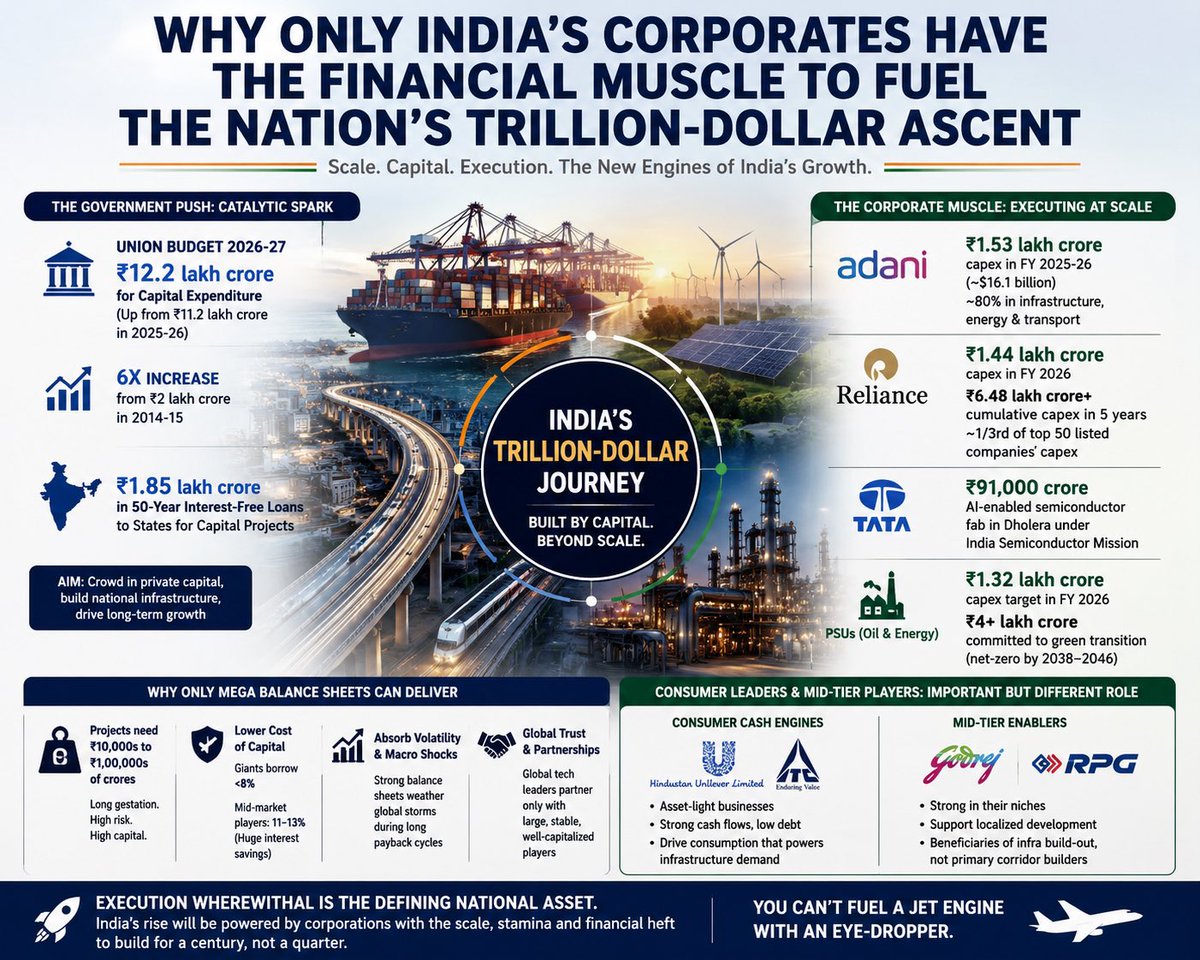
India’s path to a multi-trillion-dollar economy won’t be built by policy announcements alone. It will be built by capital at scale.
SMEs create jobs and local growth, but they cannot finance semiconductor fabs, gigafactories, ports, national logistics corridors, or multi-decade energy infrastructure.
The math is brutal: projects now require investments measured in lakhs of crores and long payback periods. Only mega-balance sheets can absorb that risk.
Government capex can ignite the engine, but private giants provide the fuel. Reliance, Adani, Tata, JSW and major PSUs are deploying capital at a scale that reshapes entire sectors.
Nation-building at this stage is less about fragmentation and more about execution capacity.
You can’t fuel a jet engine with an eye-dropper.
Warm greetings to my sisters and brothers of West Bengal on the occasion of Paschimbanga Divas.
This day celebrates a state that has profoundly shaped India's history through its contributions to diverse areas be it literature, music, art, spirituality, science, trade and commerce, social reform and more. Time and again, West Bengal has enriched India's national consciousness in countless ways.
Today, 20th June is of immense significance in West Bengal’s history. This was the day which ensured that West Bengal remains an integral part of India. The role of Dr. Syama Prasad Mookerjee was invaluable in the same. This year, 2026, we are also marking the 125th Jayanti of Dr. Mookerjee.
The Central Government will work with the West Bengal Government to fulfil the dreams and aspirations of the people. I pray for the progress of West Bengal and the prosperity of its people.
@monidipadey@punarutthana But a million thanks nevertheless to you for igniting that ebbing love of mine for West Bengal, despite being economically forced into 'probashi' status.
@monidipadey@punarutthana Correction. Sarat Chandra Bose wanted a separate, independent and united Bengal. It was, of course, a terribly flawed (not to mention stupid) idea on his part to 'collaborate' with that butcher Suhrawardy and cook that dream. I guess Satish babu saw through this flaw...
Today on 20th June 2026, the first official Poschim Bongo Dibosh/West Bengal Day, as declared by our PM Modi ji, here’s a look back at the historic event of creation of West Bengal from an United Bengal.
Unlike Netaji Subhas Chandra Bose’s elder brother Sarat Chandra Bose, who along with Suhrawardy, tried his level best to form an ‘United Bengal’ under Pakistan and ruled by a Muslim Prime Minister; Netaji’s eldest brother Satish Chandra Bose (seen here with Netaji) supported the creation of a separate West Bengal with Hindu majority.
Satish Chandra Bose stood with Shyama Prasad Mukherjee in this regard. On 15th April 1947, Shyama Prasad Mukherjee at the historic ‘Tarakeswar Hindu Mahasammelan’ had successfully authorized the partition of Bengal, ensuring Hindu-majority areas were carved out into a separate homeland (West Bengal) within the Indian Union.
On 20th June 1947, Satish Chandra Bose was among the Hindu members of the Bose family that voted in favour of dividing Bengal, and creating a Hindu homeland for the Bengalis.
[Image was shared by Somen Sengupta ]
@riteshmjn@ActusDei You have ignored the one time GST payment of Telecom spectrum which happened in May25.
Remove that and GST growth is 9.2% YoY in May26, not 3%.
Unable to get how you missed that.
Of course road encroachment via illegal parking has to be stopped. But you DON'T run trams efficiently by having two way tram traffic on a one way street. Instead open up SN Banerjee Road also to trams (one way). That way BOTH roads will serve the Sealdah station efficiently via trams.
Also consider trolley buses for better utilisation of the tram network. But do overhaul tramcars and get new ones, too!
Ticketing can be made FAR more efficient too. The tech exists, the will was missing.
Let's see the new govt turn on the power now...
ראש הממשלה בנימין נתניהו, הערב במסיבת עיתונאים:
"אזרחי ישראל היקרים,
במשך עשרות שנים אני נאבק במאמצים של איראן להתחמש בנשק גרעיני. אני יכול להגדיר את זה כמשימת חיי. עמדתי בה עד היום, ואני אעמוד בה גם בעתיד. עם הסכם, בלי הסכם - לאיראן לא יהיה נשק גר��יני. לא היום, ולא מחר. כל עוד אני ראש ממשלת ישראל - זה לא י��רה.
אני שומע אנשים שואלים: מה השגנו? ואני עונה להם: ״מה השגנו״? הרחקנו מעלינו סכנת השמדה מיידית. יחד עם ידידינו האמריקנים יצאנו למטס התקיפה הגדול ביותר בתולדות ישראל. סיכלנו את מדעני הגרעין, ערפנו את מנהיגי משטר הטרור, ריסקנו את מפעלי הגרעין, השמדנו טילים ואת רוב רובם של המפעלים שמייצרים טילים, פגענו באינספור תעשיות ותשתיות צבאיות, השמדנו את חיל הים שלהם, את חיל האוויר שלהם, סיכלנו מפקדי בסיג׳ שטבחו בעם האיראני, גרמנו נזק אדיר - אנחנו מעריכים את זה מאות מיליארדי דולרים, ויש שמעריכים את זה אפילו קרוב לטריליון דולרים - נזק אדיר לכלכלת איראן שלקח להם עשרות שנים לב��ות.
אבל הנה הדבר הכי חשוב - שהצלנו את מדינת ישראל מאיום השמדה גרעינית. כי צריך להבין, איראן דהרה לגרעין ממש לפני "עם כלביא" היא דהרה לגרעין ודהרה ולהטמין ��ת תעשיית הטילים והגרעין שלה עמוק מתחת לאדמה.
אם לא היינו פועלים בזמן שבו פעלנו, ובעוצמה שבה פעלנו - גם ב״עם כלביא״ ואחר כך ב״שאגת הארי״, בשיתוף פעולה היסטורי עם הנשיא טראמפ עם הצבא האמריקני - אם לא היינו פועלים בדרך הזאת, לאיראן כבר היו פצצות אטום. ומה המשמעות? המשמעות היא שמיליוני אזרחי ישראל, אתם ששומעים אותי עכשיו, כולכם הייתם בסכנה איומה של מוות המוני. כולנו היינו בסכנה הזאת. ואת הסכנה הזאת, של חיסול אוכלוסיית ישראל, הרחקנו מעלינו לשנים. זה מה שהשגנו - הצלנו את מדינת ישראל מהשמדה.
אבל אני אומר לכם אזרחי ישראל, המאבק לא תם ונשלם. אנחנו נצטרך להמשיך לעמוד על ה��שמר, להמשיך להיות חזקים ונחושים להגן על עצמנו ככל שיידרש. זה נכון לא רק מול איראן. זה נכון גם מול זרועות הטרור של איראן, שבהן פגענו באופן חסר תקדים. עשינו זאת בעזה, עשינו זאת בלבנון, בסוריה, בתימן, עשינו זאת במחנות הפליטים ביהודה ושומרון - עשינו זאת בכל מקום.
חיסלנו את דף, את הנייה וסינוואר יחד עם רבים מראשי החמאס. בעצם כמעט כולם כל מי שהיה שם בטבח הנורא, אני חושב שנשאר עוד אחד, גם הוא יחוסל. השמדנו אלפי מחבלים ואין ספור תשתיות טרור. החזרנו את כל חטופינו מעזה, עד האחרון שבהם. אף אחד לא האמין שנעשה זאת. אני האמנתי.
אמרו לי: ראש הממשלה, חייבים לוותר, אל תכנס לרפיח, תסיים את המלחמה. נביא את החטופים, נמסגר את היציאה שלנו מעזה כניצחון. אני לא קיבלתי את דברי ההבל הללו. אנחנו נכנסנו לרפיח, נכנסנו לעיר עזה, בניגוד לדעתם של רבים - והחזרנו את כל החטופים, עד האחרון שבהם. ולא רק זה, פוצצנו את הביפרים, חיסלנו את הצורר נסראללה, מנענו את פלישת כוח רדוא�� לגליל, השמדנו את הרוב המכריע של 150 אלף רקטות וטילים שנסראללה בנה כדי להחריב את ערי ישראל.
אתם זוכרים מה אמרו לנו – 'אם נכנס לקרב עם חיזבאללה יהיו לנו עשרות אלפי הרוגים, המגדלים יפלו בתל אביב, בחיפה, בירושלים, בבא�� שבע. הרי ישראל יהפכו לעיר חורבות'. אתם זוכרים את זה. אני לא קיבלתי את זה, אנחנו נלחמנו בהם, ועוד איך נלחמנו בהם, תפסנו גם עמדות מפתח שלהם כמו הבופור, שמהם חיזבאללה איים במשך שנים על יישובי הצפון, בעצם על המדינה כולה.
במקביל, עשינו דבר נוסף הקמנו רצועות ביטחון עמוקות סביב מדינת ישראל. עשינו את זה בעזה, בלבנון, בסוריה - שם אגב חיסלנו את כל הנשק של צבא אסד שהיה חוליה מרכזית בציר הרשע. ואני רוצה להבהיר: אנחנו נישאר ברצועות הביטחון ככל שיידרש כדי להגן על המדינה שלנו.
כי אחרי ה-7 באוקטובר קבעתי עיקרון פשוט: ישראל לא תאפשר לארגוני טרור לחנות על גבולותינו. לחתור במנהרות ט��ור לתוך שטחינו, להיערך לטבח קרוב לאזרחינו. היום לוחמי צה״ל הגיבורים חוצצים בין המחבלים לאזרחינו. בעצם מה שעשינו, שינינו את כל תורת הביטחון שלנו. שינינו גם את עצמנו. פרצנו את מחסום הפחד. אנחנו יוזמים, אנחנו תוקפים, אנחנו מפתיעים, ואנחנו הולמים במבקשי נפשנו.
ישראל חזקה מאי פעם, וציר הרשע של איראן חלש מאי פעם. אם מישהו היה אומר לכם, בתחילת המלחמה שאנחנו נשיג את כל מה שפירטתי, ולא פירטתי את הכל - הייתם אומרים שהוא הוזה בהקיץ. טוב מדברים מבטחים, לא. עשינו את זה.
והיום, אחרי שהשגנו את כל זה, יש מי שרוצים למזער את זה, לבטל את ההישגים הכבירים שלנו. ואני אומר לכם - אנחנו הולכים להשיג עוד הרבה דברים גדולים. אנחנו נוסיף לסכל איומים במרחב, אנחנו נבנה בריתות חדשות עם המדינות באזור ומחוץ לאזור. אנחנו נבטיח את העצמאות החימושית שלנו, זה עוד עיקרון שקבעתי ואני שם 350 מיליארד שקל תוספת לתקציב הביטחון. אנחנו נפתח טכנולוגיות שפורצות את גבולות הדמיון, ואנחנו נהפוך את ישראל למעצ��ה חזקה עוד יותר. כי החוזק שלנו, הוא המפתח לעתיד שלנו, הוא המפתח לביטחון שלנו, הוא מפתח בכלכלה שלנו, הוא מפתח לבריתות שלנו. כי בריתות עושים עם החזק וישראל היום היא מדינה חזקה מאוד. היא חזקה תודות לכם אזרחי ישראל.
אני רוצה להודות לכם אזרחי ישראל על העמידה האיתנה שלכם, על הגיבוי שאתם נותנים לממשלה על הגיבוי שאתם נותנים לי כראש הממשלה. ומעל הכל אני רוצה להודות ללוחמים והלוחמות הגיבורים ��לנו בסדיר ובמילואים, בים, ביבשה ובאוויר. בצה״ל ובכל זרועות הביטחון. אין כמוכם גיבורי ישראל.
יחד נמשיך לעמוד, ויחד נמשיך לנצח.
״אַל תִּירָא עַבְדִּי יַעֲקֹב, וְאַל תֵּחַת יִשְׂרָאֵל״.
יחד בעזרת ה' נבטיח את נצח ישראל".
וידאו: עומר מירון / לע"מ
סאונד: ניר שרף / לע"מ
Massive Point of View thievery again:
Since my interview on NDTV where I gave the Kapil Dev analogy of how Indian IT services companies cannot be blamed for not doing AI just as Kapil could not be blamed for not getting runs (because he always claimed to be a fast bowler): The blame has to fall on the other thousands of companies and entrepreneurs in India who did nothing except sit on their butts, waiting for the 4-5 IT giants to lead all tech revolutions. Imo, Indian IT services companies delivered on their original promise massively and that's where the matter should end. Somebody else should have taken the baton. But people chose to make food delivery, ride healing apps, f&o apps.
Since that day last week, there are now plenty of social media commentaries, articles and posts, copy pasting pretty my view, defending IT services companies. Without any attribution, of course 😂
One such post was even complimented by Kris Gopalakrishnan😊!
Long live the Low IPR country!!
Weekend thoughts:
This summer, we have been receiving an unusually high number of requests for internships and associate level openings.
What has surprised me is that many of these requests are coming from students from reputed institutes both in India as well as overseas specially from non finance backgrounds who now want to explore careers in finance.
I can understand why. Campus placements and internship opportunities seem much tougher this year than what we have seen in the recent past.
While responding to these requests, I found myself reflecting on a few lessons that I have learned over the years.
For those at the beginning of their career:
First, don’t be afraid of hard work. The early years of your career are not meant to be comfortable. They are meant to help you learn, build skills, make mistakes and develop character. The effort you put in during these years compounds for decades.
Second, stay humble and empathetic. People often underestimate how far humility, good behaviour and the ability to work with others can take them.
Third, follow your passion, not just the industry that appears to be paying the most at a point in time. Every industry goes through cycles. What’s hot today may not be hot tomorrow.
And finally, a small observation after looking at hundreds of CVs over the years.
Many resumes today show frequent job changes after very short stints.
Of course, every situation is different. But sometimes I feel youngsters are in a hurry.
Give an organisation time to understand you. Give yourself time to learn. Give your manager and mentors an opportunity to invest in you.
The biggest opportunities, responsibilities and learning often come after people have seen you perform consistently over a period of time.
To all the students navigating a difficult job market: keep learning, stay curious, stay grounded, and keep showing up.
In the long run, your first mentor will matter far more than your first pay cheque.
#Mentorship #CareerAdvice #Leadership


![monidipadey's tweet photo. Today on 20th June 2026, the first official Poschim Bongo Dibosh/West Bengal Day, as declared by our PM Modi ji, here’s a look back at the historic event of creation of West Bengal from an United Bengal.
Unlike Netaji Subhas Chandra Bose’s elder brother Sarat Chandra Bose, who along with Suhrawardy, tried his level best to form an ‘United Bengal’ under Pakistan and ruled by a Muslim Prime Minister; Netaji’s eldest brother Satish Chandra Bose (seen here with Netaji) supported the creation of a separate West Bengal with Hindu majority.
Satish Chandra Bose stood with Shyama Prasad Mukherjee in this regard. On 15th April 1947, Shyama Prasad Mukherjee at the historic ‘Tarakeswar Hindu Mahasammelan’ had successfully authorized the partition of Bengal, ensuring Hindu-majority areas were carved out into a separate homeland (West Bengal) within the Indian Union.
On 20th June 1947, Satish Chandra Bose was among the Hindu members of the Bose family that voted in favour of dividing Bengal, and creating a Hindu homeland for the Bengalis.
[Image was shared by Somen Sengupta ]](https://pbs.twimg.com/media/HLOggO_awAAxidu.jpg)


