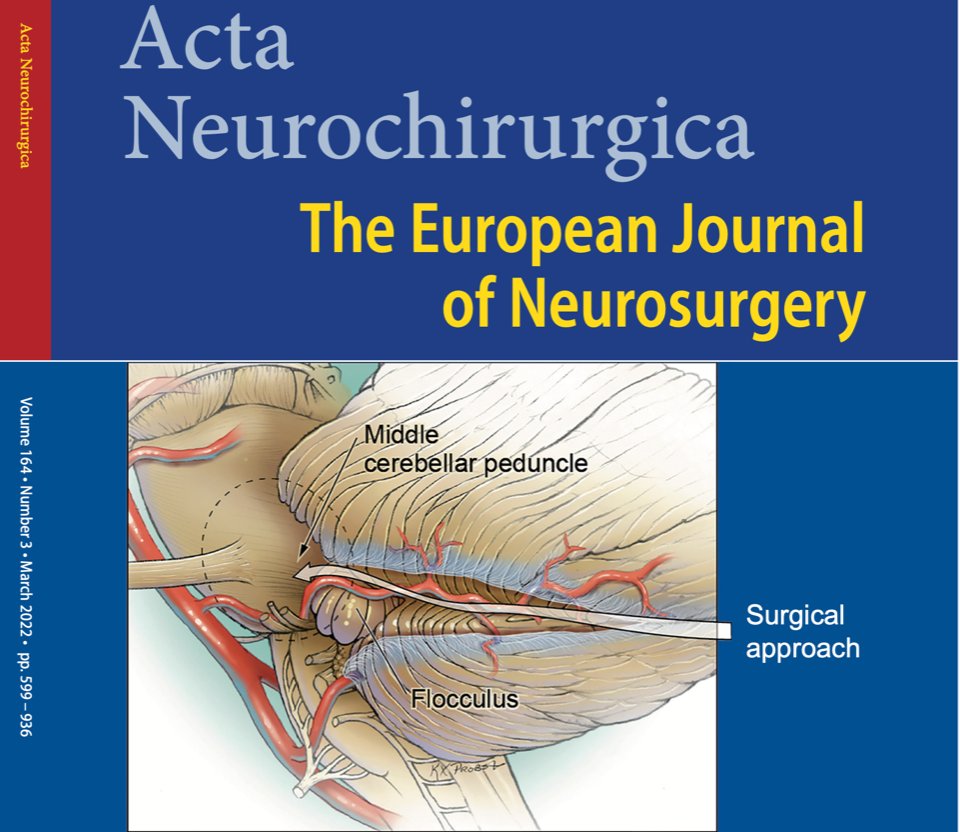
ICYMI - beautiful cover art by Ken Probst on the @ActaNeuro March cover illustrating a horizontal fissure approach to the middle cerebellar peduncle. Article & surgical video by @calebcuts, @DanTonettiMD, @kunalraygor & Adib Abla, MD: https://t.co/eT4iJtKPXg
@txmed@razmik_dr@sudhakar_satti I think it’s clear nowadays most ruptured aneurysm are small <7 mm and I do think we need better tools (flow modeling, bio marker, etc) to predict what 3, 4, 5 mm aneurysm at risk for rupture.
@txmed@razmik_dr@sudhakar_satti I agree 100%. The study design is flawed- its retrospective analysis of prospective tool. We did same thing with UIATS and and similar result, fewer than half ruptures would have received treatment rec based on UIATS. Interestingly though, PHASES and UIATS did not correlate.
New research on enhancing #MoyaMoya post-op monitoring: "Immediate Postoperative Electroencephalography Monitoring in Pediatric Moyamoya Disease and Syndrome" https://t.co/hzME3HOlKG Authors include: resident Anna Huguenard MD, @MdLimbrick@strahleMD@GregoryZipfel@WUSTLmed
Can AI help to better predict who will develop vasospasm after subarachnoid hemorrhage, or perhaps equally importantly, who will NOT? We think so, and thanks to @NINDSfunding for believing we can, as well. @ionita_n @MokinMax@_AdnanSiddiqui@UB_Neurosurgery
We need better treatment strategies for symptomatic intracranial atherosclerosis, particularly those with hypoperfusion who are likely to fail medical treatment. STA-MCA appears to be safe in such patients in this small case series. @ENossek@eytanraz https://t.co/gIcVJWGB1I
New in @NeurosurgeryCNS: @UCSF chief of vascular neurosurgery Adib Abla, MD, @calebcuts & team present a novel trans-quadrangular lobule approach for resection of brainstem cavernous malformations in the upper pons. https://t.co/daj0Brj5Zt