❖ Is the New Covenant the Missing Bridge Between the Tanakh and the New Testament?
Most people think the New Testament begins in Matthew.
But what if its foundations were laid centuries earlier?
What if the bridge between the Tanakh and the New Testament is found in a single promise God made through Jeremiah?
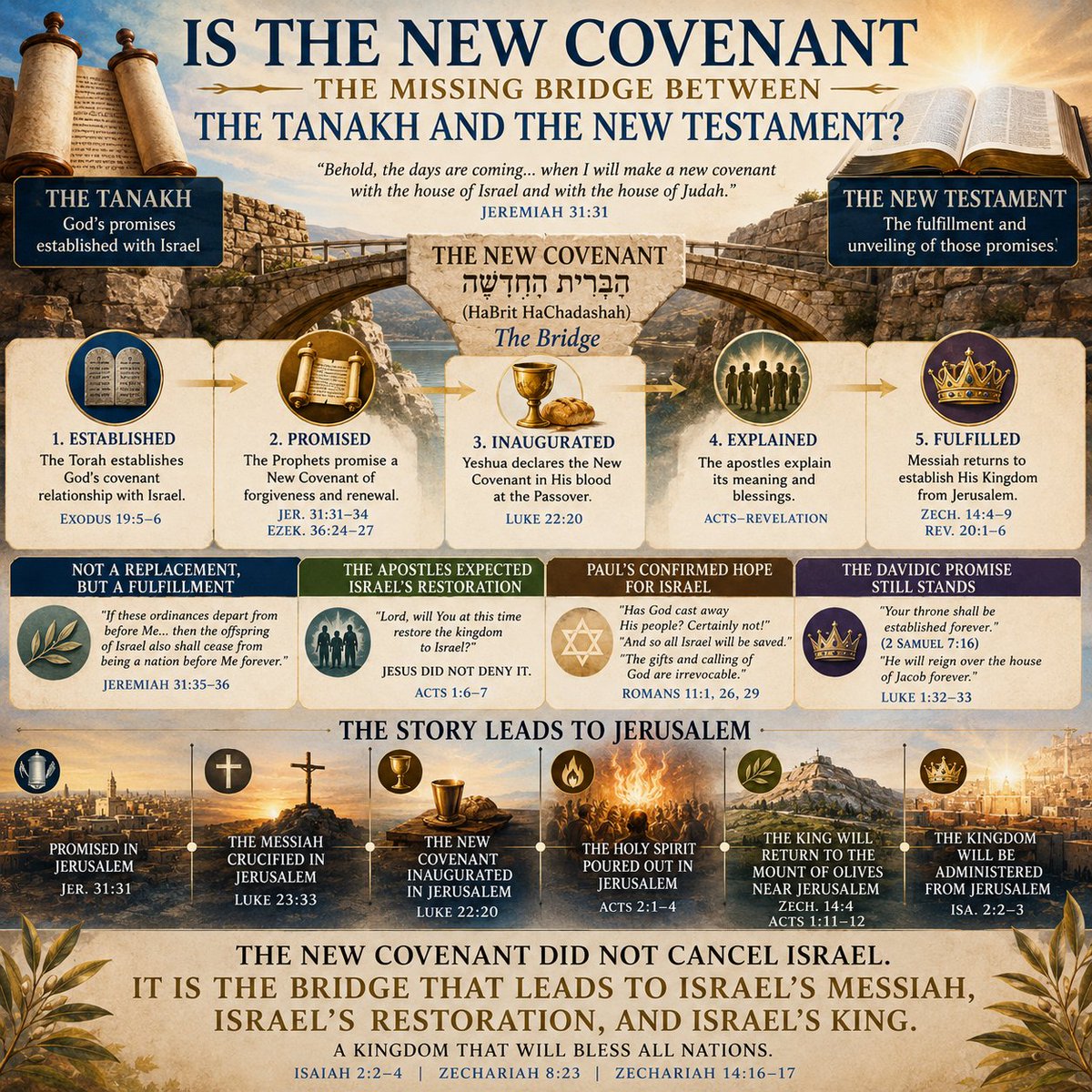
"Behold, the days are coming... when I will make a new covenant with the house of Israel and with the house of Judah." (Jer. 31:31)
In Hebrew, the New Testament is often called הַבְּרִית הַחֲדָשָׁה (HaBrit HaChadashah)—"The New Covenant."
That title is not accidental.
The New Testament does not emerge from a vacuum. It grows directly out of God's covenant promises to Israel. The very name points us back to Jeremiah's prophecy.
Notice the recipients of the covenant:
"I will make a new covenant with the house of Israel and with the house of Judah." (Jer. 31:31)
God did not promise this covenant to a new people. He promised it to Israel and Judah.
The New Testament records how Yeshua inaugurated the covenant God had already promised centuries earlier.
The flow of Scripture is remarkably seamless:
❖ Torah establishes God's covenant relationship with Israel.
❖ The Prophets promise a New Covenant (Jer. 31:31–34; Ezek. 36:24–27).
❖ Yeshua declares, "This cup is the new covenant in My blood" (Luke 22:20).
❖ The apostles explain its meaning and blessings.
❖ Messiah returns to establish His Kingdom (Zech. 14:4–9; Rev. 20:1–6).
Far from replacing the Hebrew Scriptures, the New Testament assumes them.
After His resurrection, Yeshua explained:
"Beginning with Moses and all the Prophets, He interpreted to them in all the Scriptures the things concerning Himself." (Luke 24:27)
If Moses and the Prophets already testified about Messiah, then the New Testament is not introducing a new story—it is unveiling the climax of the existing one.
Consider the central figures:
❖ The Messiah is Jewish (Matt. 1:1).
❖ The apostles are Jewish (Acts 1:13–14).
❖ The prophets are Jewish (Rom. 3:1–2).
❖ The covenant is made with Israel and Judah (Jer. 31:31).
❖ The Scriptures they quote are the Tanakh (2 Tim. 3:15–16).
Even years after coming to faith, Paul still declared:
"I am an Israelite, a descendant of Abraham, of the tribe of Benjamin." (Rom. 11:1)
But the New Covenant is only part of the story.
The prophets also spoke of a coming King.
God promised David:
"Your house and your kingdom shall endure before Me forever; your throne shall be established forever." (2 Sam. 7:16)
The angel Gabriel connected Yeshua directly to that promise:
"The Lord God will give Him the throne of His father David, and He will reign over the house of Jacob forever." (Luke 1:32–33)
Notice the language. The promise is not abandoned. It is reaffirmed.
A common objection is that the Church has now replaced Israel.
Yet decades after Pentecost, Paul asked:
"Has God cast away His people? Certainly not!" (Rom. 11:1)
And later declared:
"And so all Israel will be saved." (Rom. 11:26)
"The gifts and calling of God are irrevocable." (Rom. 11:29)
Paul saw Israel's future restoration as the fulfillment of God's covenant promises, not their cancellation.
Even the apostles expected a future kingdom for Israel:
"Lord, will You at this time restore the kingdom to Israel?" (Acts 1:6)
Notice that Yeshua did not deny the restoration. He simply said the timing belonged to the Father (Acts 1:7).
The story therefore moves forward—to the return of the King.
The New Covenant was promised in Jerusalem (Jer. 31:31).
❖ The Messiah was crucified in Jerusalem (Luke 23:33).
❖ The New Covenant was inaugurated in Jerusalem (Luke 22:20).
❖ The Holy Spirit was poured out in Jerusalem (Acts 2:1–4).
❖ The King will return to the Mount of Olives near Jerusalem (Zech. 14:4; Acts 1:11–12).
❖ The Kingdom will be administered from Jerusalem (Isa. 2:2–3).
The geography matters because God's promises matter.
The prophets consistently describe Messiah reigning from Zion:
"For out of Zion shall go forth the law, and the word of the LORD from Jerusalem." (Isa. 2:3)
"The LORD will be king over all the earth." (Zech. 14:9)
The Bible begins with a promise.
It moves through covenants.
It reaches the Cross.
It looks toward a King.
And when that King returns, His feet will stand on the Mount of Olives, exactly as the prophets foretold (Zech. 14:4).
The New Covenant did not cancel Israel.
It is the bridge between the Tanakh and the New Testament.
And it leads ultimately to Israel's Messiah, Israel's restoration, and Israel's King reigning from Jerusalem over a kingdom that will bless all nations (Isa. 2:2–4; Zech. 8:23; Zech. 14:16–17).
Gabor Maté dropped a sharp contrast in his conversation with Joe Polish that really stuck with me.
Mainstream medicine calls ADHD the most heritable mental condition.
Maté says that’s like calling quartz the most chewable crystal — because it’s neither a disease nor primarily inherited.
Instead, he argues it’s often a protective response: when a developing brain (from in utero onward) faces too much stress — whether from a stressed mother during pregnancy, fractured adult-child relationships, or the uncertainty, isolation, and loss of control baked into modern life — the mind automatically tunes out as self-protection.
The Harvard Center on the Developing Child has shown that the quality of emotional connections with adults is one of the most critical inputs for healthy brain development. In our increasingly stressed and fragmented society, parents and kids both carry elevated stress hormones, and “tuning out” becomes a wired-in survival strategy.
We’re medicating a cultural and relational problem more than a genetic one.
One person’s “broken brain” is another person’s understandable adaptation to an environment that wasn’t designed for how human brains actually evolve.
Do you see ADHD more as a fixed genetic trait, or do you think early relational stress and modern societal pressures play a much larger role than we usually admit?
According to Jeremiah 31, the New Covenant is not the cancellation of Torah.
It is Torah in our hearts.
Literally.
Christians need to come to terms with this.
Members of the New Covenant will have God’s Torah inscribed upon their hearts, producing obedience to the commandments (Jer. 31:33). Ezekiel similarly proclaims that God will give his people a new heart, put his Spirit within them, and cause them “to walk in my statutes and be careful to obey my rules” (Ezek. 36:26-27). Paul alludes to these prophecies when he characterizes believers as those who fulfill “the righteous requirement of the law” because they walk “according to the Spirit” (Rom. 8:4).
What Tucker says here about islamic eschatology is not true. Islam believes that their Jesus (who didn’t die on the cross, by the way, according to Islam) will return, submit to Islam, and condemn Judaism and Christianity. This is supported by both Quran and Hadiths.
The people in charge don't want you to know this, but Muslims love Jesus.
Islam reveres Him as a major prophet and messenger of the Lord, believes He performed miracles, and states that He will return to Earth to defeat the Antichrist. That's why Donald Trump's painting depicting himself as the Son of God offended the president of Iran. It was an attack on his religion as well as Christianity.
Today's Morning Note newsletter covers Masoud Pezeshkian's condemnation of Trump's “desecration of Jesus,” the Iran War's gutting effects on America's housing market, Colombia's plan to murder Pablo Escobar's hippopotami, and more. Read below.
https://t.co/KrgZifc2ZM
@AnalogRules61@rabbriansamuel “The Lord spoke to Moses, saying: Speak to the children of Israel and say to them: The Lord’s appointed [holy days] that you shall designate as holy occasions. These are My appointed [holy days].” Leviticus 23:1-2
@janos_gyori_@rabbriansamuel I don’t think the rabbi is using that scripture to make a point about feasts - I think he’s making a point that, while gentiles used to be excluded from the “covenants of the promise” (namely Abrahamic, Davidic, New), we are now brought near to them by the blood of Christ.
One of my most joyful markers of success is when a boy comes to me and says: I took the games off my computer.
Video game addiction among boys is a significant issue today. The conventional response is to blame the games or restrict screen time.
The deeper problem is that many of these boys have nothing more compelling to do. The school offers compliance. Video games offer agency, mastery, and social connection. The games are not the disease. They are the painkillers.
When a young person enters an environment where their real interests are taken seriously, where they can pursue meaningful work with real stakes, the games often lose their grip.
The boy does not stop playing because someone told him to stop. He stops because he found something better. He found work that matters to him. He chose to delete the games himself.
This is the difference between compliance and agency. Compliance says: put the controller down. Agency says: I have something more important to do.
What would your son choose to work on if he had something genuinely meaningful to pursue?
The opening line of Ecclesiastes Rabbah 6 quotes Ecclesiastes 6:1 and then moves immediately into a list of evils: those who dilute wine with water, those who mix pure oil with inferior substitutes, and other deceptive practices meant to inflate profit while passing off a diminished product as quality.
It stands out because this is hardly an ancient problem. In the U.S., it is routine. Try buying olive oil that has not been cut with something cheaper. The pure olive oil I order from Israel makes the contrast obvious. What we brush off as normal business practice is called what it is in this text: evil.
What caught my attention even more, though, was the commentator’s hesitation:
“Woe is me if I say it, and woe is me if I do not say it. If I say it there is the danger the cheats will learn what to do, and if I do not say it, the cheats may assert, ‘the sages are unacquainted with our actions.’”
In the end, “Finally he did say it, ‘For the ways of the Lord are right’” (Hosea 14:10).
The footnote adds the context directly: “The necessity to expose the frauds overcame the fear that others might learn to practice them. The teacher’s duty is to advocate what is right irrespective of the wicked.”
That tension is not theoretical. I have wrestled with it more than once. Some insights bring clarity to the kind of wickedness we see playing out today. At the same time, putting those insights out publicly means they are not just seen by the righteous. The wicked are listening too. Does naming the problem sharpen their methods or teach others new ways of evil?
This midrash brings clarity to that question.
Silence does not restrain evil. It emboldens it. Leaving it unspoken gives the impression that no one sees, no one understands, and no one is willing to confront it.
Calling it out matters. As disciples of Jesus, this matters. We are not called to be silent in the face of wickedness. Too much of the church has fallen silent with the rise of antisemitism.
If we stand idle and silent as too many have in the past, we are not avoiding evil. We are participating in it.
🚨 Notice how the Christian Zionists are teaching the Anti-Zionists what it says in the Bible. They are literally quoting scripture to debunk the counters the other side is trying to invoke.
Romans 11:28-29 reveals a powerful paradox: while many Jews rejected the Messiah, Paul explains this happened "for your sake" to open the door for the Gentiles. Their temporary opposition was the catalyst for the Gospel to reach the world, yet God’s calling remains irrevocable.
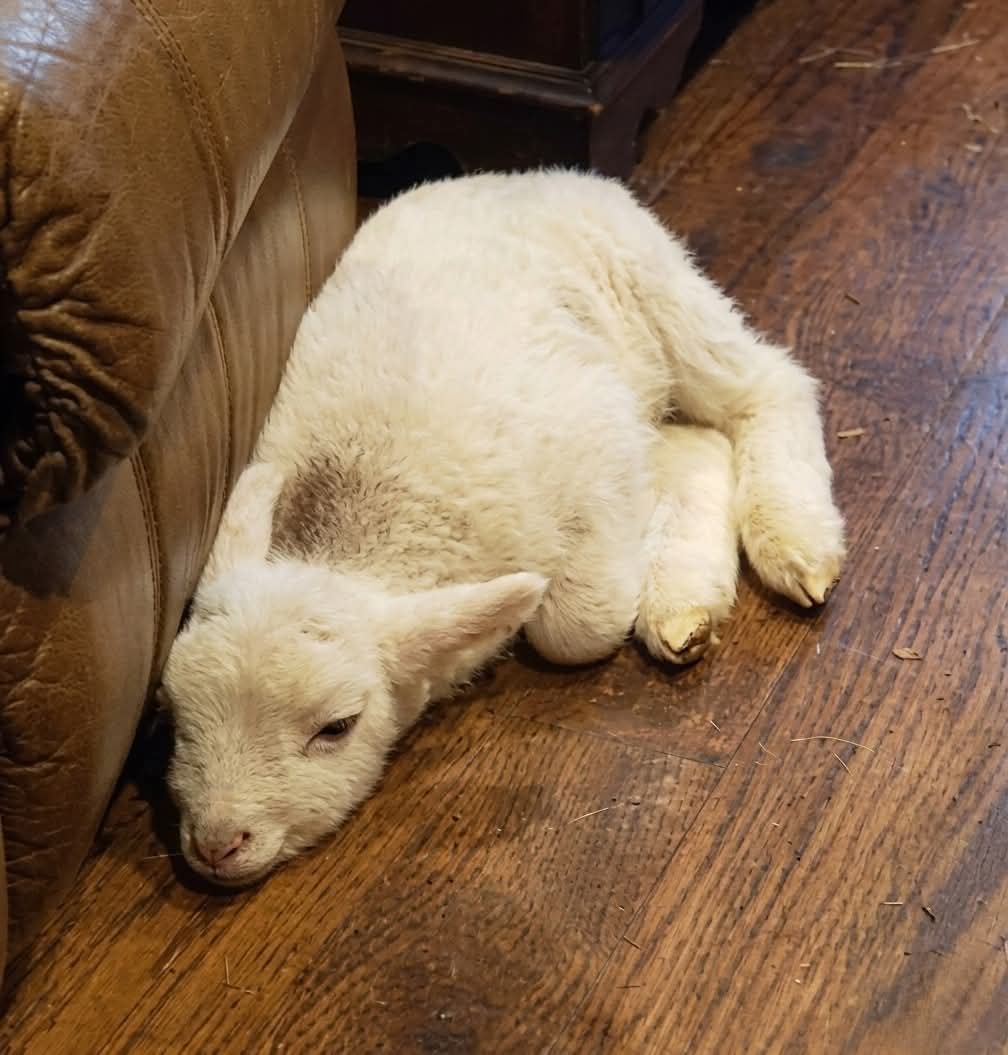
Every once in a while, a ewe will give birth to a lamb and reject it. There are many reasons she may do this. If the lamb is returned to the ewe, the mother may even kick the poor animal away. Once a ewe rejects one of her lambs, she will never change her mind. These little lambs will hang their heads so low that it looks like something is wrong with its neck. Their spirit is broken. These lambs are called “bummer lambs.” Unless the Shepherd intervenes, that lamb will die, rejected and alone. So, do you know what the Shepherd does? He takes that rejected little one into His home, hand-feeds it and keeps it warm by the fire. He will wrap it up with blankets and hold it to His chest so the bummer can hear His heartbeat. Once the lamb is strong enough, the Shepherd will place it back in the field with the rest of the flock. But that sheep never forgets how the Shepherd cared for him when his mother rejected him. When the Shepherd calls for the flock, guess who runs to Him first? That is right, the bummer sheep. He knows His voice intimately. It is not that the bummer lamb is loved more, it just knows intimately the One who loves it and has experienced that love one on one. So many of us are bummer lambs, rejected and broken. But He is the good Shepherd. He cares for our every need and holds us close to His heart so we can hear His heartbeat. I am a bummer lamb adopted and loved by The Good Shepherd!! Hallelujah!!
@megbasham online dating apps are a *response* to the problem, not the *cause* of the problem. what are young single adults supposed to do when no one our age goes outside anymore unless to the bar???
The notion that Jewish apostles such as Peter, Paul, and James would instruct Jewish believers to abandon the laws of Moses because Jesus fulfilled them is not only absurd but also offensive. I wish Christians understood this more.
~ Rabbi Brian Samuel
@rabbriansamuel i feel like genetic modification itself violates torah, so that in itself would make it non kosher, regardless of the cloven hoof / chew the cud violation
If you can’t bring yourself to say “Jesus is a Jew,” then you don’t really follow Jesus—you follow a fake version of Jesus that you made up. The Yeshua of the Scriptures is the King of the Jews, the Messiah of Israel.