@SparkingFIRENC We have a 21 Highlander hybrid and I love it. 38mpg all day long. The hybrids are like 5k more than an equivalent gas (V6) model usually though.
Playing Super Mario 64 for 30 minutes a day for two months physically grew the brains of the people who played it. A 2014 study in Molecular Psychiatry scanned participants before and after two months of daily play and found increases in grey matter in three regions involved in memory, planning, and fine motor control.
The study was led by Simone Kuhn at the Max Planck Institute in Berlin. She gave 23 adults a Nintendo DS and told them to play Super Mario 64 for at least 30 minutes a day for two months. A control group played nothing. MRI scans taken before and after showed that the Mario group had measurable increases in grey matter in the right hippocampus, the right prefrontal cortex, and the cerebellum, and the increases were not found in the control group.
The hippocampus is where the brain stores spatial maps. Super Mario 64 is a game built entirely around navigating three-dimensional space, jumping between platforms, remembering which doors lead where, and building a mental model of a world that does not exist. The brain treats a virtual world the same way it treats a real one: it maps it, stores it, and grows to accommodate it.
The prefrontal cortex handles planning and strategy, which the game demands constantly. The cerebellum handles timing and coordination, which every jump requires. The brain was not just entertained. It was being trained, and the tissue responded the same way muscle responds to a weight: it got bigger.
Kuhn said the results suggest that video game training could be used as a therapy for conditions where these brain regions are reduced, including post-traumatic stress disorder, schizophrenia, and age-related brain shrinkage. The prescription is a plumber in a red hat, 30 minutes a day. https://t.co/8hKZMvh8VN
Trump claims he was basically lifted out of the rubble on 9/11: "Two fireman, big strong guys, they grabbed me under the arms -- 'got to get our of here!' -- and they literally lifted me up, and they started running with me."
Regret the tone of my post on data centers yesterday.
What I should have said:
There were reasonable concerns about data centers 18ish months ago: water, taxes, jobs, electricity prices, the environment and what they would do to small towns. Well-structured data center projects have largely addressed these concerns today and we should be celebrating this.
On balance, data centers are awesome for America in every way.
On water: U.S. data centers use a fraction of what golf courses use. A lot of the numbers from 18 months ago were off by over 1000x. Newer data centers use closed-loop systems or recycled water. Should be required by every town approving a data center project.
On taxes: looking only at sales-tax exemptions, as Ronan Farrow did, is the wrong way to evaluate this. Data centers pay significant property taxes. Loudoun County, which is the wealthiest county in America, now collects on the order of $1 billion a year from data centers. In Quincy, WA, data centers are more than half the property-tax roll. Over time, property taxes can go to zero while government spending increases in these towns.
On jobs: this has been unambiguously awesome for blue collar Americans. Demand for electricians, plumbers, welders, HVAC techs, and contractors has gone vertical, and it is not a one-time construction job. These buildings get upgraded and expanded over time. That is why the building trades are fighting for them, and why some unions are now treating opposition to data centers as a reason not to endorse politicians.
On power: the original fear was that households would pay for the incremental electricity demand in the form of higher prices. That is why the ratepayer-protection deals and the new large-load tariffs exist. The right structure is: the data center brings or pays for new generation and signs a contract long enough that existing customers are protected. Where that is happening, utilities are cutting or freezing residential rates and saying so on the record. Where it is not, people are right to object. Electricity prices are going down *today* in a number of large states because of data centers.
On the environment: data centers overwhelming use natural gas today, which is the cleanest power source outside of nuclear, solar and wind. And the companies that are building the data centers are committed to carbon neutrality such that an equivalent amount of solar will likely be built. Maybe more importantly, the data centers need batteries to function effectively and these batteries can also sell energy back into the grid (which recently prevented blackouts in Texas). Over time, data centers will run on solar plus batteries.
On the towns: Poverty in Quincy, WA fell from 29% to 6%. Data center taxes paid for a new high school, a hospital, a library, police and fire stations. This is happening in many left for dead former mill and farm towns that had no other bidder for the land.
Data centers are actually reindustrializing parts of America and creating the kind of working-class jobs both parties have spent decades claiming to support. That should not be a partisan issue. Data centers can and should be awesome for America and they increasingly, overwhelmingly are. Supporting the outsourcing of data centers to China will likely age just as well as support for the outsourcing of high quality, blue collar manufacturing jobs to China has aged.
When the facts change, I change my mind. I hope that reasonable people who had good faith reasons to oppose data centers at least consider updating their beliefs given the change in the facts over the last 18 months. This really matters for America.
I will say I also think the idea of making data centers beautiful is a good one that has yet to be implemented. Data centers should be just as beautiful as Grand Central Station. We can learn a lot from the railroad buildout. Neoclassical revival ftw.
Might write up open-weight AI tomorrow as this is equally essential to America.
A Chinese bot farm of 200,000 accounts has been operating on 𝕏 (and likely other major social media platforms) to drum up opposition to data centers.
China has run influence operations in the U.S. for years to sow disagreement about strategically important industries: https://t.co/lLQXTUfWbM
I changed my mind on minimum wage after reviewing the data. I used to believe in letting the free market handle it, like most of you.
However, when California raised the minimum wage for fast-food workers, it increased prices for consumers by pennies (~1-2%).
There was zero downside... it didn't drive massive automation, nor did it cause businesses to shutter.
Exactly the same result as Australia and other American cities... no changes in jobs; restaurants didn't close.
We are at record profits for corporations.
We are at a record low in unemployment in America over the past five years.
We are at maximum social unrest due to wealth disparity.
We should WANT to see the lowest-earning Americans go from $12 to $15, to $20, and then to $25 an hour over the next decade.
This isn't virtue signaling; this is good business!
Why?
Individuals earning under $40,000 a year spend 100% of their income.
They save nothing... they just spend it at the same companies they earn it at (Amazon, McDonald's, the Apple Store, DoorDash, Uber, etc).
It increases monetary velocity.
Take the time to research all of this, and you'll find the only downside is for teenage workers, who aren't worth $15-20 an hour. It does depress those jobs, so we should keep teenagers at a lower rate.
#Tether watch!
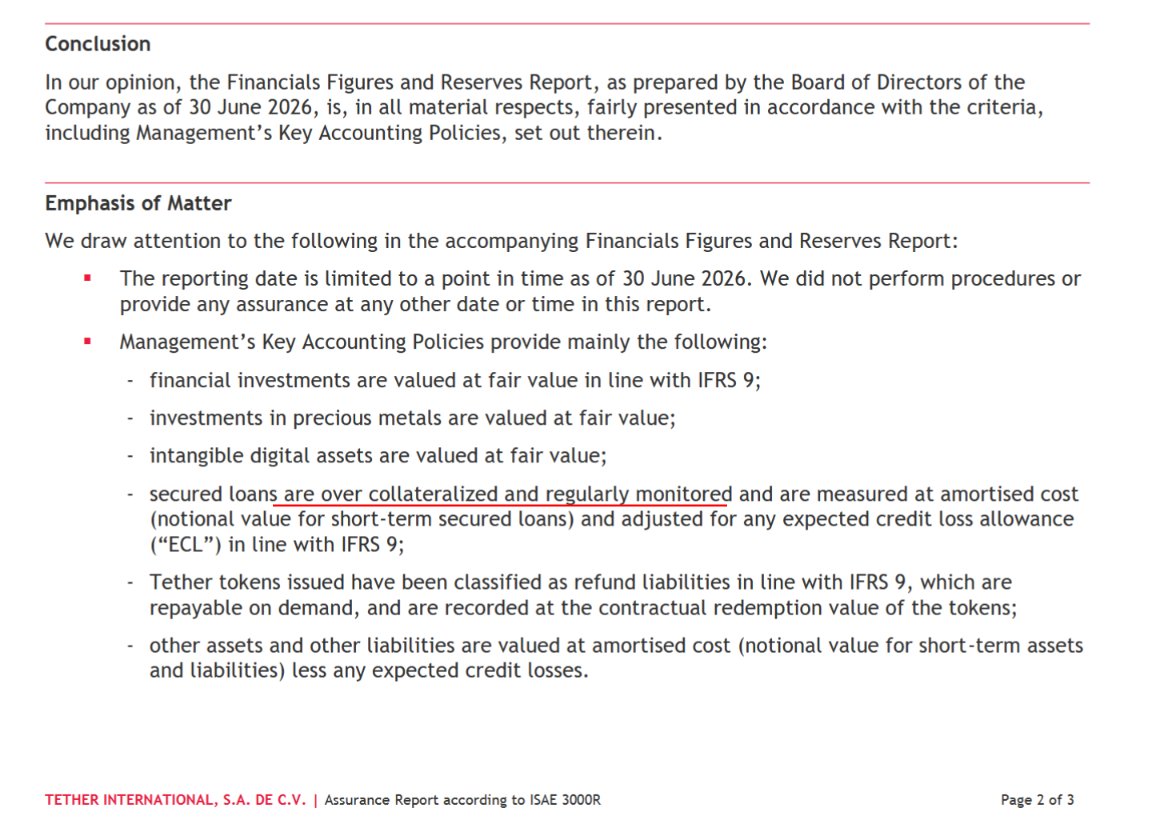
Tether's new attestation is out and i might as well go through it considering it's expected. Again, i wouldn't trust it, but i guess there's some fun to see the creativity in lying.
First change on page 2. Secured loans are no longer backed by liquid assets.