Dear President Elon,
India is a sovereign country, not your personal business project. You run a private company, not a charity.
Just because you want to enter the Indian market doesn't mean you get to mock people and lecture India on what it should do.
And please stop selling this idea that you are coming to save poor Indians. Starlink is VERY expensive. It's not free internet that you are giving away out of kindness.
You are here to do business, just like every other company. So let's not pretend this is some social service.
Nobody is stopping you from making an offer. Make it affordable, follow Indian rules, and let the government decide. That's how it works.
Please keep attitude in check, you just sell internet. You don't own India.
marketing is free in 2026
don’t cry about your product not selling
either your product is shit - fix that in that case
or create content - it’s free and promote
don’t cry - don’t be a dumb person - put reels, post tweets, linkedin posts
it’s free - put efforts
call me whatever:
modi, bjp laakh bura hain
but they are still better than congress, aap, sp type parties and their leaders
politics has always been about choosing a lesser devil
all of them are devils; people of the nation always choose a lesser devil
Rahul Gandhi’s reply to Elon Musk’s tweet today exposes two things that define Rahul Gandhi’s and the Congress ecosystem’s politics. Nothing exposes them better than this one tweet.
First, when discussions were going on last year about Starlink’s possible entry into India, the Congress party opposed it, alleging that this was being done to support businessmen close to Prime Minister Modi. They even brought in the national security angle to oppose Starlink’s entry.
And now, the same Rahul Gandhi has made a complete U-turn and is pushing for Starlink’s entry into India. He has not only reversed his party’s stand from a few months ago, but has also conveniently forgotten the national security arguments his own party had raised then.
This shows that Rahul Gandhi’s opposition is simply for the sake of opposition. When they thought the Modi government was supporting Starlink, they opposed it. Now, when they think the government is opposing it, they are supporting Starlink.
They can sway whichever way they want, as long as it is to oppose Modi. Principles, consistency and even national security can be conveniently forgotten.
Second, look at what has happened today and how history has parallels to this.
Rahul Gandhi is supporting a foreign businessman because he believes Indian businessmen are close to the Prime Minister. He seems willing to welcome a foreign businessman to challenge Indian businesses simply because he believes those businesses support Modi.
This reminds us of Jaichand. There are many such examples in Indian history where our own people sided with foreign interests to further their individual political ambitions. Every time, such choices cost the nation dearly. These divisions and betrayals contributed to centuries of foreign domination and subjugation.
Rahul Gandhi seems determined to replay the same textbook.
But this time, the consequences could extend beyond political hegemony to technological and economic dependence as well.
And for what? Just to oppose Modi?
Will you oppose India just to oppose Modi, Mr. Rahul Gandhi?
It is unfortunate that we have a Leader of Opposition like you, Mr. Rahul Gandhi.
Karnataka has historically stood firm in defence of national interests.
Bengaluru, in particular, has consistently been a bastion of nationalist politics from decades.
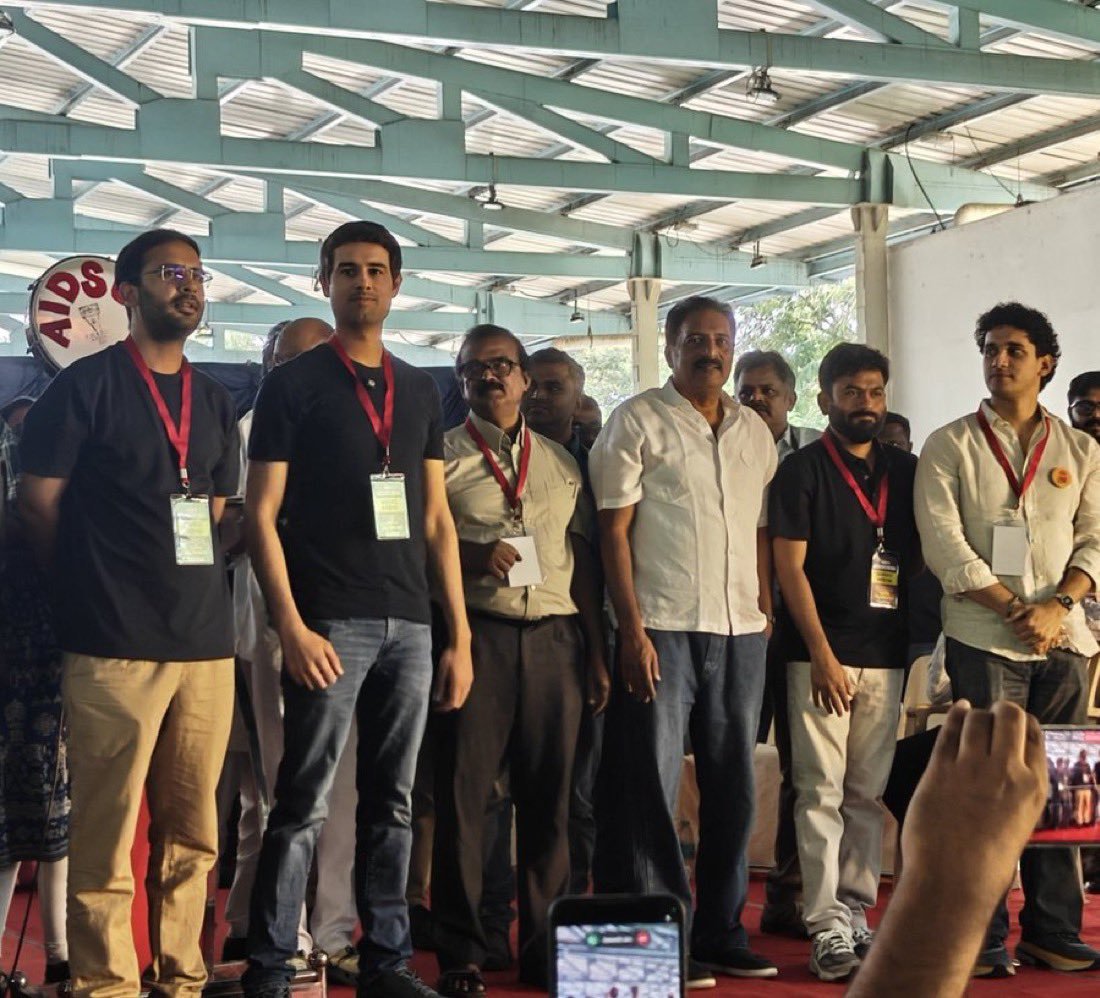
Today, Bengaluru proved yet again that no amount of social media dramebaazi can manufacture support on the ground.
You would find more young people in a college canteen during lunch break than turned up for today’s anarchists’ rally.
huawei ships next level innovative phones. Yet, not allowed in open market like USA.
EV cars are another example.
So Starlink is another one such example, that’s it.
- tweeting from Jio internet.
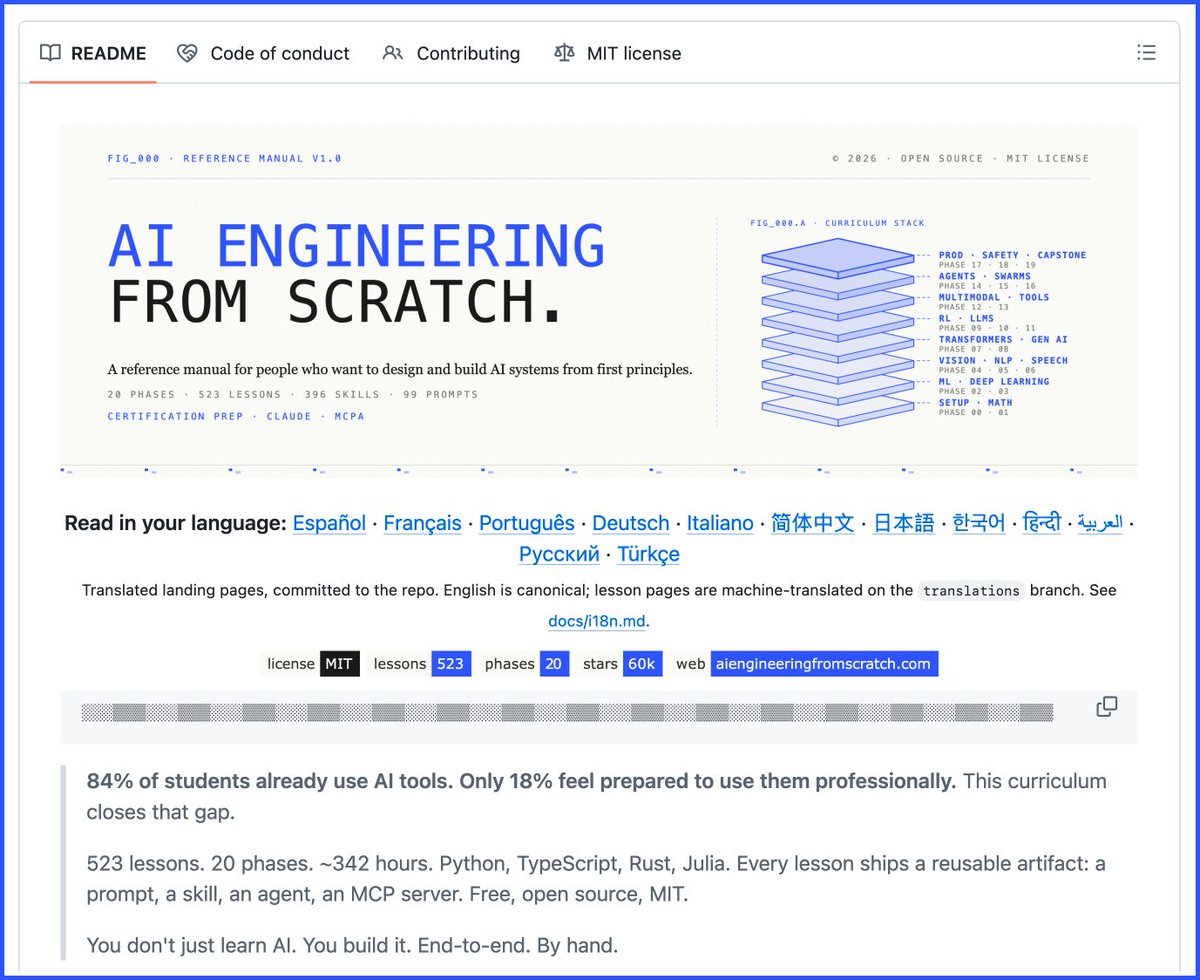
Someone literally put an entire AI engineering degree on GitHub and made it 100% free 🔥
523 lessons across 20 phases, with ~342 hours of material.
The whole curriculum is built around learning AI from first principles.
You start with the math, then implement the concepts yourself: backpropagation, tokenizers, attention, agent loops and more. Production frameworks come later, once you've already built the core mechanics by hand.
Every lesson runs these 5 steps:
Read the problem → derive the math → write the code → run the test → keep the artifact.
By the end of each lesson you have reusable: prompts, SKILLmd files, agent definitions, MCP servers you built yourself. The code runs in Python, TypeScript, Rust or Julia, depending on what fits the concept best.
The curriculum goes from linear algebra all the way to autonomous agent swarms, multi-agent coordination, production infrastructure, and AI safety.
It’s 100% free, open source, MIT licensed and available to clone and run locally. 65k+ stars on GitHub.
https://t.co/OhK9MK0CaL
If you're learning RAG, don't build another basic "PDF chatbot."
Build these 10 projects instead.
They'll take you from basic retrieval to production-grade AI systems:
1. Hybrid Search RAG
What you'll build:
Combine BM25 keyword search with dense vector retrieval to find both exact matches and semantically relevant documents.
Stack:
Python · BM25 · Elasticsearch/FAISS · Sentence Transformers
2. Metadata-Filtered RAG
What you'll build:
Combine semantic search with filters such as date, category, author, or location to narrow down relevant context.
Stack:
Python · PostgreSQL · pgvector · Pydantic · OpenAI
3. Reranking RAG
What you'll build:
Retrieve many candidates, rerank them using a cross-encoder, and send only the most relevant chunks to the LLM.
Stack:
Python · FAISS/pgvector · CrossEncoder/Cohere Rerank · OpenAI
4. Contextual Chunking RAG
What you'll build:
Preserve document-level context when creating chunks so retrieved passages remain meaningful on their own.
Stack:
Python · Docling · OpenAI/Claude · pgvector
5. SQL + Vector RAG
What you'll build:
Combine SQL for structured data with vector search for unstructured knowledge.
Stack:
Python · PostgreSQL · pgvector · SQLAlchemy · LangGraph
6. Knowledge Graph + Vector RAG
What you'll build:
Combine semantic search with explicit relationships between entities to answer questions where connections between facts matter.
Stack:
Python · Neo4j · pgvector · OpenAI · LangGraph
7. Corrective RAG
What you'll build:
Evaluate retrieved context before answering. If retrieval is weak, rewrite the query, retrieve again, or use another source.
Stack:
Python · LangGraph · OpenAI · pgvector · Tavily
8. Self-RAG
What you'll build:
Let the system decide when retrieval is needed, evaluate the evidence, and check whether the answer is sufficiently supported.
Stack:
Python · LangGraph · OpenAI · pgvector
9. Multimodal RAG
What you'll build:
Retrieve and reason over text, tables, images, and document pages instead of treating everything as plain text.
Stack:
Python · Docling · Multimodal LLM · Vector DB · OpenAI
10. Agentic RAG
What you'll build:
Build an agent that decides which knowledge source or tool to use, performs multiple retrieval steps when necessary, and combines the results.
Stack:
Python · LangGraph · OpenAI · Vector DB · Search APIs
The interesting part?
These aren't 10 completely separate architectures.
You can combine them.
Hybrid search + reranking + metadata filtering + corrective retrieval can eventually become one production RAG pipeline.
If you're learning RAG seriously, don't stop at:
"I can retrieve documents and send them to an LLM."
Learn how to make retrieval accurate, contextual, verifiable, and adaptive.
20 AI problems interviews love to ask:
1/ Design a RAG system for company docs
2/ How do you stop hallucinations in production?
3/ When would you fine-tune vs prompt vs RAG?
4/ Design an AI customer support agent
5/ How do you evaluate an LLM app?
6/ Explain embeddings like I'm hiring you
7/ How do you cut inference cost by 10x?
8/ Design a multi-agent system that doesn't loop forever
9/ How do you handle prompt injection from user docs?
10/ Build a semantic cache. When does it fail?
11/ How do you choose chunk size for RAG?
12/ Design observability for every LLM call
13/ How do you A/B test two models safely?
14/ What's your fallback when the model provider is down?
15/ Design memory for a long-running personal agent
16/ How do you grade tool-calling, not just final text?
17/ Rate-limit, retry, and timeout strategy for agents
18/ How do you keep PII out of the context window?
19/ Design a coding agent that can edit a real repo
20/ Walk me through an AI system you shipped end to end
They don't care that you "know ChatGPT."
They care that you can build, measure and break things safely.
Bookmark this.
The only businesses left to build in the AI era:
1/ AI agents that replace one boring job end to end
2/ Vertical SaaS for one industry, powered by agents
3/ Eval + monitoring for production AI
4/ Security for vibe-coded apps
5/ Cost control for AI API bills
6/ Human-in-the-loop for high-stakes decisions
7/ Fine-tuning and data pipelines for niche domains
8/ Voice agents that actually close tickets
9/ AI implementation agencies for non-tech companies
10/ Compliance tools for AI in regulated industries
11/ Memory and identity layers for personal agents
12/ Marketplaces for reusable agent skills / MCP tools
13/ QA agents that break products before users do
14/ Local / private AI for companies that can't send data out
15/ Content + distribution systems that turn AI output into revenue
AI makes building easy.
Distribution and trust are still hard.
Bookmark this + tag a founder still chasing "another chatbot."
Underrated life advice: Just be easy to work with. Show up on time. Do what you said you'd do. Bring solutions, not problems. Never create drama. Be responsive. Be emotionally consistent. Be kind. People will always want to support someone who just makes their life easier.
Be wealthy,
but never mention money.
Be strong,
but never boast about the grind.
Be wise,
but never talk like a teacher.
Dear bro,
Real power is silent,
they should feel it, not hear it.
This is literally the best time to switch jobs if you are in AI, but why?
Almost every AI startup who has raised funding is hiring for an AI Engineer, FDE, Deployment Engineer, or ML Researcher, etc and the syllabus is not yet defined for interviews.
Most of the interview discussions are around your knowlegde of RAG, Inferencing, System Design, Deployment, Fine Tuning or designing systems and not pure DSA or Problem solving.
and how can you be the one to get selected, what should you do now?
1. Solidify a base in these technologies - learn, upskill, and build.
2. Apply for as many roles as possible in which you are eligible.
3. Give interviews, you would get an idea on what's being asked in the initial 3/5 interviews and after that you know what you can expect.
4. Make naukri. com account, apply for all LinkedIn jobs and start cold DMing CTOs, Engineering Leaders from these companies with your resume.
thats it, you land a role soon and then once you are in the game - you can switch to a better role way more quickly with the new experience in your organization.
I have seen people jumping from 20 LPA to 40 LPA to 60 LPA in a matter of 1 to 1.5 years and its possible.
go give your shot, all the best!
#arshgoyal #ai #fde
Assume everything always works out for you.
Assume whatever you start, you get exceptional at, whatever you build, it is exactly what people want, whoever you approach already wants to talk to you.
Make that your personality. Your whole life will change.
It’s so tough and mentally taxing to go back to coding the traditional way without using AI.
Everything feels so damn slow. I hate to admit it, but I’m spoiled.
This is an irreversible change.
A boy is born. But a man is built through pain, failure, rejection, loss, disrespect, loneliness, and heartbreak. Manhood isn’t gifted. It’s forged. Pay the price.