Milton Friedman's greatest regret.
The federal government discovered the perfect crime in 1943: make employers collect taxes before workers ever see their paychecks. You think you earn $60,000 per year, but you actually earn $75,000 and hand over $15,000 to politicians without ever touching it. The psychological difference is enormous.
Before payroll withholding, Americans wrote quarterly checks directly to the Treasury. Picture yourself sitting at your kitchen table, writing a $3,750 check to the IRS every three months. The pain was immediate and visceral. Politicians faced constant pressure to justify every dollar because citizens felt the extraction in real time.
Withholding transforms this concrete loss into an abstract accounting entry. Your employer becomes an unpaid tax collector, and you never experience the actual cost of government. Worse, most people celebrate their tax refunds as government generosity rather than recognizing them as interest-free loans they provided to politicians. The Treasury collects your money throughout the year, spends it immediately, then returns your own cash and receives gratitude.
This system enables the explosion in government spending you witness today. Defense contractors billing $640 for toilet seats, agricultural subsidies for corn syrup, and congressional salaries for 535 people who rarely show up to work. When taxation feels painless, voters stop demanding accountability for how their money gets spent.
Milton Friedman helped design withholding as a wartime emergency measure and later called it his greatest regret. Free market economists recognized that the psychological pain of direct taxation creates political pressure for fiscal restraint. The temporary always becomes permanent in government hands, and the emergency justification disappears while the extraction mechanism remains forever.
We just dropped Gemma 4 Quantization-Aware Training (QAT) checkpoints on Hugging Face!
All Gemma 4 model sizes and their drafters are now optimized with QAT to cut memory requirements and maximize on-device performance!
We discovered that it's possible to create an AI-driven computer worm using an open-weight model that anyone can download. This work was conducted in a lab walled off from the outside world, & shared only after removing details that could aid bad actors.
https://t.co/WBbER7O7ZB
Leftists have deliberately blurred the vital distinction between rights and privileges.
Liberty is a right, not a privilege.
A right is something that cannot be legitimately taken from you. It is inherent to your existence.
A privilege is something granted to you, which can just as easily be revoked. Government entitlements.
There are no “positive” rights handed to you by the government. Those are privileges.
Only natural rights exist.
Life, liberty, property.
Everyone obsesses over Starship's height and thrust.
The number that actually matters: cost per kg to orbit.
Falcon 9 brought it from ~$54,500 (Shuttle era) to ~$1,500. Starship targets <$100.
A 500x reduction in 25 years. That's the curve enabling Mars, lunar bases and orbital industry. Everything else is a consequence of that one number.
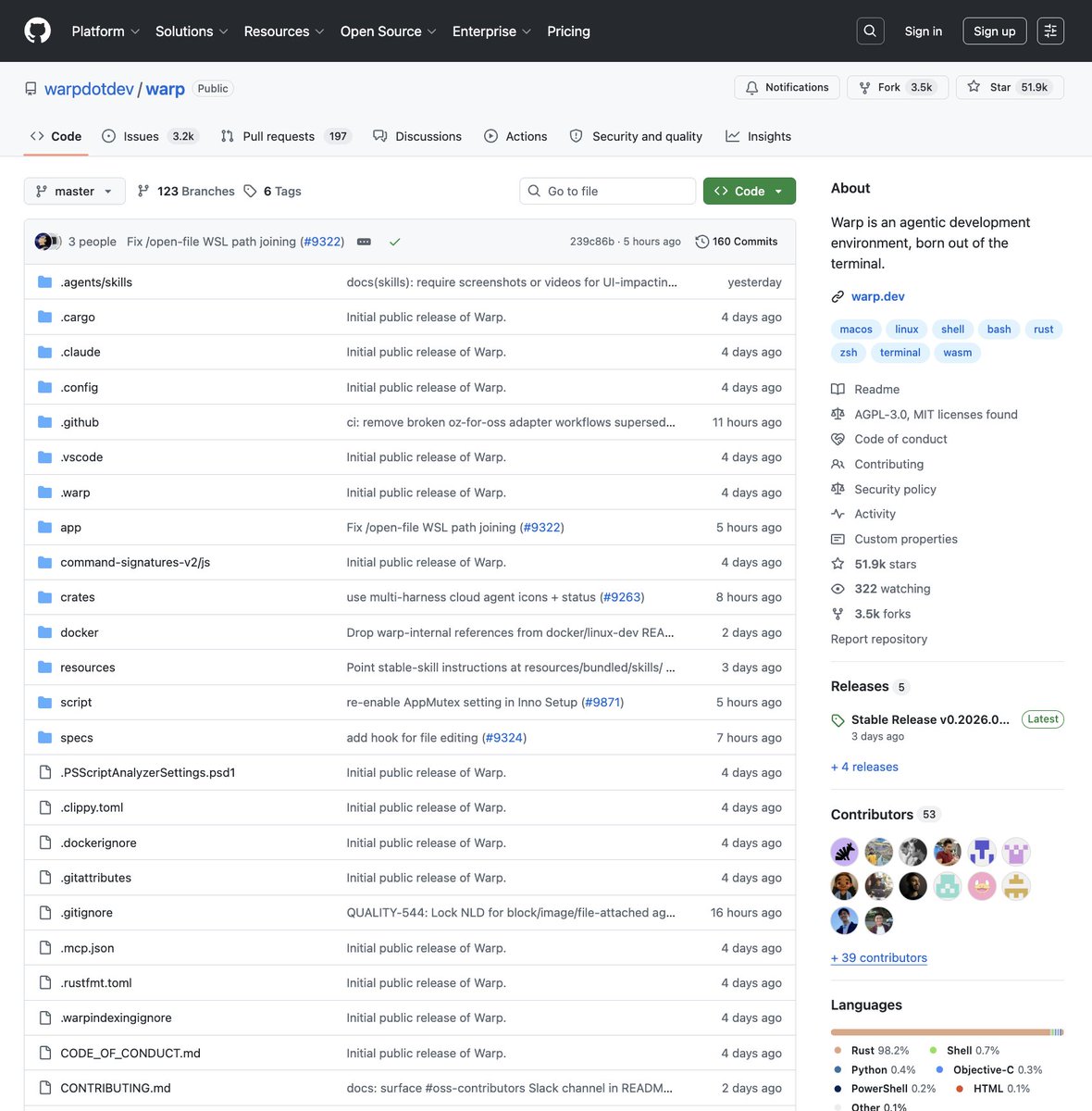
🚨 BREAKING: Warp just dropped its entire source code. 42,000 GitHub stars. Written in Rust. And it just made the traditional terminal obsolete.
This is not a terminal with AI features bolted on.
This is an agentic development environment where coding agents operate with full autonomy. From issue to PR. No babysitting.
Here's how it works:
→ You plug in Claude Code, Codex, or Gemini CLI
→ You give it a GitHub issue
→ The agent reads the codebase, writes the spec, implements the fix
→ It opens a PR with full context
→ You review and merge
That's the entire workflow. No prompting. No copy-pasting. No hand-holding.
Here's how far ahead they are:
At build. warp. dev you can watch thousands of AI agents building Warp's own codebase. Live. Right now. Triaging real issues. Writing real code. Submitting real PRs.
Click into any session. Watch the agent work in a real terminal. In your browser.
They are building the product with the product.
OpenAI is the founding sponsor. GPT powers the agentic management layer. The entire client is Rust-native and GPU-accelerated. Works on macOS, Linux, and Windows.
Your terminal types commands.
Warp ships features.
100% Open Source. AGPL-3.0 + MIT.
(Link in the comments)
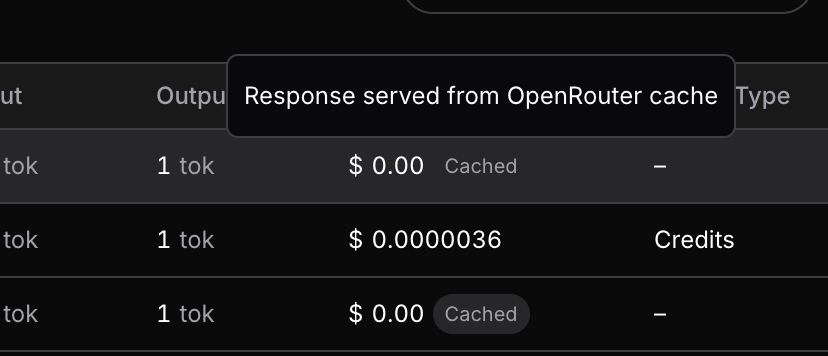
Introducing Response Caching: save tons of money and time on tests and agent retries.
Blog post: https://t.co/1tasyIRssI
Available for free. Learn more 👇
Java 25 is now GA on Azure Functions 🚀🎉
Start building with the latest Java runtime today!
Try it out -> https://t.co/8f8wb6mh24
#AzureFunctions#Java
GPT-5.5 is now available on Cloudflare AI Gateway! 🤖
Purpose built to power agents tackling complex professional work, GPT-5.5 can plan, use tools, check its own work, and persist until the task is done. It's 2x more cost-efficient than other frontier coding models with no tradeoff on latency and comes with a 1M token context window. Try it out now: https://t.co/114d17qN4H
🚨 Google just released Gemma 4, and from an outside perspective, it is a massive leap for the open-source community.
They have successfully packaged Gemini 3 technology into a highly capable, fully open agentic model.
What is genuinely impressive is the licensing.
It ships under Apache 2.0, giving developers complete commercial freedom to build and scale without walled gardens.
Looking at the architecture, here is why this release changes the local AI landscape:
→ Agentic workflows: Native function calling, structured JSON, and built-in system instructions for reliable tool interaction.
→ Flexible sizing: Ranges from a 31B dense model for workstations down to a 2B model for edge devices.
→ Code generation: High-quality offline output that turns your local machine into a private code assistant.
→ Massive context: 256K tokens on the larger models and 128K on the edge, allowing for repository-level prompting.
The token efficiency is also remarkable.
Their 26B MoE variant only activates 3.8 billion parameters during inference, maintaining high tokens-per-second while keeping hardware costs incredibly low.
The day-one ecosystem readiness is flawless.
You can run it immediately on @ollama, llama.cpp, @lmstudio and @huggingface 🤗
Blog announcement from Google in 🧵↓
Grokipedia is on fire 🚀
Just surpassed 420,000 backlinks — more and more websites and blogs are now citing Grokipedia articles.
The website registered over 4.6 million visits last month.
Share Grokipedia links and cite Grokipedia on your websites and blogs.
Wrote up about my personal journey from AI skeptic to someone who finds a lot of value in it daily. My goal is to share a more measured approach to finding value in AI rather than the typical overly dramatic, hyped bait out there. https://t.co/SpiIy7DEc9
A lot of people quote tweeted this as 1 year anniversary of vibe coding. Some retrospective -
I've had a Twitter account for 17 years now (omg) and I still can't predict my tweet engagement basically at all. This was a shower of thoughts throwaway tweet that I just fired off without thinking but somehow it minted a fitting name at the right moment for something that a lot of people were feeling at the same time, so here we are: vibe coding is now mentioned on my Wikipedia as a major memetic "contribution" and even its article is longer. lol
The one thing I'd add is that at the time, LLM capability was low enough that you'd mostly use vibe coding for fun throwaway projects, demos and explorations. It was good fun and it almost worked. Today (1 year later), programming via LLM agents is increasingly becoming a default workflow for professionals, except with more oversight and scrutiny. The goal is to claim the leverage from the use of agents but without any compromise on the quality of the software. Many people have tried to come up with a better name for this to differentiate it from vibe coding, personally my current favorite "agentic engineering":
- "agentic" because the new default is that you are not writing the code directly 99% of the time, you are orchestrating agents who do and acting as oversight.
- "engineering" to emphasize that there is an art & science and expertise to it. It's something you can learn and become better at, with its own depth of a different kind.
In 2026, we're likely to see continued improvements on both the model layer and the new agent layer. I feel excited about the product of the two and another year of progress.
We made a video with @simonw exploring some of the behind the scenes work to analyze government data.
Datasette is an invaluable tool to quickly orient yourself to a dataset and build products (or graphs iteratively).