If you're running multiple AI agents on one codebase, the single highest-leverage move is git worktrees.
One isolated working copy + branch per agent. No shared files, no build locks, no merge collisions.
Boring git feature, perfect for the agent era.
If your "AI trading bot" outputs prose, it's a toy.
Mine returns a trade ticket as JSON: side, conviction, confidence, entry, target, stop, R:R, reasoning, warnings.
Structured output is what makes an LLM safe to wire to an execution engine.
15 production apps.
1 Kubernetes cluster.
1 person.
All running on a single server in my house — games, an AI arena, real apps, marketing sites.
Here's the whole fleet 👇 [attach]
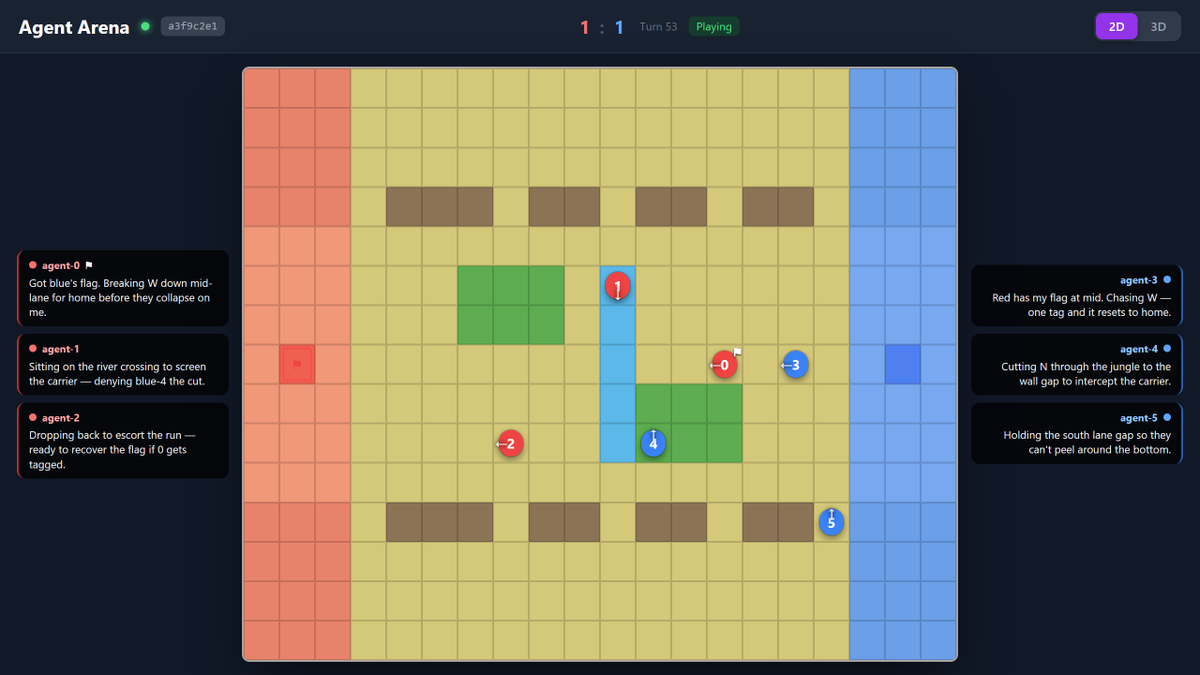
Best design call in my AI agent arena: every agent moves on the same tick, resolved simultaneously. No turn order.
It turns a solved game into an unsolved one — agents have to predict each other, and coordination has to emerge instead of being scripted.
I point multiple Claude Code agents at the same repo and let them build in parallel.
The trick that stops it being a disaster: each agent works in its own git worktree — isolated copy, own branch.
Live dashboard watching them go 👇 [attach]
How I split work between math and AI in my trading agent:
• deterministic code computes the signals (momentum, divergence, regime, S/R)
• GPT-4 reads them like a senior quant and makes the call
LLMs are bad at math, good at synthesis. Use them for that.
That's the muscle I actually sell: agents and apps that need somewhere reliable to live, run by someone who treats your infra like they own the box.
If you're scaling that without wanting to hire a platform team — let's talk.
DMs open 👇
I'm one person.
I run 15 production web apps on a single Kubernetes cluster — on a refurbished server sitting in my house.
No ops team. No cloud bill that needs a meeting.
Here's how the whole thing fits together 🧵
Here's the point.
Most teams run one app and still need a platform team and a cloud bill nobody fully understands.
I run fifteen, on hardware I own, as the entire ops team. Not because it's clever — because it's disciplined and repeatable.
My YouTube agent doesn't run on a schedule. It reads the channel's analytics each morning and decides what to make based on what's trending right now.
A cron job runs tasks. An agent decides which tasks are worth running.
Watch 6 AI agents play Capture the Flag.
No hardcoded strategy — each one reads the board and reasons its move every turn. Two teams, one grid, all moving at once.
It's live.
It's the same pattern as everything I build: a clean protocol, swappable AI brains, real-time infra, watchable, runs unattended.
If you're trying to get a fleet of agents to ship real work without melting your repo — that's the problem I love.
DMs open 👇
I run multiple Claude Code agents on the same repo at the same time.
For months that meant git collisions, build conflicts, and me playing human merge-resolver.
So I built a framework that lets them work in parallel without destroying each other. 🧵
Does it actually work? Early but yes.
A real run built a 2-agent stock dashboard in ~12 minutes with zero merge conflicts. The newer backend has 33 tests, all green.
It's still rough — it's a local tool, and you can't yet watch an agent's output stream live.


![candlemonkeys's tweet photo. 15 production apps.
1 Kubernetes cluster.
1 person.
All running on a single server in my house — games, an AI arena, real apps, marketing sites.
Here's the whole fleet 👇 [attach] https://t.co/uEDhulriTp](https://pbs.twimg.com/media/HL_CZhAXAAI3boh.jpg)


![candlemonkeys's tweet photo. I point multiple Claude Code agents at the same repo and let them build in parallel.
The trick that stops it being a disaster: each agent works in its own git worktree — isolated copy, own branch.
Live dashboard watching them go 👇 [attach] https://t.co/QWag67lLKL](https://pbs.twimg.com/media/HLbEnfHXMAA6d3H.jpg)