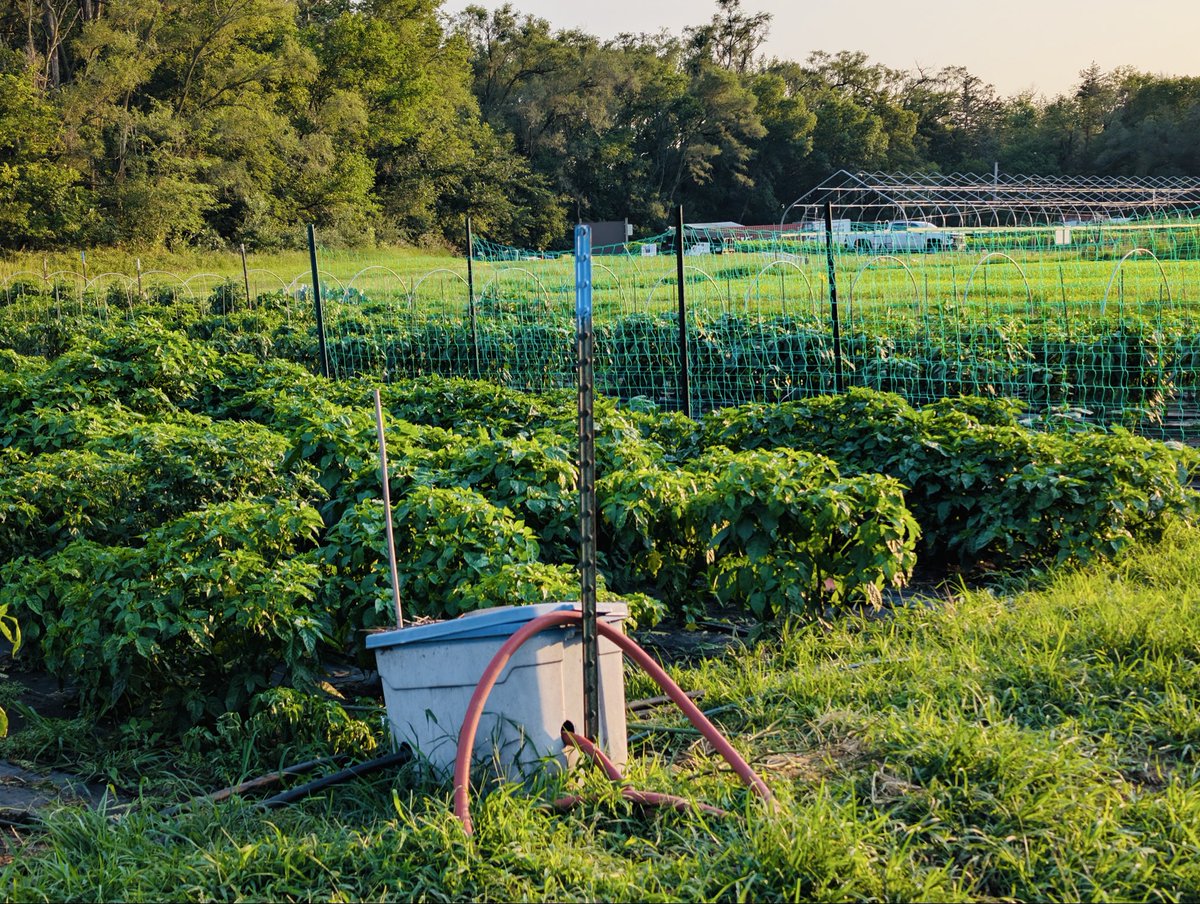
It is a Sunday afternoon in Lincoln, Nebraska, and instead of taking the afternoon off, we are installing smart sensors on small urban farms.
Apparently, soil moisture does not recognize weekends.
For the past two months, I have had the opportunity to be involved in research focused on a simple but important question:
How can small urban farms use water more efficiently while maintaining productivity and profitability?
We have been visiting urban farms in Lincoln and Omaha, observing their irrigation practices and measuring water use in drip irrigation systems.
Now we are moving into the next phase: installing soil moisture sensors at no cost to participating farms.
These sensors will record soil moisture approximately every 15 minutes throughout the growing season.
That gives us something farmers cannot get from occasional observation alone: a continuous picture of what is happening below the soil surface.
This matters because irrigation decisions are often about timing as much as quantity. Soil moisture monitoring can help farmers better understand when crops actually need water, potentially reducing unnecessary irrigation while supporting crop productivity.
@USDA notes that monitoring soil moisture can help regulate plant-available water, conserve water, improve water-use efficiency, and support crop yield
Summer gives us an especially valuable window to study drip irrigation because water demand is high and irrigation systems are actively being used.
One part of precision agriculture that interests me deeply is making sure the conversation does not stop with large farms, autonomous tractors, drones, and expensive equipment.
Small urban farmers are too often neglected in conversations about agricultural technology.
Yet they also make daily decisions about water, labor, inputs, productivity, and profitability.
Precision agriculture can be as simple as putting the right sensor in the soil, collecting meaningful data, and turning that information into a better irrigation decision.
And for someone whose broader research interests include AI, farmer trust, and adoption of agricultural technologies, this is particularly interesting.
Before asking farmers to trust advanced AI recommendations, we first need to understand the field data behind those recommendations and whether the technology solves a problem that actually matters to the farmer.
Looking forward to learning what an entire season will teach us.
Thank you, Akeem O. Adeniran, for involving me in this research and giving me the opportunity to learn directly from the farms, the irrigation systems, and, now, the sensors buried in the soil.
Interacted with Director-General of the World Trade Organization (WTO), Dr. Ngozi Okonjo-Iweala on the sidelines of the G20 Summit in Johannesburg.
@NOIweala
I am a happy boy 😊. Much as I haven't achieved the goals, at least I'm trying. Learning each day that with determination, you can make it. Hii ikinikubali, delivery zitakua za mayai na nyama Tu.
Nani ako na resources "land and water" tufanye large scare. My only scarce resource is water.