@RedEagleLaw Hi Red Eagle team!
The July Visa Bulletin has just been released. Could you provide some flexibility on the deadline to participate without it affecting the filing date?
It’s that moment of the year, seeking a part-time job this summer.
PhD student (gender, crime, education) with experience in causal inference, RCTs, and applied micro.
Open to RA work, collaborations, and policy work.
🌐 https://t.co/iMDT9pxnYA
#EconTwitter#RAJobs#PhDLife
Check out this interesting new article titled: "The Returns to Education: A Meta-Study" by @GregoryClarkUCD & @CAANielsen 🎓
👉Read it here: https://t.co/lFPCpqAPy5
Join our team! We are hiring pre-docs/RA(s) to work with us on an exciting education project in Turkey. Start date: Feb–Mar 2026. Several flexible positions available. Details: 👇 @predoc_org
Job posting!
The Education Data Center (EDC) is seeking a Data Analyst to support the development and maintenance of comprehensive, high-quality education datasets. This would be a great fit for anyone with Stata skills and experience with education-related datasets! To apply: https://t.co/a9sjJNV003
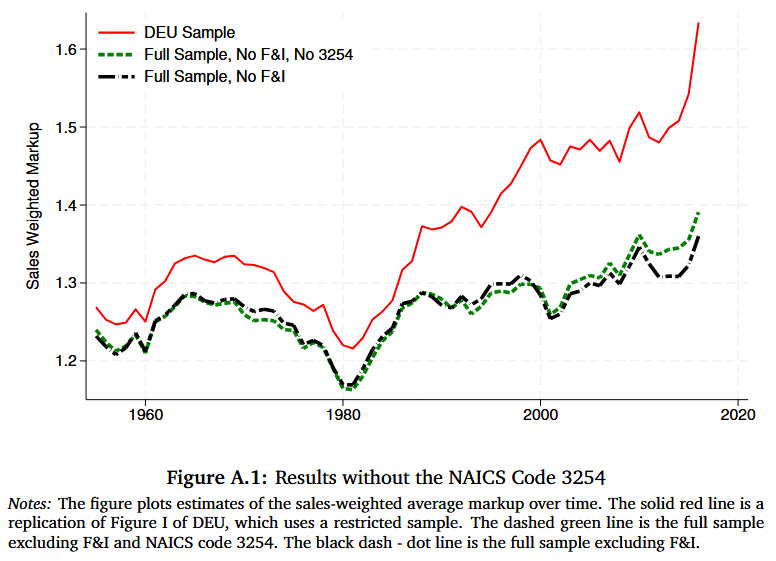
My takeaway: markups are rising, but just the magnitude is smaller. Here are the sources:
Main paper: https://t.co/D5ps0gnX7s
Replication: https://t.co/LpJVqBuPiZ
Response to replication: https://t.co/5OHe9GJyTj
Response to response: https://t.co/qf6xrHp6Wu
3/3
🔥A hot debate on rising U.S. market power 📈🇺🇸 This famous QJE paper (De Loecker et al., 2020, >3.3k citations) finds a big rise in markups since the 80s. Benkard et al. (2025) replicates it and argues the increase isn’t economy-wide, mostly Finance & Insurance. 1/3
They also accuse authors to drop 27% of observations without explanation. Authors reply that they only removed firms missing key variables and counter with replication’s findings mostly come from a single sector pharma ⚕️(NAICS 3254). 2/3
Finishing the semester and on the lookout for work in Dec and Jan 🐻📚. Hoping to save up for a proper PC, so if you need someone with econ chops, data analysis, causal inference, Stata/R, or policy, I’m your guy. Open to short-term projects + RA gigs! 💼✨@econ_ra#EconTwitter
@Keleesssss E() operatörü ile beklenti aynı değil tam işte. Ya bir de uyuşmazlık 1'in tek sayı olmasından da kaynaklanıyr. 3 kere kırmızıya basınca E(X)=1.5milya dolar ama kimse 1.5 milar dolar kazanmayı beklemeyecek.
💧 ODTÜ’de suyun izi yayılıyor!
KaynakODTÜ projesiyle hedefimiz kampüsün dört bir yanına 200 içme suyu sebili kazandırmak.
İlk 50’si için bağışlar toplandı, kurulum başlıyor.
Geriye kalan 150’si için desteğini bekliyoruz 💙
Sürdürülebilir bir kampüs, dayanışmayla mümkün.
💦 https://t.co/ptml6aHX8T
#KaynakODTÜ
1 ay önce artan ev sahipliğinin doğurganlığı artırdığına işaret eden bir makale atmış ve demografik çöküşün sebeplerinden birisinin de mülksüzleşme olabileceğine dikkat çekmiştim.
Tam da bu konuda bugün muazzam bir working paper makale yayınlanmış. 1930’lar ve 1940’ların ABD’sinde genç çiftlerin ev sahibi olmasını kolaylaştıran federal programlar 1953-1957’de 3 milyon doğuma sebep olmuş ki bu da WW2 sonrası ”Baby Boom” olgusunun yüzde 10’una tekabül ediyor. Makale, genç çiftlerin kolayca ev sahibi olabilmesimin, onların doğurganlık kararlarını çok olumlu biçimde etkilediğini gösteriyor. Nitekim ABD’deki “Baby boom”da bu bağlamda kısmen ev sahibi olmayı kolaylaştıran federal refah devleti uygulamalarının bir sonucuydu.