Sec. Rubio names it plainly: radical leftism is a distinctive and unique evil, a revolt of the worst against the best. To 66 nations he laid out the plan to dismantle far-left terror networks brick by brick. It is time to defend ourselves and fight for what is ours.
.@StephenM: "Here in the United States, we have taken the necessary and essential action formally recognizing left-wing violence as a form of political terrorism that is a direct threat to our national security and the survival of our republican form of government."
Once we have completed our review for security vulnerabilities, we will make the entire codebase of 𝕏 open source, with no exceptions.
Moreover, we will invite third party reviewers to examine the system that is running to confirm that the open source code is what is running.
Trust through total transparency is the only thing that should be believed.
🇯🇵🇨🇳 Japan's defense establishment has begun contesting Beijing on the terrain Beijing prefers to control: the framing of what counts as militarism, and who gets to define it.
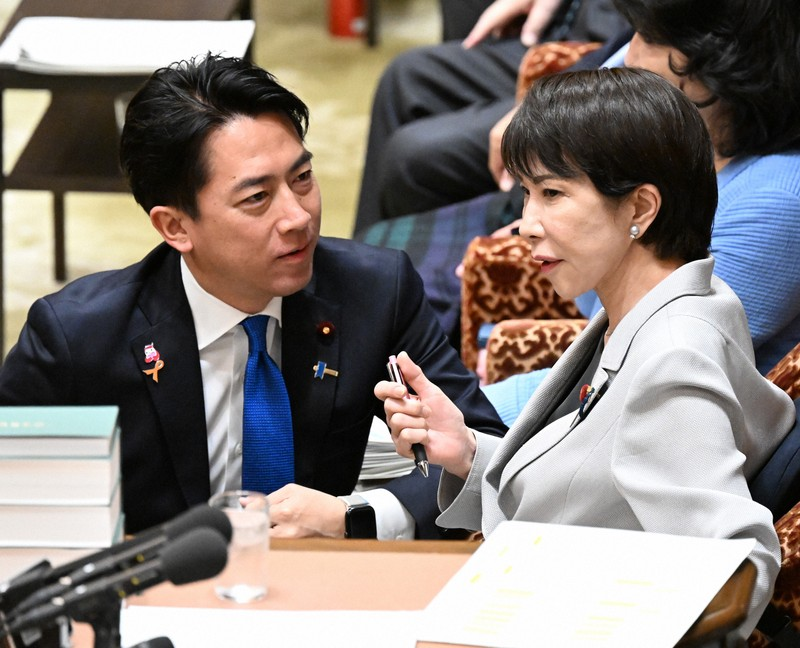
In his first interview with foreign media as defense minister, Shinjiro Koizumi did something Tokyo has generally avoided in the postwar era. He questioned the basic factual integrity of the People's Republic of China's announced defense budget, asking whether the figures Beijing puts forward are "genuinely grounded in fact, backed by evidence, and highly transparent." The challenge lands on solid ground.
The Pentagon's December assessment concluded that the PRC's actual 2024 defense outlays ran 32 to 63 percent above the announced $231 billion headline, once armed police, provincial security spending, veterans' affairs, mobilization activities, defense-related research and military capital expenditure are folded in. Beijing's announced 2026 budget of 1.91 trillion yen, roughly $283 billion USD, is therefore best read as a floor rather than a ceiling.
The accountability inversion
What is novel is not the underlying critique. Academics and Western governments have long discounted the PRC's headline figure. What is new is the institutional voice now delivering it. Koizumi paired the transparency challenge with a deliberate reversal of Beijing's "new militarism" label, noting in his May Singapore speech that Japan possesses neither nuclear weapons nor strategic bombers, while the country leveling the charge maintains both. The move shifts the burden of explanation. Rather than defending Japan against a stigma, Tokyo is asking which actor in the region actually fits the description, and inviting third parties to draw their own conclusions from the disclosed numbers.
A coordinated turn at the G7
The discursive shift is not Koizumi's alone. At the G7 summit in France on Tuesday, Prime Minister Sanae Takaichi named China directly when raising concerns about Beijing's measures against Japan and their downstream effect on G7 and like-minded supply chains, departing from the diplomatic convention of leaving the antagonist unspecified.
The pairing matters. A defense minister contesting the numbers and a head of government contesting the coercive economic instrument together signal that Tokyo no longer regards strategic ambiguity toward Beijing as the prudent default. The pressure campaign over Takaichi's Taiwan remarks, including the tightening of rare earth export controls that followed, appears to have produced the opposite of its intended effect.
The strategic implication is verifiable rather than rhetorical. By anchoring its critique in parliamentary scrutiny, Pentagon assessments and disclosed budget lines, Japan is offering allies a template that does not depend on shared sentiment. Numbers either reconcile or they do not. Koizumi's insistence that Japan remains open to dialogue with Beijing, regardless of how far positions diverge, preserves the diplomatic surface while quietly removing the protective vagueness Beijing has long exploited. That is the shift worth watching.
ACI — Aric Chen | Insights
This is incredible.
This machine is capable of cleaning up 100 million kg of plastic ocean waste, and as of 2025, it has already collected about 500,000 kg of plastic.
It aims to remove 90% of ocean plastic by 2040.